 | Chapter 2. Organizational Structure | |
|---|---|---|
| ↢ | ↣ |
Table of Contents
In every organization, we need to integrate effectiveness and equivalence. The organizational design principles at work here are as simple as they are effective:
Empower every workgroup (circle) by giving it as much authority as possible. Any circle can form its own sub-circles.
Nest every circle with other related circles to keep communication lines short.
At the center of the circle structure, have a circle for information sharing and support to avoid silos or disconnected compartments.
Circles are linked with each other by two people to ensure feedback and good flow of information.
These design principles are the foundation for every circle structure, from the beginning on. Some organizations start out as full-fledged organizations, some start out as a group of friends working together. All organizations will go through similar stages as they differentiate and mature. A sociocratic organization can be as small as three people, or as large as ten-thousands of people. Like fractals, the principles that guide how we organize our work are the same on every level of the organization. Like in a living organism, every part of the system is autonomous but interdependent.
Since the organizational structure in sociocracy is decentralized, the system can grow and adapt on its own. New branches can be formed following the same mechanisms, like a tree that forms buds in the right place when the right time comes. Growth (and de-growth) is smooth and follows the demand and intention of the organization.
We call work teams ‘‘circles’’. They are the heart of every organization. A circle is a group of people who work together and decide together how the work is being done. Circles are a way to ‘‘package’’ related parcels of work and to focus attention easily and maximally, while still keeping the pieces of the whole connected. The difference between non-sociocratic committees and circles is that circles have more authority and the requirement to be connected to the other circles. Circles are never floating around, they are always linked to another related circle. An ideal circle structure will represent the idea of ‘‘a place for everything, and everything in its place’’. Since the circle structure is also dynamic, we have order without having rigidity. We can grow, adapt, and be nimble.
The members of the circles are workers and they are policy-makers. Sociocracy translates to “those who associate together govern together”. The circle members are the experts of the work they do, and they have the skills and knowledge to govern how their work is being done. Policy is made as workers see fit in order to make their work together easier and more successful.
On an organizational level, decision-making power is distributed with the work: Whatever circle is performing the work in one area of responsibility makes the decisions for that area. For example, the group of people that takes care of membership matters in an organization decides how this is being done.
As clusters of tasks get more complex, we divide up the tasks and form what we call sub-circles. Like in a fractal structure, there can be sub-sub-circles formed by any sub-circle.
Figure 2.1. A circle with two sub-circles
 |
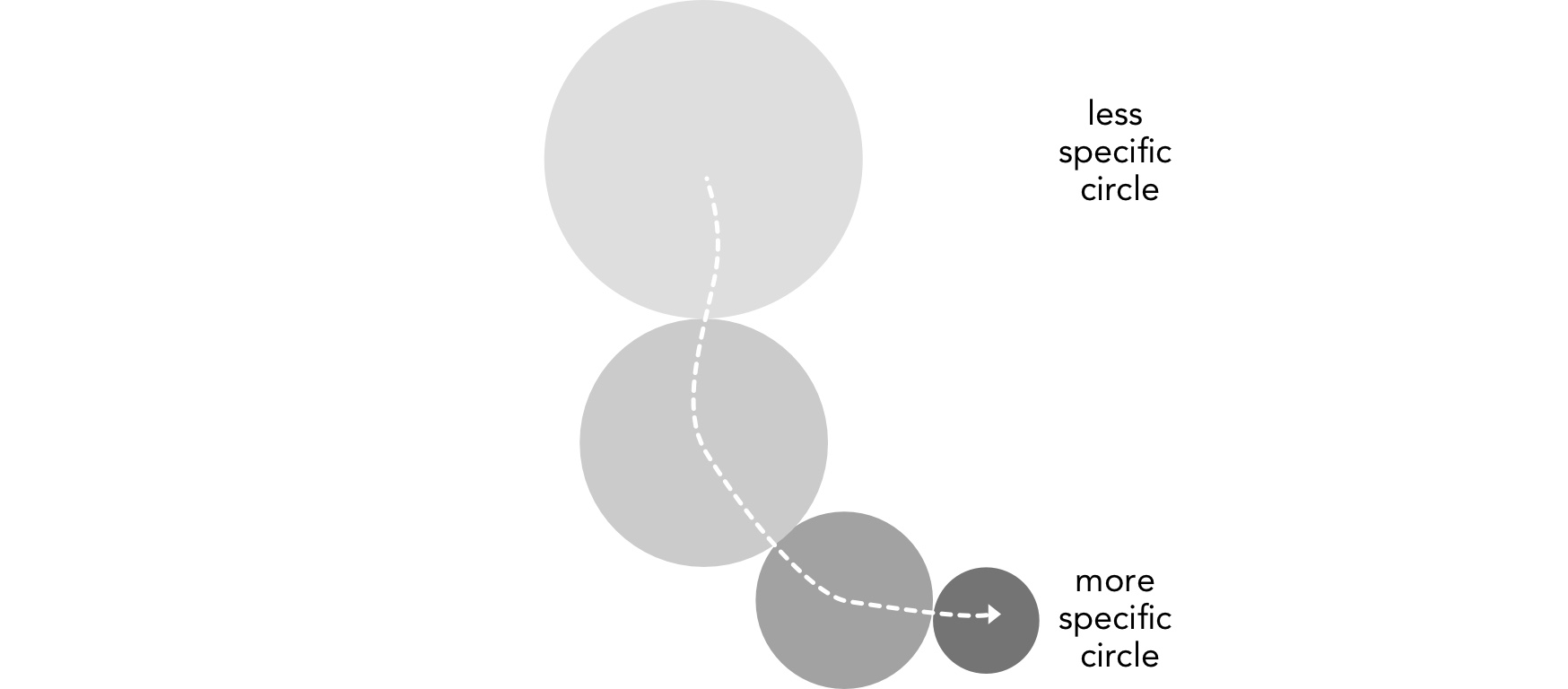
We make as many decisions as possible on the most specific level of the organization. That means if a decision can be made in a sub-sub-circle, then there is no need for approval anywhere else. Any circle will be dealing with the specific decisions for their level. Power is always as decentralized as possible: Power is configured in a healthy way, and every circle is empowered to act.
Figure 2.2. Drive the power to the most specific circle possible
 |
Distributed power has many advantages. A system with distributed power will be resilient, fast and nimble. Every circle is part of a network of related domains. The support system for every circle is baked into the circle system. If one circle struggles, there will be a circle around it that can help the circle get back on track.
Since the do-ers are the decision-makers, we have authority and power to act. No one has to wait for anyone’s approval.
Imagine a customer has a request for a change in a recipe for a Pastry Circle in a bakery restaurant. Let’s say, a loyal customer is allergic to hazelnut and is asking whether there could be chocolate croissants without hazelnut. The request is in the domain of Pastry Circle. Pastry circle will consider this request. Let’s assume they decide to change their recipe. They do not have to ask anyone for permission, they just change it.
In addition, workers will have a high level of buy-in and intrinsic motivation because they are taking full responsibility. No one will be forced to do anything they do not see the need to be doing because everyone in the circle decides together what and how it is being done. Again, in our example, if someone sees harm in making puff pastry for the Pastry Circle or the entire bakery, the group of workers in that area will be able to address this. No policy in their own domain can be forced onto them.
We think of it as a living organism where each system (respiratory system, circulatory system, nervous system, etc.) is autonomous in that it responds to needs in its own system. The respiratory system does not have to ask permission from the circulatory system. Every system (every circle) takes care of their own needs. On the other hand, however, the systems are interdependent: if the muscular system requires more oxygen, this will affect the respiratory system. One system over-ruling the other systems does not sound healthy. Circles in a sociocratic organization work the same way: they are semi-autonomous because they have full authority over their domain, but they also are part of a whole system that needs to respond to each other’s needs.