 | 2.5. Types of circles | |
|---|---|---|
| ↢ | Chapter 2. Organizational Structure | ↣ |
One can run a sociocratic organization with one circle. As tasks need to be more differentiated and/or the organization grows, we grow into a more complex structure. We will describe the generic set-up here. There are some comments on tiny organizations in section Section 6.6, “Sociocracy in tiny groups”.
Figure 2.38. A basic implementation
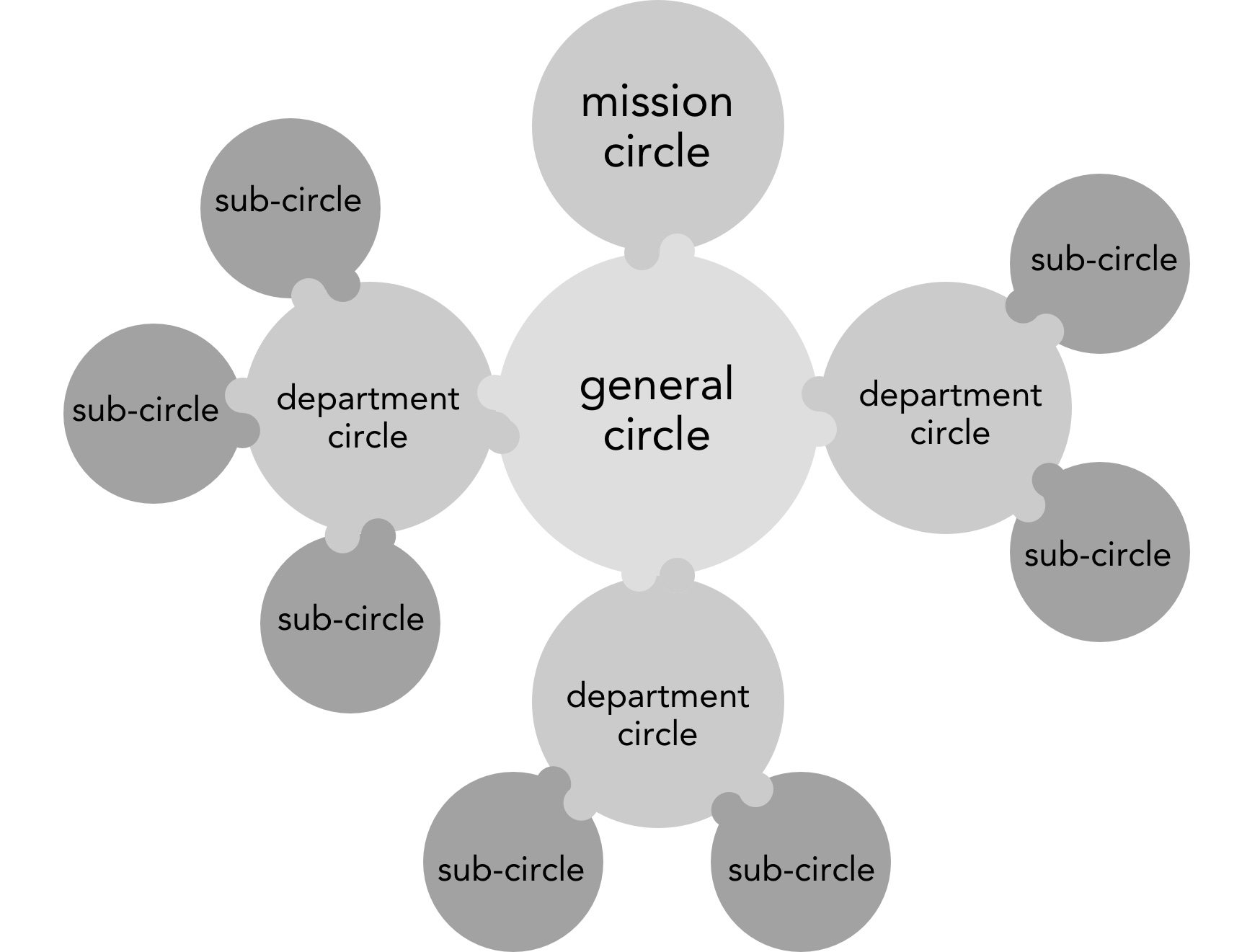 |
After having talked about circles and sub-circles, we will now look at circles in the context of a complete organization. We call work circles department circles if they are linked to the circle in the middle, the general circle. They are the equivalent of departments in a traditional organization. Other names for the highest level work circles are “main circles”, “division circles”, or “core circle”. We can, of course, call them by any other suitable name.
In diagram Figure 2.38, “A basic implementation”, there are three department circles. Any number between 2 and 5 will work, although 3 or 4 seems to be the ideal. Any department circle can have sub-circles. Different department circles in the same organization might have different numbers of sub-circles. There is no need for symmetry. The number of sub-circles is determined by the department circles and their needs. It is not shown in the diagram but any sub-circle can have sub-sub-circles, going down to any level of differentiation that might be needed.
One can see the double-link between every level, which is always a leader as top-down link and a delegate as bottom-up link.
Side note: on a sub-circle level, it is easier to have more than 5 circles if there is a lot of overlap between people holding linking roles, so that the intermediary circle does not get too big. The balance we are looking for is to have good flow of information in all directions while avoiding big circles.
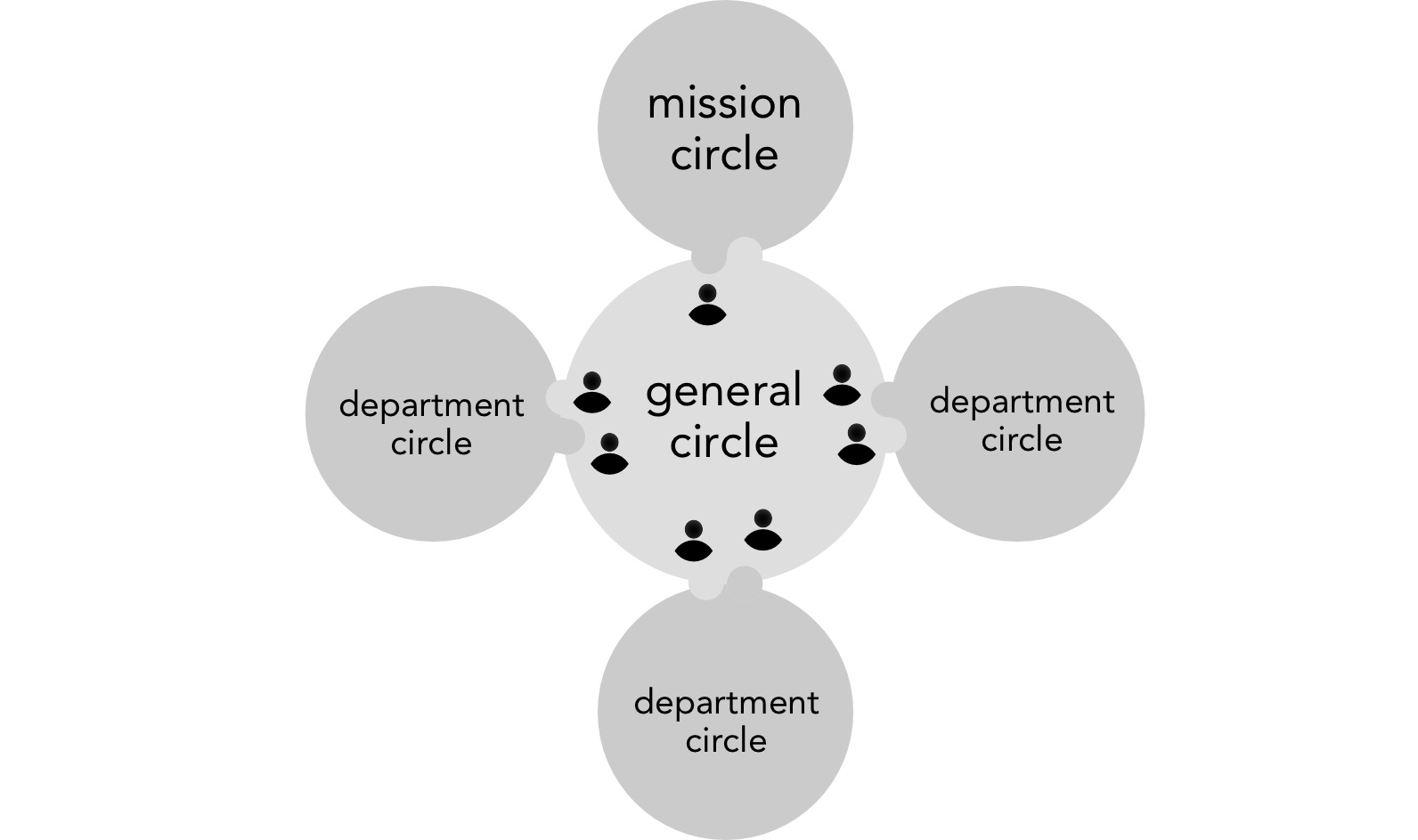
The general circle (GC) connects all the department circles. As such, the GC owns the entire aim and domain of the organization. Note that of course, we strive to ‘‘pass on’’ as much authority as possible to work circles -- we do not hold on to that power.
Figure 2.39. The general circle (GC)
 |
The GC has three main tasks:
The GC holds the department circles accountable and supports their functioning.
The GC is also the center of the flow of information between circles that carries out the aim. ‘‘What are circles working on? What does Department Circle 1 need to know about Department Circle 3? How can circles support each other?’’ Remember that the delegate reports from the department circle into the general circle, while the leader – besides their other tasks of leading the circle – take the information from the GC into their department circles.
The GC sets the aims of the circles and supports clarifications of aims. In practice, this means that the GC decides who decides. If a new issue or topic arises, the GC will assign it to one of the department circles. When an issue concerns the aims/domains of more than one department circle, it can be explored and decisions can be made in the GC.
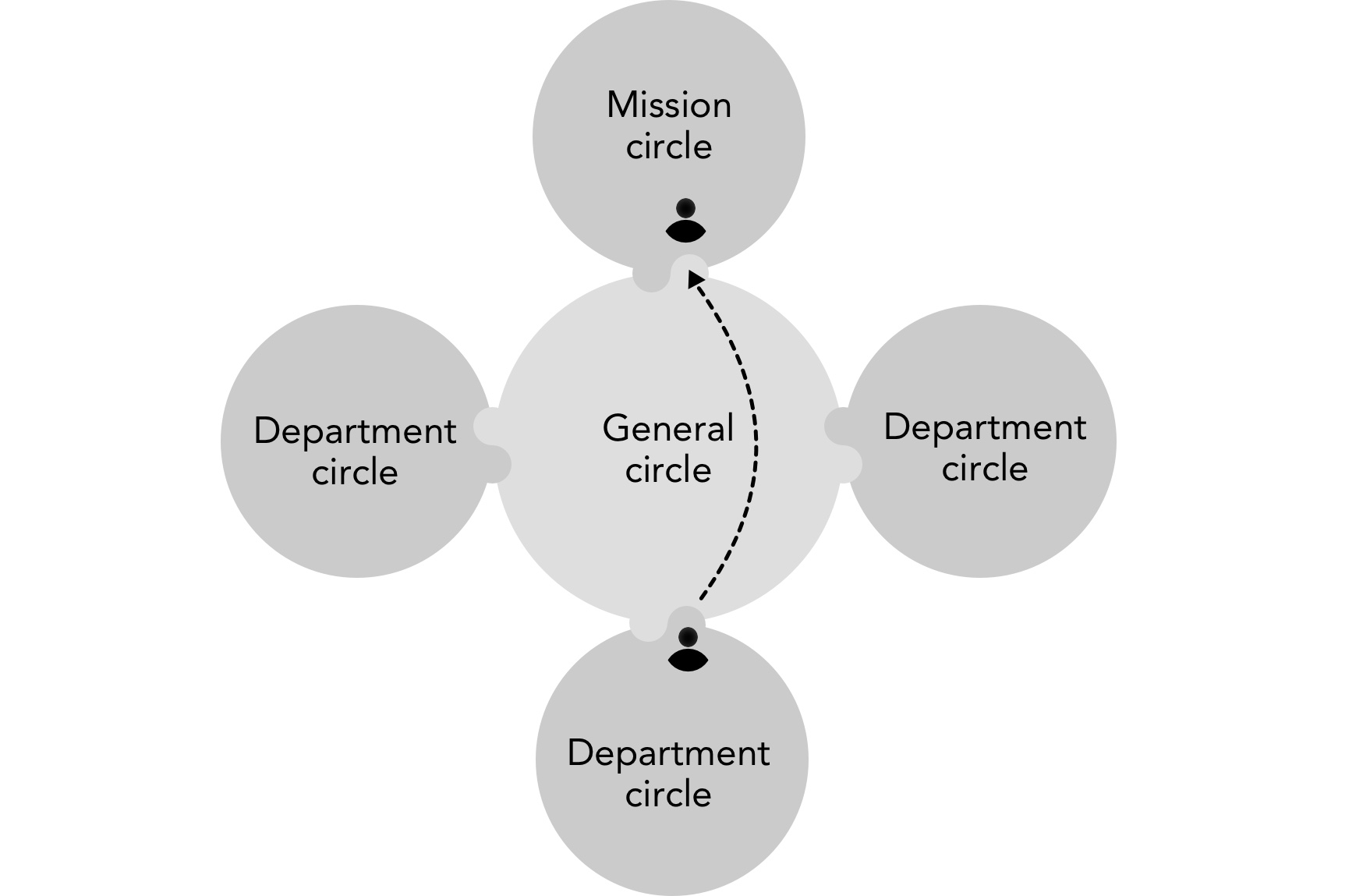
In Diagram Figure 2.39, “The general circle (GC)”, the GC would consist of the leaders and delegates of the three department circles, the leader of the GC would be selected by the mission circle.
The mission circle (MC) is a circle that can be compared with the board of directors. A mission circle pays attention to long-term planning and makes sure the organization stays true its mission (and vision) and connected in its organizational and cultural context. As shown in Fig. Figure 2.40, “Difference between mission circle and general circle”, the MC gives general direction and support, may have legal and financial responsibilities and supports the operational leader. The GC (general circle) supports the aim-related work.
Figure 2.40. Difference between mission circle and general circle
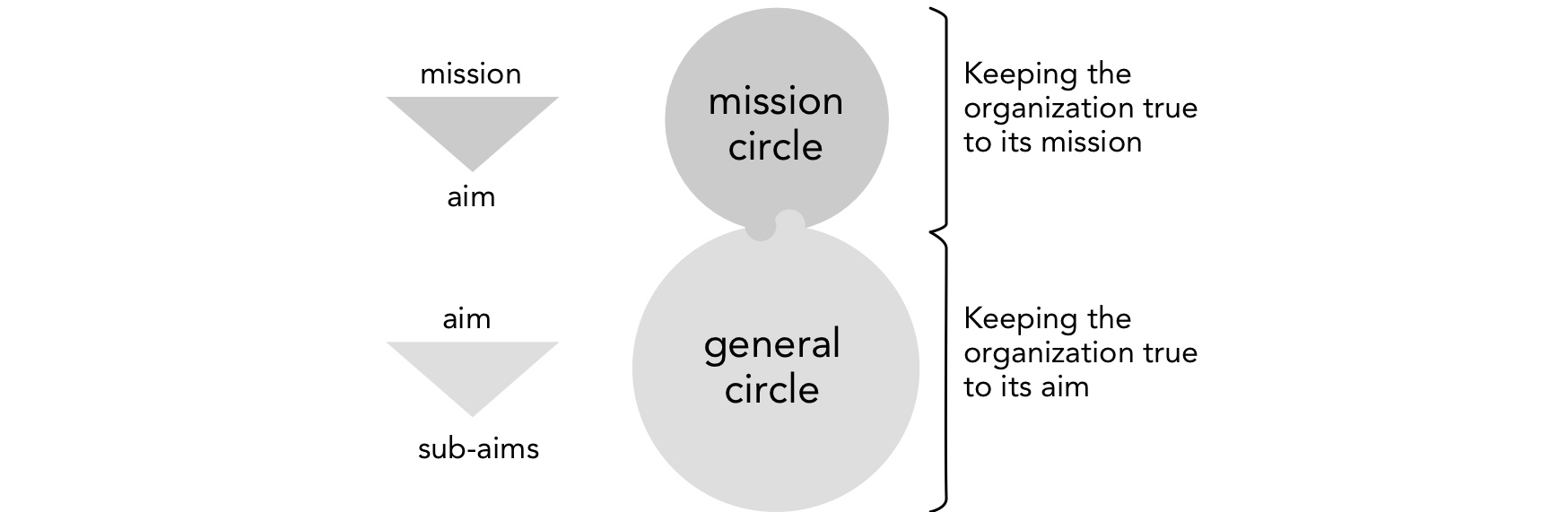 |
We chose the name “Mission Circle” (MC) because it is the best description of what this circle does: keeping the organization true to its mission. The traditional name for this circle is Top Circle, a term that often raises eyebrows. We understand the cultural baggage the term “top” brings in a hierarchical culture. Other names we have heard:
vision-keepers circle
Board of Directors
Board of Trustees
strategic planning circle
root circle
Council of Elders
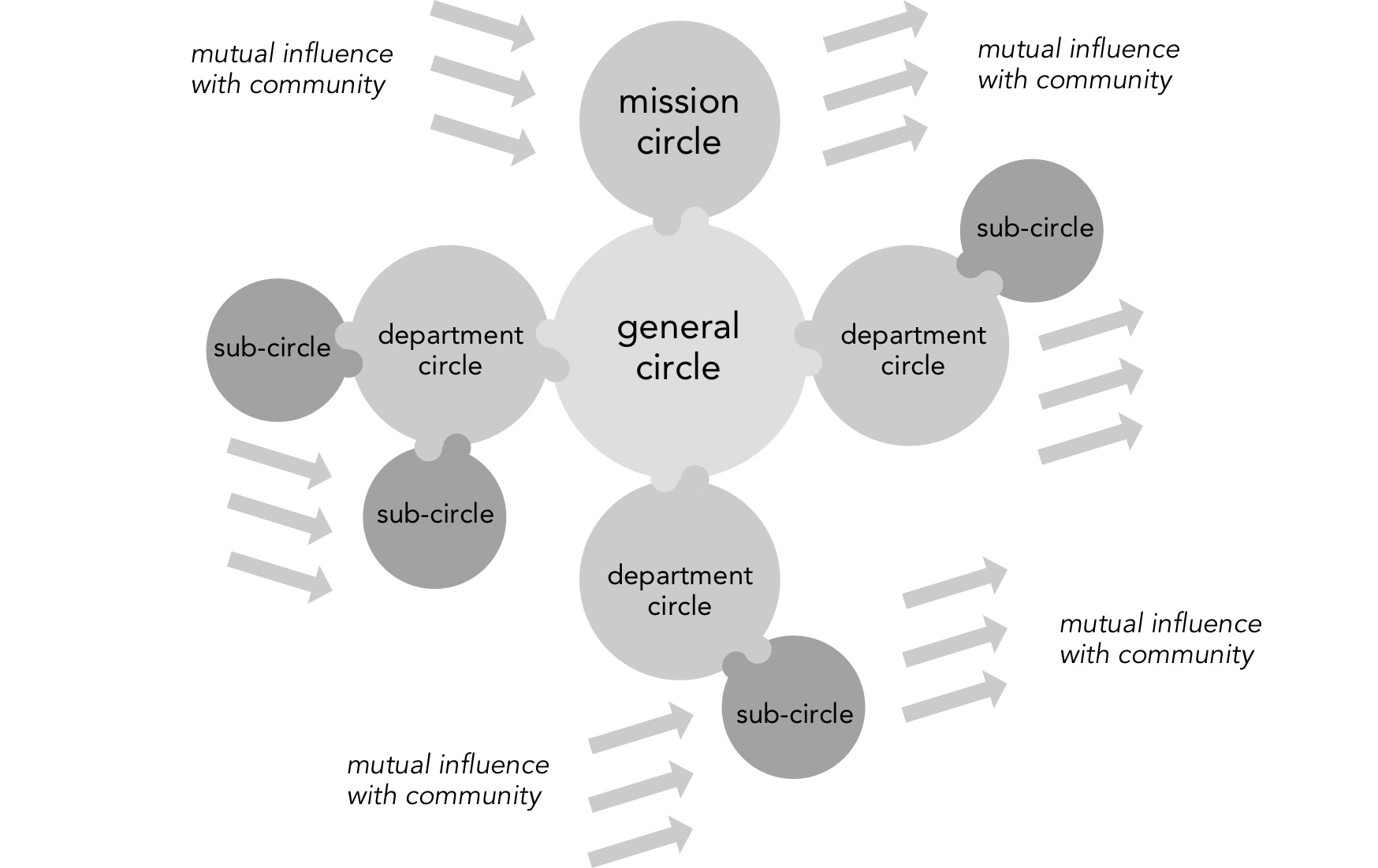
The mission circle offers one of the organization’s opportunities for mutual influence between the outside world and the inside of the organization. Thanks to outside members in the MC and to contact with clients, customers, users or members in specific circles, any organization will have mutual influence with the larger community, and as shown in figure Figure 2.41, “Mutual influence between organization and outside world on Mission Circle level and on specific circle level: any organization benefits from this kind of exchange with the outside world; closed systems are not sustainable”.
Figure 2.41. Mutual influence between organization and outside world on Mission Circle level and on specific circle level: any organization benefits from this kind of exchange with the outside world; closed systems are not sustainable
 |
There is no us vs. others within a sociocratic organization. This is also true for the relationship between the larger community and the MC. The MC is the link with and to the larger community. (Related to this topic, see more on networks in chapter Section 2.7, “Other groups that meet”.)
The MC consists of:
Experts from outside the organization may be from areas such as legal, finance, fundraising, communication, sociocratic governance, related content or aim. A few examples:
A business may bring in legal assistance, an expert from their industry, or a governance expert.
A producer coop might have someone from the local food cooperative on their board, someone from a cooperative development fund, someone from a different worker-coop in the area and whatever makes sense in relation to the aim.
An intentional community might have someone from related non-profits in their area on their board, maybe someone from a cohousing association or a community in the area, and a governance or permaculture expert or a trainer for non-violent communication (NVC).
Depending on the aim and the specific implementation, the MC can also include representatives of stakeholder circles, circles that are double-linked to the MC and represent a stakeholder group (see section Section 2.5.3.5, “Stakeholder representation in the mission circle” on page Section 2.5.3.5, “Stakeholder representation in the mission circle”).
The link for coordination between MC and GC is the operational leader, or Executive Director or CEO. The bottom-up link is the delegate from the GC. Note that this will likely be a leader or delegate from one of the department circles.
Figure 2.42. One of the leaders/delegates becomes delegate to the mission circle
 |
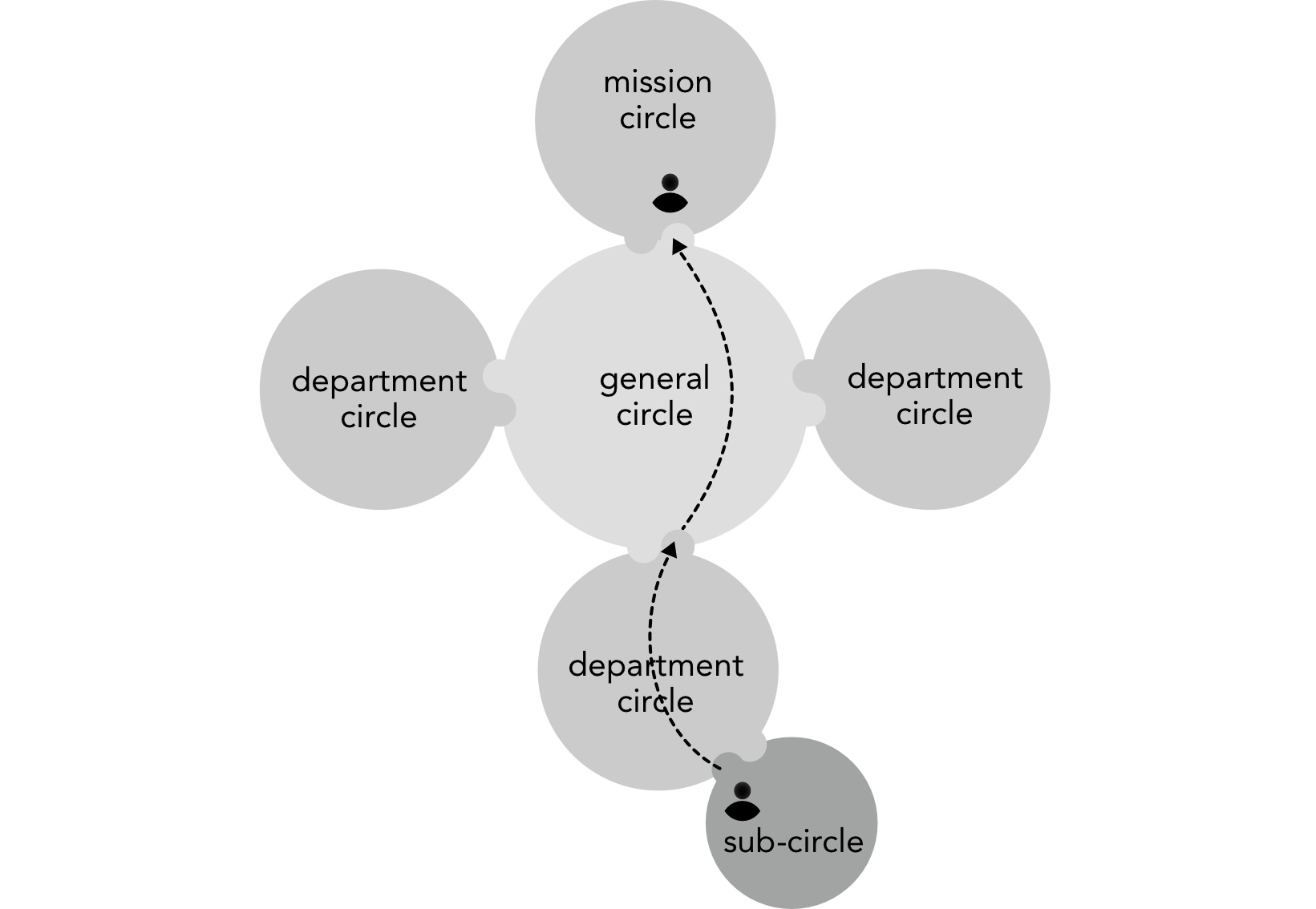
As shown in diagram Figure 2.43, “A worker can become delegate through all layers of the organization.”, a worker from the most specific level might be selected delegate into the department circle, and from there become delegate into the general circle and from there become delegate from the general circle into the mission circle.
Figure 2.43. A worker can become delegate through all layers of the organization.
 |
Representation of work circle delegates on the MC is more than just ‘‘being heard’’ on board level. With consent as the decision-making method, working members cannot be ignored. Sociocracy is more than giving workers a voice in the management. The workers are the management. When workers are running the organization, and the decision-making method is consent, workers do not need to be protected because they hold the decision-making power in the first place.
The MC itself will select a facilitator, a secretary and a leader (counterpart of a president of the board) to manage their own circle. The MC typically does not have a delegate because there is no ‘‘higher’’ place to represent this circle inside the organization; this is different for organizations of organizations. An organization may be connected to others in networks and associations. More on these in Section 2.7, “Other groups that meet”.
Below are some important differences between a traditional board and a mission circle. Note that what a “traditional board” is highly dependent on your context.
Like any other sociocratic circle, an MC operates by consent. There is no factionalism/out-voting/out-numbering in sociocracy. One objection from anyone in the mission circle would require addressing the objection and finding a solution together.
The double-link. There is flow of information in both directions. Two staff members, namely the leader and delegate of the general circle, are members of the board with consent rights.
MC members can be “working members” if they are also members of work circles.
Especially if we come from a domain where it is common to have board-run organizations, there is a noteworthy difference in sociocracy. Separating the operational level (general circle and the circles under the general circle) from the mission-keeping level (mission circle) creates a clean distinction between every-day business and longer-term focus. Both are essential to run a successful organization but they have different angles on what is happening and are therefore best kept separate.
The short answer is: yes. The long answer is: we might start out with only work circles and a general circle, but over time, there will be questions we won’t get around to talking about. An organization easily gets tied up in pressing issues. We don’t want to give in to “tyranny of the urgent over the important”. There will always be something urgent to deal with – but without taking the time to reflect and set a direction, we will lose out in the long run. Not only does the organization need direction but also adjustment and steering because the outside world changes continually. It is false economy to omit time devoted to conscientious steering.
If a group is afraid that having an MC will stretch the organization too thin in a given moment, see section Section 6.4.3, “Generating the mission circle” on page Section 6.4.3, “Generating the mission circle” for workarounds and temporary solutions.
 |
A sociocratic MC will usually have members from outside the organization. Those outside members might be individual supporters, experts, or they might represent an entire group of stakeholders.
Questions to ask:
Who do we want to involve on the mission circle?
Whose input will be valuable?
Who would like to know what is going on inside the organization?
Who needs to be heard and considered who is not directly part of the organization?
It could be the general membership or contributors. Or member-owners, funders or investors. Some groups are reluctant to have “outsiders” serve on the MC: “But we don’t want outsiders controlling our organization!” On this point, remember that decision making on the mission circle happens by consent. The idea of the outside members, be they investors, funders or anyone else, will be considered but they cannot outvote the other members of the mission circle. Hence sociocratic organizations cannot be subject to takeovers or be moved involuntarily to another location where there are cheaper labor costs etc.
Figure 2.44. An example of the mission circle of a for-profit
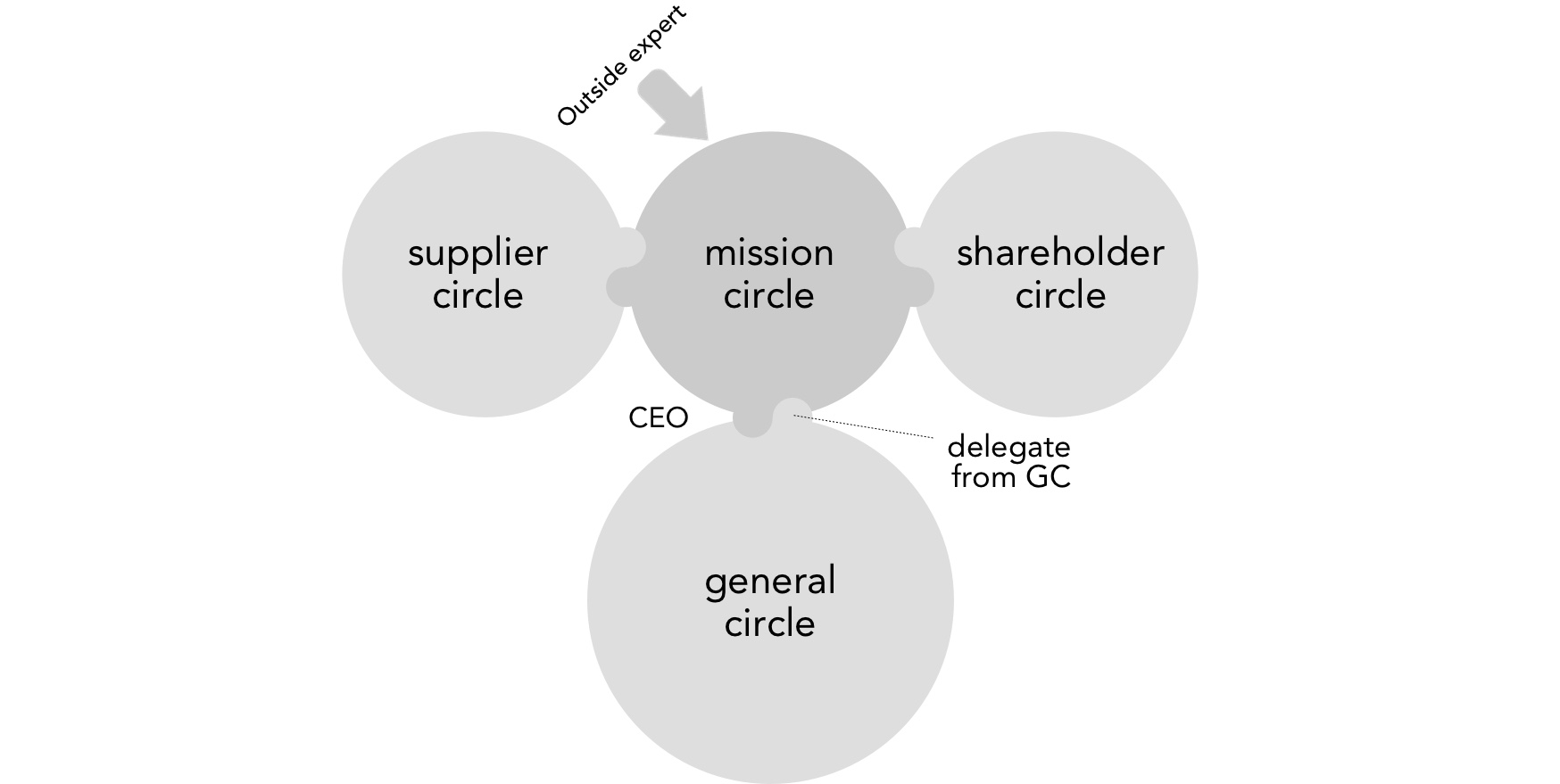 |
Diagram Figure 2.44, “An example of the mission circle of a for-profit” shows what a sociocratic for-profit can look like. Please keep in mind that these are examples – a supplier circle makes sense in some contexts and not in others. The actual organization depends on what constellation works well in the mission circle.
Figure 2.45. A sample structure of a worker cooperative
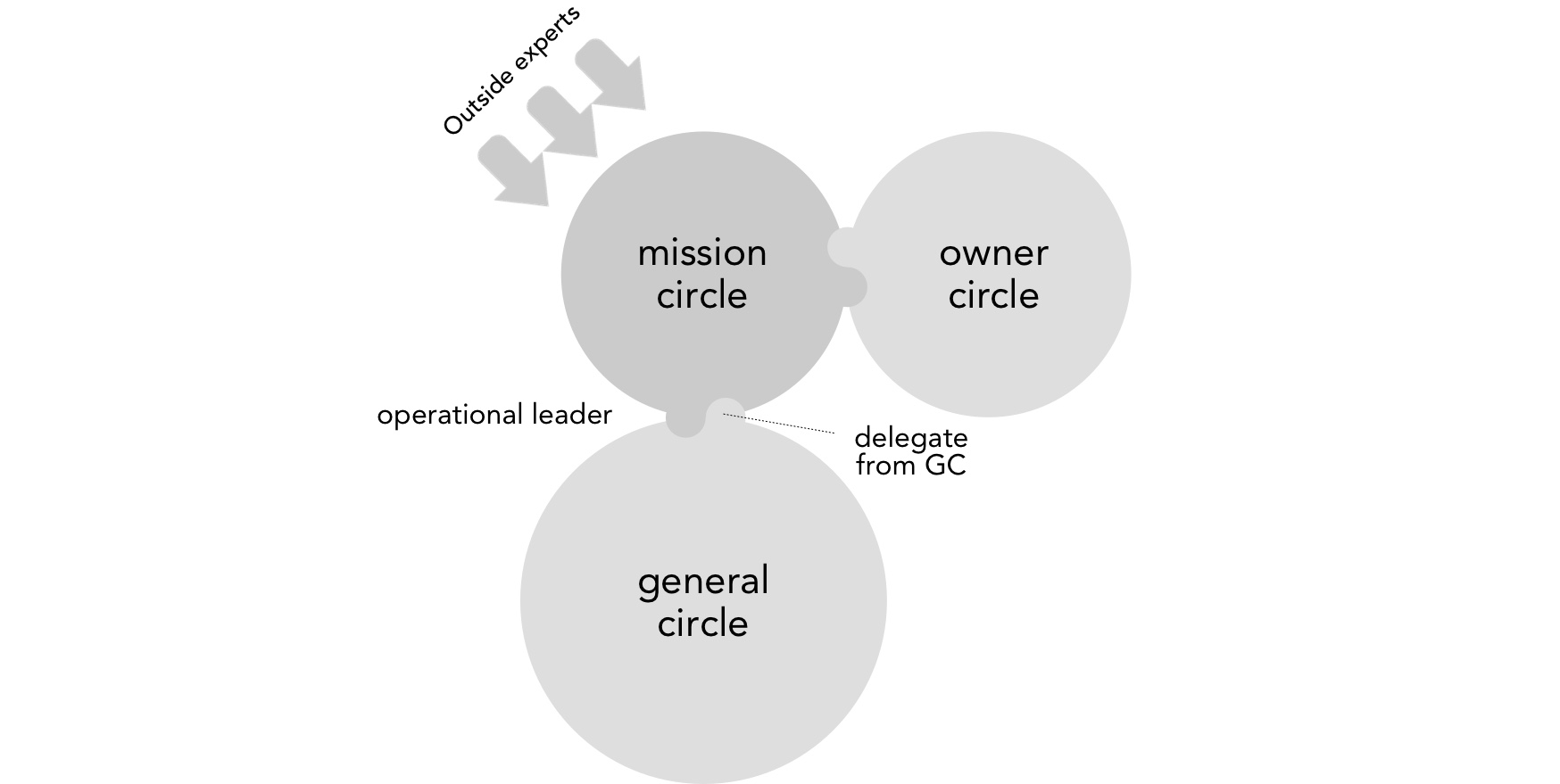 |
Diagram Figure 2.45, “A sample structure of a worker cooperative” shows part of the structure of a worker-cooperative. There are two aspects to notice here. First, this cooperative has all workers represented in the work circles, including non-owners like seasonal workers and provisional members. To give a voice to the long-term planning interest of member-owners a voice, the owners form an owner circle that has two delegates in the MC.
They also have people from outside the cooperative on their mission circle, for example a co-op developer, or members of other enterprises that are related to their field, like suppliers.
An example of an intentional community is shown in Fig. Figure 2.46, “Outside experts on the MC of an intentional community”. There are three outside experts shown. For example, a member of town government could be on the community’s mission circle. Someone from a different intentional community, a local farmer, a permaculture design expert, someone with expertise in elder care or in communication skills or in conflict resolution.
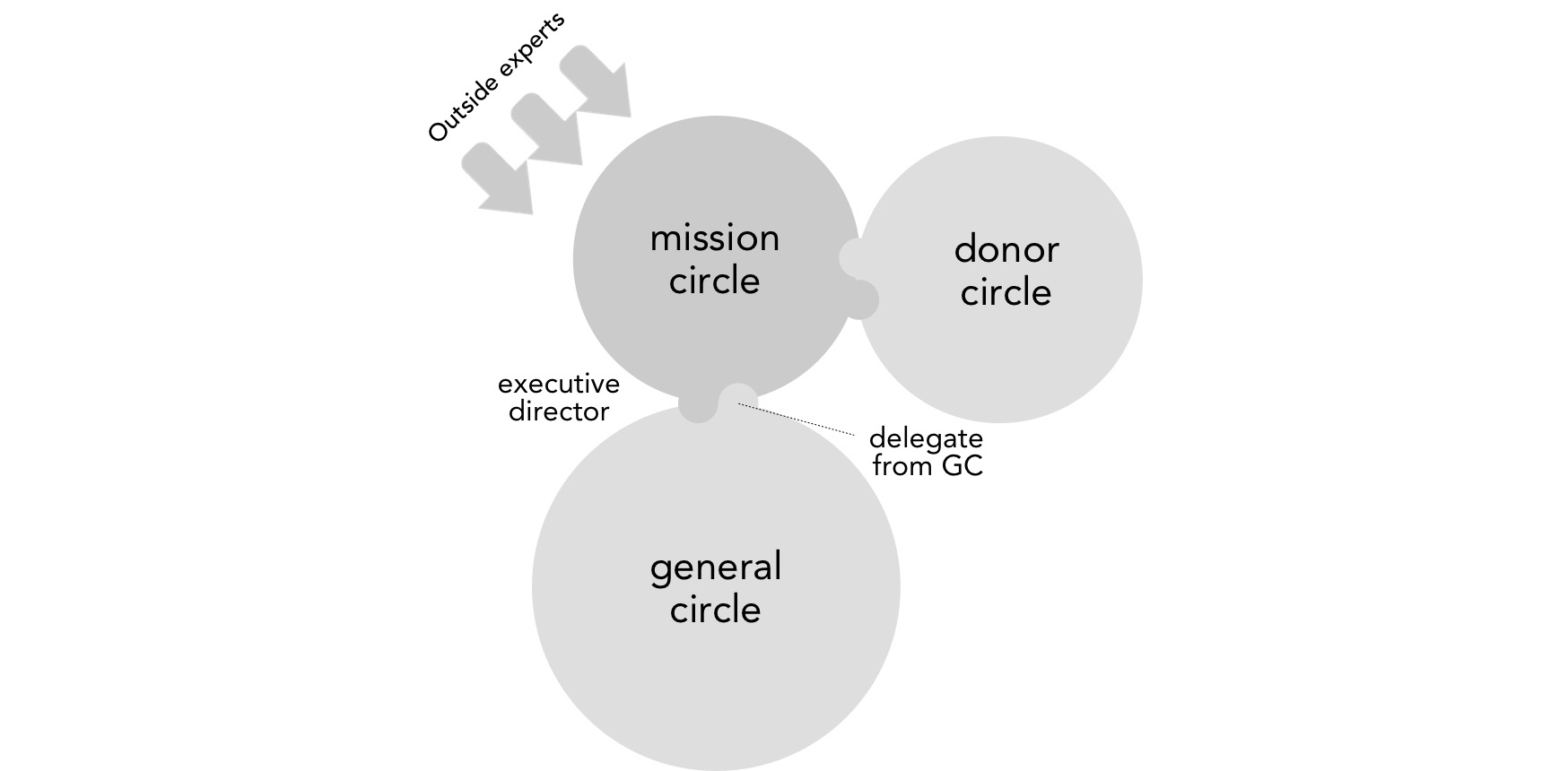
For completeness (even though there is not much of a difference), let’s explore a non-profit structure as illustrated in Fig. Figure 2.47, “An example of the mission circle of a non-profit”. Depending on the nature of the non-profit, there might be a coherent set of donors. (Coherent enough to select a delegate among them.) They might have an expert from local government or school administration or from another organization with a similar aim. A non-profit may have a membership base which meets occasionally. The membership may select a delegate to serve on the mission circle to represent the interests of the members.
Figure 2.46. Outside experts on the MC of an intentional community
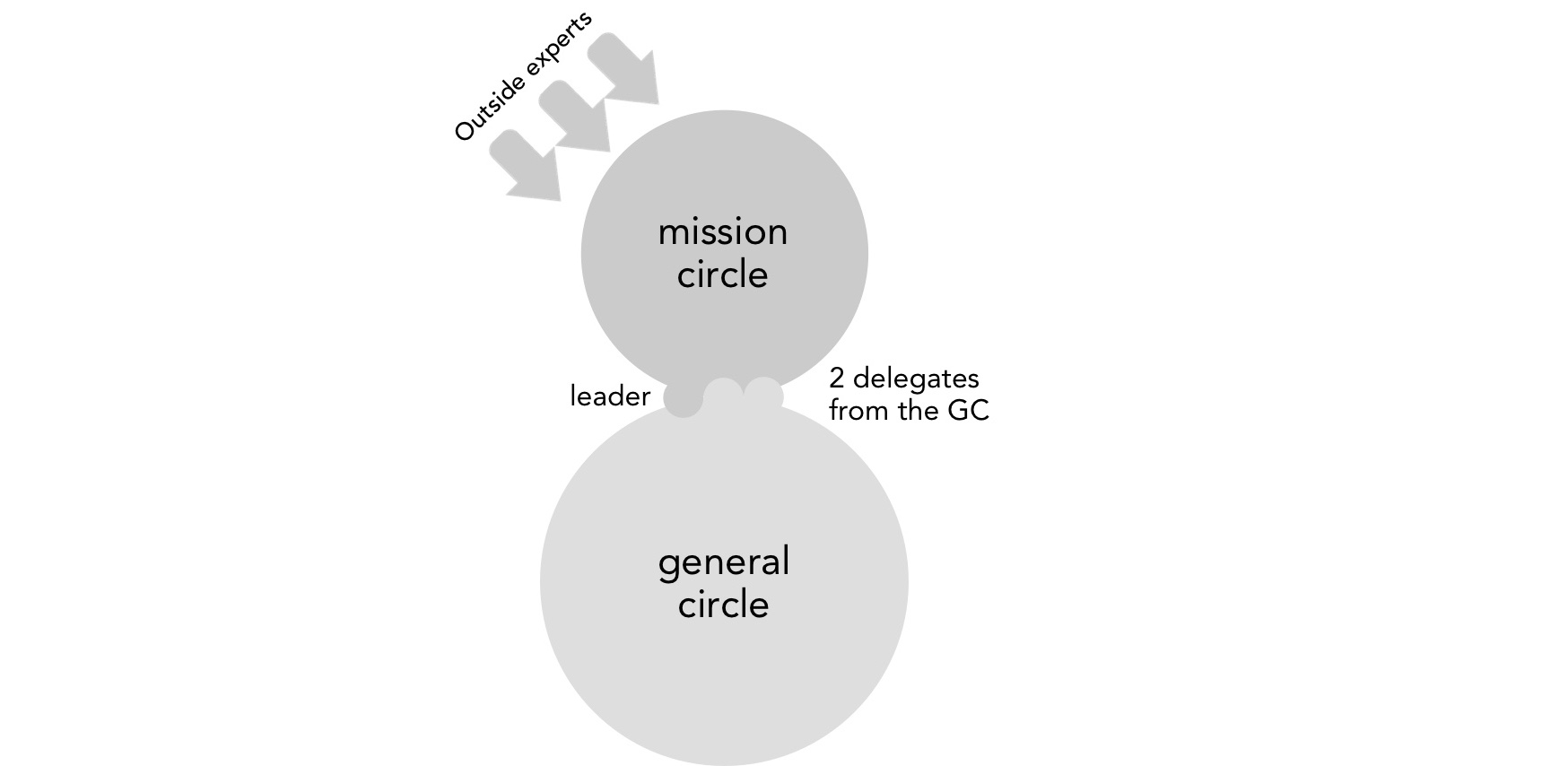 |
Figure 2.47. An example of the mission circle of a non-profit
 |
There are many ways to tie stakeholder groups together. The basic ideas are
to connect within your field
to seek outside expertise for your organization
to implement representation of entire stakeholder groups, if that makes sense
Remember that:
In consent decision making -- different from majority vote -- number is not a factor. We do not need to have one group outnumber another. Everyone will have to collaborate.
It is better to keep the numbers manageable. In a large group, people will have difficulties hearing each other and being productive as a group. We can always make policy around rotating stakeholder groups over time if that helps, or ask a stakeholder to visit and report.
Typically, the leader of the general circle (executive director, CEO or other titles) will represent the mission circle on the stakeholder circle to complete double-linking in the usual way. This is another way to ensure flow of information. If we choose to and we value distribution of leadership, we can select another mission circle member (not the leader of the general circle) to link to a stakeholder circle. Whatever works and is decided in the spirit of the principles!
The MC member who serves on the stakeholder circle is that circle’s leader and has consent rights on who that circle’s delegate on the MC will be.
We choose the number of delegates from each group (stakeholder circle or CG) as desired.
If a group gets anxious at the thought of having all those outside people on the ‘‘board’’, then they can simply have more than one delegate from the GC on the mission circle (see Fig. Figure 2.46, “Outside experts on the MC of an intentional community”).
Helping circles are ‘‘ad hoc circles’’ that only exist temporarily for a specific purpose, to accomplish a specific aim within a limited period of time. Usually, helping circles have a limited domain of decision-making. The typical aim of a helping circle is to research, gather feedback, discuss, synthesize, and to come back to the parent circle with a recommendation or proposal.
The parent circle may select the members of the helping circle or select a leader and ask that leader of the helping circle to select the members. All circles must have a clear aim and leadership. The helping circle members can be from inside the parent circle or from outside. It can have two members or many members. A helping circle can exist just for one meeting or for much longer, depending on the needs of the parent circle.
Helping circles can also be used to build cross-sectional teams, for example to work out better alignment between two (unrelated) circles or even between two organizations.
Figure 2.48. Forming a helping circle.
 |
Form a helping circle whenever it would be more efficient to have a few people deal with a question or a task instead of everyone in the circle. Examples:
The circle needs more information on an issue. A helping circle can gather more information and make a recommendation.
A written piece requires a re-write. Gather ideas and let a helping circle work out the details.
A discussion among a subset of the circle comes up and the group has a clear sense that their discussion does not require everyone’s presence.
The idea of a fractal circle structure is to reduce the number of items we have to pay attention to in one circle by compartmentalizing tasks into sub-circles. The temporary version of that is the helping circle.
The three most common pitfalls are:
A helping circle without a leader. We can nominate the leader (or all the members of the helping circle) as part of the proposal to create the helping circle or do a selection process after consenting its creation.
A helping circle without clarity on its aim (e.g. without a clear description of what the outcome or product is intended to be).
Helping circles without a link to the parent circle; if the helping circle leader is not a member of the parent circle, there needs to be a plan to facilitate flow of information between both circles.
Figure 2.49. It is crucial to be clear about the mandate given to a helping circle.
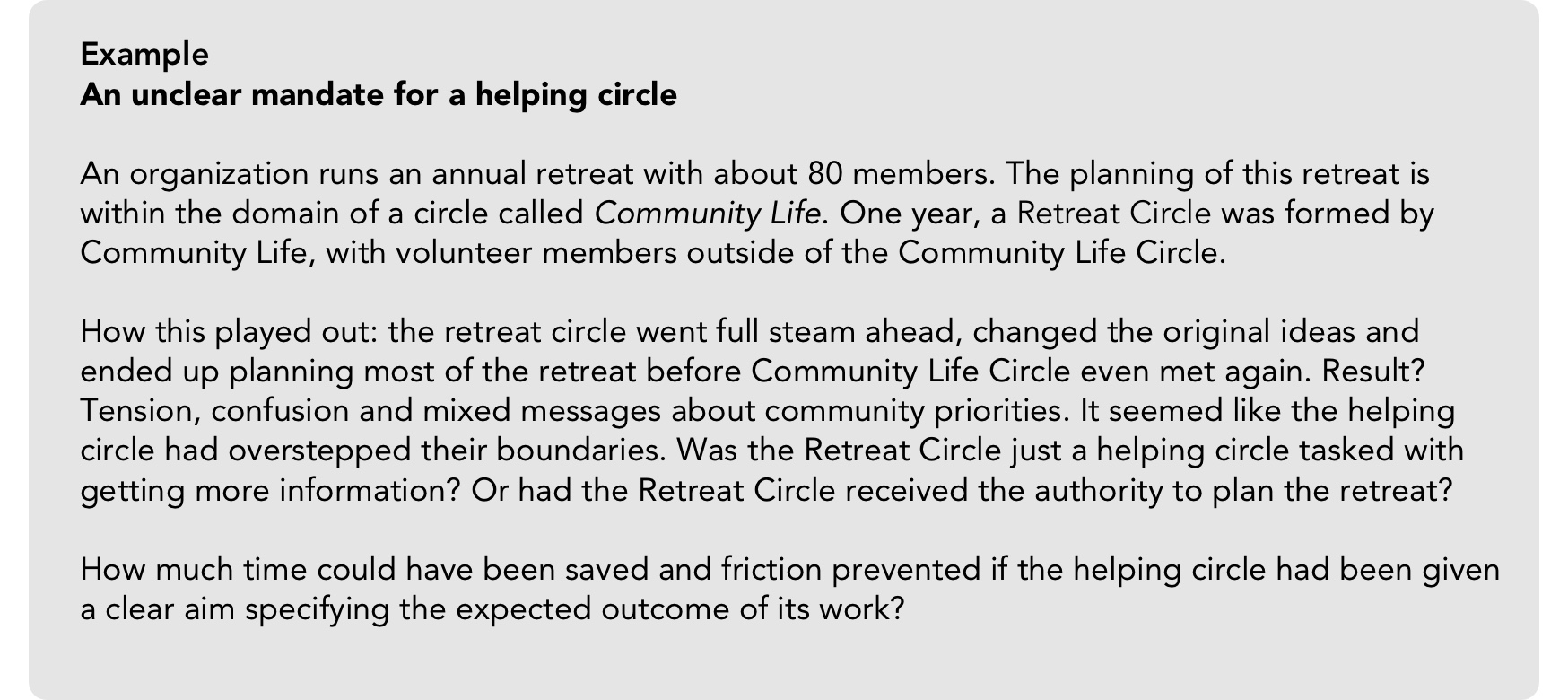 |
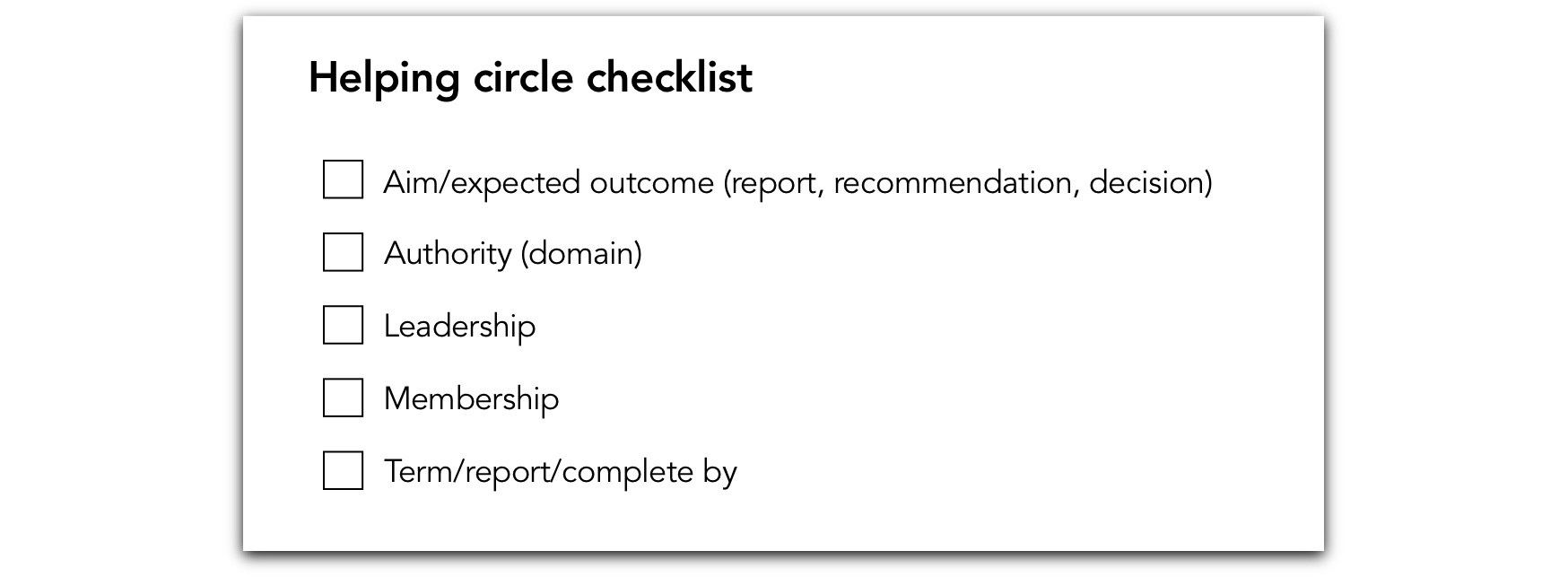
Example Figure 2.49, “It is crucial to be clear about the mandate given to a helping circle.” tells a story from one of our organizations. When setting up a helping circle, use the checklist in Figure 2.50, “Checklist for forming a helping circle”. If all boxes are checked, it just takes a minute. If not, we’ll be glad we noticed!
Figure 2.50. Checklist for forming a helping circle
 |
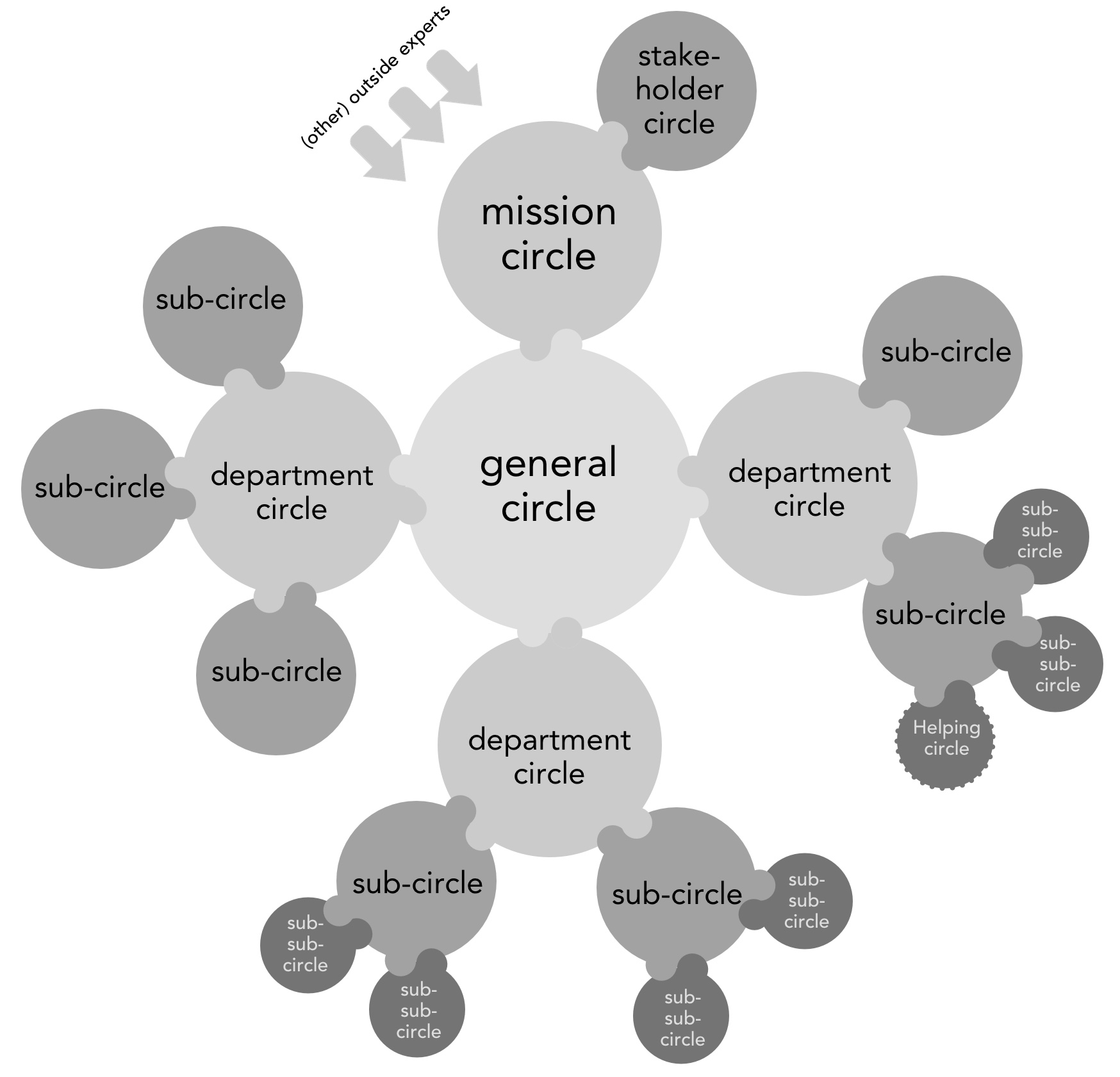
For you reference, Figure Figure 2.51, “A full structure” is a complete example organizational structure in a generic form. Note that not all circles have to be present in every implementation, and it is intentionally slightly asymmetrical to show the organic nature of circles structures. Notice it also has a helping circle, so one can see all circle types in one structure at a glance. See section Section 6.4.2, “Designing a new organizational structure” for a step-by-step process on how to approach designing an organizational structure.
Figure 2.51. A full structure
 |