 | 6.6. Sociocracy in tiny groups | |
|---|---|---|
| ↢ | Chapter 6. Implementing Sociocracy | ↣ |
Some people assume that sociocracy is something for medium-sized groups only. What about very small groups, like groups of 4-5 people? Does a circle structure here create too much overhead? It depends.
There is some truth in the assumption that a very small group will not benefit from a circle structure as much as a larger group will. However, sometimes the advantages of establishing circles will outweigh the effort. The considerations:
The desire to focus attention to one particular part of the overall aim. The aim drives the entire organization. Often, even in a small group, members get overwhelmed. Topics start falling through the cracks.
The desire to have differentiation of who does what. Having a circle structure might give clarity on what the authorities are. It makes a difference whether a group is a general circle that holds the entire domain together or whether that group is a general circle of ‘‘circles of one’’. In other words, does everyone know who has authority to act on what?
The desire to have all agenda items be always relevant for everyone in the GC. Is everyone doing exactly the same work and therefore interested in the same topics? If not, one might benefit from a circle structure, even in a small organization.
Let’s say one has a group of seven people who are part of a climate action group. The overall aim might be “Supporting climate awareness in Madison county”. Four people are interested in promoting permaculture as an inspiring alternative to the practices that generate harmful climate change. Three are interested in doing public education events. One manages the website and the mailing list. The aim of three of the members is to collect and write articles and make them available on social media. If, at a meeting, the circle talks about event planning and strategy around their event series, the website manager might be bored. Conversations about permaculture might not be relevant to the event planners.
Figure 6.8. A tiny organization: a small number people spread out into several circles
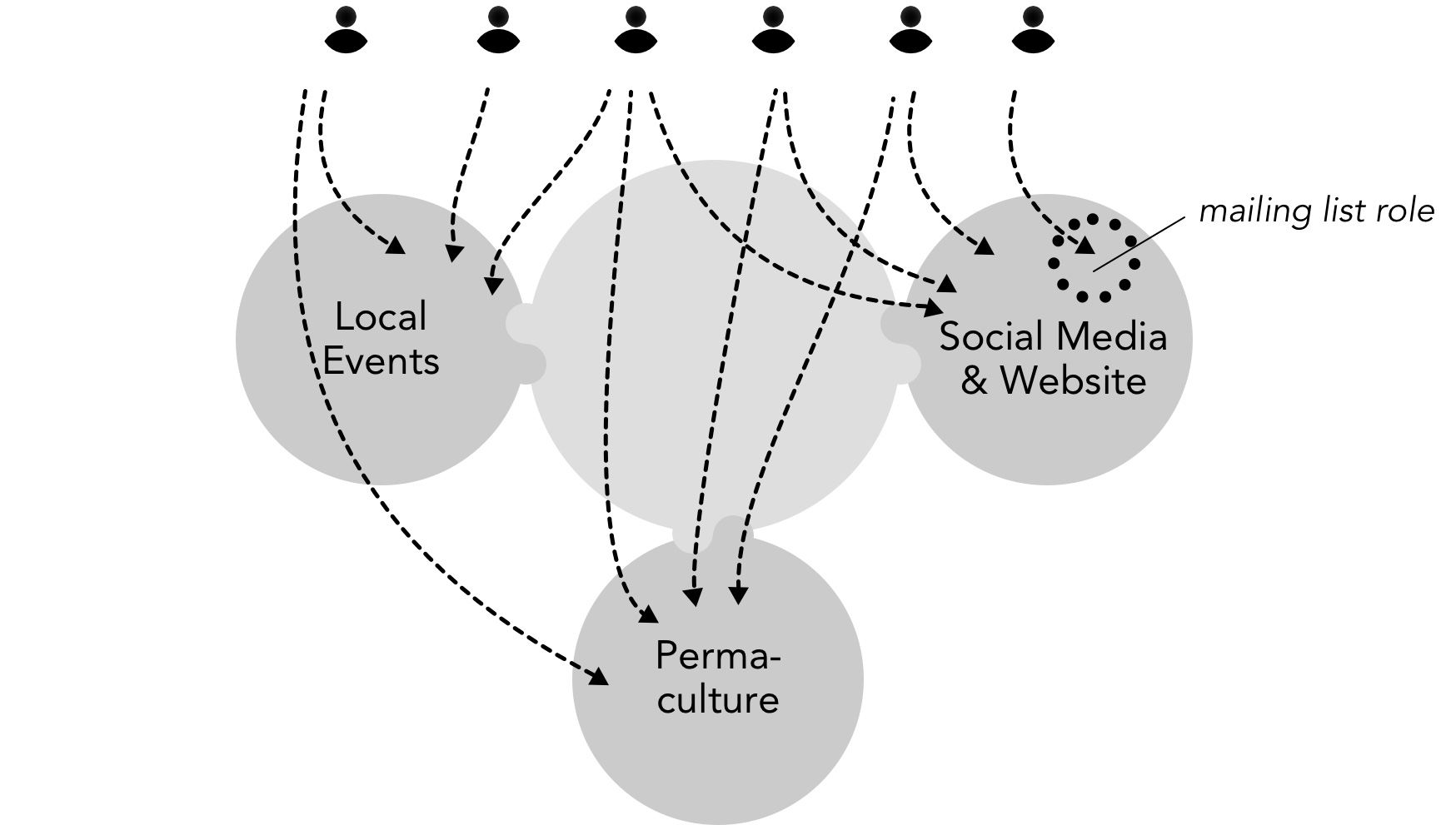 |
The advantage of breaking up into circles is to keep every meeting relevant and to make policy in a group that actually carries out that piece of work. Also, we can be sure that each of the sub-aims gets the attention it needs. The general circle might only meet from time to time, as the real work happens in the work circles, and this is what those people are actually burning for.
Here is another very subtle advantage of having the clarity of domains and aims and who holds which domain: it is easier to recruit prospective members if they have a clear choice about where to put their energy. The question to them is not: “do you want to join a group that does events, social media, a mailing list and permaculture?” The question becomes “do you want to help us organize a monthly event? We’ll show you who else is connected to us and how it all comes together.” Volunteer workers are sometimes intimidated by unclear structure because we all know that volunteer work can easily be “dumped” on the first one who does not say no. In a structure with complete clarity, this will be less the case and people feel more confident to join.
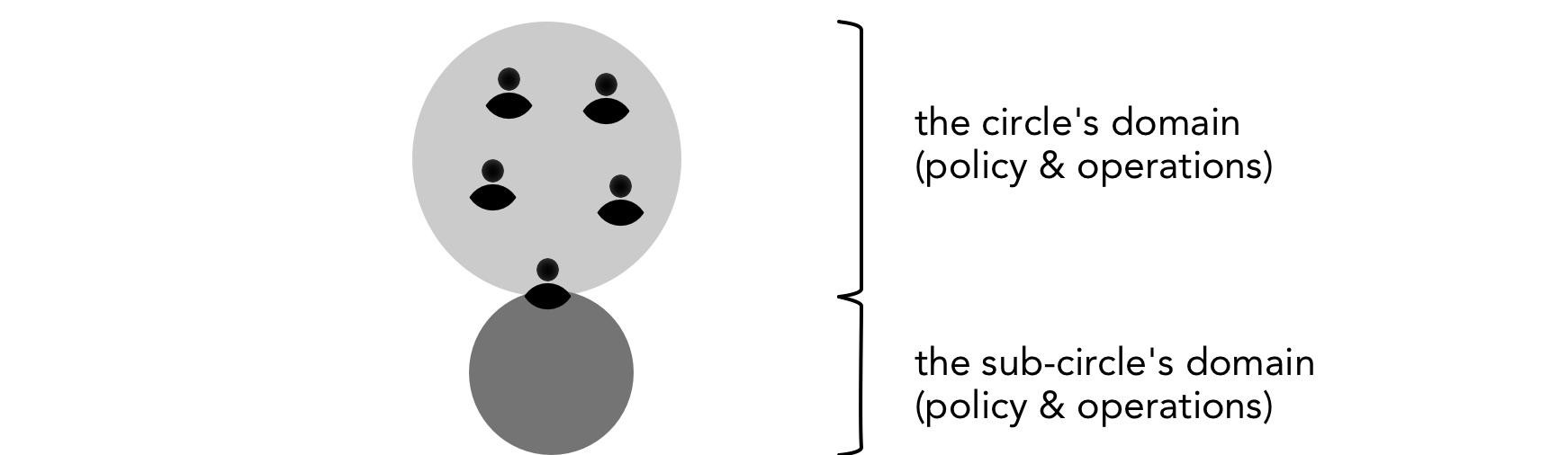
In tiny organizations, there is a tendency to have circles that only have one member. There is a problem here: what about double-linking? A circle of one, in our view, is more a transitional solution because it lacks the sparring partner, the other perspective. In a small start-up situation, one might assign one person to do marketing. That person might at the same time be the one who oversees all marketing activities (most likely because he or she is the only one doing it), and he or she makes all policy decisions. By default, the circle member of a circle of one is the leader of the circle.
Figure 6.9. Only one member in sub-circle
 |
In that temporary set-up, we have to pay more attention to transparency than usual.
Make sure, the leader (and only member) of this circle of one attends the circle meetings of the next higher circle and reports on a regular basis.
Make it a priority to grow the circle of one into a more stable position, by adding members or by finding a better place for the domain, for example by merging it with another domain/circle.
What is the difference between a circle of one and a person who holds a role in a circle? The general answer is that circles make policy whereas roles carry out policy. But the difference can get blurry. A circle of one with a narrow aim and domain may not be much different than a person in a role with a broad aim and domain of decision making that in other circles or organizations would be considered policy. In the end, what is significant is not the identity as circle of one or as role filler but how well values of effectiveness and egalitarianism are being served by the way we conceptualize the identity.