 | 2.4. Double-linking | |
|---|---|---|
| ↢ | Chapter 2. Organizational Structure | ↣ |
In sociocracy, as much authority as possible is distributed into specific circles. All circles are related but each circle has full authority in their domain. Giving a circle full authority in their domain often leads to an increase in productivity. But how do we avoid silos? How will the circles know about each other’s work?
What we need is a way to connect the circles. Let’s assume that in image Figure 2.34, “Unlinked vs. linked circles” (a), the domains of the two circles are related. Circle 2’s domain is a piece of circle 1’s domain. Circle 2 will be a sub-circle of circle 1. The connection between circle 1 and circle 2 will be done by double-linking. Double-linking is the sociocratic way of connecting two circles. Two circle members will be full members of both circles as shown in diagram Figure 2.34, “Unlinked vs. linked circles” on the right.
Figure 2.34. Unlinked vs. linked circles
 |
 |
More precisely, we will consider one of the two links the ‘‘top-down link’’ (or the ‘‘leader/lead link’’), and the other link the ‘‘bottom-up link’’ (or ‘‘delegate’’ or ‘‘representative’’). The top-down link carries the parent circle’s matters into the sub-circle and makes sure all actions serve to carry out the sub-circle’s aim. The bottom-up link reports from the sub-circle into the larger organization by reporting to the next ‘higher’ sub-circle what there is to know from the sub-circle (what decisions have been made, how the sub-circle is doing, the impact on the sub-circle of policies made in the parent circle etc.; see diagram Figure 2.35, “Leader and delegate”).
Figure 2.35. Leader and delegate
 |
With both links, we get what is called ‘‘circular hierarchy’’. Linkage is not only top-down and not only bottom-up but both at the same time. Information flows in an infinite loop from one circle to the next, in both directions. That also allows the circles to take care of each other if a circle struggles.
Figure 2.36. Circular hierarchy
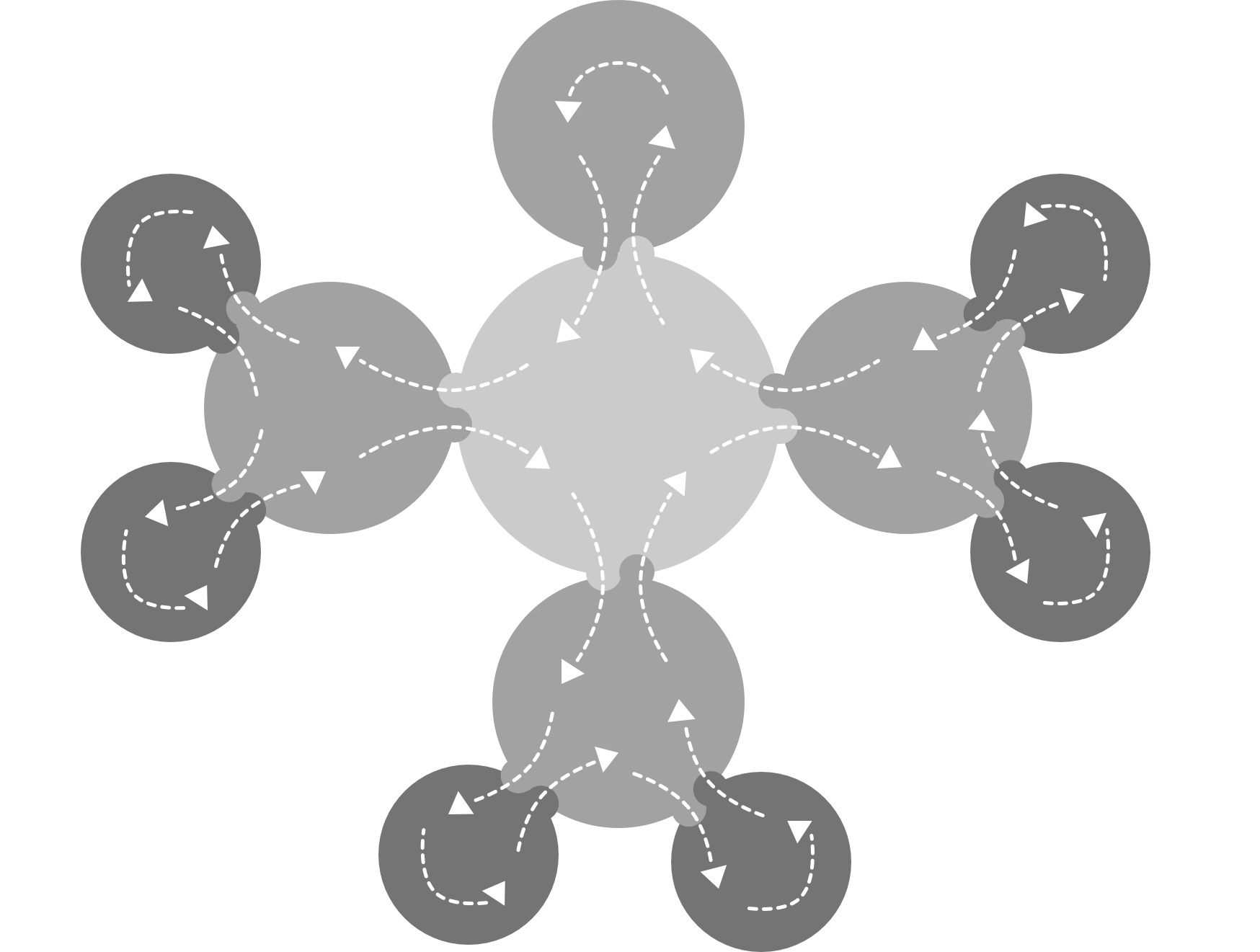 |
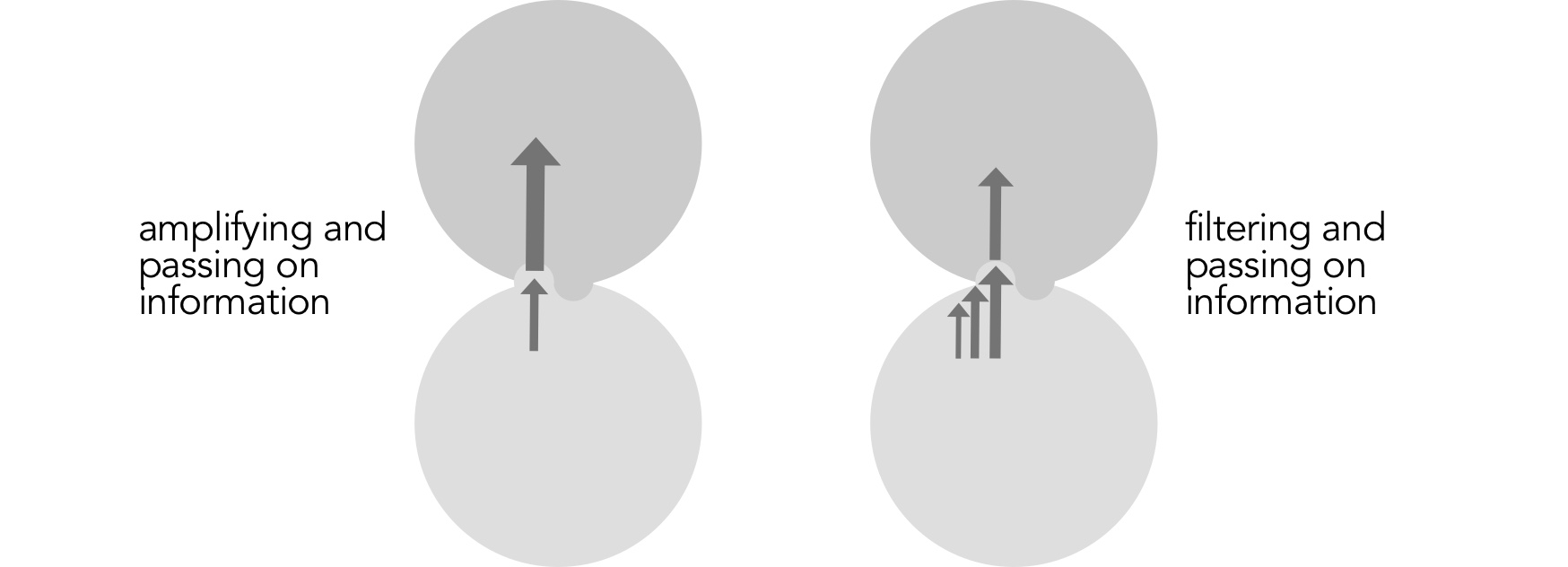
We need flow of information to make sure everyone and everything works well together. The two links also serve as a filter – no one in an organization can (and wants to) hold all the information from all the circles. Attention is a scarce resource and we have to protect it. That way, each circle can focus on what’s important to them. Only what is relevant is passed on. The top-down link filters information coming from the next-’higher’ circle and passes on everything that is relevant for this circle. The bottom-up link only reports what is important to the next-’higher’ circle and filters out details that are not relevant to know on that level.
On the other hand, issues can also be amplified. For example, some regional work circles of the same organization might report a problem that does not seem to be huge on their scale – but the circle on the national level starts seeing a pattern that points to a systemic issue. We want that kind of information to bubble up. A parent circle does not need to know who is performing what task within the circle. However, a circle might want to report to the parent circle that it is hard to find people to do extra tasks because all members of the circle are overcommitted. This might be a systemic issue that needs attention on a general level. It could also be that the IT solution that the organization is working with is too complicated and create a disconnect between people. This again would be important information. Decentralization and the filtering/amplification of information is a relief. Flow of information will not lead to overload.
Figure 2.37. Flow of information in the context of circular hierarchy: amplification and filtering
 |
See the list below for relevant topics that can be reported on. There might be policy regulating what is reported (like a set of defined measures).
Delegates report from their circle to the parent circle on a regular basis. Picture this: both the leader and the delegate will be present as they are both full members of both circles. Both the leader and the delegate will have been part of any decision or challenge that is being reported. Whenever delegates report from their sub-circle, the other one will be listening too and might add to it to complete the picture. By hearing two voices, we get a more complete picture of what has been going on in the circle.
But there is more to double-linking than that, and that is a psychological effect: since leader and delegate both know that the other one is present, their awareness will shift. They will monitor themselves internally more:
How can I report in a way that all voices from the circle are represented?
Is what I am saying true, and is it the complete picture?
Just the other person’s presence makes a difference in how the other link self-assesses and speaks.
People might own their unique perspective more and acknowledge uncertainties. If people are aware that they do not have access to the only and absolute truth, they are much more open to listening, and to considering other people’s point of view. Perspective-taking is a huge learning in this kind of setting.
In organizations with double-linking, a parent or child circle will not be seen as other. Imagine a circle does not agree with a decision a parent circle made: if two people who are part of “my” circle are also part of the parent circle, it will increase understanding instead of creating a sense of separation. Since it is harder to dismiss two voices than one, double-linking supports mutual understanding and a sense of togetherness.
Historically, double-linking is one of the defining principles defining sociocracy (with linked circles, open elections, consent decision making). What we find in practice is that some groups choose to skip double-linking and only implement single links. Practitioners do not always see the need to implement double-linking, or they simply do not have the humanpower to fill all the roles. What we recommend is to strive for double-linking, especially on the highest levels (department circles, to the general circle and to the mission circle). Double-linking is a strategy to support equivalence in an organization. Below are some of the considerations around the topic of double-linking:
If more than one person knows what is going on in a related circle (higher, or lower), then this increases the likelihood that we will have access to information from that circle even if members miss meetings due to travel etc. Double-linking helps keep the organization together: if the leader is not present, the delegate will know what is going on in the other circle. If the delegate is absent, the leader will know.
In a context where members participate in two or more other circles of the same organization, we might pass on formal double-linking, knowing that we will always have enough information from more than one person in the room. Double-linking is critical for any circles that link to the Mission Circle or General Circle. At these levels, having only a single link may result in too little or distorted information sharing and a decrease in equivalence. At lower levels of the organization, particularly in organizations where volunteers serve on multiple circles, there may be enough information flow.
At minimum, have a delegate ‘‘on call’’. If the leader can’t make the circle meeting of the next-higher circle, or if there is a controversial issue, then we have a delegate in place who will be able to report. It seems like a good idea to select this delegate before there is an issue, however, or it might turn into a “political” decision.