 | 2.3. Operations and the internal structure of a circle: Roles | |
|---|---|---|
| ↢ | Chapter 2. Organizational Structure | ↣ |
| 2.3. Operations and the internal structure of a circle: Roles | |
|---|---|---|
| ↢ | Chapter 2. Organizational Structure | ↣ |
We have described how circles connect to their related circles through linking and how circles have aims and domains that define their work. In addition, circles need some internal structure to function well. Of course, we can define (by consent) what those features might be in a particular organization. What we describe here is what is considered good practice and has been used in many sociocratic organizations. We have not seen any need to deviate from this basic structure, but readers might find their own way.
Why do we define roles? For the same reason that we make policy: for effectiveness, and clarity. For repeating tasks, we do not want to re-invent the wheel every time so we make policy about how it is done. But we also do not want to determine, which circle member is going to take the task every time: that is why we define roles. This is both true for circle roles and for operational roles. It is inefficient to start every meeting having to determine who is facilitator or secretary for that meeting. We want to settle those roles so we can focus on what is relevant. Also, in defining a role, we give the person filling a role the authority to act without having to check back with the circle, and the person a chance to build expertise in that role. Roles in sociocracy are generally about empowerment, building expertise and paying attention.
Some people see a circle as a bundle of operational roles in a domain – the holders of roles are the people who carry out the work of a circle. Another way of looking at it is to see all circle members as people who carry out the circle’s operations, while some repeating tasks live in roles. Either way, we are separating roles, like hats, from individuals. One person can wear many hats, but each hat can only be worn by one person. One circle member can hold many roles, depending on resources and skills. Ideally, we would like to see roles distributed among several people as this distributes power. (On rotating facilitation, or roles in general, see section Section 2.3.4, “On rotating or sharing roles” on page Section 2.3.4, “On rotating or sharing roles”.)
There are only two roles that can’t be filled by the same person: leader and delegate. Double-linking requires the leader and delegate to be two separate individuals. Readers not familiar with double-linking are referred to section Section 2.4, “Double-linking” on page Section 2.4, “Double-linking”.
In order to stay in touch with where we want to be heading in the future, we need leadership. A circle leader (also called top down link) is paying attention to the circle’s operations in relation to the circle’s aim. What needs to be done, who agreed to do it. What is in the future to decide? The leader also serves as a top-down link, bringing information from the parent circle into their circle.
In order to be present with each other, we need a good facilitator. Facilitators run meetings according to the format of meetings and decision making adopted by the group. Leader and facilitator are separate roles because facilitation and overseeing operations are different skill sets. They can be held by the same individual.
In order to manage continuity with the circle’s past, we need to have written records. The secretary manages the notes during the meeting, makes sure the minutes are distributed and accessible. The secretary also manages the records of the circle and is the interpreter of policies. Bigger organizations may choose to have a logbook keeper who keeps the records and the current policies in one central place so they are accessible.
The delegate (also known as the bottom-up link, or representative or rep) is selected from within the circle to represent the circle in the next-‘‘higher’’ circle. This creates a double-link between two circles. The leader and delegate carry information into the circle and out of the circle, a feature we call double-linking. (See section Section 2.4, “Double-linking”.)
Figure 2.20. Circle roles take on a defined set of operations for a longer term
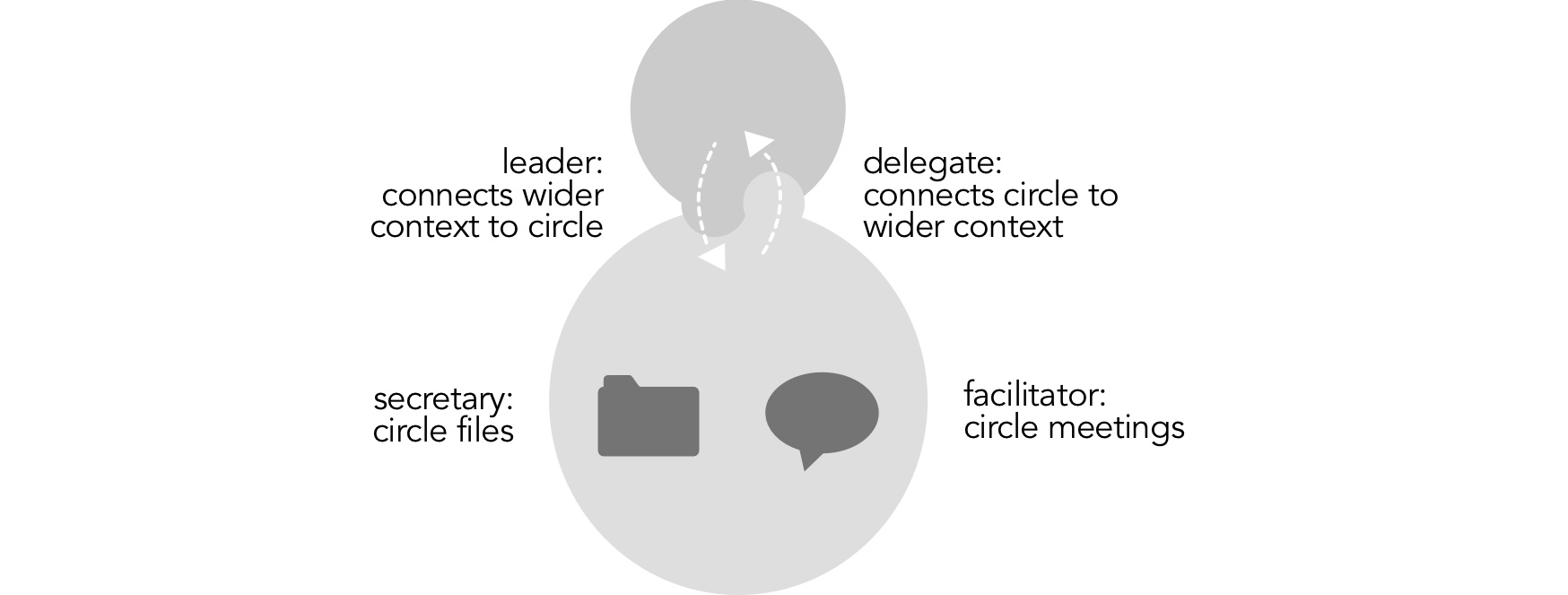 |
The leader supports forward-motion on the operational level of the circle. Equivalence is embodied in the idea of a double-link of leader and delegate: We increase the chances of more voices being heard when we have a second person forming a link between circles. Facilitator and secretary make sure the circle meetings run smoothly, establishing an effective practice with transparency and equivalence in meetings and between meetings.
Every circle member is free to act within the frame of policy of the circle. The leader makes sure operations and decisions are moved along so the circle can (continue to) work toward the aim of the circle. The role of the circle leader is both a circle role (supporting circle process) and an operational role (paying attention to operations in the entire circle’s domain, see section Section 2.3.2, “Operational roles”). The leader operates within the frame of policy to which the circle has consented.
Figure 2.21. Checklist for the role of the leader
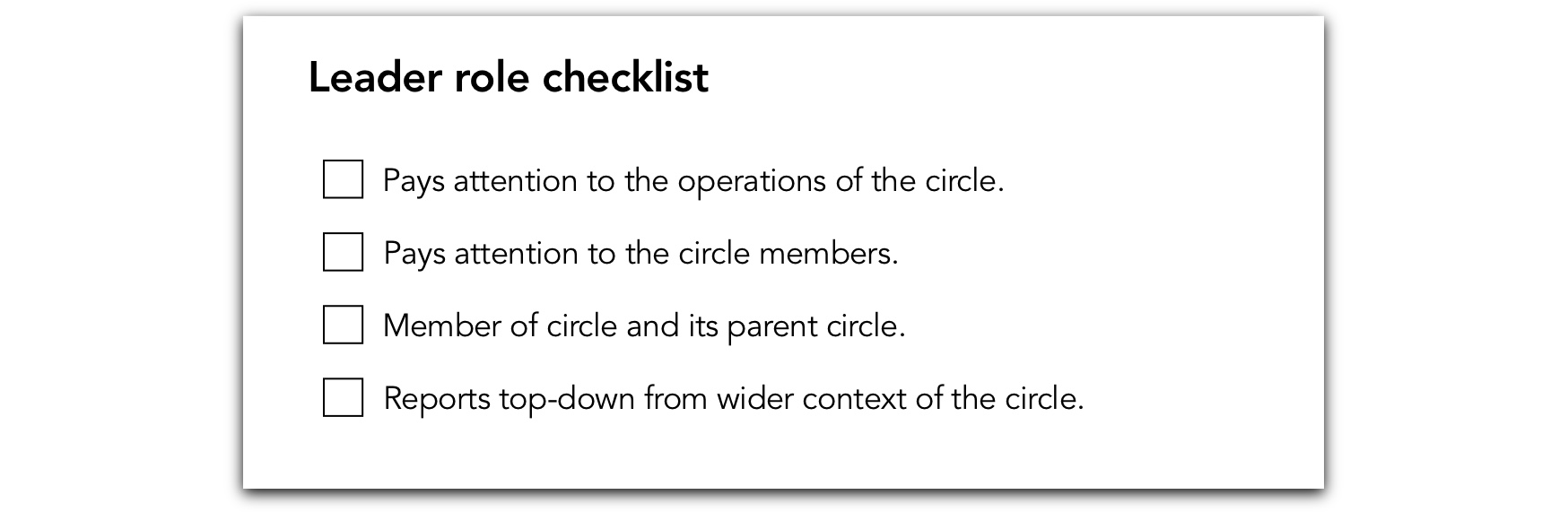 |
Part of the operational leadership is to pay attention to the whole of the circle. “What needs doing next? Are circle members doing what they agreed to do? Who needs a check-in, and what might be needed so operations can run more smoothly? What comes from a broader circle that needs to happen here?”
Imagine a Membership Circle. Any operation happens within the policy framework given by the Membership Circle. The operational activities of a Membership Circle include outreach, orientations and ongoing education. The circle sets who is responsible for communication with people seeking information about membership. The leader makes sure this actually happens by checking in with people or doing whatever level of management is needed to make sure things happen smoothly. In that way, the leader pays attention to the whole.
Leadership is absolutely essential. Without defined leadership, the circle can easily lack the person who pays attention to the whole and leads the circle forward. Leader-less circles can easily fade away and/or go into ‘‘coasting’’ mode (functioning but not moving forward). Remember that in a system of consent, the leader is not demanding circle members do things they do not want to do. It is not coercive leadership. Consent or sociocratic leadership is more like a running partner: the person who is paying attention to whether we show up and who checks in if we skip two running days in a row. This running partner does not have power over you; each circle member has given consent to the frame of how work is being done in the circle. The leader is the one who holds the operations and the members together, who is their accountability partner and their cheerleader. Because we have so much experience with the abuses of power, the reactions to leadership will depend on the organizational culture and context.
It is not easy for leaders to find their place if they enter a sociocratic organization for the first time. We often experience leaders as rather cautious around stepping into this role. Despite it being an egalitarian governance system, sociocracy is perfectly compatible with strong leadership. In our view, strong leadership with good listening skills and a good mix of self-reflection and pragmatism is service to the circle. It cannot be said often enough: in consent decision making no person can be over-powered. If there is tension around leadership styles, remember three ways to smoothen out the tension: (1) building everyone’s communication skills, (2) giving each other feedback and (3) defining the role or related policy better to create more clarity. We encourage an open conversation and reflection on how circle members feel about leadership. It can be an enlightening process to define together in the circle how they want to be led!
Which circle proposes the leader depends on the type of organization. In a hierarchical organization, the leader will be proposed top-down, by the circle’s parent circle. Traditionally, the leader is the top-down link while the delegate is the bottom-up link (see section Section 2.4, “Double-linking” on double-linking). In a more horizontal organization, the leader can be proposed by the circle. Either way, the receiving circle has to give consent to the selection.
Figure 2.22. The leader can be selected top-down or bottom-up
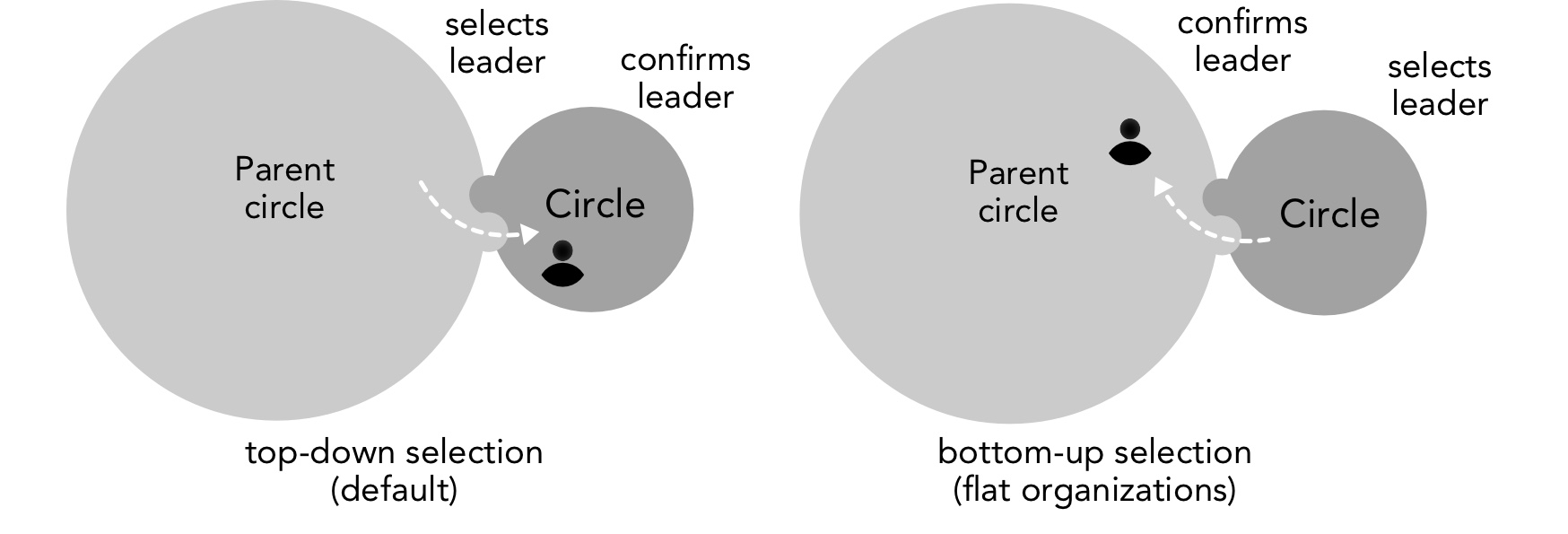 |
The two scenarios are shown in diagram Figure 2.22, “The leader can be selected top-down or bottom-up”. Since roles and membership of a group are always based on consent (an individual consents to being part of a group, and a circle consents to any new member), neither of the two scenarios involves power-over.
Whenever an existing circle creates a new circle, the existing circle will usually select the leader for the new circle to get the new circle up and running well.
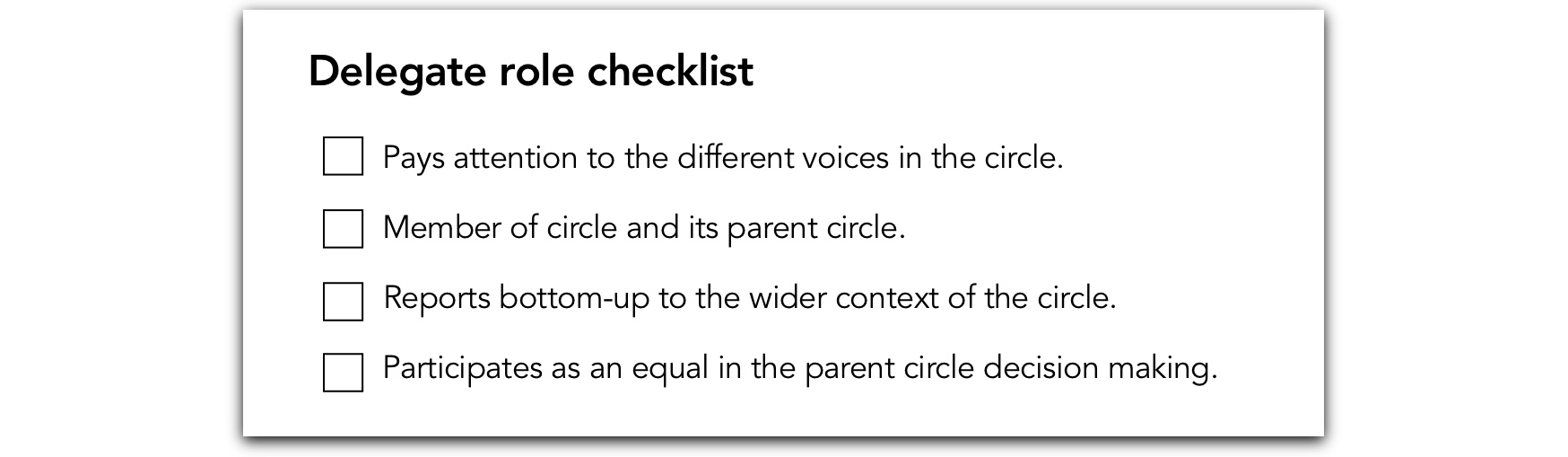
Each circle selects a delegate to participate in the parent/next-broader circle. The delegate attends the meetings of the next-broader circle and has full consent rights in that circle. Delegates report from their circle to that next-broader circle and make sure their circle’s concerns will be heard.
Whose opinions and needs does a delegate represent? Their own or the circle’s? Their own. A circle selects a delegate for their capacity to work effectively as a member of the parent circle. The delegate makes sure that policies that the parent circle makes will work well in the child circle. The delegate might not have any operational responsibilities in the parent circle.
Since the leader is also a member of the parent circle, there are now two members from each circle on the parent circle. Hearing more than one voice from a circle in the broader circle supports the flow of information and transparency within an organization. A second voice is particularly useful when there is disagreement within a circle that needs to be represented. More on the psychological effect of double-linking in section Section 2.4.2, “The psychological effect of double-linking” on page Section 2.4.2, “The psychological effect of double-linking” @@TODO@@: Figure out page references..
We strongly recommend having a delegate at the very least on your highest-level circles. Whether or not having a delegate is necessary depends on several factors. (See section Section 2.4.3, “Is double-linking mandatory?” on page Section 2.4.3, “Is double-linking mandatory?” for a discussion on whether a circle always needs to be double-linked.) Remember: in order to have a double-link, the delegate cannot be the same person as the circle leader.
The delegate is not just a reporting voice but a full member in both circles; the delegate has consent rights on both circles. This is crucial to establish and sustain equivalence between circles. Having a delegate is an embodiment of providing feedback in both directions.
Figure 2.23. Checklist for the delegate role
 |
The delegate is selected by its own circle and needs to be confirmed by the circle receiving the delegate as a member.
Figure 2.24. A circle selects a delegate; the parent circle confirms that delegate as a circle member
 |
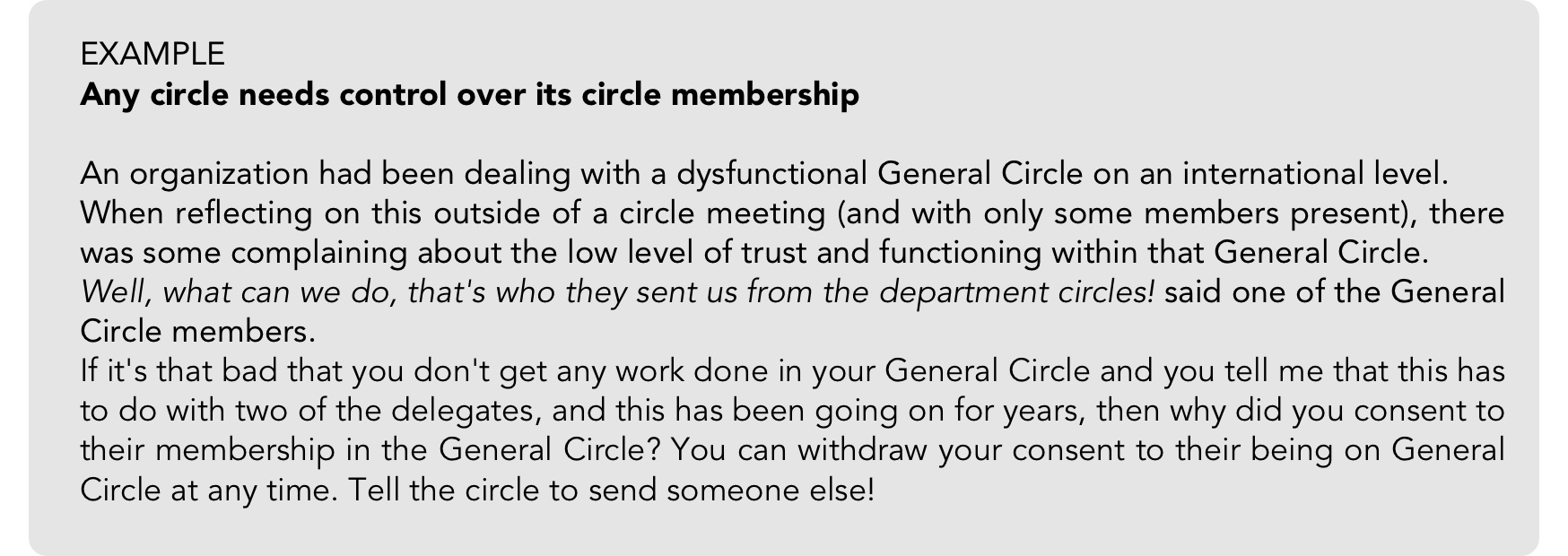
The reason for that is that every circle needs to have full control over its membership. There can be an objection to accepting a member which will make it necessary for the ‘‘lower’’ circle to select a new delegate. As always, the basis for this objection has to be reasoned and in relation to the circle’s aim. A dysfunctional general circle can slow down the entire organization – if a delegate is not supporting the work of the general circle, this needs to be taken seriously and addressed. See diagram in Figure 2.24, “A circle selects a delegate; the parent circle confirms that delegate as a circle member” and example Figure 2.25, “Make use of your consent rights, including for delegates into the next-“higher” circle.” for a story around this.
Figure 2.25. Make use of your consent rights, including for delegates into the next-“higher” circle.
 |
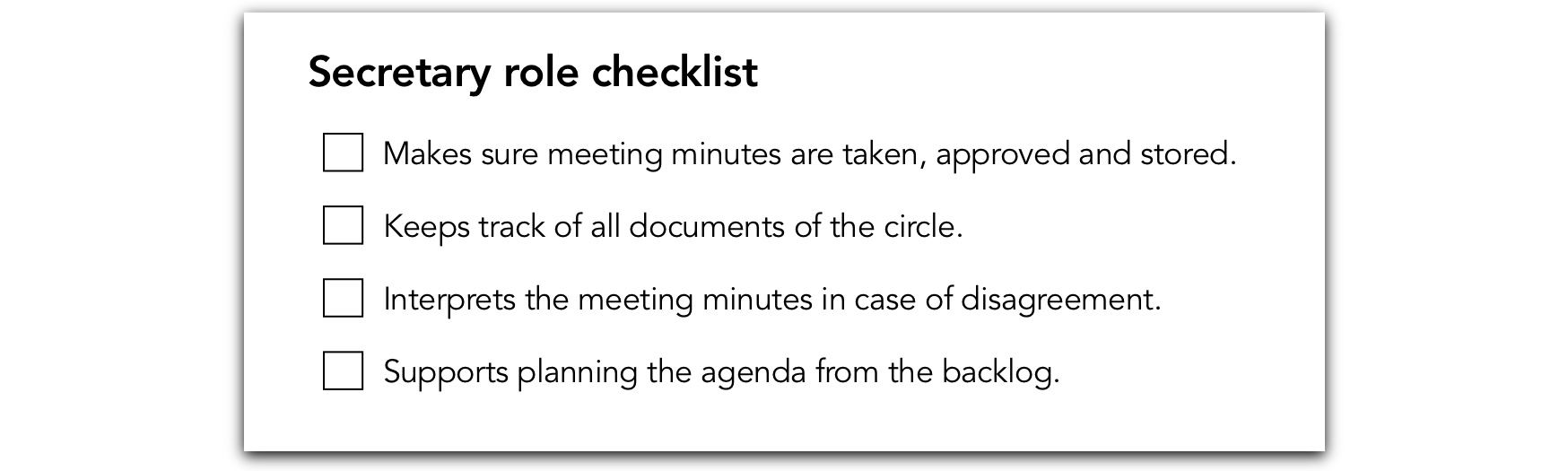
Each circle selects a secretary to take notes and to publish the minutes within the organization. In some organizations, the role of the secretary (also called the circle administrator) might also involve announcing circle meetings, preparing the agenda in consultation with other circle members (see section Section 5.4, “Supporting documents: backlog, agenda, minutes” on page Section 5.4, “Supporting documents: backlog, agenda, minutes” @@TODO@@: Figure out page references. on your options of who prepares the meeting agenda), and distributing study materials and proposals. The secretary also tracks what needs to be on meeting agendas, particularly remembering when a policy needs to be reviewed or that it is time for a new selection process for a role whose term of office is ending. As the keeper of the records, the secretary interprets policies when questions arise or if there is disagreement or confusion.
Figure 2.26. Checklist for a secretary
 |
Since decisions in sociocracy are made in small, focused circles, it is vital for the circles and the organization that meeting records are not only written down but also accessible to the whole organization -- otherwise, no one would hear about new policies that might affect them. In larger organizations, logbook keeping (storing/updating all policies in a central place) can be done by another role, the logbook keeper. In smaller organizations, this will typically be part of the secretary’s role. Either way, it is important to define which tasks the secretary is expected to fulfill.
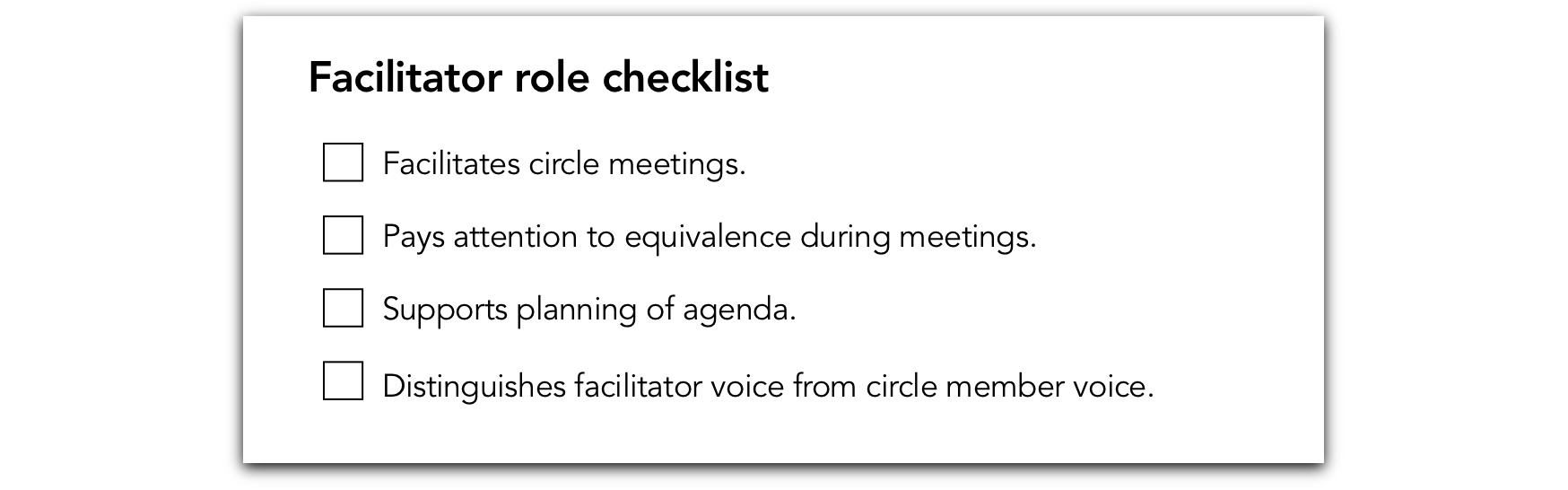
A facilitator is selected by each circle to run circle meetings. Facilitators are responsible for understanding the aim of each item on the agenda so that they are confident they can facilitate each item appropriately and guide the circle through all the steps of decision making. The facilitator may check in with the leader and/or the secretary to plan upcoming meetings. The facilitator supports circle members to be effective participants in the meeting.
Figure 2.27. Checklist for a facilitator
 |
The leader can be the facilitator if that works well for your circle. In that case the two roles would be filled by the same individual.
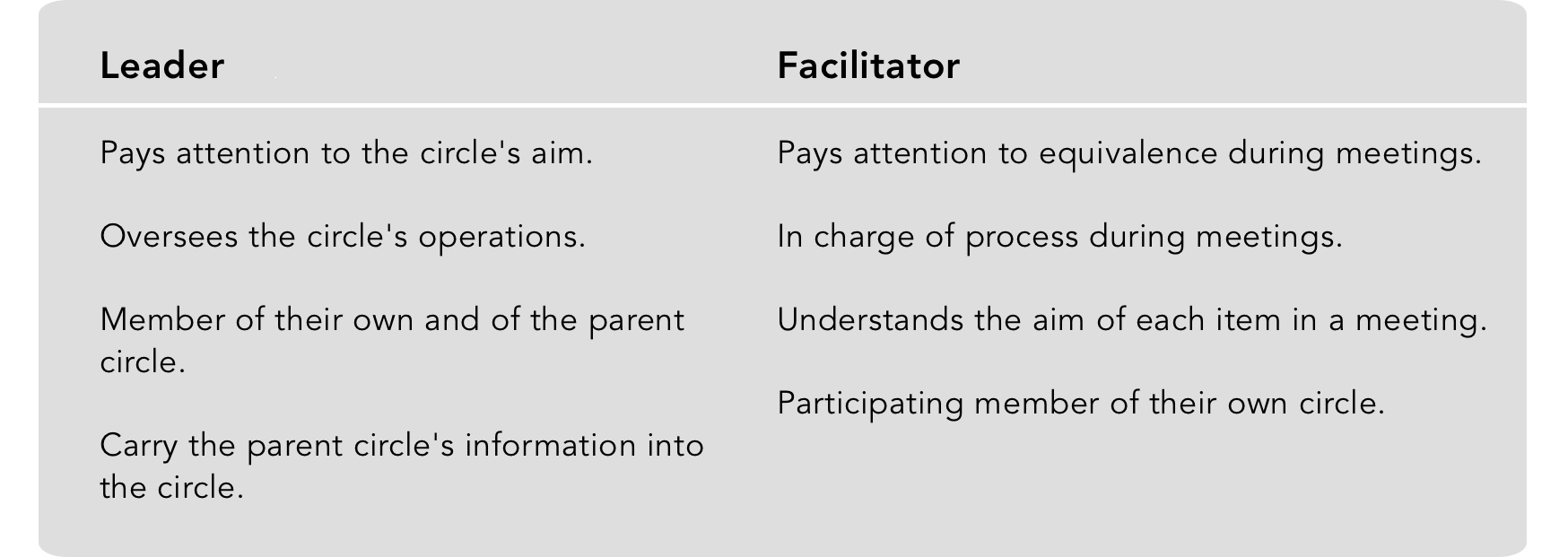
Since the skill set of a leader is very different from the skill set of a facilitator, sociocracy separates those two roles so that we are intentional about filling them each on the basis of their own requirements. We might have someone in your circle who is good at both leading and facilitation, but there are many examples of great leaders who do not enjoy facilitation and of great facilitators who have a hard time leading operational work. The leader role typically asks for a person who is a doer, who is good at holding people accountable, delegating and paying attention to what needs to be done on a broad level while not losing track of details. A facilitator has to be comfortable in front of the group, paying attention to process so equivalence can be ensured during the meetings. A facilitator should be good at listening and synthesizing. Also, it makes sense that the leader has free attention to attend to content during the meeting while the facilitator holds the process level.
Figure 2.28. Comparing leader and facilitator
 |
The logbook keeper manages and maintains the minutes and the set of policies for the entire organization. This role is defined by the general circle if the secretary of the general circle cannot perform those tasks in addition to the regular secretarial tasks.
The objective is to have one person pay attention to the policies, remind circles to update the logbook with new or revised policies, make sure new members have access to the logbook etc. Depending on the size of the organization, this can be a big job. We want to have only policies that are current and want to have them easy to find for maximum transparency. Example Figure 2.29, “An example of a logbook” shows what a logbook might look like.
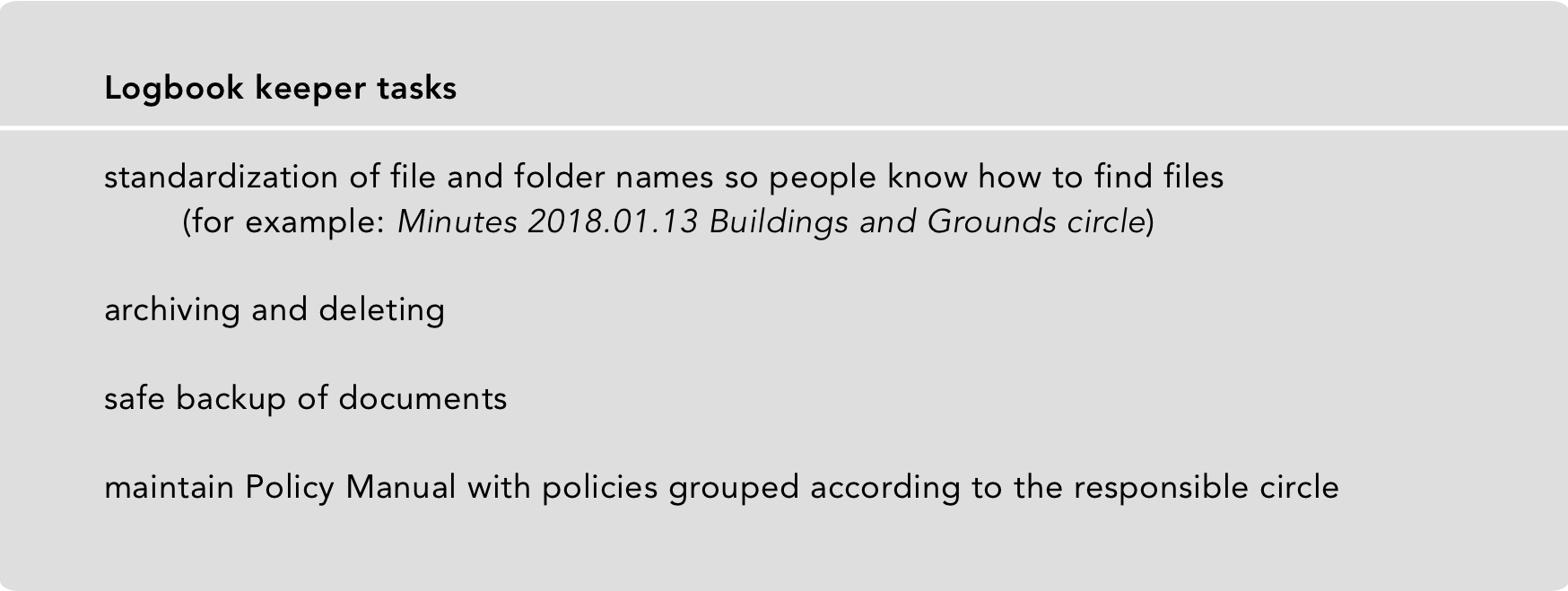
Table Figure 2.30, “The tasks of a logbook keeper” lists the tasks; more specific arrangements can be made by the general circle.
If desired, any circle that has a lot of policies to maintain can define a role of a logbook keeper just for their own policies and in addition to the secretary role.
Figure 2.29. An example of a logbook
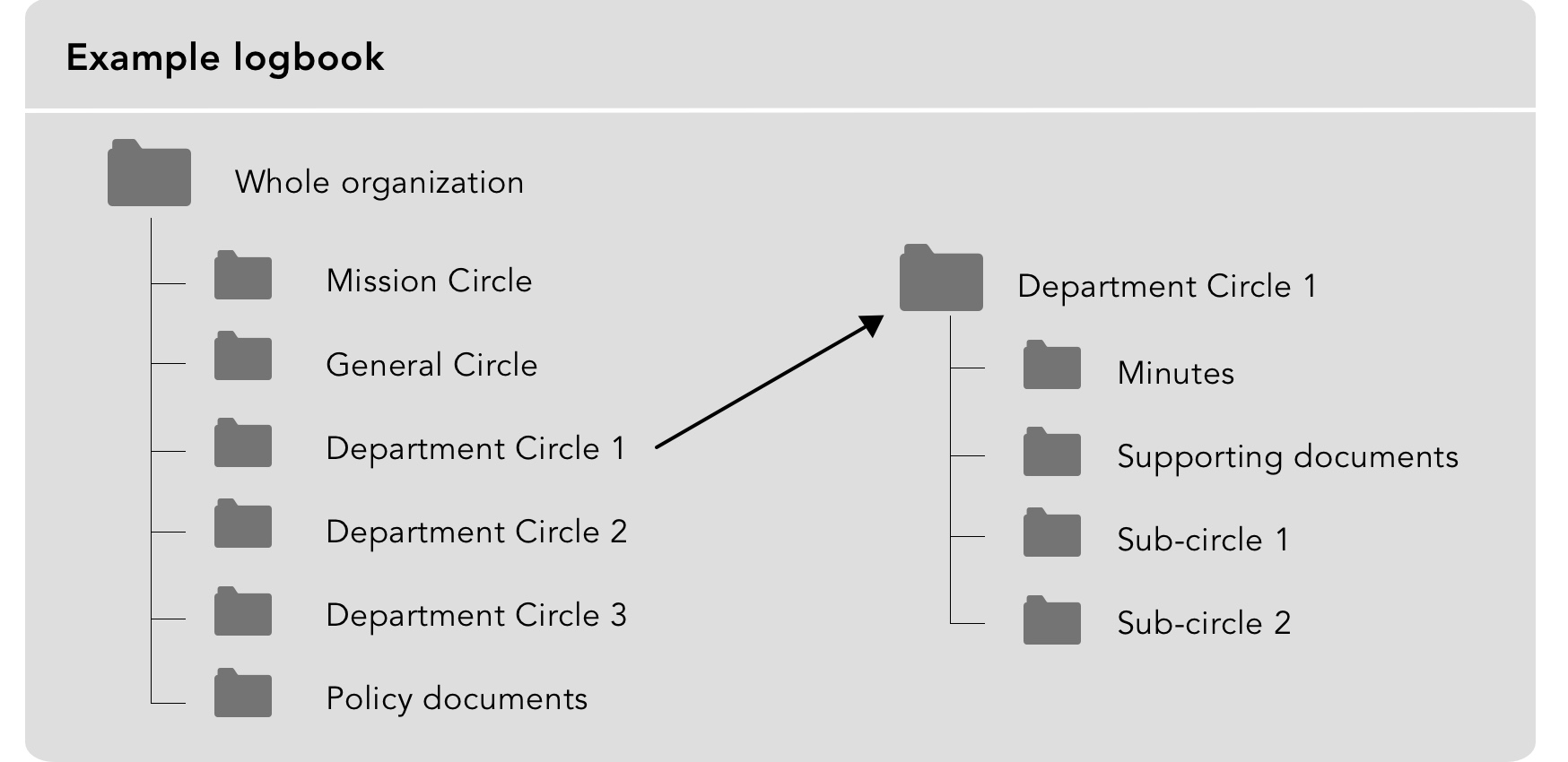 |
Figure 2.30. The tasks of a logbook keeper
 |
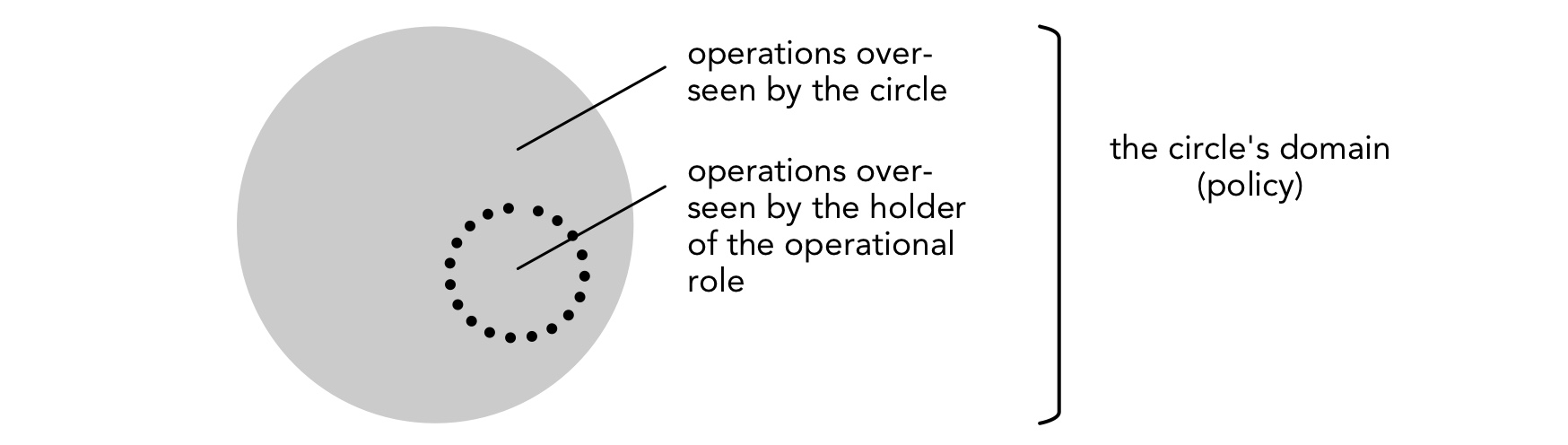
Most circles will choose to define what we call operational roles: parts of the domain of the circle that are overseen by individual (or paired) circle members in a role as shown in figure Figure 2.31, “Operational roles take on a defined set of operations for a longer term”.
Imagining a machine maintenance circle in a printing business, a role could hold attention for a special printing machine, its maintenance needs, coordinating repairs, and giving introductions to new workers using the machine. While the printer itself is in the domain of the machine maintenance circle, the operations in relationship to that printer are being performed by the holder of the operational role. Another example might be a membership circle that wants to put some effort into outreach. They might ask one person within the membership circle to coordinate outreach efforts. If this proves successful, and if that is a direction the circle wants to pursue, then the circle might decide to form a separate outreach circle that meets separately, makes its own policy in the domain of outreach.
Figure 2.31. Operational roles take on a defined set of operations for a longer term
 |
The advantages of roles for circles are:
Roles “outsource” the workload in meetings and free the circle’s attention so they can address and solve blockages that might be holding back operations in the circle’s domains. The maintenance circle should not have to talk about regular service work for each machine unless there is an systemic issue to deal with.
Separating out particular repeated operations into “packaged” roles supports effective collaboration because we do not need to involve every circle member to do or even talk about repetitive tasks, like scheduling repairs or regular service work.
Different from job titles, roles allow for a more fine-grained chunking of responsibilities.
Advantages for the holder of roles:
When the role is well-defined and the holder selected based on qualifications and skills, then the holder of the role has clarity and freedom to act. There is no need for micromanagement.
The tasks can be performed faster, with more focus and with less need for coordination.
Holders of roles can build expertise around their role.
Separating work into roles (instead of job titles) allows for flexibility. An area of authority can be passed on, even temporarily, more easily.
The same individual can hold different roles, with varying degrees of abstractness or concreteness, to create a mix of areas of responsibility that matches the needs and desires of the individual.
Holders of operational roles will typically be circle members – for example if someone is hired to fill the role of the outreach manager, then that person joins the circle that holds that role. Note: holders of roles within a circle domain don’t necessarily have to be members of the circle that owns the role but it is recommended in order to more easily receive and respond to feedback. The limit here is the circle’s attention: we can only distribute authority to the extent we prioritize gathering meaningful feedback. If a circle distributes authority into many roles with half of them not being circle members, it will take a lot of effort to track and support their work and feedback.
In order to create a role, a circle needs a role description. A role description can be generated in the same way other policies are generated – defining a brief needs statement, picture forming and proposal shaping. (See how to write roles in section Section 3.6.1, “Creating roles” on page Section 3.6.1, “Creating roles” @@TODO@@: Figure out page references..)
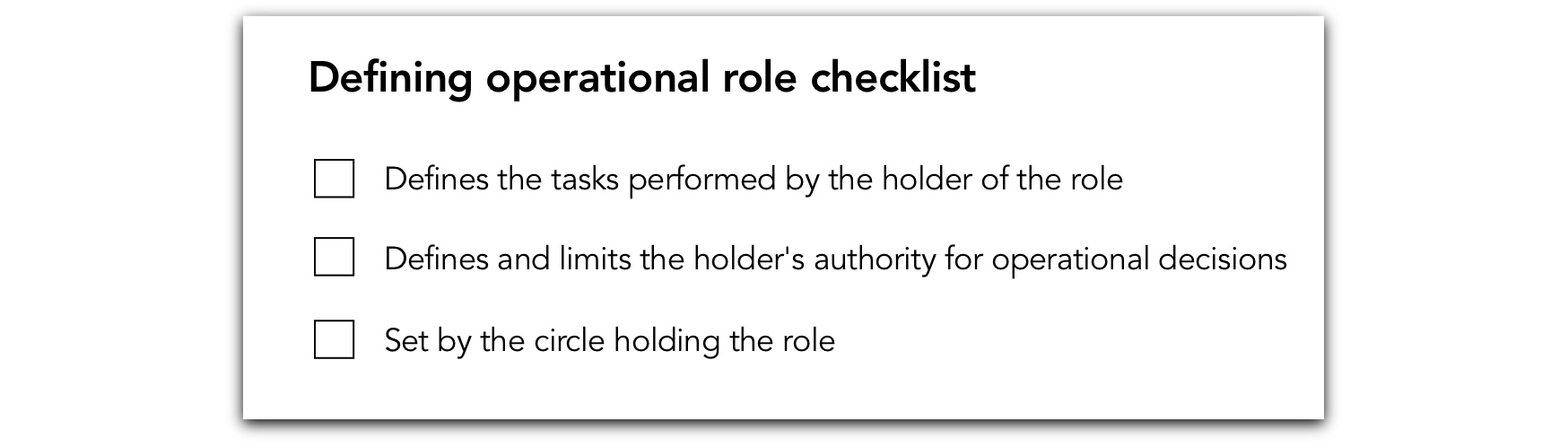
Policy guiding the operations will be made by the circle. The holder of the operational role will operate according to circle policy and has exactly the authority they are given by the circle. They do not have the authority to make policy alone. Most typically, holders of roles will suggest policy to the circle that affects their role.
The circle’s job is to create framing for the roles with enough clarity so holders of roles can act without having to check back with the circle and so nothing holds them back. Like any policy, we create the smallest amount of policy -- enough to guide, avoiding blockages or clashes with other tasks, without creating unnecessary overhead or bureaucracy. Policy, including role descriptions, is made to free people, not to limit people.
Figure 2.32. Checklist for defining an operational role
 |
It is a good idea to have some system that creates redundancy (e.g. a second person who knows how to fix the copy machine!) so we do not depend on single individuals and skills, and knowledge can be spread. What is important here is that it has to be clear who is in charge. If two people hold a role, the risk is that they each assume the other one is responsible.
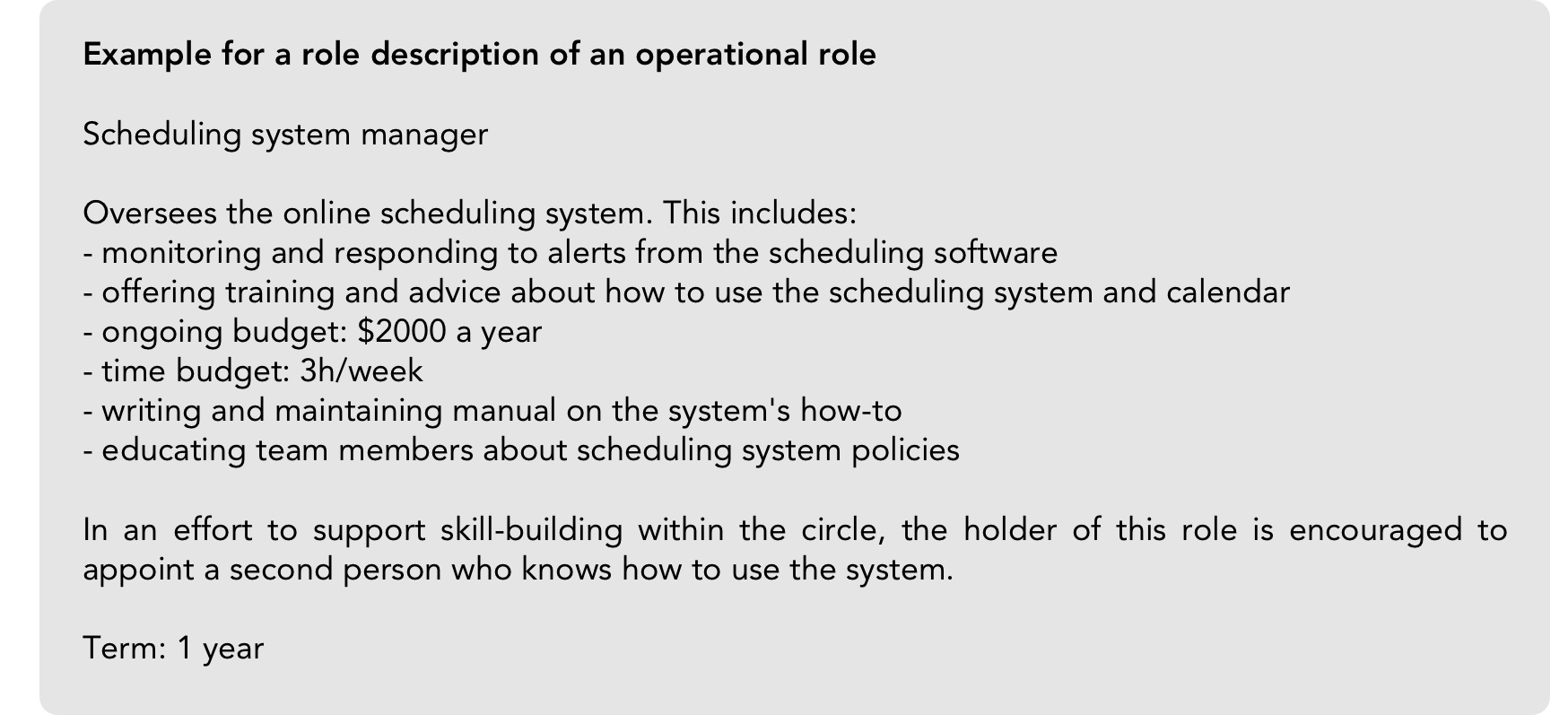
A role description might look like example Figure 2.33, “Sample description of an operational role.”. A circle consents to the role description.
Figure 2.33. Sample description of an operational role.
 |
Once the role exists, the circle selects someone into that role. The sociocratic selection process serves to fill roles based on qualification and skills in a transparent way.
The circle may then create a new sub-circle with its own aim and domain and roles. An operational role might be turned into a sub-circle if this set of tasks grows in complexity, more and more people are involved and the circle wants to move policy-making for this role out of the circle. The important difference between an operational role and a sub-circle (besides, typically, the number of members) is the fact that a sub-circle owns the domain of the sub-circle and can make policy in its own domain instead of ‘‘just’’ carrying out operations.
Every person is selected into operational roles for a set term. The length of that term is completely up to the circle. Often, groups will have a standard term that they modify if there is a reason.
With short terms, we have to do a selection process often, which takes up meeting time. With long terms, we might miss opportunities to spread leadership.
During the selection process, the term will be part of the proposal and can be modified like any other aspect of a proposal.
Groups often ask whether they could just “share” the facilitation. In our own circles, we prefer to have the role of the facilitator filled for a year at a time – this applies to all the roles.
Facilitation can be rotated among members under two conditions.
Only one person is facilitator per meeting (or a section thereof; there might be a good reason to fill in, for example if the facilitator is strongly attached to an outcome or triggered by a situation).
If facilitation rotates throughout individual meetings, it must be clear who is responsible for the preparation of the agenda -- does that rotate as well, or does only the actual facilitation rotate? In our experience, if meeting preparation rotates, it can be hard to keep track of who does what! (It basically means someone will have to remind people that it is their turn to prepare the meeting which creates an extra step.) Preparing the meeting agenda is an important part of effective decision making. While preparing the agenda, the facilitator -- ideally with the circle leader and the secretary -- thinks about next steps for each agenda items: Are we doing picture forming? Is there a proposal ready? Is everyone present at the meeting who we want there to gather feedback or make a decision? Just putting an item on the agenda is no guarantee of an effective meeting. Being clear about what is realistic and desired as a next step is a crucial ingredient for boosting the circle’s productiveness and will be highly appreciated.
We see more disadvantages than advantages in rotating facilitation. Filling a role for at least a few months frees the circle’s attention to take care of operations instead of tracking facilitation tasks. Also, building skills takes time and repetition.
The group can still spread the facilitation skills by having short terms for the facilitator, for example 4 months. That way, it is still clear who is responsible for making the agenda and facilitating the meeting. However, this comes at a cost also: the circle will have to do a selection process every four months which takes away from meeting time. We want to be intentional about how long a term we choose for selections. We can choose the terms separately every time we select and they can be different for every role. We can tailor our system to our needs at all times.