 | 5.4. Supporting documents: backlog, agenda, minutes | |
|---|---|---|
| ↢ | Chapter 5. How To Run A Sociocratic Meeting | ↣ |
Backlog, agenda and minutes are documents that support the circle’s work. The three documents do not have to be in three different files. The same document can have different sections that serve different purposes. In a digital document, create a space for the backlog, type directly into the agenda and keep adding your minutes within the same file. That way, everything will remain in the same place. Of course, we may have good reasons to keep backlog, agenda and minutes in different files.
The backlog is a list of topics that the circle needs to talk about. The backlog is like a rolling to-do list of a circle. It is best to create a backlog in a place that is visible to everyone. Some circles gather their agenda items at the end of the running minutes file, or on a whiteboard or on a digital or physical board.
Between meetings, new ideas for agenda items can be put on the backlog so they can be remembered and tracked. Figure 5.12, “An example of a backlog to be carried at the end of the meeting minutes.” is an example of a backlog. Use whatever sorting supports the group in addressing topics effectively without creating a lot of need for maintenance.
Figure 5.12. An example of a backlog to be carried at the end of the meeting minutes.
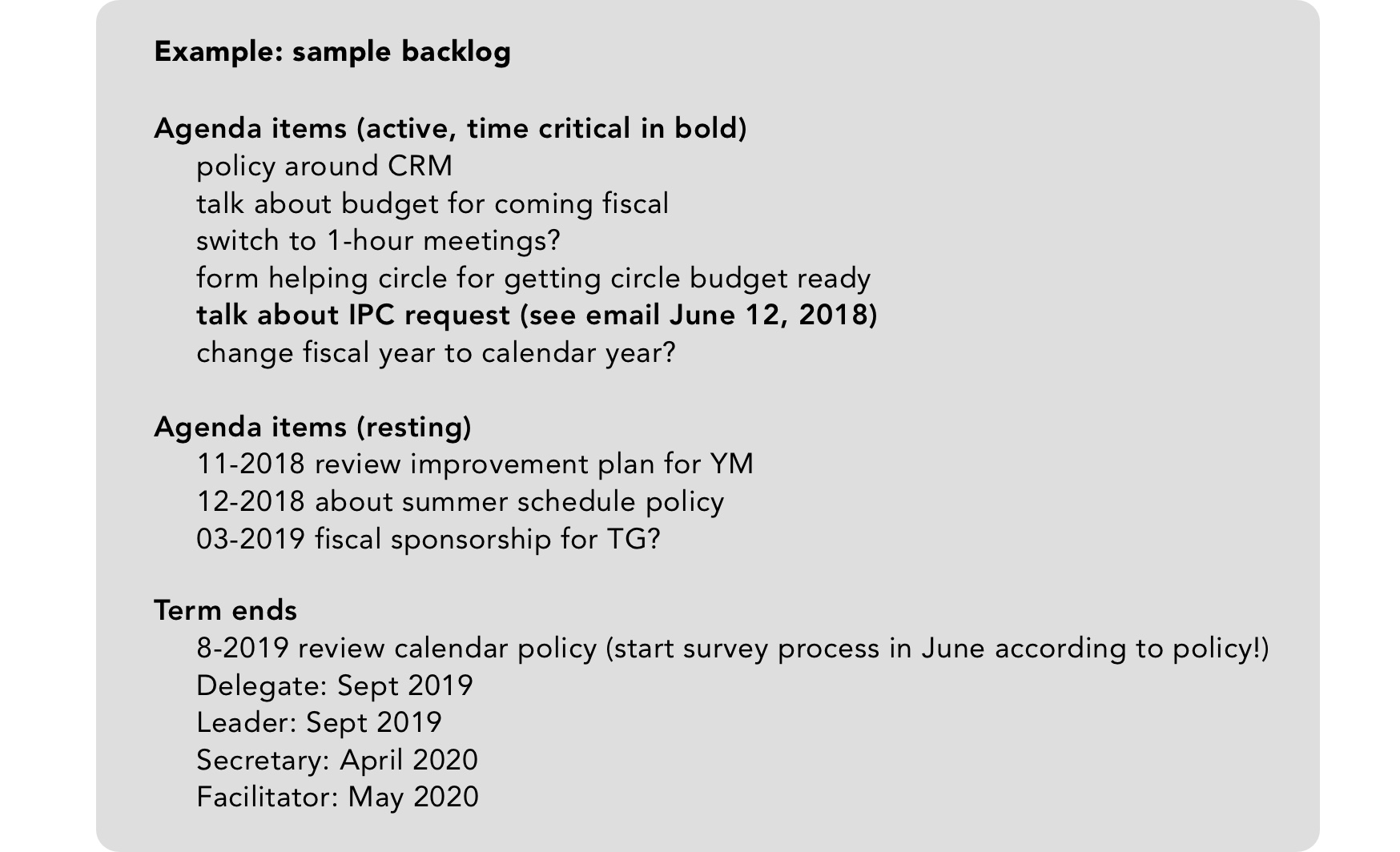 |
The backlog will ideally be updated during the last content phase of each meeting when new topics, active or resting items, are added to the backlog or items that have been dealt with during a meeting are taken off the backlog. The overall goal of circle meetings is to check topics off your backlog!
The agenda is the list of topics that a circle talks about at a circle meeting. Having an agenda set before the meeting is the first step toward an effective and time-efficient meeting. Time is precious for everyone in the room. It can be frustrating to have all the right people in the room but no prepared agenda to make good use of everyone’s time!
Who sets the agenda for a meeting? There are two answers to that: one around power and one around logistics. As for power, what is important to keep in mind is that regardless of who prepares the agenda proposal, what we choose to accept as the agenda is a consent decision by all circle members. The circle members hold equal responsibility for the agenda once consented to.
Logistics: There is variety in how sociocratic organizations set the agenda for their circle meetings. One practice is to have the leader, facilitator and secretary prepare the agenda proposal. The initiative comes from the facilitator who will contact the leader and secretary. Facilitators will have to have an agenda proposal ready at the meeting, so facilitators are relying on there being an agenda more than everyone else. Ideally, the agenda is made by secretary, facilitator and leader, bringing together past, present and future as shown in figure Figure 5.13, “The agenda unites past, future and present needs”.
Figure 5.13. The agenda unites past, future and present needs
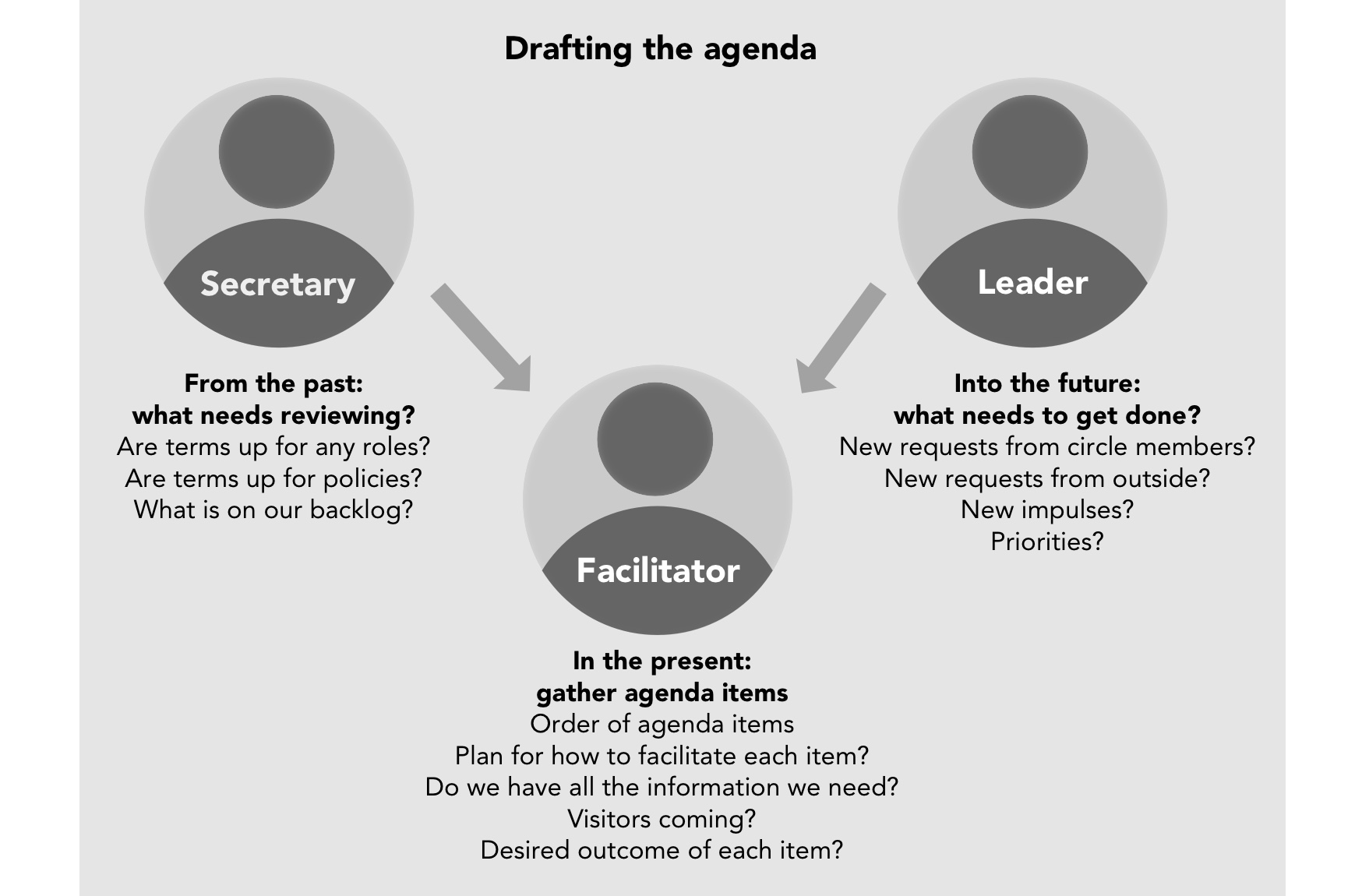 |
The leader will weigh in on what needs to be done in a larger picture. Have circle members identified any new topics? Are there topics from the parent circle or sub-circle that should come to the circle? From the leader’s perspective, do some items have priority?
The secretary will track whether elections are due or whether a policy is due for review. Sociocracy does not prescribe what tool to use for tracking due dates, and there are plenty of options. A tracking tool or simply your calendar will help the secretary remember when those items need to go onto the agenda. Please note that just going back to last meeting’s agenda does not provide the long-term planning. For example, when the circle agreed to re-evaluate a decision after 6 months, the secretary (or logbook keeper) needs to remember to put this on the agenda. We might also decide to go for an error-proof option and put all our review dates into our backlog and keep them there (see figure Figure 5.12, “An example of a backlog to be carried at the end of the meeting minutes.” on page Figure 5.12, “An example of a backlog to be carried at the end of the meeting minutes.” @@TODO@@: Figure out page references.). Some circles select all their roles on the same day each year. Some organizations ask all their circles to review the policies in their domain at the same time, for example from September to October of odd number years. These are easy ways to support continuity and the additional accountability.
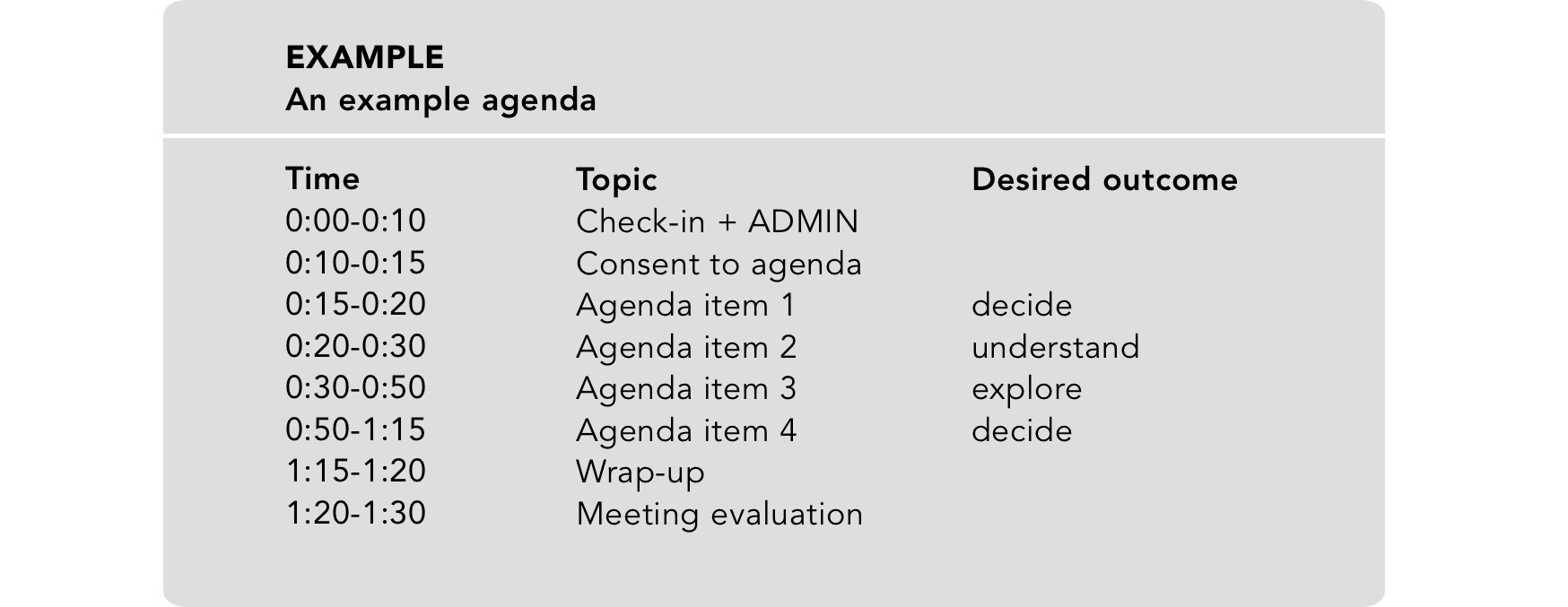
All the agenda items, new and from the backlog, will be gathered and will be put in order in the agenda proposal or draft agenda by the facilitator. Any complete agenda includes: agenda topics, timing and order of topics, desired outcomes for each item (see below).
The facilitator or leader will make sure the right people are in the room; for example, inviting guests whose input would be helpful to the discussion in the circle.
The facilitator also makes sure that the agenda proposal with supporting documents goes out to the circle members ahead of time so they can prepare for the meeting.
Figure 5.14. Forming an agenda
 |
This agenda format is an enriched format that allows for better agendas. Instead of just a list of topics, we add all relevant information.
Topic: items that need to be talked about.
Timing: time we plan for each agenda item.
Desired outcome: understanding, exploration, or decision (see section Section 5.2.2, “Content block: 3 desired outcomes”).
Further: supporting documents, presenter names.
All topics, those from the backlog and new agenda items, will be gathered into a list, prioritized and sequenced. The backlog will likely have more items than can be talked about in one meeting. Prioritize and make a realistic agenda.
It is essential to put time information into an agenda, at least more or less. The reason to do this is to have feedback during the meeting. Timing information does not have to be followed by the book. If we notice in the middle of agenda item 1 that we are already 25 minutes behind our own schedule, we will know that we need to make adjustments. We cannot always predict in advance how long an item will take but we can make a good guess. During the meeting, we compare the plan to reality and consider the implications. What changes do we want to make to the rest of the agenda for this meeting?
Be realistic! If a group does over time chronically, it might work to address it and be intentional about how meetings are planned and run. Maybe we need to increase the meeting time, frequency, outsource reporting out of meeting time, or make more use of helping circles. There are many ways to address timing but the first step is to have a way of assessing how we intend to use our time.
For a more general look at content during meeting agendas it helps to think back to the three possible content items or desired outcomes as described earlier in section Section 5.2.2, “Content block: 3 desired outcomes” on page Section 5.2.2, “Content block: 3 desired outcomes” @@TODO@@: Figure out page references.: reports/understanding, exploration and making decisions (synthesis or output). Each agenda item needs to be assigned one of these desired outcomes. The desired outcomes are measurements for each agenda item.
Don’t aim too high. Sometimes just getting to a shared understanding of the status quo is a success! Whatever we do, this is our starting point, as all three desired outcomes have shared understanding as a first step. Confirm that people are on the same page and have a shared understanding of what there is to know (to the level of detail that makes sense in your context).
Make sure to share with the circle what the desired outcome is for each item and put it on the agenda.
Be proactive and intentional, instead of just dealing with whatever falls into the circle’s lap. Agenda planning should have a longer-term view. This is why the leader’s input is important. What is your circle’s one-year plan (informed by the aim)? What needs to happen so we can get there?
Figure 5.15. Example of an agenda. Each agenda item can also name the person responsible for the item and reference any supporting documents
In a decentralized governance system like sociocracy, meeting minutes are a significant source of transparency. With so much authority distributed into circles, we need to be able to rely on minutes to hear what is going on in circles, in addition to reporting through linking.
Notes are written, ideally, in real time as the meeting progresses. In our organizations, we type directly into the agenda, which is a document on the secretary’s computer or in the cloud. We do not write detailed minutes (no “who said what”) but write down only decisions and any content we generate together, as shown in example Figure 5.16, “Keep your minutes short and relevant”. This includes policy decisions (in their exact wording), selections, action items for operational decisions.
Figure 5.16. Keep your minutes short and relevant
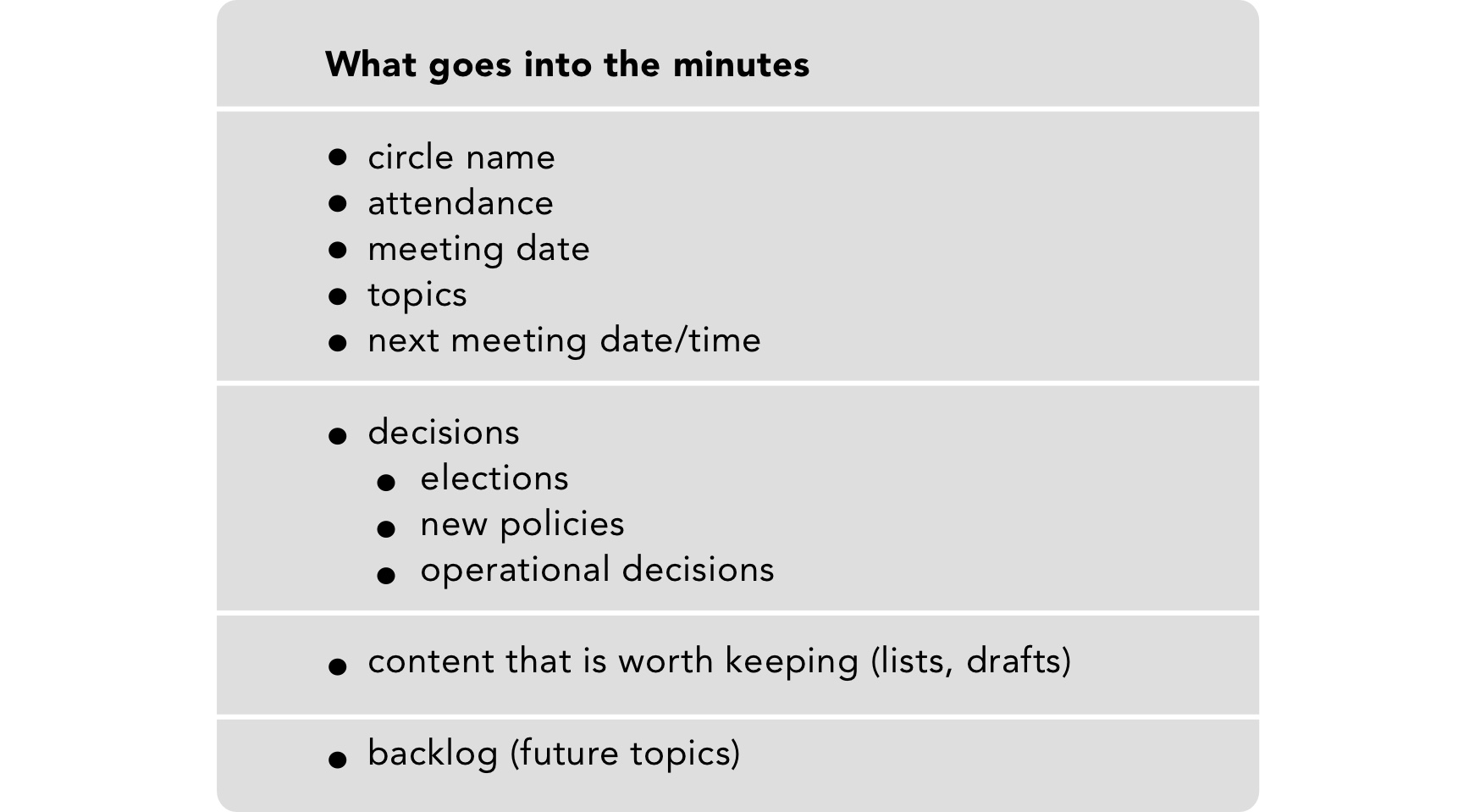 |
Figure 5.17. Example minutes to go public.
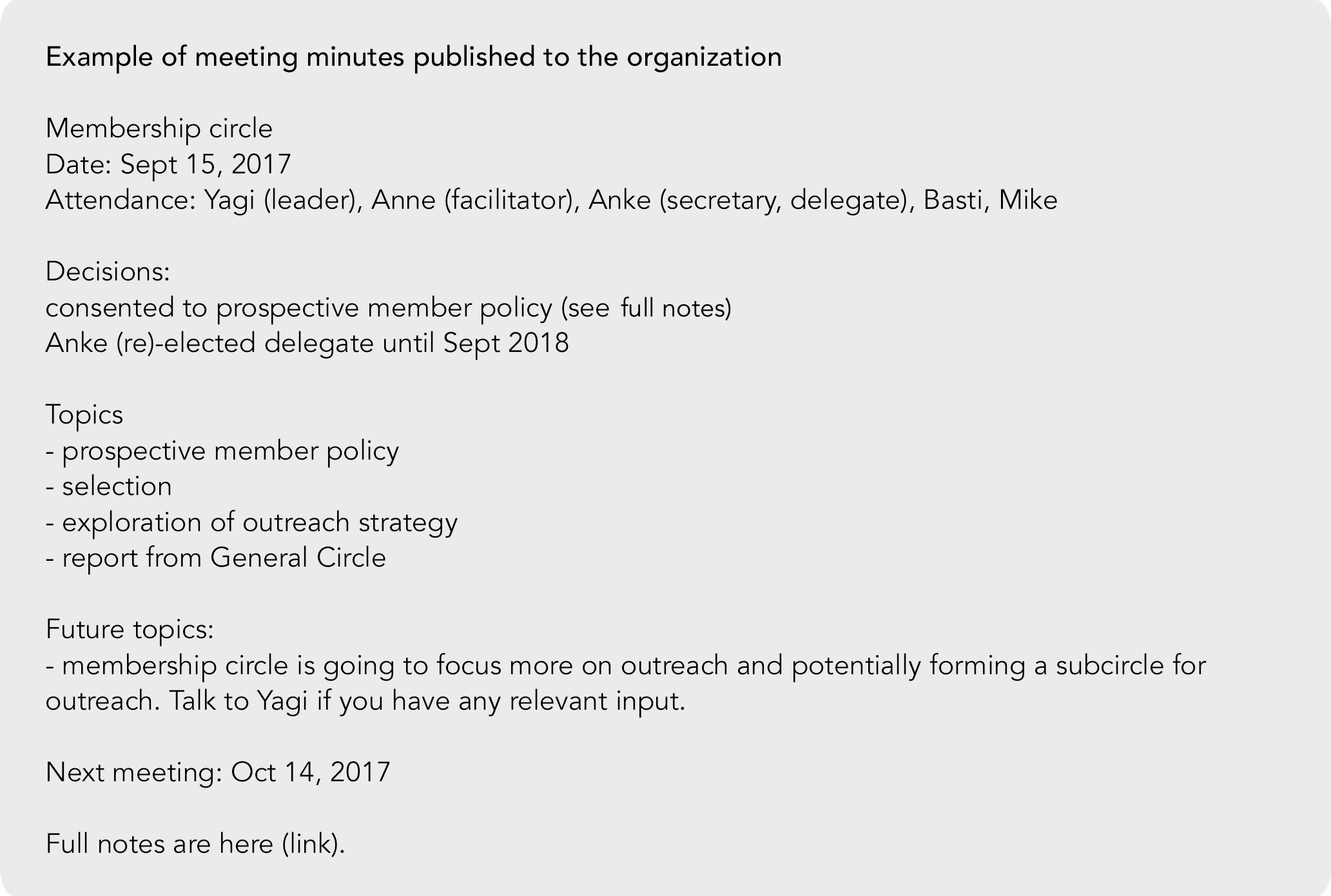 |
Although sociocracy does not come with special requirements for minutes, we recommend only recording relevant information and keeping the minutes brief so the larger organization can manage the amount of information. If we write wonderful notes but they are very long, people will stop reading them, which will lead to lack of transparency. Transparency and practicability need to be in balance.
It is helpful to write down every decision (policy and operational) that is relevant beyond the meeting. If minutes are available in real time, we can make use of this resource by asking the secretary to read a proposal out loud that is being formed in the meeting before consenting to it.
Additionally, the notes of a particular agenda item can be read back to the circle before moving to the next agenda item. This serves as a measure of whether the agenda item has been covered and captured well and can often surface whether the circle is on the same page about what happened.
Figure 5.18. What others do
 |
Meeting minutes need to be approved so the circle as a whole can take ownership of what has been written down during the meeting. Consenting means to not have any objections to the proposed minutes. A person who missed the meeting cannot object to the minutes since they were not there to witness what has been decided, unless they object to how a report got recorded. (They might object to decisions made but that is different and it is covered in section Section 3.2.5.4, “Can we make a decision if a circle member is absent?” on page Section 3.2.5.4, “Can we make a decision if a circle member is absent?” @@TODO@@: Figure out page references..)
The earlier we can approve the minutes, the better. Minutes need to be approved before the content phase of the next meeting begins. Some options:
Consent to the minutes as the last content item of the meeting (if the minutes are taken in real time during the meeting and cleaned up on the spot).
Send the draft minutes out to the circle after the meeting and give circle members 48 hours to object (lazy consent); otherwise assume consent, as described in the example in Figure 5.19, “An example policy implementing lazy consent for approval of minutes”.
Send draft minutes to circle members and approve them at the beginning of the following meeting.
Figure 5.19. An example policy implementing lazy consent for approval of minutes
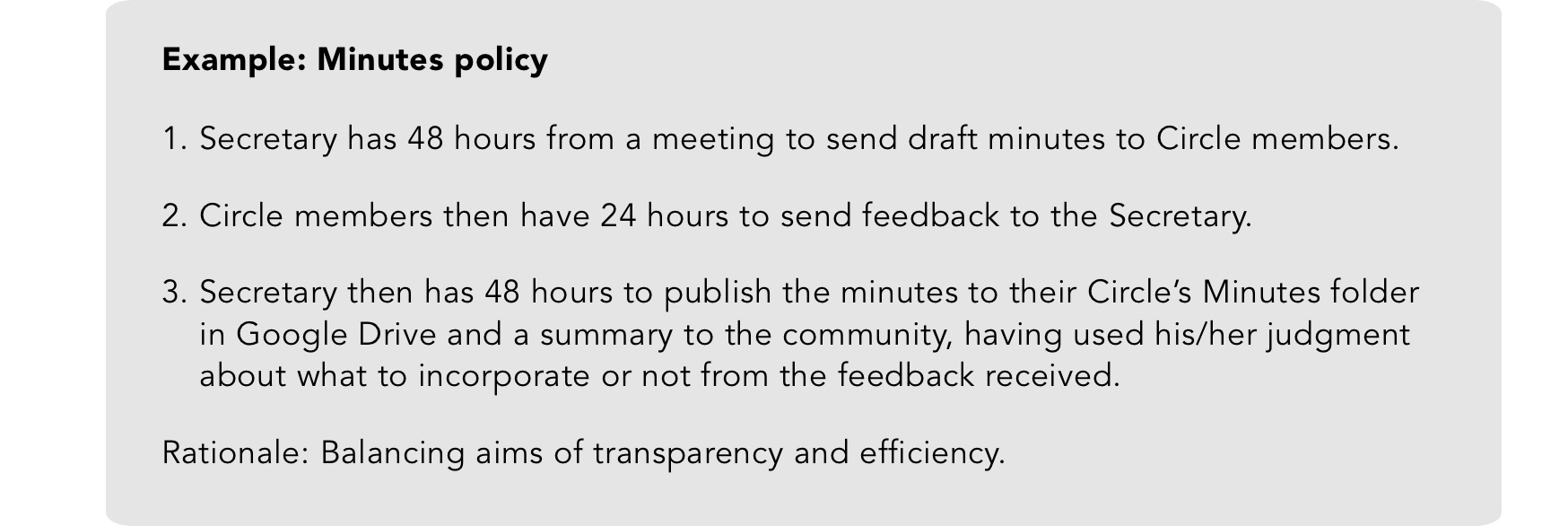 |
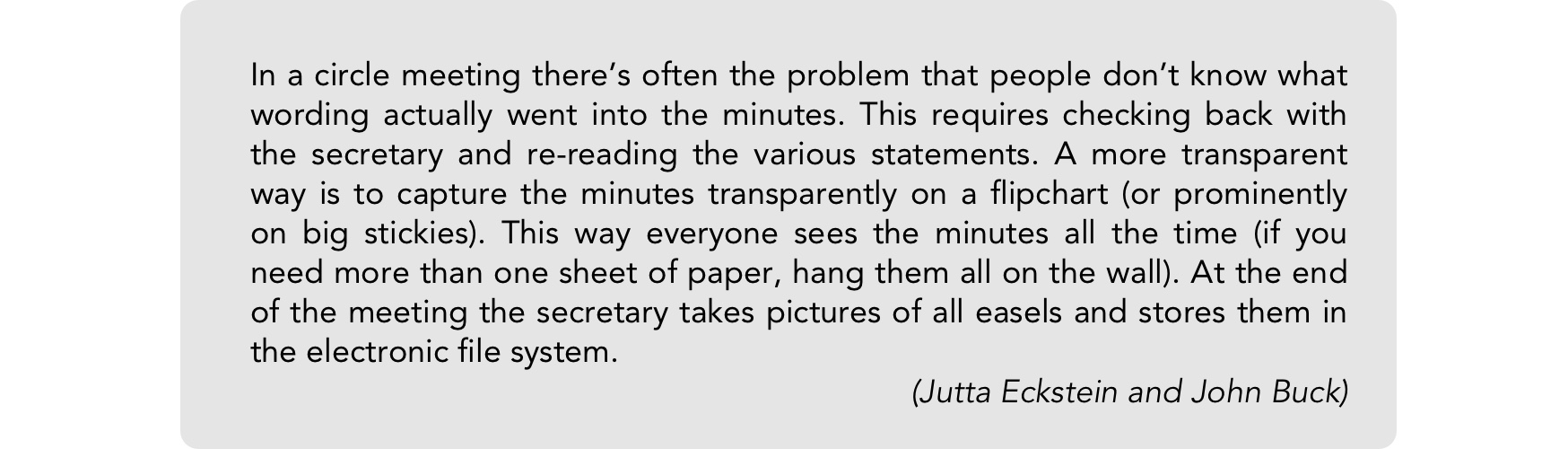
Figure 5.20. What others say
 |
Minutes are filed in the circle’s logbook, in an online folder or a binder.
Minutes need to be published within the organization, not only in the circle. At least a brief summary is made available to the whole organization.
Minutes in a sociocratic organization are even more important than in other organizations because of the way power is distributed. Transparency and easy access to information is crucial when decisions are made in small groups.
If we consent to a policy in a meeting, the new policy needs to be added to the appropriate document (policy manual, organizational agreements, rules and regulations) of the organization’s logbook. Policies are only useful if people know about them. Make sure to implement a logbook system that works for the organization. In sociocracy, in large organizations, there is the additional role of a logbook keeper (see section Section 2.3.1.5, “Logbook keeper”) so the logbook remains up to date and accessible to everyone in the organization (or even to the public). Note: It is useful to do ongoing education about existing policies to your organization.
Meeting minutes are a natural place to invite feedback. However, keep in mind that not everyone will read every set of meeting minutes that are published. If we want feedback on something, it helps to be explicit and make a clear request. Just sending out minutes and saying later “well, you could have given us feedback when we said we were working on this” is not enough! What channel we use to put out our minutes depends on the nature and the patterns we find in our organization and in our culture. Sociocracy balances out the relationship between individuals and circles. Circles have to make an effort to be transparent, while individuals have to make an effort to respond to the information. There is no right and wrong here – everyone is responsible.