 | 5.5. Facilitation formats | |
|---|---|---|
| ↢ | Chapter 5. How To Run A Sociocratic Meeting | ↣ |
Since this book is only about sociocratic methods, we are not covering all other approaches to facilitating conversational processes like Dragon Dreaming, Art of Hosting and Dynamic Facilitation. They are compatible with sociocracy but describing them is outside the scope of this book. We encourage all readers to get familiar with those approaches to build a broad skill set. In this book, we focus on the strength of sociocracy – small groups whose focus it is to make decisions.
Although sociocracy did not invent rounds, they are the signature tool. Like all tools in sociocracy, rounds support equal voice and effectiveness. Everyone gets a chance to talk. Everyone listens. Rounds are often the first tool from sociocracy that a group starts using.
Rounds are simple: the facilitator gives the prompt, and calls on one person to speak. After that person has spoken, the person next to the first speaker has a turn, until everyone has spoken. Depending on the nature of the topic and the group size, one round might take 20 seconds or 20 minutes or anything in between.
We know that for some people rounds take some time to get used to. If people argue that rounds are “constraining”, “artificial” and or they prefer “natural” flow, consider:
What is “natural” is highly debatable. For example, there are/were times and cultures where it was unthinkable for a child to speak during family dinner without being asked. People then probably assumed their style of family dinner was the “natural” order of things.
Rounds have been practiced in some cultures for hundreds if not thousands of years. Rounds become second nature fairly quickly.
It is very likely that internalized power patterns shape how we show up in a meeting with “natural” flow. This means the cultural biases we might not even be aware of might give one group of people more time to talk than other groups. This may be based on class, race, gender or other categories. The same biases even distort our perception of how long and how often people from different groups speak. Our perception of what is “equal” might not be accurate.
Not having any format in a meeting typically turns discussions into debates. In debate style conversations, whoever speaks up will be heard, and heard again if they repeat themselves. This works well for people who have an easy time with this kind of format. It does not work for people who don’t enjoy having to overtalk people to contribute. Some people are more likely to engage in over-talking than others. We favor more extroverted or privileged people if we choose to talk in debate style. Since debate style is what we resort to in the absence of a format, not being intentional about how we talk with each other will favor some voices and ignore others. It is crucial to understand that not making the choice to talk in rounds is still a choice we make with its own implications.
When we talk in rounds, we know that we will have our turn to talk. We don’t have to sit in a discussion wondering how to get our contribution heard, and how to get a turn. We can relax and know that the group will get a chance to hear our input.
In debate style, everybody loses. Just because someone is less likely to speak up in a heated discussion, does not mean their contribution is less valuable. This means that if we choose to skip rounds, we lose out on valuable information.
Rounds change the dynamics of a conversation. When it is other people’s turn, we can sit back and listen. And by that we mean: really listen. I don’t have to wait for a good moment to jump in and interrupt. I don’t have to think about how to prove the other person wrong. I can just listen and take in the other circle members’ experience.
In debate style, we often tend to try and convince people of our viewpoint. When some express different views, others may repeat their own views again, just louder. With rounds, it feels more like everyone brings their ideas, perspectives and experiences to the table. It is more like an offering to the group because it is not targeted at anyone.
We can only be a group when we are sure that everyone in the circle is included. Talking in rounds gives everyone the confidence that their voice matters. What we each bring individually becomes the group’s. The group wisdom starts growing in the middle of the circle. It is deeply satisfying when that happens, and rounds make it much more likely.
In debate style, our “task” is to win. In rounds, we spend more time listening than speaking. We each have access to only our view of the world. After taking in the experience of a number of people in a row without even considering saying something for myself, it becomes obvious how my own experience is just one way to see things. One way among many others.
When people start out learning about rounds, their first judgment is often that rounds will be lengthy and not time efficient. It takes a bit of practice and experience to see how the opposite is true. There are several ways in which rounds support effectiveness.
In debate style, people feel compelled to re-state their contribution so they can be sure they can be heard. Rounds slow down conversations enough so every contribution can be taken in and valued. Statements typically do not need to be repeated. We all have been in discussions where the same thing was said by the same person multiple times. Rounds reduce the amount of redundancy because we can be sure we hear it the first time.
In rounds, as much information as possible is heard early in the process. That means we as a group (or, more precisely, a subset of the group) don’t run into one direction just to find out it was a dead end. We move more slowly, taking into account a wider number of aspects and viewpoints. That way, we don’t have to change direction as many times. Slow and steady!
There is a subtle but powerful effect of rounds: rounds help us stay on track. When we start a round, we all start with the same prompt. That means, everyone having their turn after the first person to speak has options: refer back to the prompt and increase the variety of opinions in the group and to see an issue from different angles. The other option is to reflect on what other people have already said and let statements build on each other with increasing information in the group. Ideally, people do both, share their initial reaction and their reflections on what has been stated before them. In an ideal world, people are transparent about that and build their statements according to the pattern “My first reaction/idea was…, and then I heard Eduardo speak, and I learned that…, and now I think that…” Rounds give us the maximum input, both from individuals and for building group wisdom.
When everyone is part of a decision, it increases the accountability and buy-in of everyone involved. Everyone in the group owns the decision. If members are heard and fully contribute to a decision, no one will undermine carrying out the plans we made together.
Although all rounds are very similar, these are some differences in the nature of a round, depending on where in the decision process they take place (see Figure 5.21, “Different rounds and their uses” and Figure 5.22, “We respond to prompts in different kinds of rounds.”).
Figure 5.21. Different rounds and their uses
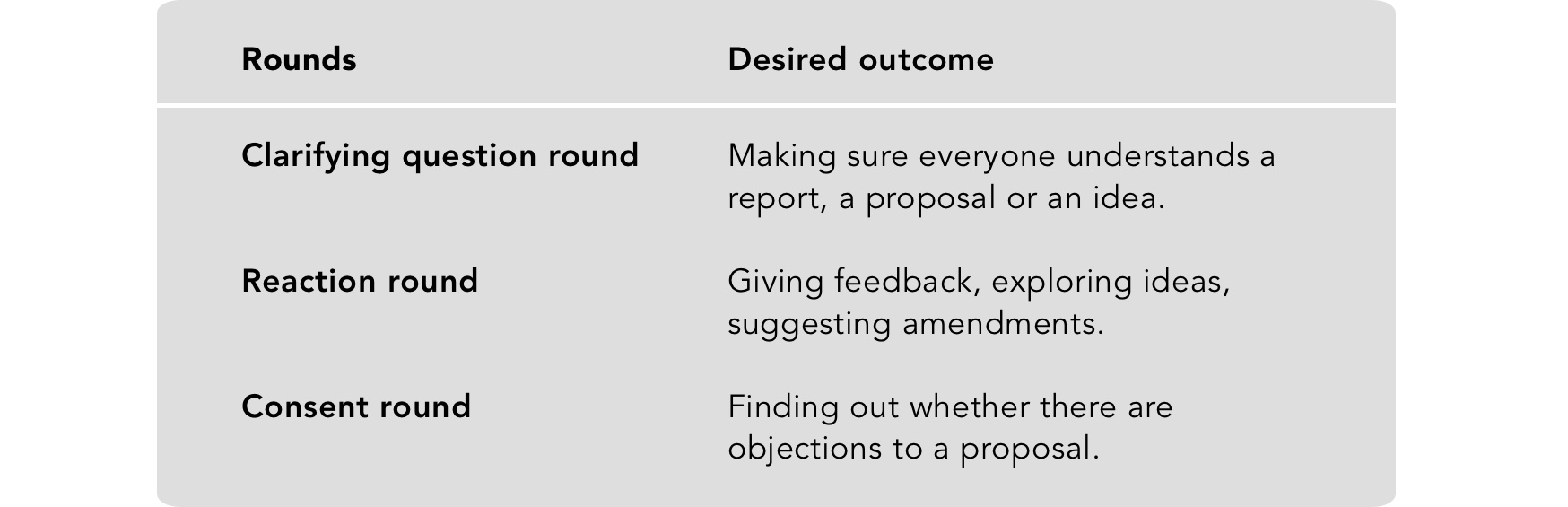 |
Figure 5.22. We respond to prompts in different kinds of rounds.
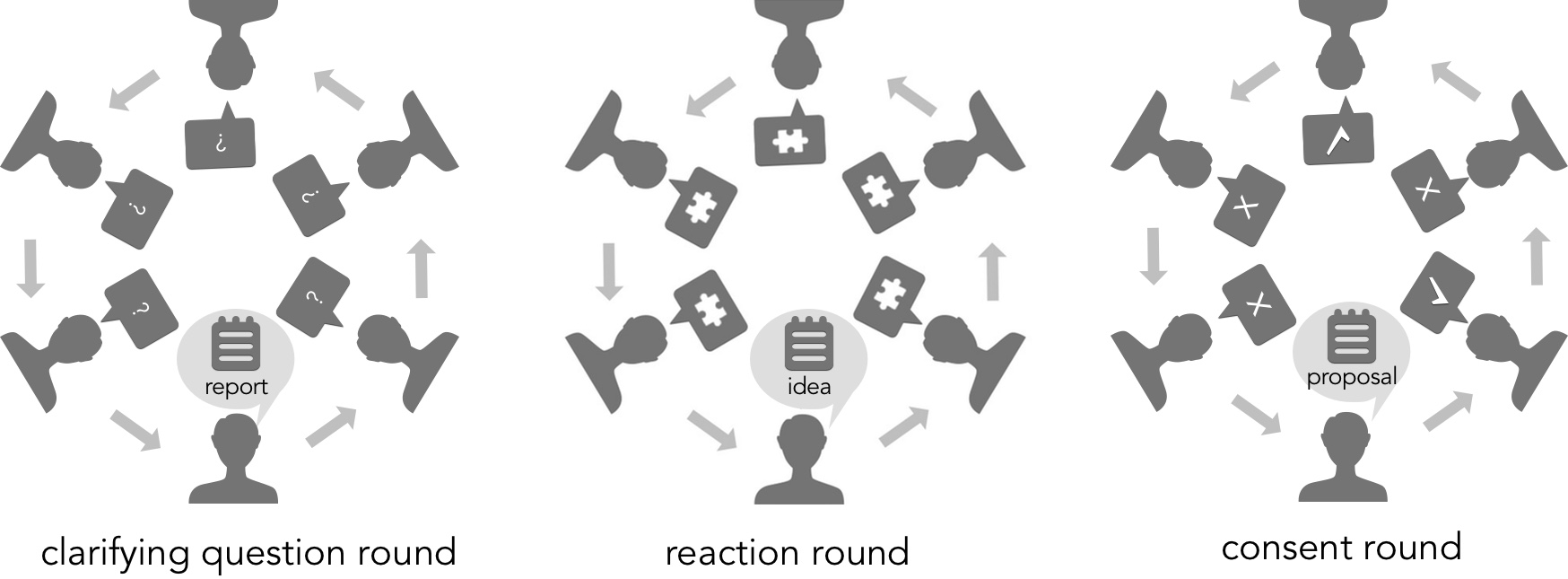 |
A clarifying questions round is called whenever there has been a proposal, a statement or idea that needs to be understood before the circle members form or state their opinions. This could be a policy proposal, or a report, but it could also be a complex objection. We are transparent about the nature of the round: “Let’s make sure we understand the proposal/objection before we talk about it more. Now is the time to ask the questions you need to have answered before moving forward.”
Questions can either be gathered in a round and then answered by a knowledgeable person in the room, or they can be answered one by one as they come up. When answers are simple and short, answer them right away. When answers are complex or involve a dialog with the questioners, collect them and respond at the end of the round. Avoid breaking the spirit of a round – don’t get into a lengthy discussion on one question in the middle of a round.
There might not be a perfect way to do it, but the facilitator can decide when questions are going to be answered. If there are many questions, the facilitator can initiate a second round because new information might also have triggered new questions. Do not forget – the overall aim of this step is to make sure everyone understands the original proposal or presentation. We only move to the next step when everyone is ready.
Sometimes the facilitator will need to work with a circle member to tease out a real question that is mixed in with the member’s opinions. Reflecting back a question is a wonderful skill for any facilitator and it can sound like “so, what I hear you say is that you would like to have clarity on….”
A challenge in the clarifying questions round is that sometimes people will jump ahead and give an opinion. Or they may express their negative judgment about the proposal through a biased question. A “question” (with potentially a lot of subtext) like “why don’t you just…” is probably going down that path! If someone expresses an opinion, the facilitator can say things like:
“Thank you for sharing your opinion. Is there a question you would like to ask in order to understand the proposal as it is written?”
“What I’d like to do right now is to understand the proposal on the table. We’d be happy to hear your ideas for improvement in just a bit. Would you note it down so it won’t be lost?”
(a more directive version) “I’d really like you to hold your opinions for now because in this moment, all I want is to make sure everyone in the room gets a chance to understand the proposal thoroughly. You will be able to share your opinion in a bit.”
Encourage everyone in the round to speak and to either confirm they understood or raise a question. They can use one of the two options: “I understand the proposal” or “What I need to understand the proposal is…”. This step helps everyone have ownership in the process.
Reaction rounds are a way to get a feel for where the group is at and to gather input from a group. Reaction rounds can be used in very different contexts:
Reactions to a report, for example a report from a helping circle.
“Thanks for this report. I suggest considering…”
“I find it interesting that Membership Circle seems to…”
Reactions to a proposal, within the consent process.
Reactions to a question, for example a question around next steps.
“I think this is a good place to create a role to deal with this on an ongoing basis …”
“I don’t really have a good idea but I am curious what others have to say.”
Reactions to an objection.
“I understand the objection. To me, the risk is small and I’d like to see what we can learn by trying what’s proposed.”
“Now that I understand the objection better, I agree we need to amend the proposal. I have an idea…”
“I am persuaded. I don’t see how we can move forward to towards our aim if we were to consent to this proposal.”
“I have a hard time relating to this objection and will listen. Come back to me please.”
A reaction round can be reflecting on what comes up for circle members, or it can have a concrete prompt (like “what do you think could be done about this issue?”). Do not restrict this phase to only one round if what people contribute seems rich and productive and contributions seem to build on each other. (For reactions to proposals in the consent process see section Section 3.3.2.3.3, “Explore reactions (quick reactions)”.) The facilitator can end the round asking if there is anything anyone wants to add. “We did two rounds now and we heard a lot of good input. Is there anything that still needs to be said before we move on?”
Time and attention span are often concerns in meetings. To introduce a quick reaction round the facilitator can say, “Let’s do a quick reaction on that. And by quick reaction, I mean five sentences or less.” Some groups will find it supportive to use a talking stick and/or a timer to keep things moving in a round. Avoid repeating redundant information. One way to save time overall is to give everyone time to quietly write down what they would like to say before the round starts. That way, everyone can be concise in their contribution.
Whenever there is some new information, let the circle take responsibility for it by calling for a round. The facilitator is only facilitating – making process easier, “facile”. The facilitator is not supposed to be the savior of a group. A sociocratic meeting should feel like ping pong: there comes the ball and the facilitator bounces it back into the group. At the end, we do not even know who contributed what – it was all co-created. If we smash the ball every single time, we might win but the game will consist of people picking up the ball and there will be no flow.
Consent rounds are very brief. They give only two options.
“I consent/I have no objections.”
“I have an objection (because…)”
In the case of an objection, we can give a one-phrase statement about the objection, for example “I have an objection to the time frame of this.”
Note that in consent decision making there is no third option of standing aside or passing. (See more on that in section Section 3.2.5.2, “Can one express a concern? Can one abstain?” on page Section 3.2.5.2, “Can one express a concern? Can one abstain?”).
We can get consent, especially on uncontroversial decisions (like for example a non-controversial agenda) in a non-verbal way. In that case, the facilitator has to make an effort to get brief eye contact with everyone in the group. In virtual meetings, non-verbal consent can be given by showing our thumbs up.
What makes consent rounds different from reaction rounds is that after every explicit consent round, if there are no objections, a decision is made. We are not asking if people would consent (which would be asking for a reaction) but we’re asking whether they hereby consent.
A consent round is a special speech act; everyone has to be aware that we are not simply providing information but we are declaring a decision made. The facilitator has to be explicit about this – have you been to meetings where afterward, there were different opinions on whether a decision was just considered or made? That’s the difference we are talking about here. Be clear! Say something like “So, the proposal is that …, and I will now ask you for your consent. Do you consent to this proposal?”
We recommend it. Below are some occasions when we break from our habit of talking in rounds:
For clarifying questions if it seems to be safe to assume that there will not be many questions, or if there is a large group. In that case, just ask “are there any questions?”
When we are asking for input (picture forming or proposal shaping) from a large group. We break large groups into small groups so they can do rounds effectively.
In a group that seems emotionally safe, we sometimes back off from rounds and allow cross-talk for a while. It is best to be intentional about this, however. Once people are “conditioned” to only talking when it is their turn, they might remain silent in a free flow discussion. For that reason, it is important to be explicit: “I propose we spend the next 10 minutes in free flow conversation and see if that brings up any new ideas.” End your free flow time with a round to re-establish equivalence and to understand where the circle is at as a whole.
We encourage groups to make rounds their default and to be intentional about deviating from that default. However, it is also a matter of practice – and the more a group practices, the better they will get at it.
Passing in a round depends on the context. It’s ok to pass in:
Clarifying questions rounds. We can briefly confirm that we don’t have a question.
Other reaction rounds that serve a gathering of ideas or brainstorming: fine to pass. For the sake of transparency, give a short explanation and make sure to express whether we request taking our turn at the end of the round:
“I’d like to pass for now. I was distracted and do not know what exactly is expected of me right now. Can I talk at the end of the round, please?”
“I’ll pass because I do not really have anything new to add/all I wanted to say has been said.”
We discourage passing in:
Reaction rounds during the policy process because then the circle does not have enough information. So instead of passing, say “it looks good to me” or “I don’t like this proposal for the same reasons Jane gave. Nothing new to add.”
Nomination rounds (see section Section 3.6.2, “Selection process” on selection process): no passing. We need everyone’s information for a co-created nomination proposal.
Consent rounds. We need to hear from everyone to make sure we hear all objections. (See more on abstentions in section Section 3.2.5.2, “Can one express a concern? Can one abstain?” on page Section 3.2.5.2, “Can one express a concern? Can one abstain?”).
Be aware that having been asked and passing is very different from not having been asked. Hearing everyone’s voice in the process, even if they do not have anything new to contribute, works like social glue for any group.
A typical situation: the circle talks and talks, and somehow, it remains unclear where the circle is going. This is not always ineffective – great things can emerge out of a muddy phase. However, it is easy to get stuck.
In collaborative decision making, we operate on many different levels.
We are working toward an aim.
We are trying to find a good process to achieve that aim.
We are practicing working with equal power.
We are getting to know each other.
Figure 5.23. 2 flow, then go: after two rounds with no progress, change your strategy.
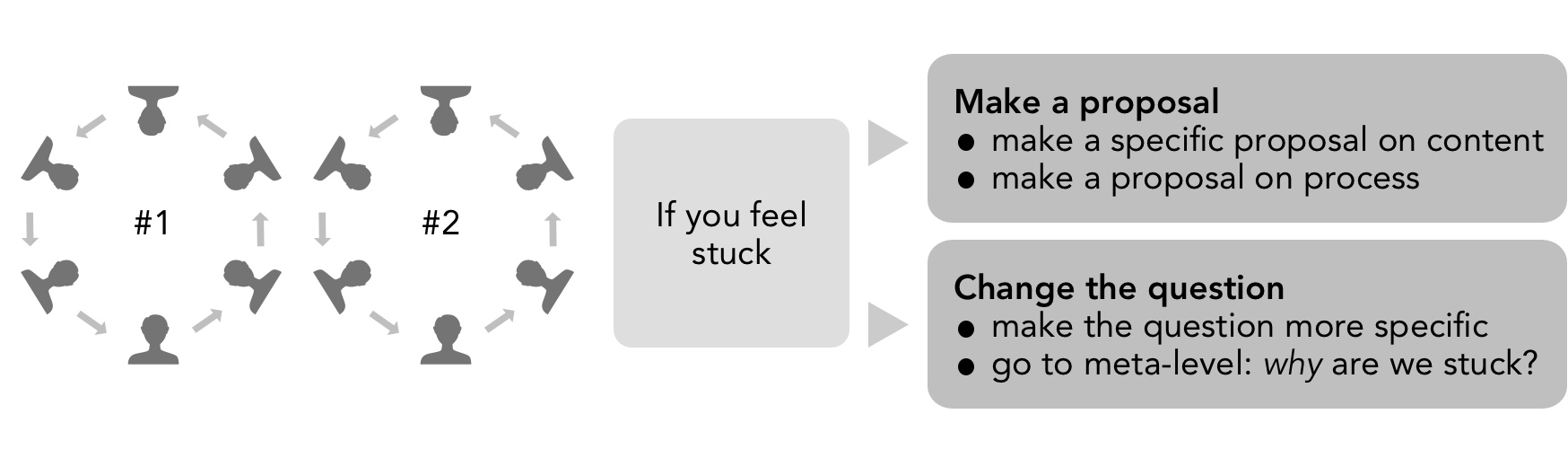 |
It can wear on the group morale when no progress is made. The flowchart Figure 5.23, “2 flow, then go: after two rounds with no progress, change your strategy.” shows four ways out of blockages, no matter on what level they might lie. More details:
Make a proposal on content: do not wait until a proposal on your topic forms magically because chances are it won’t (or at least within a reasonable amount of time). Instead, after having heard everyone for two rounds, make a proposal and ask for consent. If there are objections, we have just nailed down what the actual controversial issues are. Now we know what to address. This will move the meeting forward.
Make a proposal on process: if a discussion does not seem to go anywhere, make a proposal on how to make progress. A common strategy is forming a helping circle to generate a proposal for the group to decide on next time. This is particularly useful if there is information missing. Make a plan on how to get that information and move forward.
Make the question more specific: break up the topic into separate parts and do separate rounds on each. Sometimes it is too hard to respond to big topics.
Move the question to a meta level. For example, if we can’t make a decision, we do a round on why we think we have a hard time making the decision. If there is an unaddressed issue holding up the discussion, we try to make it easy to bring it up. This can be hard. After all, there is a reason we tip-toe around a topic. But circling forever is not an option either. It might be that our aims are different, that there is some hidden power struggle or that there is caution stemming from a trust issue or from not having enough information about each other. Better to find out!
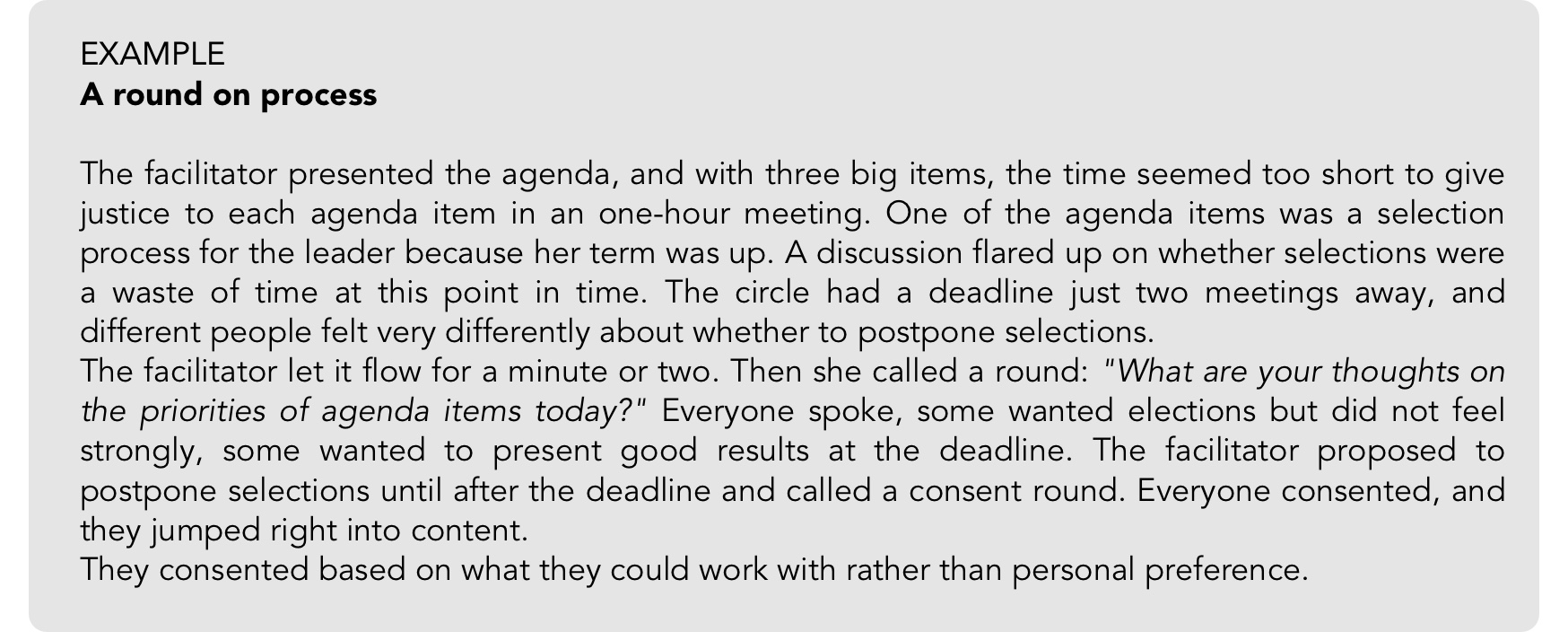
In general: If we do not know what to do, we do a round! Examples of that are shown in Figure 5.24, “Deciding on process together.”.
Figure 5.24. Deciding on process together.
 |
More examples on when to ask for input on process:
The meeting starts and only half (or fewer) of the circle members are present: “I notice only half of our circle members are present. Let us do a round on how that is affecting our agenda, and how we could deal with that.”
The group is going off on a tangent that was not on the agenda but seems important (or turns out to be time-sensitive). “I am noticing that we’re not discussing our agenda items right now but that the tangent we’re on seems important to people and needs to be dealt with now. Can we do a round to hear if people are ok with talking more about this now? I just want to make sure we’re intentional about how we spend our time.”
The circle is unprepared (did not read a proposal or a supporting document, for whatever reason). “I get the sense that not everyone got a chance to read the document. Let’s do a round on where people are at and what you think can be done in this meeting.”
You are the facilitator and you do not know what to do. “I find myself lost right now and I am not sure what is happening. Can we do a round and people just say where they see us in the process right now and what you would suggest?”
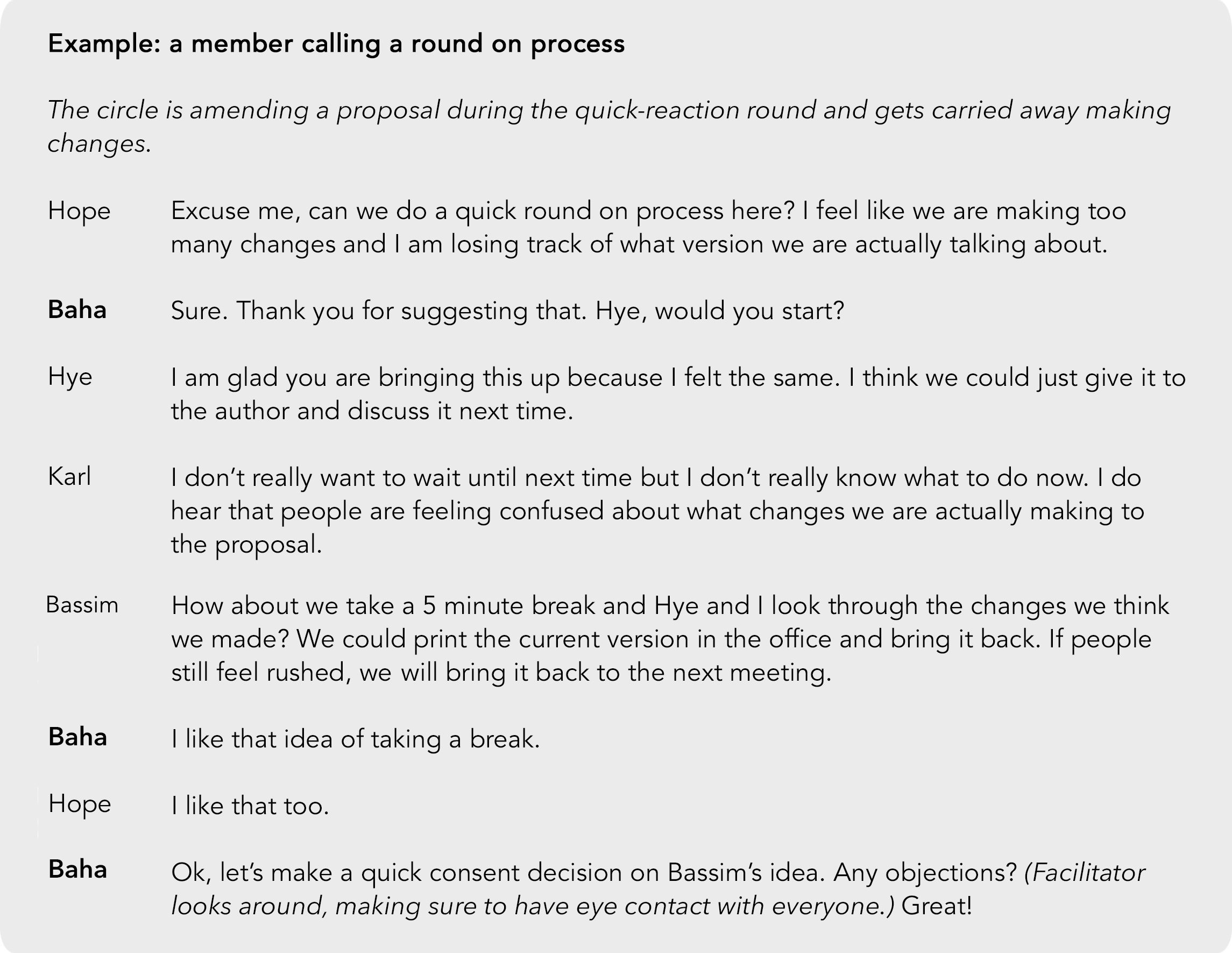
We are never victims of circumstances, but always agents with choices. Example Figure 5.25, “A member calls for a process round” shows what this may sound like with more context.
Figure 5.25. A member calls for a process round
 |
Not every decision needs to go through the entire consent process. Deciding to take a 10 min break does not justify a 3 minute process of present proposal, clarifying questions, quick reactions, consent. The most informal way we practice is saying the proposal, waiting a few seconds for questions and reactions, and having eye contact with everyone, one by one, to check whether there are objections. Shared power relies on trust, and trust needs to be earned in a hundred little steps. The reward for staying in an egalitarian frame all of the time will be a healthy culture in our organization that we can rely on for harder decisions.
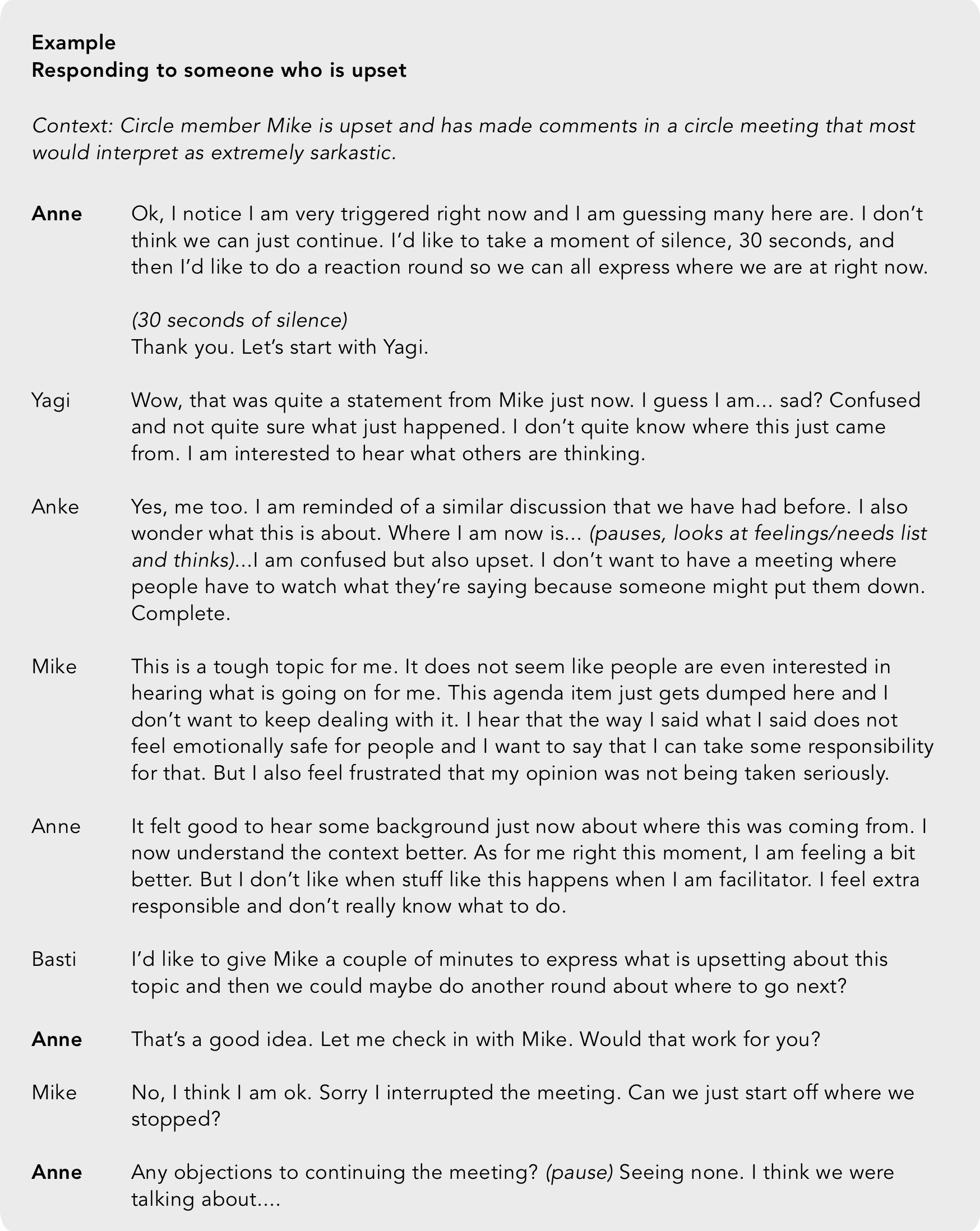
What can a circle do if one member of the circle gets too upset to continue the meeting? This might show in uncooperative disruptive behavior, displays of anger, like yelling or getting up from the chair. Ways to respond depend on (1) the capacity of that circle member in that moment to be self-responsible and (2) the time, resource and willingness of the other circle members to take time off the meeting to hear the underlying needs. Do not assume you need to interrupt the work of the meeting to deal with emotional reactivity. Consider the circumstances and be intentional.
Figure 5.26. Example: responding to feelings
 |
Options:
Invite the person to speak, followed by a request. “Do you want to share what is going on for you? Do you have a request of us?” Do a reaction round of reflective listening or empathy before hearing the focus person again.
Ask a circle member to support the upset circle member outside of the meeting while the meeting continues or after the meeting ends.
Take a 5min break or a minute of silence.
Any combination of these options.
If we decide to do a round, we put the person who is most affected emotionally in the middle of the round (like in example Figure 5.26, “Example: responding to feelings”) so they have enough time to get back on their feet but are not the “problem person” speaking at the end. Doing so will be a manifestation of everyone’s voice mattering: those with strong feelings and everyone else. We embody the principle that everyone can take responsibility for their feelings and behavior.
Crosstalk, if it happens too often, can be harmful to the group.
People might be silently resenting that someone is talking out of turn. They might not say so but virtually no one enjoys being interrupted or sitting through inefficient meetings.
People might be getting cautious about what they say in fear of being interrupted or criticized – this is important to keep in mind because the impact can be invisible.
The group misses out on “group magic”. The flow of forming and building a thought or a proposal is a wonderful and connecting experience.
It depends on the group -- sometimes speaking out of turn adds some clarity or clears up a misunderstanding. But there is such a thing as too much. People who tend to engage in cross-talk have to be educated on the impact of their behavior. One way to address this in a meeting is feedback during the evaluation round at the closing of any sociocratic meeting. Chances are that we will have someone in the group who feels constrained by rounds, and we will have people in a group who get triggered when there is cross-talk. It helps to be open and respectful with each other and find the balance that seems right for the group.
To address cross-talk while it is happening, simply say something like “I want to hear what you have to say. Please hold that thought or write it down. Let’s get back to the round.”
Here are some other blame-free phrases one can use to help live up to the discipline of rounds. Some even work in non-sociocratic contexts.
“I have things to say but I am noticing that I would have to over-talk other people to speak and I don’t enjoy that. Can we do rounds so we don’t have to over-talk each other?”
“I am noticing a lot of cross-talk. I would prefer to go back to our round.”
“I’d like to give everyone a minute to explain their viewpoint. That way we could gather all the expertise in the room.”
It is not unusual to run out of time. If the agenda we consented to at the beginning of the meeting contained some time information, it will be easy to track how close we are to our plan. Once it is clear that the timing of items is impossible to stick to, be proactive.
Make a decision together. It is not the facilitator’s job to ‘‘discipline’’ the group. Every circle member is responsible for keeping to the schedule, not only the facilitator. A consent decision puts the responsibility into everyone’s hands. Below are a few examples of what this might sound like.
“I propose we take 10 minute off the last agenda item and continue the discussion on this item now.”
“We’re running out of time. I propose that we postpone this agenda item until next time. Any objections?”
“We are going overtime on this topic. I propose we drop the last item on the agenda and continue with this for 15 more minutes. Any objections?”
“I propose that we talk more about this topic. Does anyone object to taking 15 extra minutes – which would take us over time for the meeting as a whole?”
It is fine to adjust plans. Plans are there to support us, not to bind us. And it is better to make an informed and intentional decision before the meeting gets too rushed.
In this example, we make sure the circle makes a decision to get the information and a plan on how the training can be scheduled between meetings. For example, we can have the group consent with a condition.
Proposal: the training is approved by the circle if and only if the training can still be paid for during the current fiscal year.
We do not have to postpone our agenda item altogether. Instead, we encourage facilitators to be fierce on always making a next step. We cannot consent now? Ok, let’s make a plan on how we get the missing information and consent now to a conditional proposal. The rule of thumb is that we do not want to hit the same wall again. What can we do now so we are in a better position at the next meeting? Missing information can be gathered, a piece of writing can be given to a helping circle. This requires flexibility and some creativity.
Even if an agenda item does not go anywhere, “make a proposal to drop it or to postpone it for 6 months”. That way, we are making an intentional decision that creates clarity. We are not putting the same agenda item on the agenda repeatedly without progress. There has to be a next step, some outcome from every agenda item, even if that outcome is different from the one we planned.
It is very tempting to bring up a counter-proposal in a quick reaction round. “Instead of this proposal, why don’t we just …?” In addition to dismissing the thoughts that already went into the original proposal, counter-proposals put the group into a very awkward situation: they are tempted to consider a new proposal in the middle of the consent process on the original proposal. It is hard to compare two proposals in real time. The complexity, both around process and on content-level, increases immediately as soon as a counter-proposal is on the table, and we have seen many groups lose their focus in the face of this complexity.
More often than not, counter-proposals lead to confusion: some people in the group might still want to consider and improve the original proposal while others want to switch proposals. Just as often, the new proposal is half-baked and some people get overwhelmed or upset, and the circle finds itself in the middle of a meta-discussion that eats up meeting time and often turns the group dysfunctional. This is exactly what sociocracy is intended to avoid!
For the record, if there are several proposals on the same topic, the formally ‘‘correct’’ way forward is to do a selection process between proposals to decide which proposal to continue with. Over time, improving a weak proposal over time is a better strategy than to jump through a lot of very different proposals without too much thought. Possible options are:
Work sequentially. Bring the original proposal to consent or object and then do the same with the counter-proposal.
If switching proposals, we would propose an intentional decision to do so. Since we cannot deal with two proposals on the table at the same time (unless we are doing a selection process), formally decide to drop the original proposal. This requires consent from the circle!
If there is no time pressure, a pragmatic solution is to ask for a re-write of the proposals that could be done by the authors of the original and the counter-proposal, working together. Ideally, they’d go back to the input that was feeding into the original proposal.
description of the issue
needs statement
dimensions
and proposal ideas
What we can say or do when someone brings up a counter-proposal:
“Right in this moment, I am interested in whether this original proposal is going to do any harm to accomplishing our aim. I am sure we can improve it. For now only let us know your objections – whether you see harm in this proposal.”
“Thank you, that could be a great idea. Right now, I don’t want to confuse people and I don’t want to disregard the thought that went into the original proposal. Can we look at your proposal after we have made a decision on this one even though there are some overlaps and differences?”
“This is too complicated now. I suggest we form a helping circle of the two people who seem to have strong opinions. Maybe the two of you could meet and come back to us with one proposal? It does not seem worth the meeting time for all 7 of us right now. So, I hereby propose we form a helping circle to re-write this proposal given the ideas we got from the counter-proposal. Are there any objections to this process?”
Passing. In generative rounds, we pass when we have nothing to say. “I have nothing new to add. I pass.” Taming our ego and supporting a group process by saving time and redundancy requires maturity but people will be grateful. If we do have something to say, it is vital to speak our truth whenever possible!
Asking for more time. It’s all about balance. Sometimes some more time to think and listen pays off. Used in the right moment, this is a way to enhance your contribution to the group. We could say “it is my turn now but I’d rather think more about what I want to say and hear some more from others first. Would you come back to me?” For the facilitator, it might be hard to track who who passed and needs a turn at the end, but a friendly reminder is easy to do if the facilitator forgets.
We sometimes write notes of what we want to say. One has to make sure the note-taking does not interfere with the listening but note-taking serves three purposes:
Managing one’s own impatience by writing instead of talking out of turn.
Preparing one’s own contribution, making it denser and more to the point.
An unexpected effect: people who take notes might talk less. Typically, something feels urgent and burning the moment it is written down. A few minutes later when the turn to speak comes, half of the ideas seem less critical.
We want to avoid redundancy but we also want to understand where everyone is coming from. If something has been said a few times that we agree with, just passing would be a loss of information. As a temperature check, it is helpful to know how many people in a group agree with something. Just saying “I agree with what Manu said” might not be specific enough because not everyone might remember what Manu said. Give the highlights or keywords, in your own words. “I agree with Manu about environmental impact and re-using instead of buying new” for example. Don’t explain it again but give the essence. As people learn to trust that they will be heard in rounds, we might find that their turns speaking get shorter.
Not knowing. In a generative round, it is perfectly fine to say, “I hear this side because…, and I hear the other side because….” We don’t have to know. The group decides. Let it build over time.
Timing rounds. Rounds do not have to be timed but if we are running out of meeting time or if we’d like to keep airtime more or less the same for everyone, timing people is a good idea. Facilitators can do it themselves or appoint a timekeeper. We might want to explain in a blame-free way that timekeeping is helpful for everyone, for example by saying something like “let’s time ourselves so we all have an easier time to stay within the time set for this item.” Use a friendly sound that everyone can hear. Don’t get too tense when someone goes over time. Some people consider a timer something like a final whistle ending the turn, which it is not. It is feedback, or information, that a certain time frame is up. We can make it easier for others to listen if we acknowledge that by saying something like “I heard the timer go off but it is important to me to add that…”
Rounds are best if they are short. Try to split up rounds into smaller pieces whenever possible. In small, controlled moves we can move forward and make sure all group members are still on the same page. Investing time in ensuring a group stays on track together is time-efficient. The solid companionship of knowing where we are is also connecting and satisfying.
Separate member voice from facilitator voice. The facilitator is at the same time facilitator and member of the circle. As circle members, facilitators are entitled to having an opinion of their own. A facilitator in sociocracy is not expected to be impartial. It is not realistic for anyone to be impartial. The goal is to be self-governed. We want members to share the responsibility of managing the meeting. This requires the facilitator to separate clearly their own member voice from their facilitator voice in order to be transparent about potential bias. There are a few tools that help do that.
We avoid putting ourselves at the beginning or end of a round. If we do speak first, try to be transparent (by saying something like “I’d like to speak first to model the response I am looking for”). That way, it is clear whether we are speaking as a member or as the facilitator.
It’s helpful to be explicit on which “hat” we are wearing. “Speaking as a circle member, my preference is clearly to …”, or “Speaking in my role as facilitator right now, I am proposing we do a round on…”
Own your role and be transparent. There is some power in the facilitator’s role. Being open about the fact that this is the case helps take the edge off. For example, say “I am aware that I as the facilitator now have the privilege of deciding whether I accept this friendly amendment, and I will (not) do so because …”
Be mindful of your own bias. The facilitator does not have to be the one to make a proposal. The facilitator only has to make sure it happens. For example, if the faciliator’s spouse is being nominated quite a bit in an election process, that facilitator can ask another circle member to make a proposal, and may gain credibility.
In virtual meetings, rounds are even more important. Since we lack the visual cue of sitting in a round, it is not obvious whose turn it is. It has proven helpful for the facilitator to call on the next person and the person after that. “So, next we will hear Kim and then Diego.” That way, Diego can start thinking ahead about what to say, start to unmute his microphone etc. After Kim has completed, the facilitator can call “Thank you Kim. Let’s hear Diego and then Ana.”
Say when you are complete: Sometimes we take short pauses when we formulate our thoughts. It has become a habit of ours to add a marker that signals the end of our turn in a round. This could be to say check or “I’m complete” or to explicitly make eye-contact with the person who has a turn after us. That way, we know for sure that we are not cutting anyone off, and we avoid the awkward silence that happens when someone takes a moment to think and we are uncertain whether they are still thinking or done speaking.
Free flow is a format where people speak as they want to speak, like during a dinner conversation. There are different variations of free flow.
Free flow with a facilitator. If there are too many people to manage themselves in talking turns, free flow might require a facilitator. People raise their hand and speak as the facilitator picks whose turn is next. We can build stacks (ordered list of speakers) on a flip chart. We can introduce talking sticks. Those techniques organize who speaks next so only one person speaks at a time.
What we call “popcorn” is a little different because like a “pop”, a talking turn here will be short, just one phrase or a short sentence. Popcorn works well for picture-forming or similar phases where we are gathering short ideas.
The nature of free flow is that people who want to talk more get to talk more, especially those who are used to being in power. It is also easy to run out of time and easy to have a conversation that turns into a debate where we are not offering our perspective but try to convince others of our perspective. Any phase of free flow should be closed with a complete round so everyone can be heard again.
“Turn and talk” is a technique where we let two people (or a small group) turn to each other to talk. This can be very useful if emotions are high, the topic is complex and/or the group is large. Turn and talk benefits from being limited to a certain duration, like one minute for each person in the pair.
With a turn and talk, a circle member has more time and space to think out loud about the topic before sharing an opinion in a round. Having done a turn and talk, circle members are able to state their opinion more clearly and are more relaxed about listening to others.