 | 3.2. Decision-making methods | |
|---|---|---|
| ↢ | Chapter 3. Making Policy Decisions | ↣ |
Let’s look at the most common forms of decision making and their pros and cons.
There are two contexts for individual or small group rule. Autocracy means having fairly uncontrolled authority. This seems unacceptable to town or national governance. However, it is still the norm in other areas: in hierarchical corporate structures, public education, families, and in the executive branch of government. We think of autocratic decisions as simple and quick. A downside is that autocratic decisions can lead to a lack of shared information and ideas. And the reaction to autocratic decisions is limited to submission or rebellion.
In the other context in sociocracy, there is a validated form of rule by individuals when a holder of a role has been given authority by a circle to make operational decisions alone within a defined domain.
In majority rule, a group can vote against or in favor of something or someone. The standard is a simple majority rule with 50%+1 of the votes. With plurality voting, the candidate with the most votes is elected to office, even if their vote total is less than 50%. There are also different levels of supermajority vote that refine majority vote.
Preferential voting is a variation of majority vote. Preferential voting is an attempt to include more votes in decisions where there are more than two candidates.
We are used to considering majority vote “fair”. Majority vote is fast and can be done easily with very many people and little information. Downsides: majority vote means that up to 49.9% of the group will be ignored – tyranny of the majority. We are likely to miss additional information from the people who vote against (or in favor), with an uncertain level of buy-in. Voting rewards divisive behavior because the focus can easily become about winning, not about making a good decision.
A decision is made when everyone agrees -- a unanimous decision. Consensus seems to be the most inclusive way of making a decision. Buy-in will be high since everyone decides, and the hope is that accountability will also be high. Consensus works well in small, homogenous groups. It is hard to scale to a larger group or organization and can be time-consuming and frustrating in groups where needs and expectations differ. The hidden cost in consensus is that the voices of those who want to move forward may be ignored when decisions are blocked. Consensus tends to give too much power to individuals who can block a decision for an entire group – a tyranny of the minority. (See more on consensus vs. consent in section Section 3.2.5.1, “The difference between consent and consensus”.)
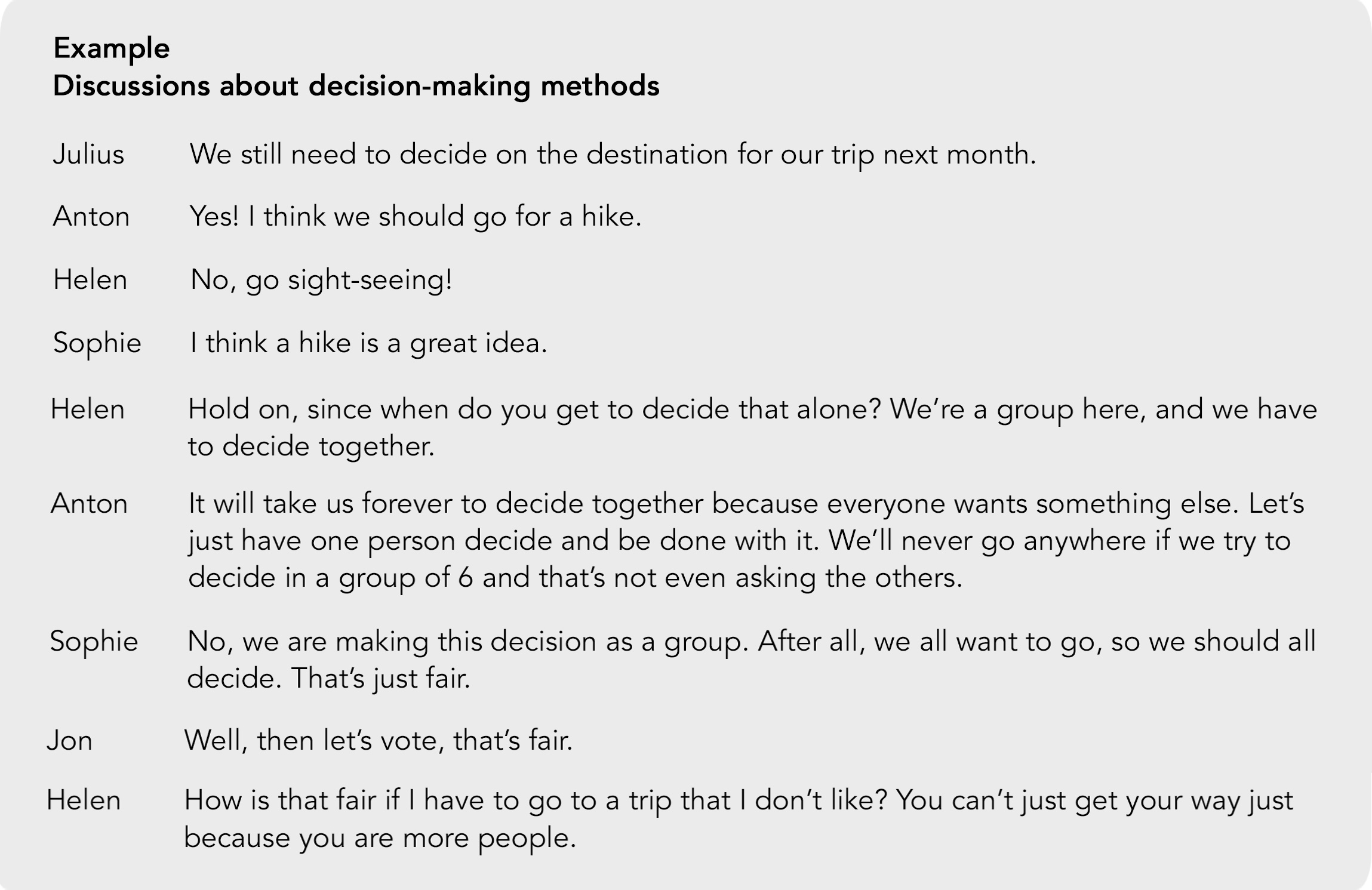
We often don’t operate with intentionality around our choice of a decision-making method. This is noticeable when an argument turns into an argument about the methods of decision making as in example Figure 3.2, “A discussion in a group with no agreed-upon method of decision making”. If the decision-making method is unclear, the method itself becomes a contentious issue.
Figure 3.2. A discussion in a group with no agreed-upon method of decision making
 |
Sociocracy uses consent decision-making for policy decisions. Operational decisions are made by individuals or by groups coordinating operational decisions. By creating those ‘‘islands of authority’’, operational decisions can be made fast. On the other hand, policy decisions require intentionality and equivalence and are made by consent by the whole circle.
Consent is a decision-making method that slightly differs from consensus. The definition of consent is: a decision is made when no one objects. To express consent in natural language, we would say “that’s ok” or “that works for me”. Consent is used for:
In order to understand exactly what consent means, one has to understand what an objection is. In its simplest form, an objection is raised when we have a reason to say “if we approve this proposal, I won’t be able to do my work towards accomplishing the circle’s aim as well as before”. On the flip side, one way to express consent in natural language would be “I can work with this idea for moving forward” or “I can still do my work well when we decide this.”
A useful concept is the ‘‘range of tolerance’’: everything a person can work with. That does not mean it is their preference. Understanding the difference between range of tolerance and personal preference is vital for sociocracy.
Figure 3.3. Range of tolerance: what we can live with outside of our personal preferences.
 |
For example, a picky vegetarian might not prefer to eat Brussel sprouts – meaning they would not cook them themselves – but they will eat them if served to them. Meat, however, might be outside of their range of tolerance.
Preferences and the ranges of tolerance differ between team members and they also change. Importantly, the deep listening practices and transparency in sociocracy help to build rapport and trust within a group over time, causing the range of tolerance of members to expand over time. As we hear each other, we become willing to accept other people’s preferences and to let go of our own.
Conceptually, if we were only able to work in the area of overlap between personal preferences, it would be hard to find common ground to make a decision, in some cases even impossible.
Figure 3.4. The overlap between ranges of tolerances (grey with black outline) is bigger than the overlap between personal preferences (dark with white outline).
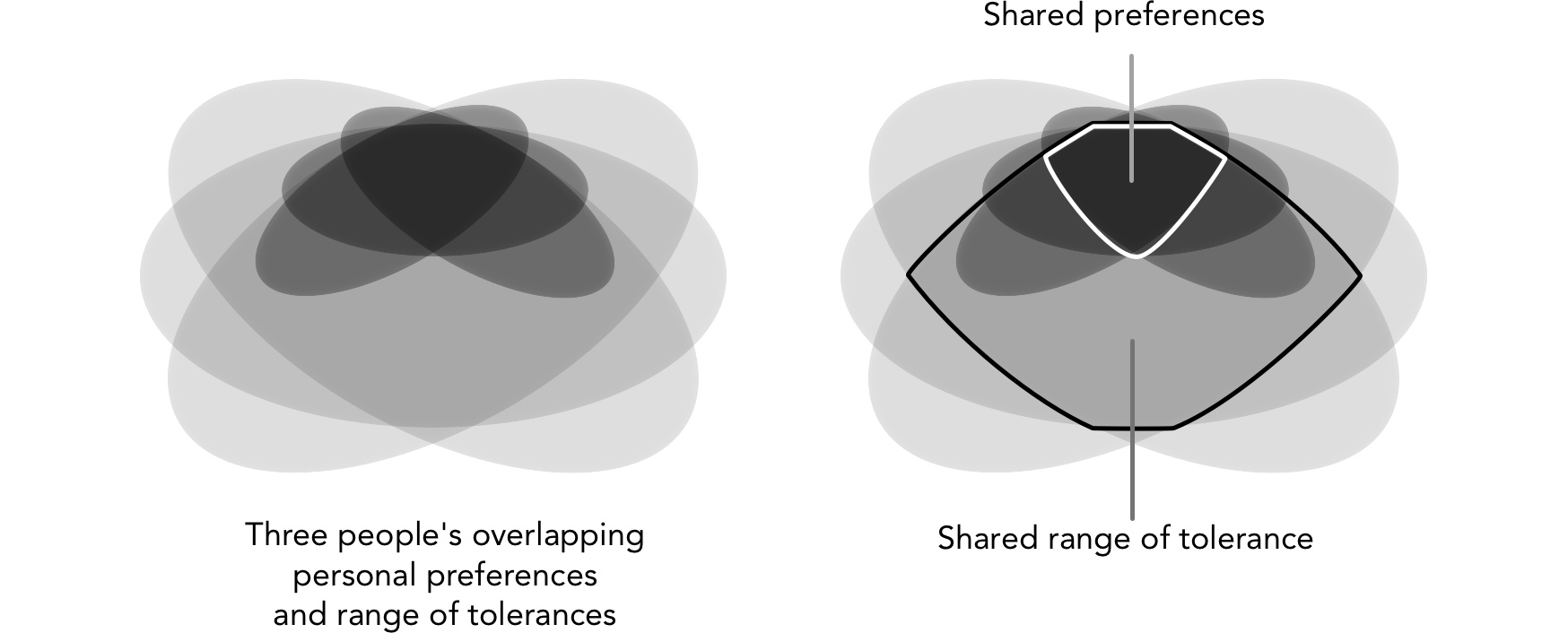 |
Diagram Figure 3.4, “The overlap between ranges of tolerances (grey with black outline) is bigger than the overlap between personal preferences (dark with white outline).” illustrates the overlap between the personal preference of the group members. The sweet spot (darkest) is the intersection where all preferences coincide; The less homogenous a group is, the smaller this area will be because people’s experiences and preferences differ. By contrast, the range of tolerance/area of ‘‘no objection’’ amongst group members is quite large. A group will reach consent to proposals more easily when the decision is based on range of tolerance rather than personal preferences.
With consent, individuals will not have as much power as they have in decisions requiring unanimity. On the other hand, with consent, a majority will not have power over a minority.
It is easier to find common ground when working with the overlap of our ranges of tolerance. Once we have made a decision, we can carry out our plans and evaluate whether the changes bring improvement. Since we learn with every decision made (and we do not learn from decisions not made), every decision made gives us more options to learn and adapt to outside and inside changes. We use the slogan “good enough for now” to encourage groups to innovate and prototype quickly.
Like a safety net, consent makes sure that no one can be ignored. If someone objects to a proposal, that person will be heard and the objection addressed. Thus, consent secures equivalence. The slogan here is “safe enough to try” which emphasizes that we only move when it seems safe – but then we don’t hold back.
Understanding and embracing objections can contribute to more efficient decisions of better quality while making decisions faster and with more focus.
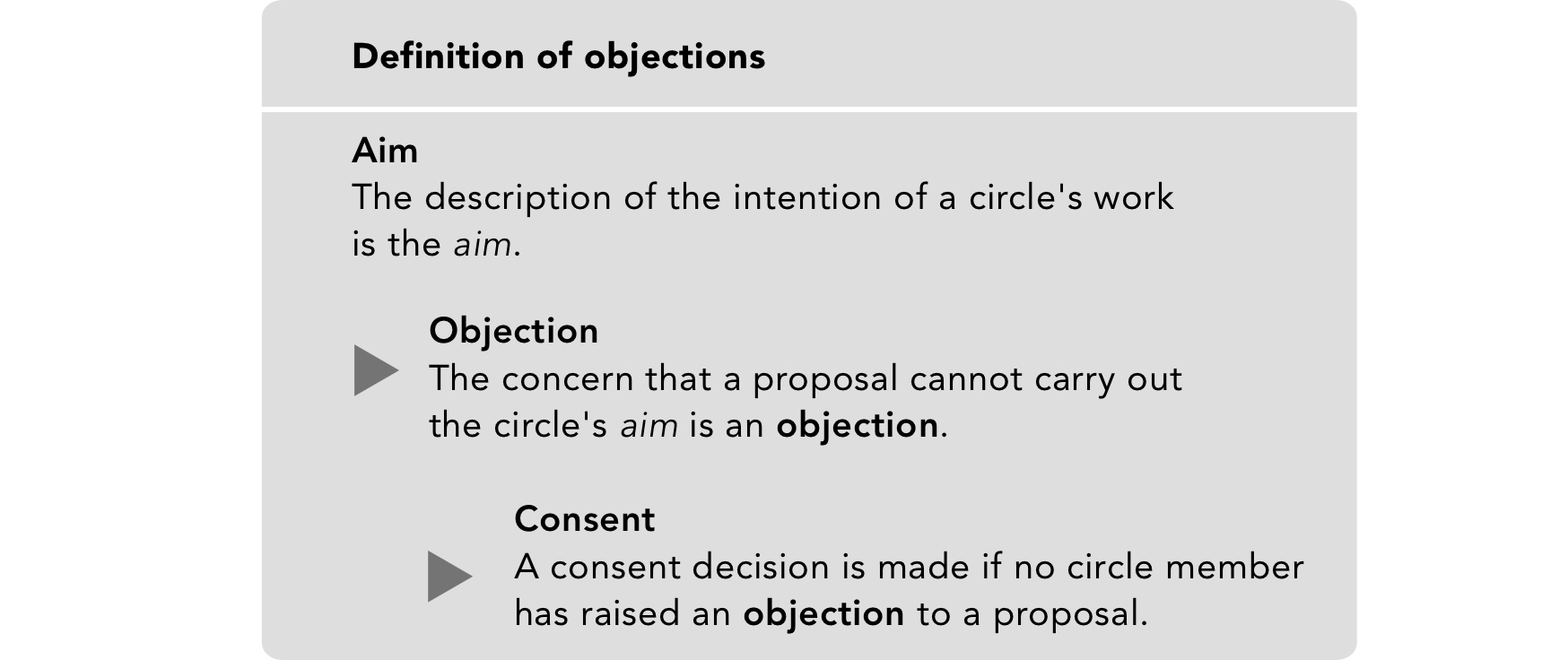
We need to understand the notion of an aim to understand how objections are being defined. As stated in section Section 2.2, “Empowering the circle: aims, domains and members” (page Section 2.2, “Empowering the circle: aims, domains and members” @@TODO@@: Figure out page references.), aims define what a circle or an organization set out to achieve, for example “baking and selling healthy bread and pastry in the North Amherst neighborhood.” If there is a new proposal, a circle member objects to that proposal “if they have reasons to assume that carrying out that proposal would have negative impact on carrying out the circle’s aim.” Proposals are intended to contribute to achieving the circle’s aim.
In short, an objection to a proposal says: “if we do this, we won’t be able to do our work.”
Figure 3.5. The definition of consent relies on the definition of objections and aims
 |
Imagine a for-profit organization running a co-working space. The overall aim of the organization is “providing a vibrant co-working space where people network, share resources, form community and are working in a productive way.” The circle that oversees the shared resources, like projectors or photo printers, has a sub-aim of “maintaining and providing shared resources and access to resources for members of the co-working space.” The Shared Resources Circle manages an online system where people check out resources as they pick them up. Someone makes a proposal to allow for equipment to be reserved in advance. Another member objects because they believe people might just book equipment without using it and wants to stay with the first-come-first-serve system.
How is this objection related to the circle’s aim? The aim of the circle includes “providing access to shared resources.” The convenience of online reservations might reduce the availability of resources for everyone because people might book equipment and then not use it. In this way, the new proposal might interfere with the circle’s aim. Raising the objection is to say “I am concerned that we won’t be able to do our work of providing access if equipment will be checked out more than it is used.”
We want to create a set of policies that make our operations easier and in alignment with our mission. Since the needs of our aims, people, work, earth and stakeholders create complex interdependencies, it is possible that we could create policy that might work on one end of the system but might create an issue in a different place. If people suspect a potentially adverse “ripple effect”, they will object to the proposal.
When a mismatch (or tension) within our current needs and proposed policy is brought to our attention, we have the opportunity to respond and to use the new information. That is why welcoming objections is so important: together with data and feedback, they are precious data we can harvest in a decision-making process.
Quite often, differences between people’s personal preferences are not worth spending the time we devote to them. We can find ourselves discussing a detail “A or B?” when no one would have objected to either proposal “A or B”. In that case, both A and B were within everyone’s range of tolerance and the discussion might have spent a lot of time on personal preferences – where we are more likely to disagree.
Objections help us sift through the different concerns so we can filter and focus on what needs attention. The earlier in the decision-making process we do that, the more time and attention we can devote to finding a good solution for an objection.
Objections in sociocracy are not a roadblock. The proposal is not off the table. Having options of how to move forward by incorporating the objection (see section Section 3.5, “Integrating objections: process”) is a core strength of sociocracy. With new information and clearer focus, it will be easier to make realistic and sustainable decisions.
Objections also change culture. Knowing that objections can be integrated encourages members to speak up. We can ease into a place of knowing that our concerns will be taken seriously. If the group can remain in a constant mindset of improvement, there will be more decisions over time, each creating and maintaining a work environment that supports us in making our best contribution possible.
A colleague, Gregory Rouillard, said: There is no consensus around consensus. It is hard to compare consensus and consent because consensus is not clearly defined. For some people, consensus is used like consent. That happens when people are willing to agree on a consensus decision even if the proposal is not their personal preference. But that is not something we can guarantee if consensus is not defined as such (and if it were, then consensus would equal consent). Consensus can be practiced like consent but does not have to be practiced that way.
It is less ambiguous to compare unanimity and consent. If we ask for unanimous decisions, we ask “do you agree?”, this question tends to focus people on their personal preferences. In consent, we ask “do you object?” and this question includes both the range of tolerance and the personal preference.
We don’t see consent as a watered-down version of consensus. In our experience, consent shifts the energy towards doing, instead of convincing others of our own viewpoint. To focus on the range of tolerance instead of personal preferences means to acknowledge that people’s experiences and perspectives are different and might remain different. With consent, we can still operate together, guided by a shared aim.
Instead, one can see consent decision-making as an organized, structured form of consensus. It is replicable and supports all voices being heard more effectively.
Some groups work with “weighted” statements, like numbers to show the level of their support or disagreement to save time, or they introduce “concerns” in addition to objections. To us, the system is binary with exactly two options: either we consent or we object. There is no difference between a concern and an objection, and no difference between an objection and a paramount objection.
Why? All facets of opinions are heard at an earlier point in the process (in the quick reaction round). While our opinions might be multi-faceted with layers and nuances, the outcome is binary: either we address the objection or we do not. If we raise a “concern” instead of an objection, we are putting the decision whether or not to integrate our concern on the circle. We prefer for circle members to take responsibility whether or not they would like to integrate their concern.
Neither do we allow for people to pass or abstain in consent decisions. Why not? Let’s look at possible reasons that could lead a circle member to abstain:
The circle member might have a concern without bringing it up. In that case, the group (ideally the facilitator) will try to surface the objection.
The circle member might not know enough about the proposal to consent. In that case, ideally, the circle member should get access to all relevant information. In a system of distributed power, the people in those decentralized circles need to take charge of their domain.
The circle member might not care. That’s ok. What is important to understand is that not caring means not having an objection. In that case, it is better to say “I have no objection”, but we do not abstain. We are actively choosing not to invest more time into the issue – perfectly fine but a choice that comes with responsibility.
The circle member might not really understand the proposal in depth but might trust the rest of the circle. Since we operate on – to some extent – partial information at all times, not understanding something at depth is not a dealbreaker. If we choose to not object and not to ask for more information, then we are consenting because we don’t object.
Issues expressed but unaddressed can create a toxic group culture. Imagine someone consents to a proposal after raising a concern. They skip any attempt to integrate their concern into the proposal but insist on having their concern noted in the minutes. If the action then generated by the proposal is unsuccessful then the person who raised the concern might say “I told you so!”. Note that in this example, everyone in the circle heard the concern and everyone (including the member raising the concern) consented. Everyone is equally responsible for the decision made. Consent is not about being right, but about making decisions together that the circle considers safe enough.
Abstaining from a decision will create the same dynamics. Every circle member is 100% responsible for the business of the circle. We want the information on the table, and we want to encourage a culture where people are comfortable to object. If there is any reason to object or to ask for more information, any circle member is required to do so. For all other cases, step up and consent – consent decision making also means “no excuses”.
Note that by consent, we can decide to use any other method of decision making. For example, we can, by consent to take a vote. By choosing to vote, one would intentionally accept that some voices might be ignored, for example for the sake of saving time. Having more variety in our decision making is useful if we are intentional about our choices and its advantages and disadvantages.
Assessing whether an objection is valid can easily turn into a power struggle. It does not make sense to make decisions by consent (defined as “no objections”) and to shift the power to someone who then decides what counts as an objection. If there is a judge needed, there cannot be equivalence.
In our experience, when following the process described in this manual, this question does not arise. By default, every objection is valid as soon as it is expressed. As a circle, we can then explore whether we see the proposal interfering with the circle’s aim. When people have trust that they will be considered and when they understand the difference between personal preference and range of tolerance, the question of whether an objection is valid or not does not apply. That said, we aim not to engage in “people-pleasing” (fine-tuning a proposal until everyone gets their preference).
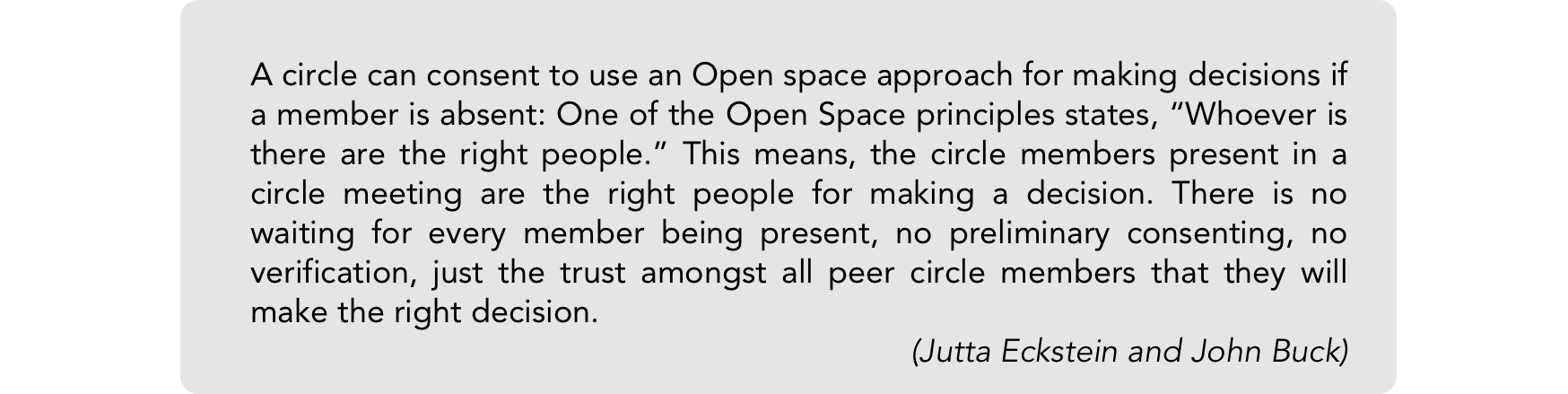
Consent means that no circle member objects to a proposal. What do we do if a circle member is absent? Can we even make a decision if we do not know whether the absent member has an objection? It is true that we do need every circle member’s consent to make a policy decision. This is a reason why defined membership is so crucial (see section Section 6.10.3, “Lack of defined membership” on page Section 6.10.3, “Lack of defined membership”). However, it is a reality of organizations that people will miss meetings from time to time. In practice, most groups we know assume consent for decisions that do not come as a surprise. Circle members have a history with each other – we often know about where others are at on a topic. Other options:
Make a policy saying that absent circle members will have to object within 24 hours of receiving the minutes. Otherwise, we would assume consent. (See example Figure 3.6, “What others say”.) ‘‘Lazy consent’’ works best in a small circle with trust that can track decisions and attendance well.
All consent decisions are on hold until the absentee consents after the meeting.
We can get the opinions of people ahead of time if we know that a proposal is going to come to a group. However, it is not uncommon for circle members to change their minds about an issue after hearing everyone. When circle members miss meetings, they not only miss out on being heard, they also miss the transformational process of hearing each other.
Figure 3.6. What others say
 |
The responsibility to catch up when someone missed a meeting lies both in the group and in the circle member. Meeting minutes and a check-in with the circle leader will support this.
Any circle member can withdraw their consent even if they consented originally. What if circle members change their mind three months after a consent decision was made? Options:
The policy stays in effect until the circle decides otherwise.
The circle member may have changed their mind based on new information or a new insight. Share this information with the circle and schedule the topic into next meeting’s agenda.
The circle member may discuss new information with the circle leader.
At the next meeting, the circle will listen to the concern and come to a (consent) decision on whether to review the policy earlier than the policy’s scheduled term end.
We want new information to be considered. But we don’t want to waste time un-doing decisions. If situations like these become a source of repeated disruption, we can always make policy on how we handle withdrawal of consent.
Consent decision making can be used in any kind of group, in any non-sociocratic organization. However, there are preconditions of consent, and we strongly encourage organizations that plan to implement (parts of) sociocracy in their organization to be aware of these preconditions.
The group is able and willing to discuss together long enough to resolve objections. We cannot decide by consent without being willing to work through objections. In taking shortcuts too often, we might create an imbalance in equivalence which can lead to frustration. If all circle members are trained well and know how to deal with objections, the task of “discussing long enough to resolve objections” will be doable and might actually be an enjoyable and connecting experience that strengthens the team.
The group shares a common aim. Consent decision making requires a shared and defined aim. Objections are defined as interference with aim. If we don’t know what our aim is, how will we know what an objection is? (See also page Section 6.10.4, “Clarity of domains/aims”@@TODO@@: Figure out page references..)
The group can choose its membership. With open or undefined membership, consent will be hard to do. If we do not know who has consent rights, how do we know when we have reached consent? Defined membership is essential for consent because consent means consent by everyone in the circle, not the people present in the room. (See also section Section 2.2.3, “Membership”.)
Not every kind of policy decision can be made by consent, for example decisions made purely by personal preference like design questions. What would be an objection for “blue”? There could be cases where colors have distinct context-specific implication or interpretations that make objections to a color decision reasonable (like if there is existing policy on corporate design). If there is no reasonable basis to object to a color, who gets to choose? We want to avoid power games.
Here is what we can do. We can, by consent, make a decision on how to decide. For example, we can hear some feedback on color issues and then decide by consent to vote. Or we can delegate to a group or even for one individual to make a decision with or without some limits.