 | Chapter 3. Making Policy Decisions | |
|---|---|---|
| ↢ | ↣ |
Table of Contents
In sociocracy, there are two basic frames of decision making:
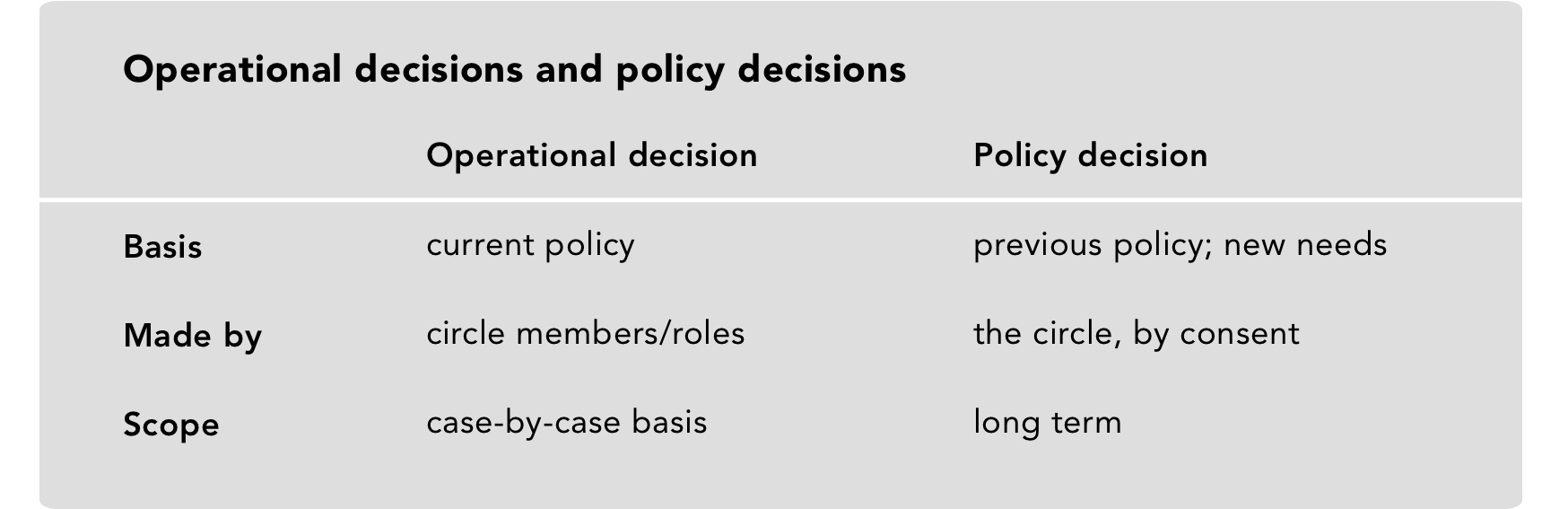
Operations are the tasks we perform to carry out the circle’s aim, typically outside of a meeting. We make operational decisions when we perform operations, deciding how to interpret policy that guides our tasks or coordinating operations with each other. Operational decisions are made by anyone with the authority to make that decision.
Policy is made to frame, guide and support operations. It is made by the circle for itself and its domain. Policy is made by consent. Consent means that no voice inside the circle can be ignored. The circle hears all relevant input and sets a good foundation for working together by equivalence.
Some circles are operations-heavy (more time spent doing work, less time spent in policy meetings), some circles are policy-heavy (more time spent in meetings, less on concrete tasks). The ratio between operations and policy only depends on the nature of the circle.
Figure 3.1. Operations vs. policy decisions.
 |
There are different reasons to make policy. The most typical reasons are:
To save time. It might be easier to make one policy decision in the place of many operational decisions.
To clarify. Policy can be useful if there is a topic that keeps producing tension or friction stemming from lack of clarity.
To improve. Policy can be made if we observe a mismatch between what we want and what we have. This includes increasing efficiency and effectiveness.
To create intentionality and equivalence. Different from practices or habits, making policy together means to make a more intentional, informed, and effective choice with more voices heard.
Policy can take different shapes, depending on what kind of decision a circle makes. The different kinds of policy, in the list below, can also be combined into one decision.
The general guidelines, workflow, and role descriptions set the frame in which work is being done. Operational decisions happen within that frame and are made by people who are authorized in a role.
Example: Imagine we hold the role of outreach manager, overseeing communication with prospective members which includes email newsletters. Then our role description – policy – guides us to do it, and it might specify how to do it. In a different context, a policy might frame the conditions of a parental leave for all members of an organization, or the number of outdoor cats allowed in an intentional community.
We only make policy if it is worth doing. Having an aim which is high-level policy might be the only thing necessary to do work well enough to start.
On the one hand, making policy takes time and creates overhead -- need for review and adjustments. On the other hand, policy helps create ‘‘islands of authority’’, like roles or other policy, that makes it easy for people to make operational decisions without having to check back with the circle. Policy and the clarity and empowerment it brings supports individuals by giving them freedom to act. Then again, too much policy can feel like being part of a clockwork with no choice or trust. As such, policy is both constraining and freeing: it frees people by creating a clear frame in which they have freedom to act, and it constrains the options of how things can be done.
Each circle has to find its own balance. This might be an enlightening question to ask our circle in an evaluation: are we operating within the sweet spot between limitation, clarity, trust and choice?
A policy typically creates enough structure to be useful but it will leave some room for operational decisions. In the example of the outreach manager, the decision of whether your team sends a newsletter to prospective members at 8.30 am or at 4.45 pm might be a case-by-case decision and might be decided differently every time a newsletter goes out. As such, operational decisions are case-by-case decisions, interpreting the aim and policy (“send out a newsletter”) and making choices to complete the task (“ok, I’ll do it this afternoon”).
The organization might realize that sending the email newsletter in the morning makes it more likely to be opened and read by their addressees. In that case, the circle might review the data and decide that all future newsletters should be sent out before 9 am. This is a policy decision. Without that policy, by operational decisions, the newsletter might have been sent out in the morning one week and in the afternoon the next week. Policy limits choices.
We sometimes call policy decisions “bulk decisions” because instead of making a case-by-case decision, a policy sets a frame for all similar decisions falling under that policy.
An analogy is to consider all the operations (tasks being done in a circle) as water flowing down a river. The water flows within the river bed (the domain) toward a destination (the aim).
We might take some water out of the river with a bucket here and there and pour that water somewhere else. This is like a case-by-base (operational) decision.
Policy, on the other hand, is like building a pipe for irrigation. We are making a general decision on how we want part of the water to flow. A pipe will have significant impact but it will also require effort to build and maintain.
We would only build a pipe if it seems worth the effort. In the same way, a circle will only make policy where it contributes to getting work done. Do not build pipes where there is no water, or where working with a bucket is enough at the moment.
Note: Operations and policy are not a binary distinction but two ends of a continuum. If we make policy for only a small number of situations, or case-by-case decisions for a set of situations, then the difference between operational decisions and policy decisions can blur. As an example, we might make policy about planning an event before we know how many parties will happen. In that case, making policy (roles, guidelines etc.) might be overdone and simple operational (case-by-case) decisions might be a better choice. If we project that there will be a lot to coordinate or that the party will become a regular event, creating policy might be useful.