 | 3.6. Creating and filling roles (selection process) | |
|---|---|---|
| ↢ | Chapter 3. Making Policy Decisions | ↣ |
All policy is made to support circles in achieving their aims. The three kinds of policy that are typically made are guidelines, workflow policies and the creation of roles. Roles are created to ‘‘package’’ operational tasks within a circle so that the attention and work will lie in the holder of the role instead of the whole circle. In order to move operations into a role, we need to take two steps:
In some cases, both steps are taken at once to save time. For example, the proposal might be “I propose that this task of staying connected to our fiscal sponsor be moved into a role of the fiscal sponsor coordinator for the next two years and that Aliyah fill that role for 6 months.”
Both decisions will come with a term. To create a role is a decision that needs to be reviewed on a regular basis, including whether it (still) needs to exist, what the tasks, limits and measures might be. At the same time, who fills a role is a decision that needs to be revisited when the term for that person is up. If there is no policy preventing it, any person can be re-elected as many times as the circle sees fit.
Since creating roles is policy, writing role descriptions follows the regular policy process. There is no real difference between regular policy and role descriptions but for convenience and usability, this section fleshes out how to use the policy process to write a role description.
The policy-generating process, as described in section Section 3.3, “Making policy – step by step”, encourages circles to make sure the need is fully understood before creating policy. The circle might understand the issue and underlying needs well enough and feel confident that a role might be the strategy that would meet their needs most effectively. Often, creating roles is one part of a larger policy context. This is true when a circle approves a general guideline and creates a role to track measures for that guideline. For example if an office is deciding to introduce a new tool for customer relationship management, they might also want to create a role to oversee this process.
The role description can be written by a helping circle, an individual or by the circle. Even for an individual writing the role description alone, it makes sense to go through the regular process.
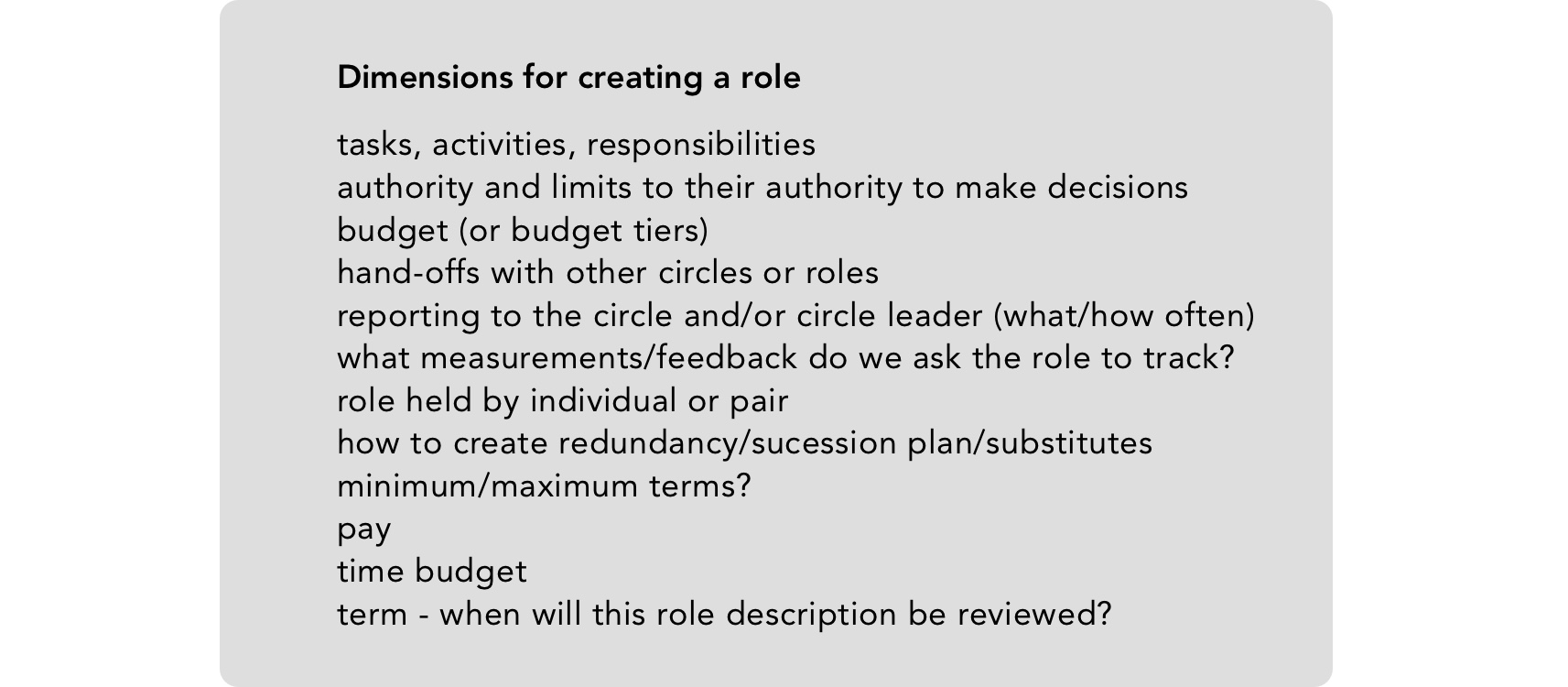
For a role description, gathering a list of dimensions to keep in mind and questions that need answers will be vital to explore the policy scope and to create a complete role description – it is really easy to forget crucial parts.
While the dimensions for guidelines will likely be different every time, the dimensions for roles will be based on the very same set every time. The list below shows the most common dimensions for creating a role. Tailor it to your situation.
Figure 3.49. List of most common dimensions for creating a role
 |
In the next phase, gather proposal ideas. As usual, a proposal idea might cover one or more of the dimensions, for example
The holder of Content Resource Management role will work independently.
Report every 6 weeks.
The work connected to this role is planned to be performed within 4h per week.
Time will be tracked in a separate time sheet.
Gather ideas (in a round) and write them down. Stay in rounds until all ideas have been gathered.
The circle leader, facilitator or any circle member can be delegated to synthesize the ideas into a proposal that will then go to the circle for consent in the usual way (see consent process in section Section 3.3.2.3, “Making a decision: the consent process”).
Everything in sociocracy is designed for both effectiveness and equivalence. Elections are no exception. The sociocratic election process:
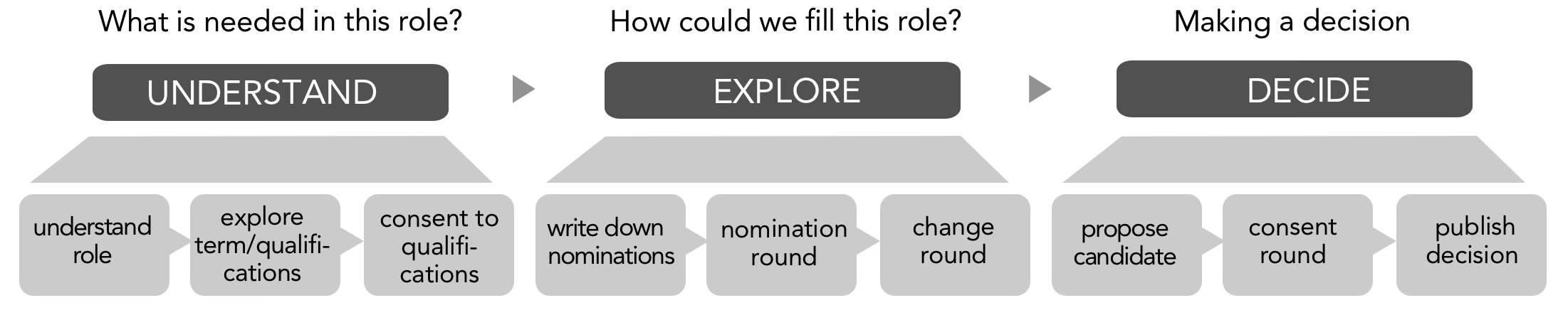
The selection process has three parts that align with the phases of understand – explore – decide. (1) First we work on a shared understanding of what we are selecting. (2) Then we explore ideas and give each other feedback so we can form a proposal. (3) Lastly, we decide about the proposal. In cases where there are objections, we deal with the objections until everyone can consent to the proposal. Figure Figure 3.50, “All steps of a selection process” is a summary.
Readers who want to understand the steps of a selection process more deeply are referred to matrix Figure A.5, “3x3 matrix for the selection process” and Figure A.6, “3x9 Matrix for the selection process with skit” on pages Figure A.6, “3x9 Matrix for the selection process with skit” and Figure A.5, “3x3 matrix for the selection process” @@TODO@@: Figure out page references..
Figure 3.50. All steps of a selection process
 |
We often call elections selections to avoid the association between elections and voting. In sociocracy, we do not vote, we nominate. Elections and voting imply majority vote. In our practice, the two terms elect and select are interchangeable.
Selections in sociocracy are very different from secret ballot majority vote. Society considers the right to secret ballot a foundation of democracy, considering that autocracy was the historical alternative. Open selection processes bring a new depth of participatory democracy.
Figure 3.51. Selection process understand phase
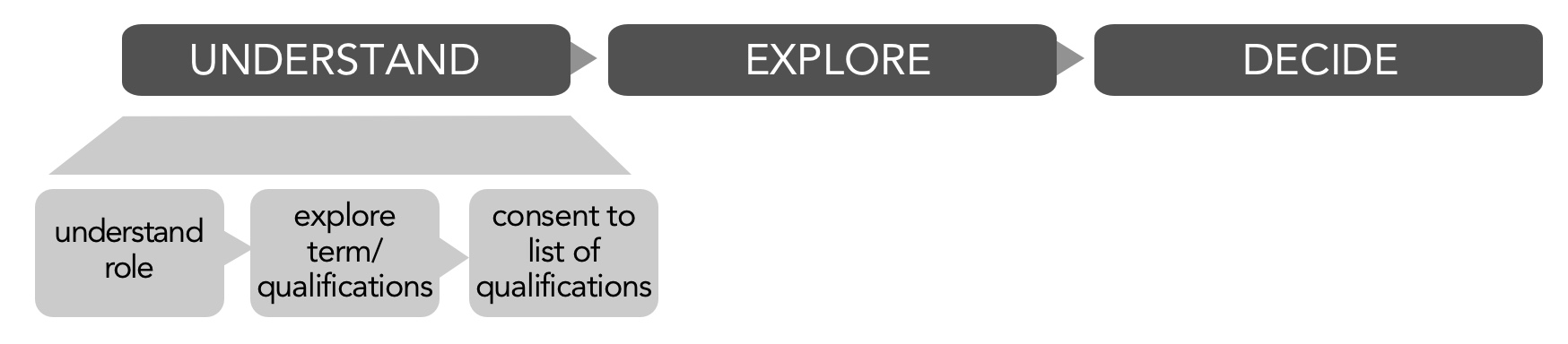 |
What role are we selecting for? What is the role description? What are the responsibilities and authorities of that role? If the circle is selecting someone for a familiar role, it still helps to review the role description briefly because role descriptions may vary from one circle to another. “Does the facilitator prepare the agenda with the secretary and the leader, or is there a different agreement? Does the secretary keep the member roster current in case of elections?”
If we are selecting a delegate, how often does the next-broader circle meet and what day/time? This might inform the selection process.
Intention: Understanding the role.
Tools: Paraphrase or read the role description.
The facilitator can ask the circle member currently filling that role to give a three-sentence overview of the role.
Not everyone in the circle might be aware of who does what and reviewing it increases transparency and learning about your own organization.
If there is a reason to change the role definition, then we want to do that before we proceed to select someone. Role descriptions are circle policy, so we have to make sure to be clear and to ask for consent if the role description is updated.
Complete when: Everyone understands the role.
We can define a default for the term, like one-year terms; however, we set the term intentionally for each selection. “We’re selecting a facilitator for this circle, and I propose the term is our default term of one year. Is there any change from our standard practice that anyone would like to propose?” What could be reasons to shorten the term or to make it longer?
Shorter terms if the circle wants to cycle more people through the roles so they gain experience and leadership skills.
Choose longer terms if the circle does not want to spend much time in selection processes.
Choose longer terms if the circle wants stability.
Choose longer terms if the role requires a long learning process for people to become effective in their role.
Intention: Explore considerations on term of role.
Tools: State default term, do a round to check if there are considerations affecting the length of term, propose a term and check for consent. This decision might be revisited when a person is chosen to fill the role.
Complete when: No objection to the proposed term.
On what basis would we select someone for a role? We want to prime our minds so we can nominate based on qualifications and make a good decision. This is even more important for operational roles that require specific expertise.
For example, if the job description says “types the minutes, especially proposals, into the shared document in real time” then we need someone who has the capacity to do that. If an operational role requires the capacity to work on weekends or evening, we have to be aware that not everyone might be able to fill that role.
Intention: Exploring what qualifications we would like to see in the holder of a role.
Tools: A round where people name one or two qualifications, continuing until the group runs out of ideas or feels complete.
Gather the qualifications visible to everyone and keep the list. For established roles, we can just read the list and ask whether there are any modifications to make.
Just like in other phases of exploration, do not comment (yet) on each other’s ideas.
This step often takes under five minutes.
Complete when: No one has another idea to contribute.
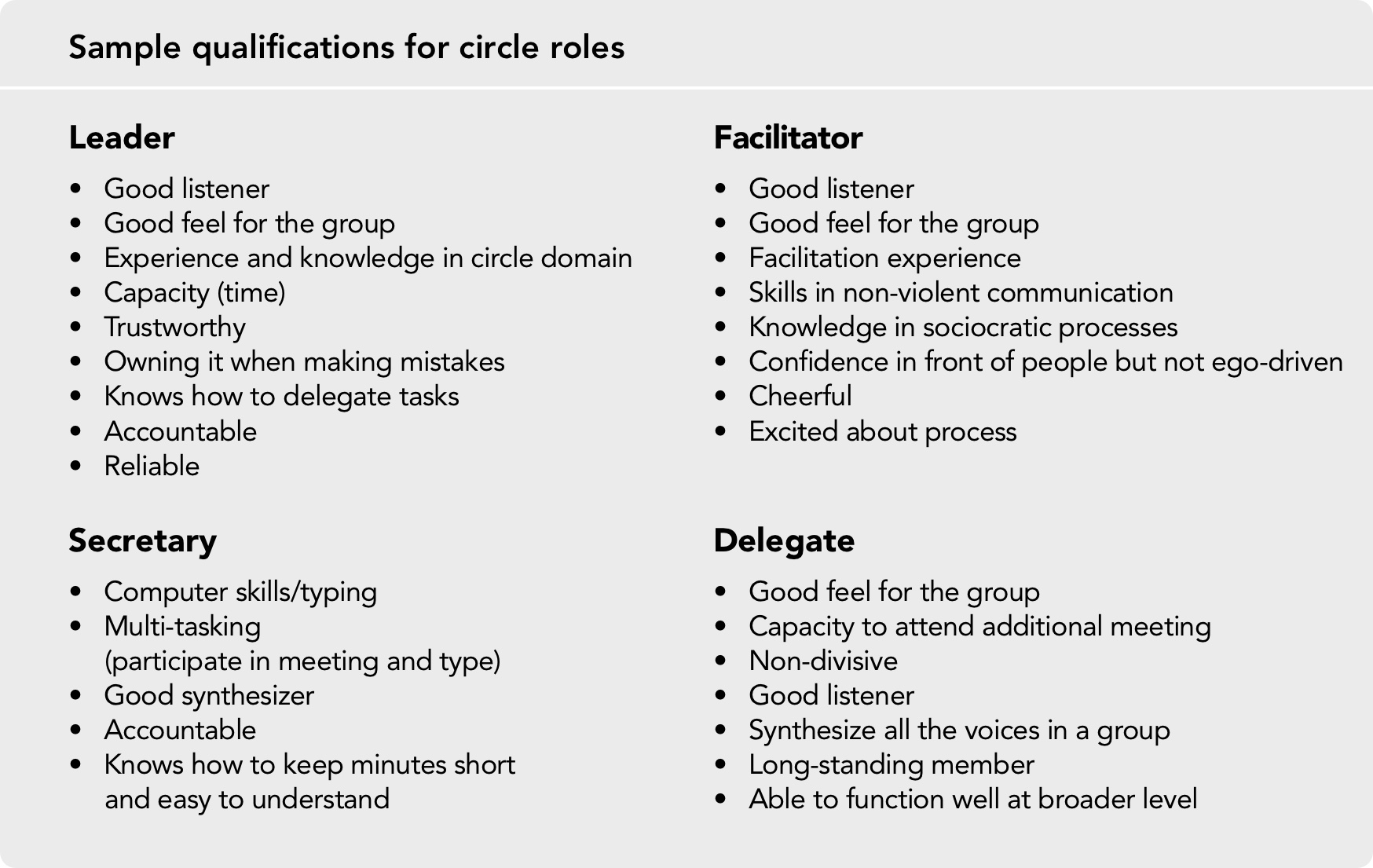
Figure Figure 3.52, “Sample qualifications for leaders, facilitators, secretaries, delegates” gives a possible list of the 4 process-related roles. Note that these are examples! Any organization/circle might prioritize very differently! Each group needs to compile their own list and keep it current and adapt it to whatever is needed.
Figure 3.52. Sample qualifications for leaders, facilitators, secretaries, delegates
 |
It is important to end this process with a consent round. If there is an objection, we explore it and see if we can find a set of qualifications everyone can consent to.
For example, in figure Figure 3.52, “Sample qualifications for leaders, facilitators, secretaries, delegates”, the item “long-standing member” for the delegate is not necessarily a qualification everyone will consent to. Someone might have suggested it, it gets written on the list, but we still need to see whether everyone can consent to that. “Why do you want someone who is a long-standing member as a delegate?” Accordingly, we might decide that we want a facilitator with only little experience on the job because in that phase of the organization, we might want to put our attention to spreading leadership and we are confident we can work with an inexperienced facilitator. As another example, in training contexts, often someone mentions the qualification impartial for a facilitator. We, personally, would not consent to that, so this would give rise to an interesting discussion. (The reasons are that we do not think there is such a thing as an impartial circle member, and the double role – being circle member and facilitator at the same time – is a consequence of self-governance. The way we look at it, the facilitator should be willing and able to separate their facilitator role and circle member role.)
Intention: Reaching consent on the list of qualifications
Tools: Consent round.
Note that these are qualifications, not necessarily requirements. No human being will be accountable 100% of the time, or will always fulfill the expectation to be a good listener to a maximum extent. We are not, ever, looking for perfect. For operational roles, be sure to define what qualifications are necessary.
If we are using an old list, we present it and ask for consent.
Complete when: There is consent to the list of qualification.
We now know what role we are selecting, the proposed term and what kind of candidate we are looking for. The only piece missing is who we would like to propose to fill that role. It helps to keep the list of qualifications visible to all in the next step so it can inform people’s thinking.
In the next phase, the group will share their ideas, allowing ideas to build on each other.
Figure 3.53. Selection process exploration phase
 |
Everyone in the circle will now nominate someone for the role.
Intention: Circle members reflect on who they would like to see in a role.
Tools: Everyone identifies a candidate. Some facilitators prefer nominations to be written down. (See below.) One can nominate oneself if someone is interested in the role and has reasons to believe they are qualified for the role.
Complete when: Everyone has identified a suitable candidate.
Why do we write our nominations down? We want to hear everyone’s reasoning without losing information. During the nomination round, it is tempting to just go with the group energy, especially when someone is speaking late in the round. Writing down a nomination before the first person speaks will encourage everyone to share their original nomination. Sometimes, the best ideas are the ones that seem peripheral at first!
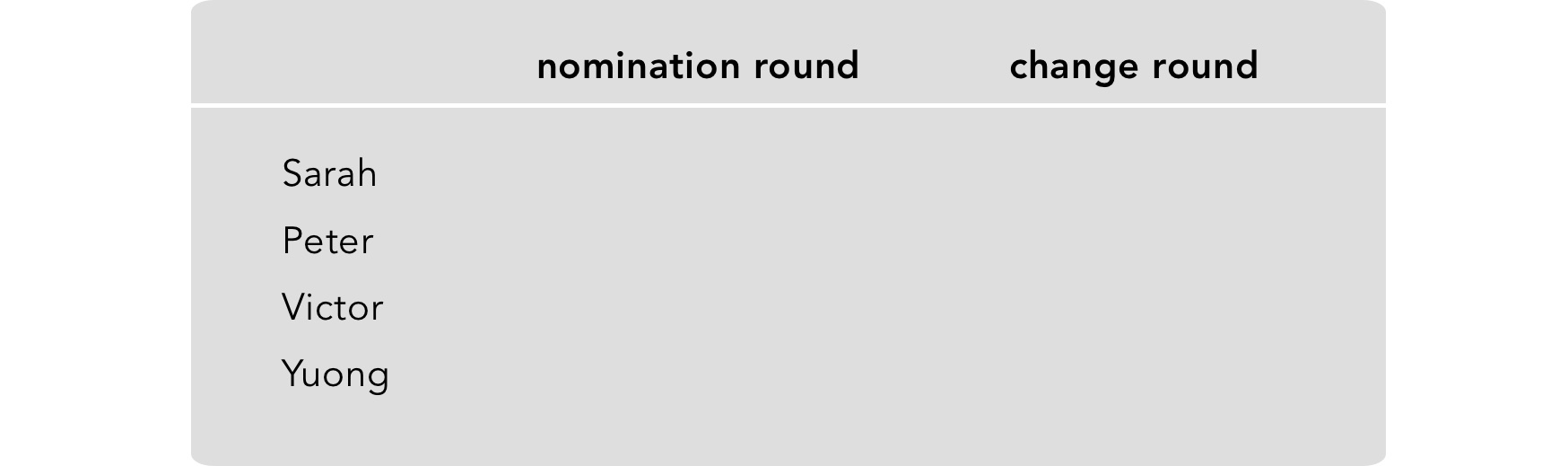
Some facilitators like to collect the nomination sheets so they can track better who nominated whom. We prefer a grid to get a picture of everyone’s nomination(s), as in Figure 3.54, “Grid for nomination round and change round”.
Figure 3.54. Grid for nomination round and change round
 |
The circle now enters a shared exploration phase.
Intention: Sharing our nominations and reasons.
Tools: In a round, everyone in the group shares who they nominated and why. This can be a one-sentence statement, or a slightly longer one, depending on the context.
The facilitator can fill in the grid as people speak. We will, ideally, hear new information or familiar pieces of information in a new light as people speak.
People can build on other people’s ideas but not invalidate or argue with other people’s contributions. The energy is more positive when it is around “yes, and”.
Complete when: Everyone has shared their nomination and reasons.
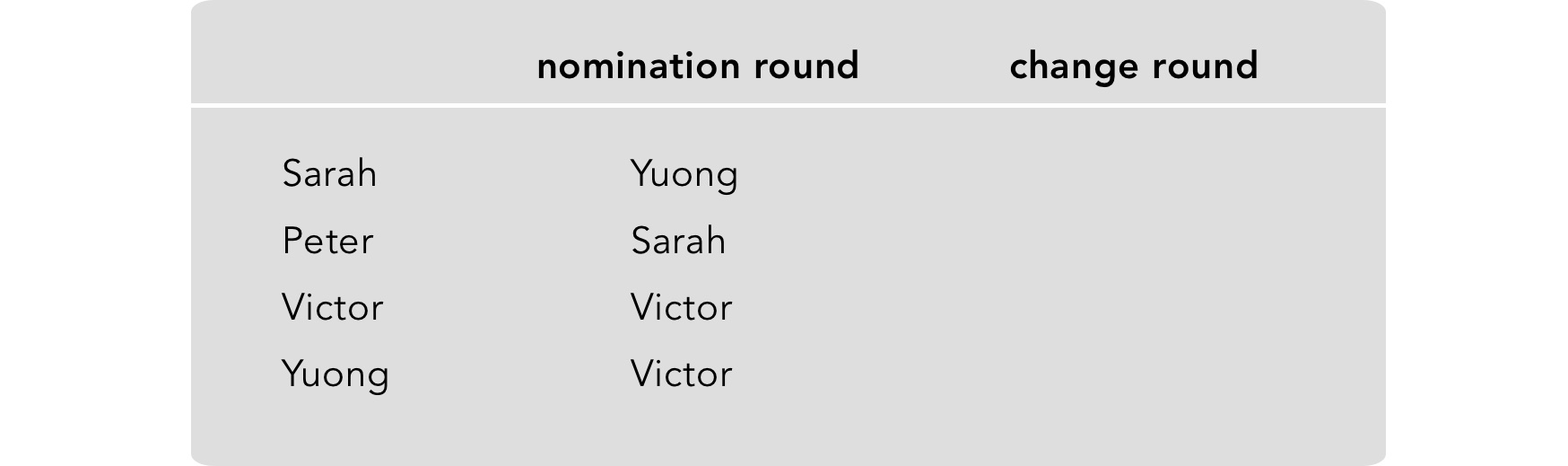
Figure 3.55. Grid after nomination round (and before change round)
 |
Below are some examples of what a nomination will sound like if we are selecting a facilitator:
Sarah: “I nominate Yuong because I have seen them facilitate in other circles. They are clear and concise and often explain why we do what, and I enjoy that.”
Peter: “I nominate Sarah because she is clear, experienced, quick to understand, and she understands process, and those are the qualifications that most people in the group named for a facilitator.”
Victor: “I nominate myself because I am looking for some more practice in facilitation after taking the course on facilitation, and I think I know enough to do a good job.”
Yuong: “I nominate Victor because I want to give him a chance to practice.”
By now, everyone has heard the other people’s ideas and reasons and something we have heard might change our nomination. Maybe there was new information, maybe something shifted our thinking or reminded us of something meaningful we knew about somebody. Note that we do not have to change our mind, of course.
Intention: Assessing nominations after hearing each other’s nominations.
Tools: A round of reactions; people say who they nominate after hearing the others.
Our standard prompt is “having heard what you heard, are you moved to change your nomination?”
If people change their nomination, we ask what led them to change their mind.
If they did not change their nomination, we ask them whether they have any new information to share.
If there is highly relevant information or a compelling argument at the end of the change round, we can ask whether more people speak again, especially the people who spoke early in the change round. Resist the urge to keep going around until everyone nominates the same person, however!
Complete when: Everyone has spoken; relevant information has been shared.
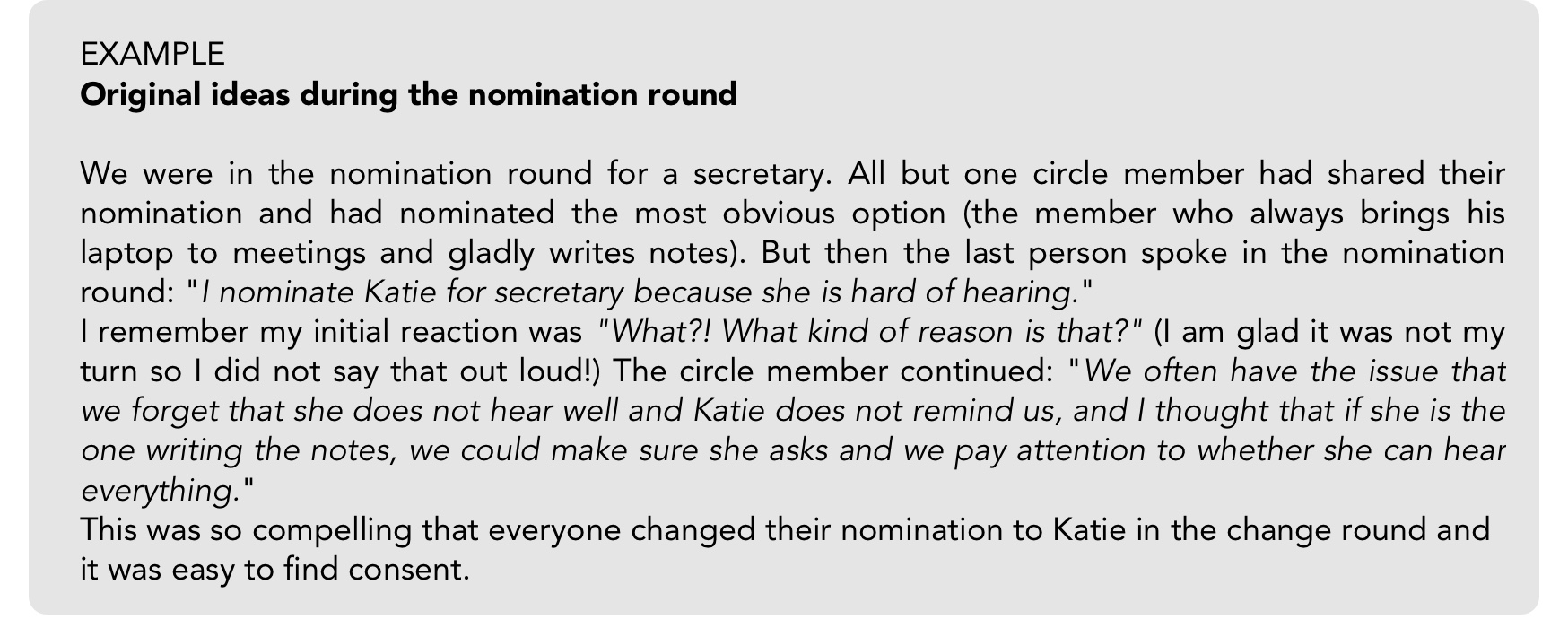
Figure 3.56. An example of a compelling reason during a selection process.
 |
Here is how above selection process might continue:
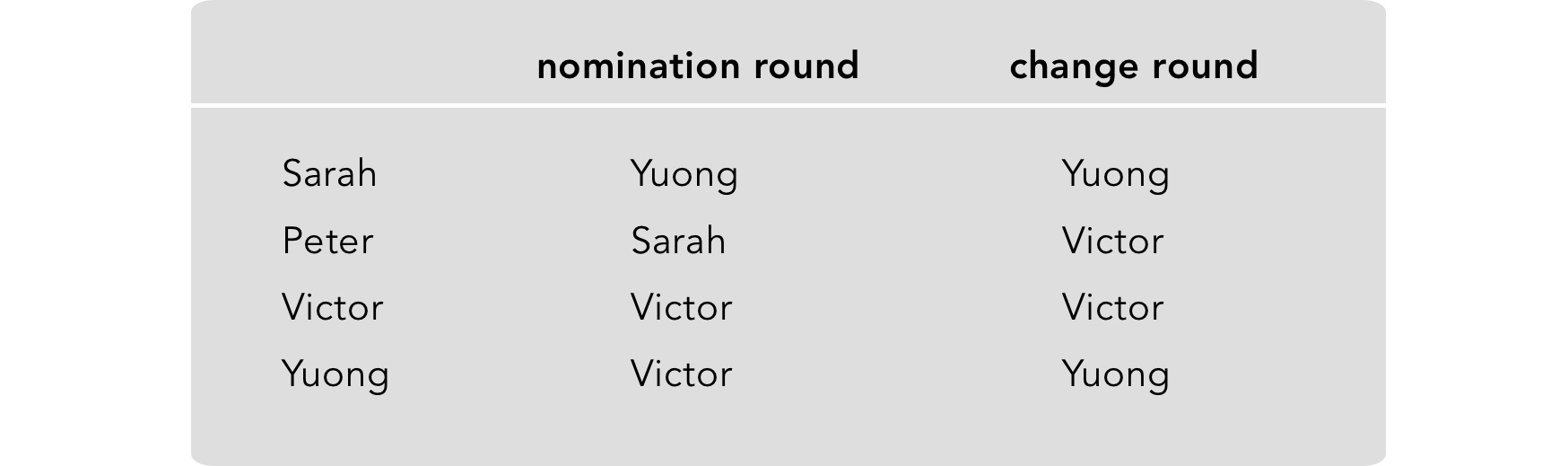
Sarah: “I am staying with my nomination for Yuong because of what I said earlier. I think he is a good facilitator.”
Peter: “I am changing my nomination to Victor because I had forgotten that he had taken that class, and I appreciate when people learn more, so I want to give him the opportunity to practice.”
Victor: “I am staying with my self-nomination for the reasons stated.”
Yuong: “I nominated Victor and I am staying with that. I think it is important to give people experience so we all get better at what we do here.”
In this example, maybe not everybody knew or remembered that Victor had taken a facilitation class. Maybe others had not seen Yuong facilitate yet. Thanks to the nomination round and people sharing their reasons, everyone in the group now knows more than before.
The facilitator of the example selection process now sees this grid, preferably written down for all to see. The nominations and the reasons that have been shared will be the foundation for the next step.
Figure 3.57. Grid after change round
 |
This last phase is about synthesizing the selection process into a decision. A candidate is proposed, we do a consent round and acknowledge the decision.
Figure 3.58. Selection process: decision phase
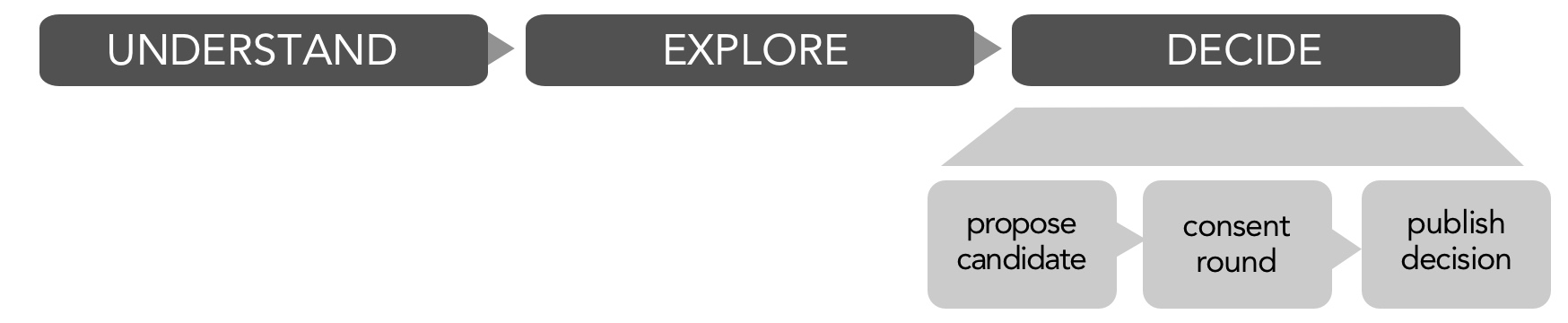 |
It is the facilitator’s job to make sure a proposal is being made now. That does not mean that the proposal has to come from the facilitator; there can be reasons for the facilitator to ask someone else to make a proposal. In general, it is important to put a proposal out now for reasons of efficiency – we could circle and circle endlessly, weighing all the reasons in search of the ideal candidate. We try to avoid that by making a proposal and focusing on objections.
Intention: Proposing a candidate.
Tools: The facilitator will make sure a proposal is being made.
Repeat the role and who the candidate is: “I propose that Victor be facilitator.”
Share reasons for this choice, referring to the qualifications gathered for this role and to the reasons shared in the nomination round and in the change round.
Include the term for the proposal, based on the input earlier in the process
For example: “I propose that Victor be facilitator of this circle, because this would give him experience and he is eager to learn, for a term of one year.”
Complete when: A candidate/term has been proposed.
The facilitator now calls for a consent round.
Intention: Hearing from everyone whether they consent or object.
Tools: In a round, let circle members consent or object.
It is absolutely crucial in this consent round that there are no negative personal preferences expressed here, for example in the pattern of “I consent but I still think that she would be the better choice”. To avoid this, we often review what a possible basis for objections would look like before the consent round begins. “I ask you to only object if you think your ability to achieve the circle’s aim would be harmed if Victor fills this role. Remember that we are not looking for a perfect candidate and that many of us could fill this role. We are only looking for a candidate to fill this role, not the perfect one.”
If we are only selecting for one role, we always start the consent round so that the nominee goes last. By the time the nominee gets to speak, all the other circle members will have given consent or objected. In sociocracy, we want people to step up into power, and sometimes the confidence and faith of a group allow a nominee to consent to taking on the role.
If there are objections, we aim to integrate them (see section Section 3.6.3.5, “Can there be objections in a selection process?” on page Section 3.6.3.5, “Can there be objections in a selection process?” on objections in selections).
Complete when: The circle knows whether there is consent.
The facilitator will assess whether there is consent and will announce the decision.
Intention: Acknowledging and publishing the decision.
Tools: The facilitator will say something like “Looks like we have consent!” or “great, we have made a decision!”
Complete when: The decision is made and is captured in the minutes.
There is a complete example of this selection process in the appendix on page Figure A.5, “3x3 matrix for the selection process” @@TODO@@: Figure out page references..
Yes. This makes sense if your choices seem interdependent, for example if we want someone as facilitator but only if he or she is not a delegate. It also simply saves time. We can select all roles at the same time.
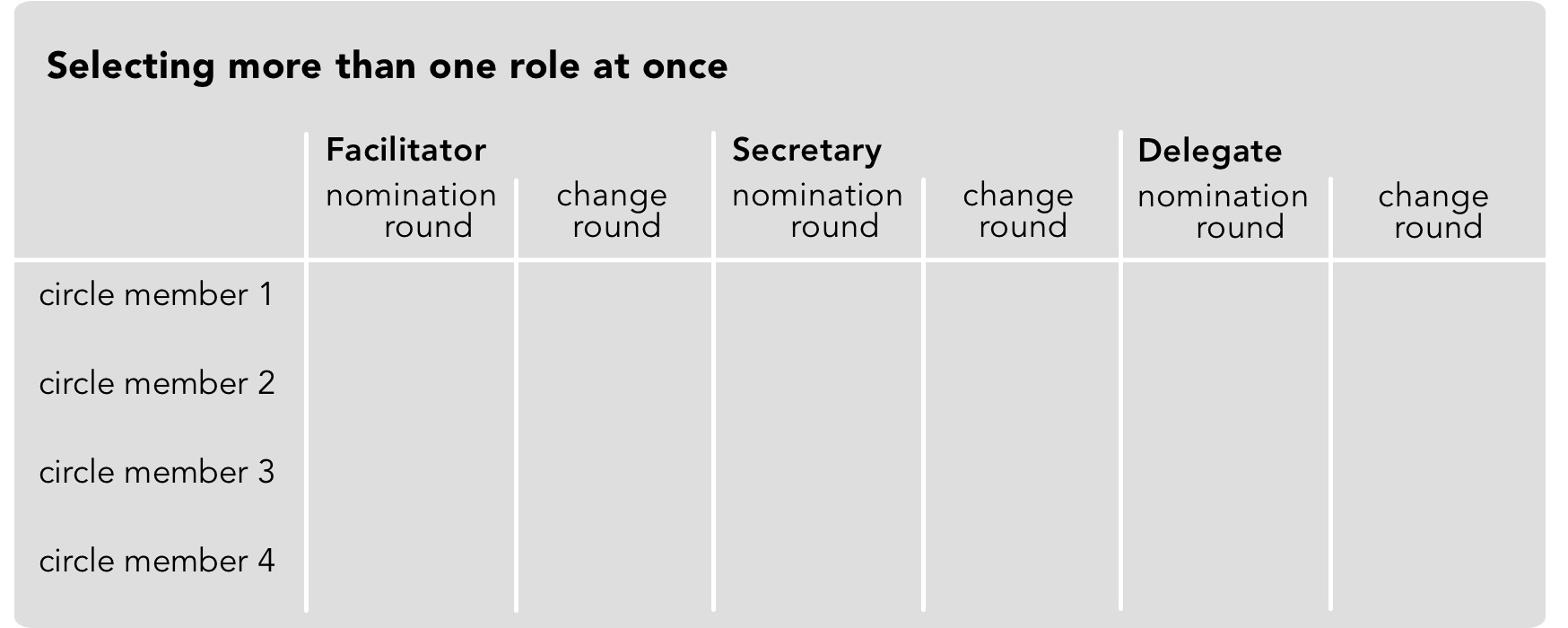
How does this work? In the nomination round, people say all their nominations. “I nominate XZY for…because…, and …for delegate because…” and so on.
The grid in diagram Figure 3.59, “Grid for nomination round and change round for three roles.” shows how we draw the grid for a multiple simultaneous selection process, in this case for facilitator, secretary and delegate. The change round follows the same pattern. Now the facilitator proposes someone for each of the roles along with the reasons why. If one of the roles is not as easy to fill, it may make sense to consent to the easier choice(s) and to focus afterward on the election that needs more attention.
Figure 3.59. Grid for nomination round and change round for three roles.
 |
Whenever we teach this process, there is someone in the group that asks: “why don’t we ask whether that person wants to do that role? How can we talk about them serving in a role if we don’t know whether they are available and willing?”
The first answer is that having the information reduces the possibilities we have. I (Jerry) was part of a group that had been working together and we were planning to select a facilitator. I had a clear preference for someone and spoke with that person ahead of time, and she shared with me that she was not available. In the formal selection process, everyone but me nominated her in the nomination round, and she ended up being proposed as a candidate and consented to her own selection. Willingness, or lack thereof, may shift.
It makes quite an impression to be told by circle members how qualified oneself is for a role. It is not unheard of that the individual selected says afterward: “I would have never volunteered for this role, but I was convinced by the positive feedback I heard here. I feel honored to fill this role.” Note that this is not about forcing people into a role. We assume they know that they can say no – and the group needs to allow them that space. They consent to fill the role – which is an active process and very different from being volunteered by not saying no loud enough! This process is designed to help people say yes and to create an opportunity of exploring what a no means and how it could become a yes.
This is why it is best to start the consent round so that the candidate speaks last. To achieve that, just start the round with the person next to the candidate and pass the round in the opposite direction. That way, the nominated person will get to hear everyone else first.
A tricky question is the following: “I am one of the people that keeps getting nominated, and understand that it is good to give feedback and I understand that people want me in a role. But I am over-committed in this organization. It is just a waste of time to even nominate me as I will object anyway.” Situations and statements like these are tricky, and we’d like to share our thoughts because we assume that what we have to say might be useful. First of all, the people who perceive themselves as overcommitted are often the same people that would like to hear more appreciation of their work. Can we hear this as feedback on how much people appreciate our contribution to our circle? The election process is more than just finding someone as quickly as possible to do the job. It can be a time for reflection too on how we spread the work. If we sit through nominations just seeing them as a waste of time, we are missing the wonderful message in it: “we appreciate you”. Also, maybe more importantly, the fact that the same people are nominated again on a regular basis but then object because they are over-committed is very important feedback. What do we as a circle do with that? How do we interpret that? As a circle, do we think we could make better use of that member’s contribution? Maybe we could talk about their overall package of tasks in the circle. Maybe we can build more leadership around the easier tasks that person is doing so we can free up time and attention for the more visionary work. Whatever we do with it, we want to be sure to notice the feedback this process gives us.
The basis for the decision of who fills the role is qualification. A volunteer might not be the fit person for the job. And the best candidate might not volunteer! Filling roles on a volunteer basis will not get us reliably good results. (Willingness, of course, is one factor. If someone really does not want to fill a role, chances are they will not perform well in that role.)
Inviting volunteers can get us into a lot of difficulties because it is difficult to object if volunteering is our method of decision making. The ability to object is important for collaboration. An organization is about doing something. Whether or not someone is suitable for a role is essential for creating a good work environment.
It is important to understand the difference between self-nominations and volunteering for a role. Self-nomination adds information since self-nomination includes saying why we nominate ourselves. What qualifications do we see in ourselves? What does this role mean to us? There is much more to learn that we would ever hear if someone volunteered saying “I can do it”. Self-nominations, like volunteering, express willingness, but being selected into that role does not happen automatically – the other circle members have to consent.
The best way to show the difference is that we have seen it happen many times that people nominated themselves but were not selected. Or they nominated themselves in the nomination round but shifted their nomination to someone else in the change round.
One tricky aspect around self-nominations is that in some cultures, it is not easy to self-nominate, either because those cultures are hierarchical (and some people will traditionally not expect to be allowed to self-nominate), or because they are extremely horizontal in which case self-nomination can look arrogant. We are aware of these patterns and still think that self-nominations are healthy if they are based on qualifications. Even apart from cultural background, self-nomination and changing the nomination from or to oneself require some practice, since those are tied to emotional baggage around how we see ourselves in the group. If it is possible, name those feelings and share them. The more information is on the table, the better the group will be able to hold it with care and respond to it if they choose to.
There can be objections to any proposal, and selection proposals are no exception.
Let’s remind ourselves that objecting means that we have a concern that carrying out the proposal will interfere with our ability to do our work. What does that mean for elections? It means exactly that: “I have a concern that if XY takes on the role of NN, we will not be able to do our work effectively because…” What reasons could there be to object to someone in a role? It helps to look back at the list of qualifications of the role. Here are a few good reasons, including what the concern is:
“I object to …being leader because I fear that …is too busy to be the leader of this circle. We need someone who has the capacity to pay attention. I am worried that things will slide if there is no strong leadership.”
“I object to …being delegate because I know our general circle already has a hard time scheduling meetings and …as a part-time worker will make it even harder. I am worried that …will not be able to attend GC meetings on a regular basis.”
“I object to …being the facilitator because honestly, in my judgment, …does not lead strongly enough and avoids conflict. I am concerned that I’d wind up feeling irritated a lot because my needs for efficiency and effectiveness would not be met.”
“I object to …being secretary because of the requirement to put minutes up in our online file system and as far as I know, …is not comfortable with the system. I guess at least I’d like to understand what NN’s thoughts are on that.”
We might find ourselves in a position where we are asked to consent or object to someone who is not our preference. It’s good to remind ourselves that in the nomination round, we are being asked about your preference. In the consent round, however, we’re asked about our range of tolerance. We only object if we see our participation or the circle’s success impacted by that candidate filling that role. Does, for example, selecting Victor as a facilitator potentially harm the circle’s work/learning? If so, then we object. If not, then we consent. (On the emotional challenge of objecting to someone, see section Section 3.6.4, “Emotional challenges”.)
Never object based on a personal preference, for instance by saying “I object to …being facilitator because I think that YY would be better in that role.” That is irrelevant information because we are not looking for the perfect candidate. Additionally, comparing people will shift the energy from an affirmative but honest process to a potentially harmful process.
If there are objections, we do not give up right away, for example by nominating a different candidate. First, we check and see if there is a way to turn the no into a yes. We do so on the basis of the objection. For example, someone might have an objection because the candidate does not have enough experience, and the group has agreed when talking about the qualifications that experience is an essential qualification in the circle’s current situation. In general, the three standard ways of integrating an objection apply to selections as well.
Modify the proposal: what can we modify? For example, if we think someone needs more experience, we make an amendment to get the candidate some extra training.
Shorten the term: if, for example, one circle member is not convinced that someone is a good candidate to be facilitator, would the objector be willing to try that person for 3 sessions and schedule an evaluation then?
Measure the concern: what would we need to track so you would feel better about the proposal? For example, if there is an objection on the basis of a circle member not being reliable at preparing agenda items, how would we measure that this is true?
Combinations thereof: what strategies can we combine? Following the examples mentioned, one might give the person extra training, track how well they are preparing agenda items and fill the role for a short term.
We can follow the template for integrating objections; but at the very least, we would want to go in rounds. We try to tap into group wisdom and be gentle with each other, to find a good solution.
If the nominee themselves objects, for example for lack of experience, we can remind them that the whole group had confidence in them, and ask what they would need to be able to say yes. Their objections are addressed in the same way as other circle members’ objections.
Another example: let’s assume an employee, Malik, works only part-time because he is taking care of his elderly mother. That does not affect how qualified Malik is as a delegate but it could come up in the form of an objection. Let’s imagine this is an international general circle scheduled across different time zones so that meetings can only happen in the afternoon, but this employee needs to leave at 3 pm because that is when the home care person leaves. Let’s not forget that if we’re even discussing his candidacy, it means that Malik was nominated by his peers for good reasons, for example because he is a well-respected employee with excellent communication skills and this is exactly what the circle saw the need for. If someone objects (could also be Malik himself raising this objection), this is an opportunity to put all the information on the table. An open, transparent process is a better approach than either not considering him in the first place or pretending his time constraints do not exist. Accept the reality so we can work with it, not against it. Once it is in the open in the form of an objection, it is not Malik’s flaw but instead, it is the shared responsibility and interest of the circle to explore options. In a place of shared power, there is plenty of space to find a creative solution. Could Malik work in his home office and we accept that there might be an occasional interruption? Maybe, the circle might be able to free him up on one morning a month, and he could switch schedules so that the monthly general circle meeting time is free? If there is no good way, don’t push too hard. Malik from our example was able to hear how much his skills are appreciated and he will feel the care for him in his situation.
The facilitator can nominate someone else. Since the other nominations are still on people’s minds, we don’t have to go through the whole process – we can just make another nomination proposal and go into a consent round.
Imagine we want to select 4 people among a group of 40 people. If we go around using the usual process of nomination rounds and change round, every round is going to take too long and the contributions people make will likely be repetitive. But we want to hear everyone’s input. What can we do? Here is one fairly easy tweak: everyone in the large group nominates a set number of people (for example 4) and writes their nomination on a sheet of paper. Then we ask the first person (let’s call them circle member 1) in the round who they nominated. They say the name of their first nomination. We ask everyone else in the room who nominated that person as well to stand up (raise their hand). Then we ask circle member 1 to share why they nominated that person. Circle member 1 shares their reasons, and we ask everyone who feels represented completely in what they heard to sit down/take their hand down. Then ask a circle member who is still standing to share their additional reasons for nominating the same person. Again, everyone who now feels represented completely by what has been shared can sit down. We do that until everyone sits. Then we ask circle member 2 to share who they nominated (can’t be the first nominee again but someone else on their list), and the whole process starts again until we have heard all the reasons and nominations, without any repetitions. We can do the same for the change round, encouraging to only speak if there is new information. The rest is the same as the regular process: the facilitator makes a proposal and we can hear objections.
We like getting this visual image of how many people nominated a nominee, and we get to hear all the reasons and at least some sense of how many people agree with those reasons as they sit down but we do not get any repetitions. Maybe not everyone will speak but everyone is represented and can speak if they do not feel completely represented either in who they nominated or in why they nominated that person. This is time-efficient, without redundant information.
A variation: after the change round, we can put the 5 people with the most nominations in a fishbowl and let them do another change round and the consent round. Other variations are possible as long as the approach and the person filling the role is accepted by consent.
If we elect an individual into a role by majority vote, then the person with the most votes wins. In general, the issue with majority vote is that in its outcome, up to 49% of the votes are being ignored. In diagram Figure 3.60, “Majority vote vs. consent” we show how a consent decision could have a different outcome than a majority rule election. Candidate A would win the election by a 4-3 vote (votes are indicated by the letter A or B). But in a consent process, two circle members would object and candidate A would not be selected. On the other hand, there would be no objection to candidate B.
Figure 3.60. Majority vote vs. consent
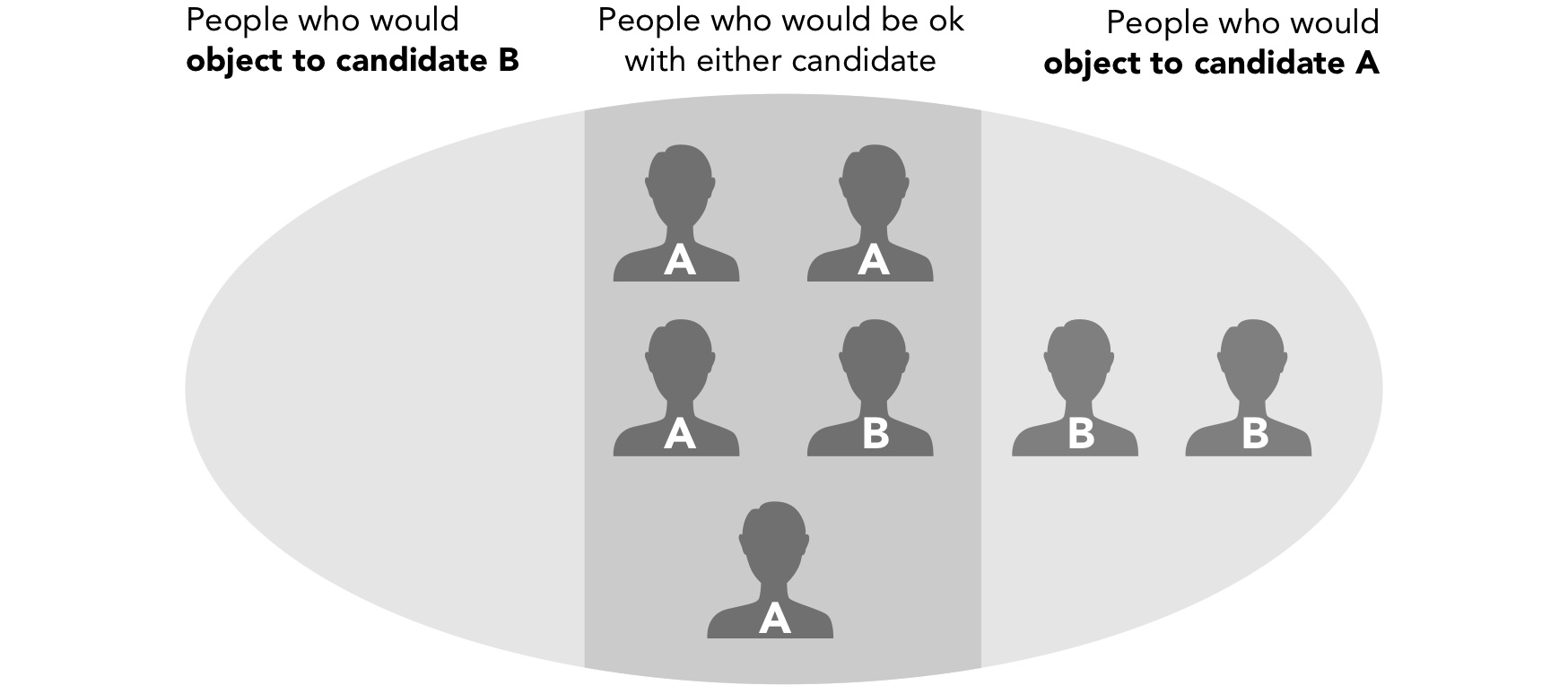 |
This scenario was designed to show the difference between consent and majority rule. Majority rule runs the risk of ignoring valuable information in the form of objections. Sociocracy focuses on effectiveness -- enabling the whole circle to make a decision rather than having the decision be made by only some of its members. In contexts where sociocratic decision making is not the accepted practice, there are variations on voting that are more inclusive than majority rule. Describing these is beyond the scope of this book but the reader may want to explore voting alternatives such as preferential voting, approval voting, Borda Counts and others.
Imagine we have a group of 6 people, and 3 people nominate candidate A, and 3 people nominate candidate B. In majority vote, this would be a tie. If you are the facilitator (and you nominated one of those people) – what do you do?
For consent decision making, we have to know a little more. What is the underlying story? Do we have objections on any side like in scenario 1 below, or do we actually have consent for both candidates like in scenario 2?
Figure 3.61. Scenario 1
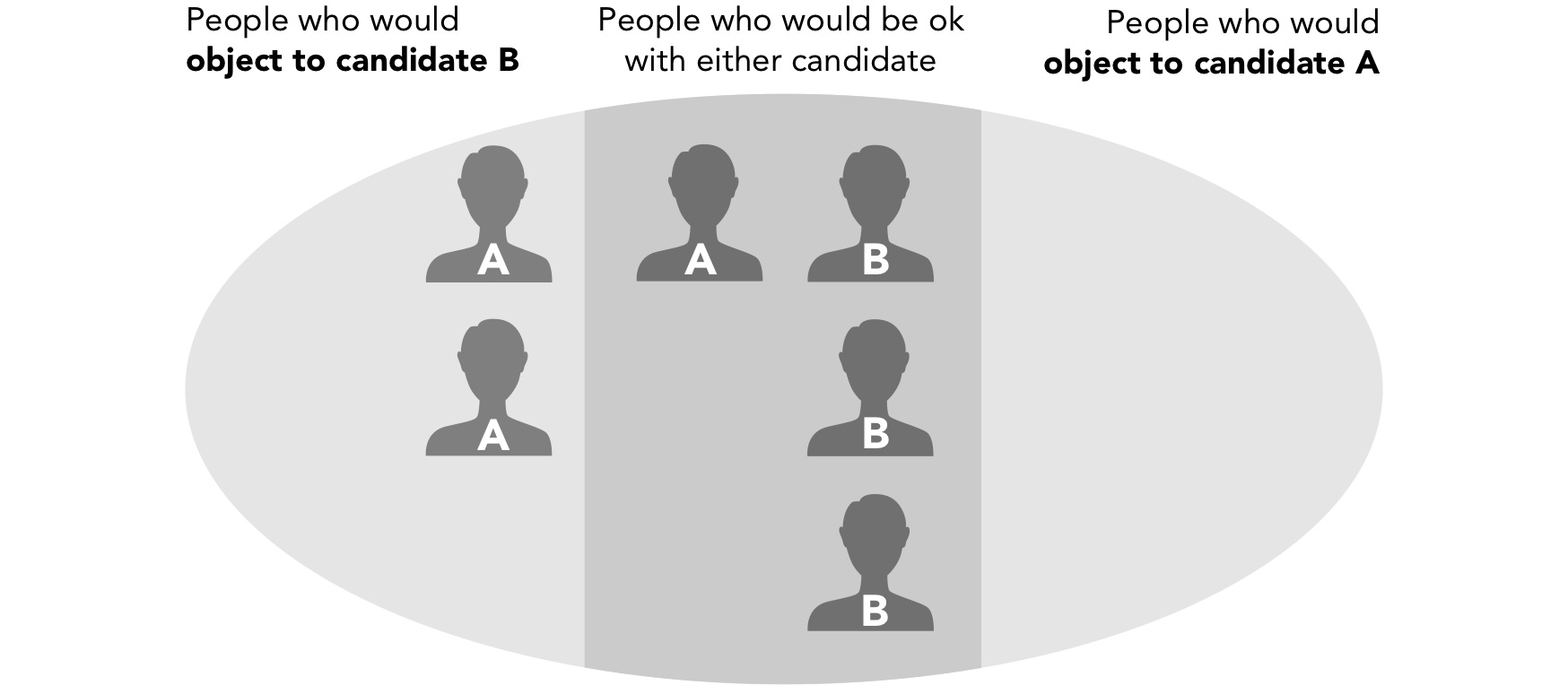 |
Figure 3.62. Scenario 2
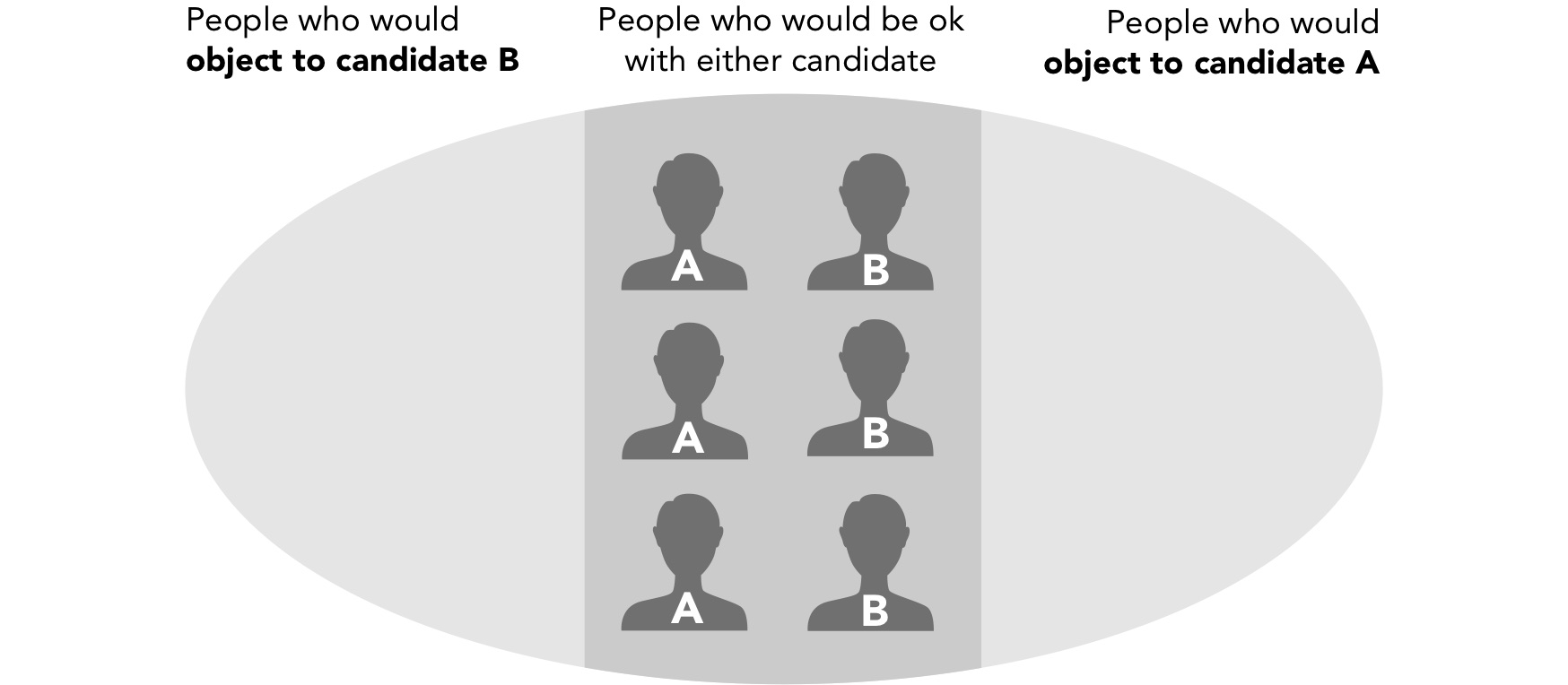 |
In scenario 1 in diagram Figure 3.61, “Scenario 1”, proposing candidate A will get us consent while proposing candidate B will bring objections.
The facilitator’s task is to get the group to come to a decision that everyone can work with. If that is true for both candidates, great. We can also say that. “I am guessing that both candidates could get consent from the group which shows how much skill and trust we have in this group.” Then make a decision, and be specific in your reasoning. We can go back to the qualifications and how we would prioritize them. For example, did we say we wanted to select someone who does not have a lot of experience yet? Then go with the least experienced candidate. Or is there another qualification that makes the difference? Always remember: we are looking to find a candidate that everyone can consent to. The task is not to find the best candidate.
We know it can be hard for groups to make a decision if it feels almost arbitrary and both candidates are good and respected. Split decisions are paralysing so any way out of a split decision is better than paralysis. We invite readers to think about it not in terms of fairness. If we try to make it fair, there is hardly a good way out. (Workarounds are typically sharing roles, taking turns etc. which we don’t support without hesitation.) Instead of making it fair, look at it from the organization’s perspective. It is not a problem to have two good members who can fill a role and have the full support from their circle – it’s a gift. It’s the expectation that things be fair that makes it so hard, not the fact that there is a tie.
Another aspect of this is that we do the organization – that is, ourselves – a disservice if we don’t make a decision or spend too much time on a decision that falls between good enough and safe enough. Sometimes doing something is better.
If it seems worth-while, we can have the two candidates talk to each other, ideally with the circle present. The potential catch here is that internalized patterns around power will be strong in that kind of situation -- it will be more likely for a person with less perceived privilege or power to “give up” the role. After the candidates’ conversation, the facilitator makes a proposal based on the new information circle members have heard.
Let’s imagine the nominee is not your preference. Or you actually object because XYZ’s facilitation style does not work for you. You might feel torn -- speak up at the cost of triggering feelings or consent at the cost of holding back relevant information -- the fact that you’re concerned about the circle’s ability to work toward its aim when XYZ is facilitating. As a first step, detach from your personal preference. We want to remember that the question is not “do I want this circle member to fill the role?” Instead, the question is: “If this person fills the role, does that affect you negatively in doing your job?” If the answer is yes, then we have to object. But how do we object when it is someone you know well, maybe even a friend? This is hard, and we can only give you some pointers -- doing it might still be uncomfortable. The first thought to keep in mind is that we are not objecting to a person. We are objecting to a person filling a role. We can love a person dearly but their competence in leading, facilitation or writing minutes just does not match the job description. In order to give useful feedback or to object, we will have to be specific. What could that person do differently so it would work for us?
Let us tell a personal story here. A friend of mine was nominated for facilitator. I was not happy. I did not want her to be facilitator. I was sitting with the judgment of “whenever she facilitates, we never get anything done. Her style is too loose, and we’ll go round and round the circle without outcome”. I was judging, not seeing what my own needs are. That lack of clarity kept me from giving constructive feedback. If we are clear about what we need, we can make a request and give very clear input that is easy to hear. In this scenario, it could sound like this: “You all know about me that I value effective meetings. I get impatient when things are not moving, and I realize I get more impatient more easily than most of you. I am concerned that it will be hard for me to sit through meetings. Can we make a deal? I am fine with XYZ facilitating if I can voice when things are moving too slowly for me and be sure I am heard and considered.” I did not object to XYZ, instead our circle just grew in mutual understanding. Of course, if I do not trust that the circle will support me, or if XYZ’s facilitation style really affects my work or the work of the circle, I will have to address it differently. The important pointer in this story is: own your own perceptions, feelings and needs first. There is a huge difference between these two statements: “Your facilitation is muddy and ineffective” vs. “I want facilitation to be clear and crisp so I don’t lose track of what we’re doing, and only that makes it possible for me to be productive in meetings. Therefore I am not confident that XYZ has the capacity to facilitate this circle.” Another way to look at it is that feedback may trigger another person’s hurt feeling but the feedback is not the cause. The cause of the pain is the receiver’s interpretation. Feedback, when delivered with care, is a gift.
In the nomination process, it is hard for some if they are not nominated. It might remind them of childhood experiences of being one of the last to be picked for a team. They experience selection process as a trial where the case is “do my peers know/like me enough to nominate me?” A selection process is not a popularity contest and neither is it a process that needs to spread appreciation evenly. The circle is trying to fill a role, that’s all.
We can take a deep breath and see what we do with the feedback that our skills are not visible to the group. We can nominate ourselves.
(A new group may do a round on what history they bring to the selection process. In a safe group, we strongly encourage being vulnerable. It is possible to say something like “this selection process was hard for me. I wanted my name to be among the nominations, and I wanted to be needed and considered. I understand that this is not about popularity but I do want to let you know that this was hard.” We could even ask for a quick round of people telling us what we bring to the circle or ask for suggestions about how we could improve your skills so that people would feel confident proposing us for that role in the future. That’s a matter of 5-10 minutes of meeting time. Why would it be worth spending those 5 minutes? Because it creates a sense of connection, trust and respect in the circle which is the basis for your collaboration. If we wanted to do a community-building exercise to build trust, we’d be very willing to spend the time on that – so why not go with a real moment? If all circle members learn over time that they can be vulnerable with each other, they can make an immense contribution to the organization.
Another challenge comes up if the facilitator is attached to a particular outcome. In that case, the facilitator can acknowledge that bias and can ask someone else to facilitate that part of the meeting. Anyone who owns being biased will earn trust from any group. “My dear friend/…is being nominated here, I don’t feel confident that I can do an unbiased job here. Roxanne, could you facilitate this election?”
The facilitator can also go through the process and then leave the proposal to someone else. “Victor, would you be willing to make a selection proposal?” In the long run, this will have a healing and connecting effect on any group. Often, the tension disappears once it is acknowledged.
If a facilitator repeatedly makes proposals that are uncomfortable for the circle, that feedback should be shared in the meeting evaluation or a separate performance/role improvement review. Any member of the circle can say that they are uncomfortable about an election process because they perceive facilitation bias or they can object to the person the facilitator proposes on the grounds that the proposal was not based on the strongest reasons.
We can easily forget that volunteering and majority vote come with emotional challenges as well. However, we are so used to considering voting “fair” that we do not acknowledge that. Just imagine what it feels like to get only one vote while there is a head to head race between two candidates who both got more than six votes.
Sociocracy does not magically make everything comfortable and easy, and it cannot make emotional triggers disappear. What the sociocratic process can do, however, is give space to talk about one’s feelings and interpretations. That requires a lot of maturity, and we are aware of that. To us, this is part of the package and preconditions of doing sociocracy successfully. Selection processes are another example where people are given “air time” to voice their feedback and opinions. Circle members still have to be brave enough to do it. The decision-making process does not do it for them in some magical way. However, what we notice is that groups can grow. Courage and vulnerability, alongside with kindness and honesty, are appreciated. In our training, we always teach sociocracy with a compassionate communication (NVC) framework as a backdrop. If the emotional challenges around any governance decision are hard for your group, we strongly recommend educating your group on communication skills. See more on this topic in section Chapter 4, Feedback and Learning.
In general, we encourage groups to accept and acknowledge that feelings come up when we make decisions together. Better to be open about it than to pretend they are not there.
The selection process can be used for more than just to fill roles. The selection process is useful whenever we have a discrete number of choices: for example, we can do a selection process where people nominate out of a set of vacation destinations; instead of people, we nominate places.
It also works with numbers. We can do a selection process around the question “should our membership fee be zero, $10, $20, or $50?” Then people would nominate an amount and share reasons why they nominated that amount. After hearing everyone, do a change round: “Having heard what you heard, what amount would you nominate now?” The facilitator then makes a proposal and the circle is asked to consent or object. Our own community used the selection process to determine by how much the condominium fee would increase for a given year.
With a more complex grid and interdependent choices, the process can be used to assign vegetables to rows in a garden, we can select a new hire or select which construction company will renovate our store.
The first time a group uses the selection process for something that is not selecting people into roles, it may not feel as familiar but it is worth keeping selection processes in mind as another option.
Figure 3.63. What others say
 |