 | Chapter 4. Feedback and Learning | |
|---|---|---|
| ↢ | ↣ |
Table of Contents
Many people are afraid of feedback. “Can I give you some feedback?” is typically announcing criticism, and humans do not do well with criticism. When we face criticism, the most typical reaction is to shut down, get reactive, defensive or to withdraw. If we want our feedback to be heard, criticism is not going to be effective.
Our aim as human beings is to survive and thrive. Everything we do we do to meet needs. We all have needs, met and unmet, in every moment of our lives. Not only food and shelter but also the need for connection, belonging, contribution, to be heard and seen, to matter. At the level of needs, we are all connected because all needs are universal. Needs are like the universal language everyone understands.
Although all human beings can relate to all those needs, the priority those needs have for someone will vary from moment to moment. If generally, we would say we are not someone for whom harmony is a priority, a painful disagreement with a family member might bring out our need for harmony to a higher priority.
In diagram Figure 4.1, “Different needs take priority in different moments”, we can imagine the same individual in different situations. Cooperation is a need that tends to rise for that person, but it can be trumped by other needs, depending on what is going on. On the other hand, if we imagine the same diagram showing the same situation for different individuals, it shows how the same situation can bring up different needs for different people. The point is that needs are at the same time universal – everyone has them – and highly personal and situational.
Figure 4.1. Different needs take priority in different moments
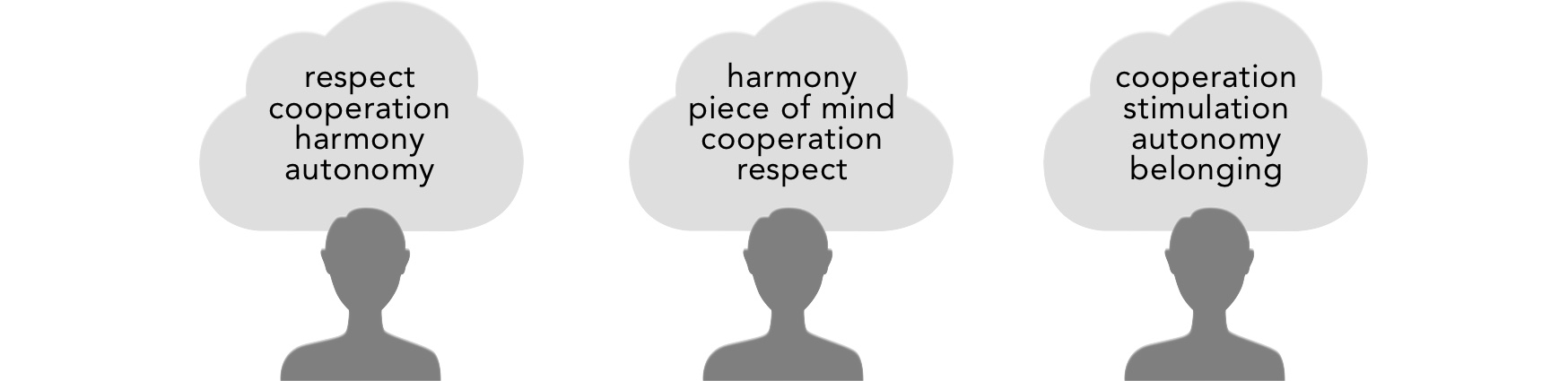 |
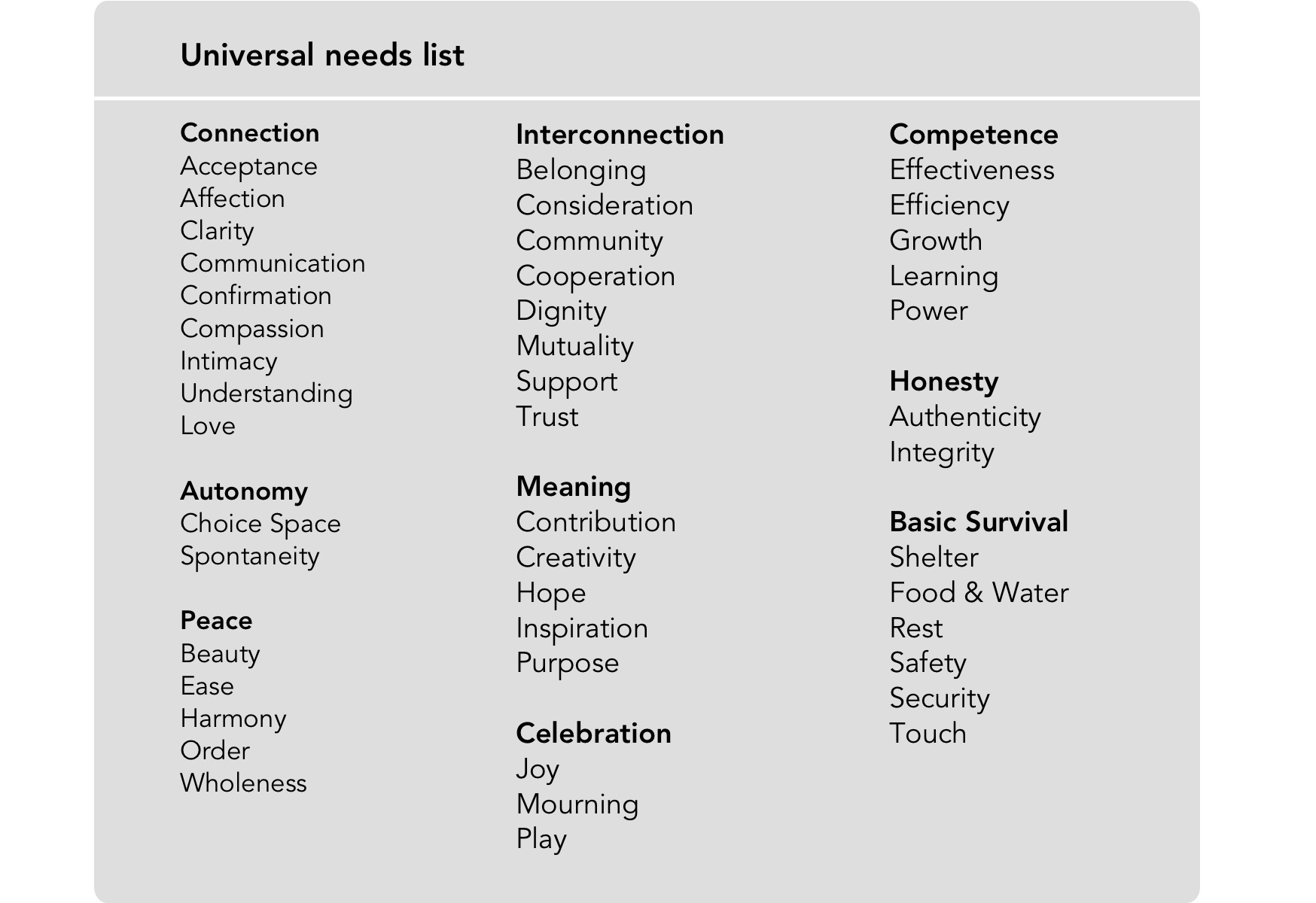
Table Figure 4.2, “A partial list of universal needs. The list is also on the meeting sheet for facilitators in the appendix on page Figure A.4, “Meeting sheet for facilitators” and we are providing a list including feelings in the appendix on page Figure A.2, “Feelings and needs list”.” shows a list of the most common needs.
Figure 4.2. A partial list of universal needs. The list is also on the meeting sheet for facilitators in the appendix on page Figure A.4, “Meeting sheet for facilitators” and we are providing a list including feelings in the appendix on page Figure A.2, “Feelings and needs list”.
 |
What we choose to do to meet needs is referred to as strategy. Strategies are not good or bad. But some are more effective than others, and that depends on the context. Going to the movies is an effective way of meeting the need for connection for some people. For some it is not, and they would choose to do something else to meet their need for connection. When we are not aware of our needs behind our strategies, it is very easy to get side-tracked into astonishingly ineffective strategies. Have you ever steamed out of a room, upset because what you really needed was connection? Leaving the room does not seem to be an effective strategy to get connection. Or when we yell at children because what we need is quiet? This is neither right or wrong in a moral sense, but it certainly is not effective.
Movies or dinner out -- we can argue over strategies. But who can argue with the need for connection? All humans share this need. And that is true for every universal need, like stimulation, autonomy, cooperation, love, or the need to be seen. Our basic set of universal needs is probably roughly the same between people, we just differ in how important some needs are for us in the moment. On strategy-level, there is a lot more variation. What works for us might not work for someone else. There is no 1:1 relation between needs and strategies. The same need can be met by different strategies. For example my need to be seen can be met by writing a post on social media, or by having a conversation with a neighbor. And a strategy can meet several needs, for example the conversation with a neighbor can meet my need for stimulation, for connection, or for belonging.
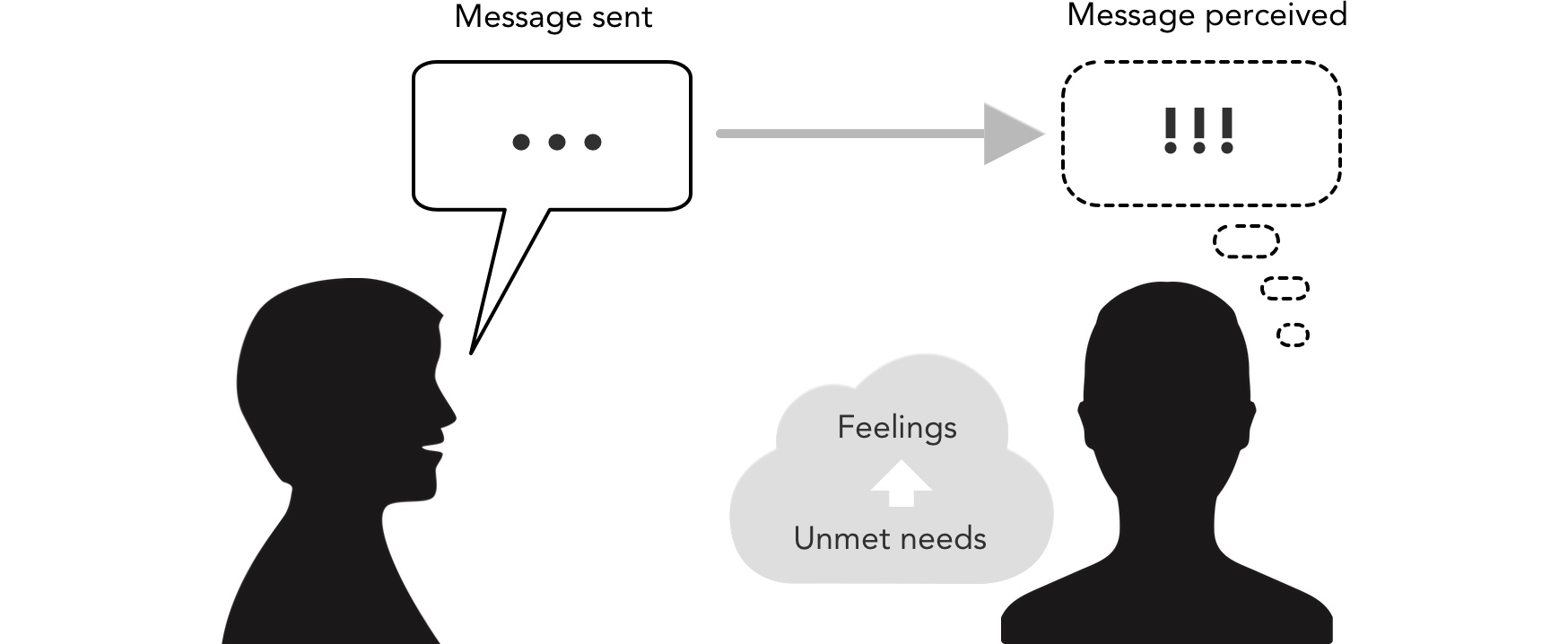
Feelings are pointers to met or unmet needs. We all walk around having needs that bubble up. What happens if a need is not being met, for example our need for connection? We might get sad. Or mad. Unmet needs will trigger feelings. On the flipside, when an important need is met, we might feel happy: when we get an unexpected phone call from a friend in a moment when connection was what we were longing for, we will probably feel happy or excited. There is a list of feelings in the appendix together with the needs list on page Figure A.2, “Feelings and needs list”.
Feelings are caused by met or unmet needs, not by situations. That means that no one and nothing can directly cause your feelings. “You made me angry” is not an accurate description of what is going on. Let’s look at the figure in Figure 4.3, “Feelings are triggered by messages but not caused by them.”. Something happens and we react to what we hear, not to what has been said or done. We see and hear everything through a layer of interpretation. But for this chapter, it is even more important to see the next step, what happens after we receive (and interpret) a message. Consciously, or unconsciously, we evaluate. How does what happened to contribute to my needs being met or not met? It is the evaluation that triggers the feelings.
Figure 4.3. Feelings are triggered by messages but not caused by them.
 |
If our interpretation remains on the level of feelings or strategies, we cannot find out what is really going on. Going to the level of needs enables us to make more informed guesses about what might be an effective strategy. Sometimes people who hear about non-violent communication fear that they will “not be allowed to say what is really going on”. The opposite is true for us. Feelings and observable strategies are merely surface phenomena. Since needs are underlying everything we do and feel, talking about needs is talking about what is really going on. Some people who start learning about needs and feelings consider this semantics. The fact that feelings are not directly caused by others, however, creates space for choice. Seeing the difference between strategies, needs and feelings creates space for inner freedom, and an opportunity for change.
Requests are when we ask someone to do something. The more specific and doable a request is, the more likely it will be effective. The other person is invited to say yes. We naturally want to contribute and because we also want choice, we naturally resist demands.
Non-violent communication (NVC) makes a distinction between action requests and connection requests that is very useful to organizational life. Action requests are simply that – “would you make copies of this form? Would you call that potential donor or customer?” Sometimes action requests are requests for collaboration: “Would you help me brainstorm ideas for a new webinar series on sociocracy? Would you be willing to sit with me and talk about how we could improve our relationship?”
The only reason anyone would ever say no to a request to contribute to our needs is that they are saying yes to meeting their own needs. The no becomes the invitation to connection – a mutual understanding of each other’s needs. Therefore, there are two kinds of connection requests. To be understood: “Would you be willing to tell me whatever you heard me say?” To understand: “Would you be willing to tell me what comes up for you when you hear what I said?” Imagine what we could accomplish if (a) we could eliminate misunderstandings and (b) hear each other more empathically!