 | 4.6. Performance reviews | |
|---|---|---|
| ↢ | Chapter 4. Feedback and Learning | ↣ |
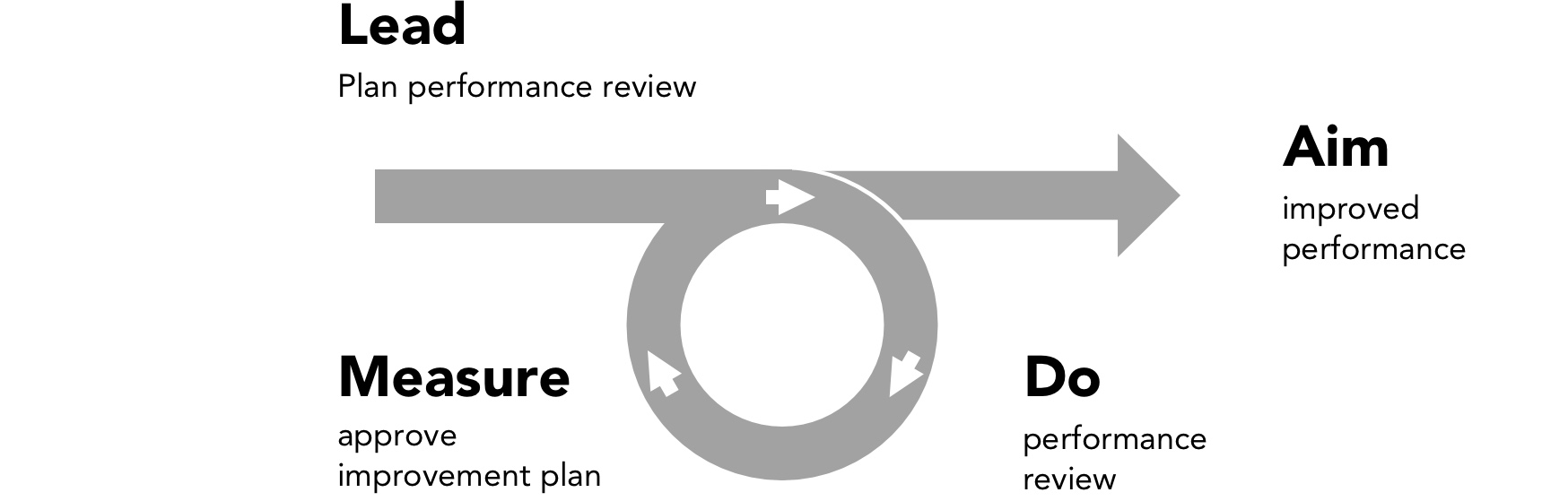
Performance reviews bring in feedback from the people who know us best in our organization: our coworkers. The person whose performance is reviewed is called the focus person. (Note: it can also be an entire circle who is in the focus.) The performance review cycle starts with informing, inviting and scheduling the members of the performance review circle (aka assessment circle). They develop an action plan of how the focus person can improve. It ends with a decision by the focus person’s circle to accept the improvement plan.
Figure 4.16. Lead–do–measure for performance review
 |
The first step is to have the right people in the room. The aim of a performance review is to give feedback to the focus person in their role(s) in the organization. We can do a performance review in our circle if we are only part of one circle. The performance review can also be done by a group of members who do not usually form a circle. For people in linking roles (leader or delegate), we need the perspective of all circle layers we are a part of. If there is substantial interaction to another circle (for example in a hand-off to a more specific ‘‘sub’’-circle), then one or two members from that circle can be invited to the performance review. The idea is that every level relating to the focus person is represented. Not everyone in a related circle needs to be invited, keeping the group to a workable group size.
A performance review can take place in a separate meeting, or it can be integrated into a circle meeting. The focus person:
The feedback circle will come up with an improvement plan. The improvement plan is like any other proposal. Since a performance review works exactly like policy-making, it also follows the same pattern. We can break the process into the usual understand–explore–decide (input–transformation–output for decision making) as shown in example Figure 4.17, “A default format of a performance review if a whole meeting is called just for this purpose”.
Figure 4.17. A default format of a performance review if a whole meeting is called just for this purpose
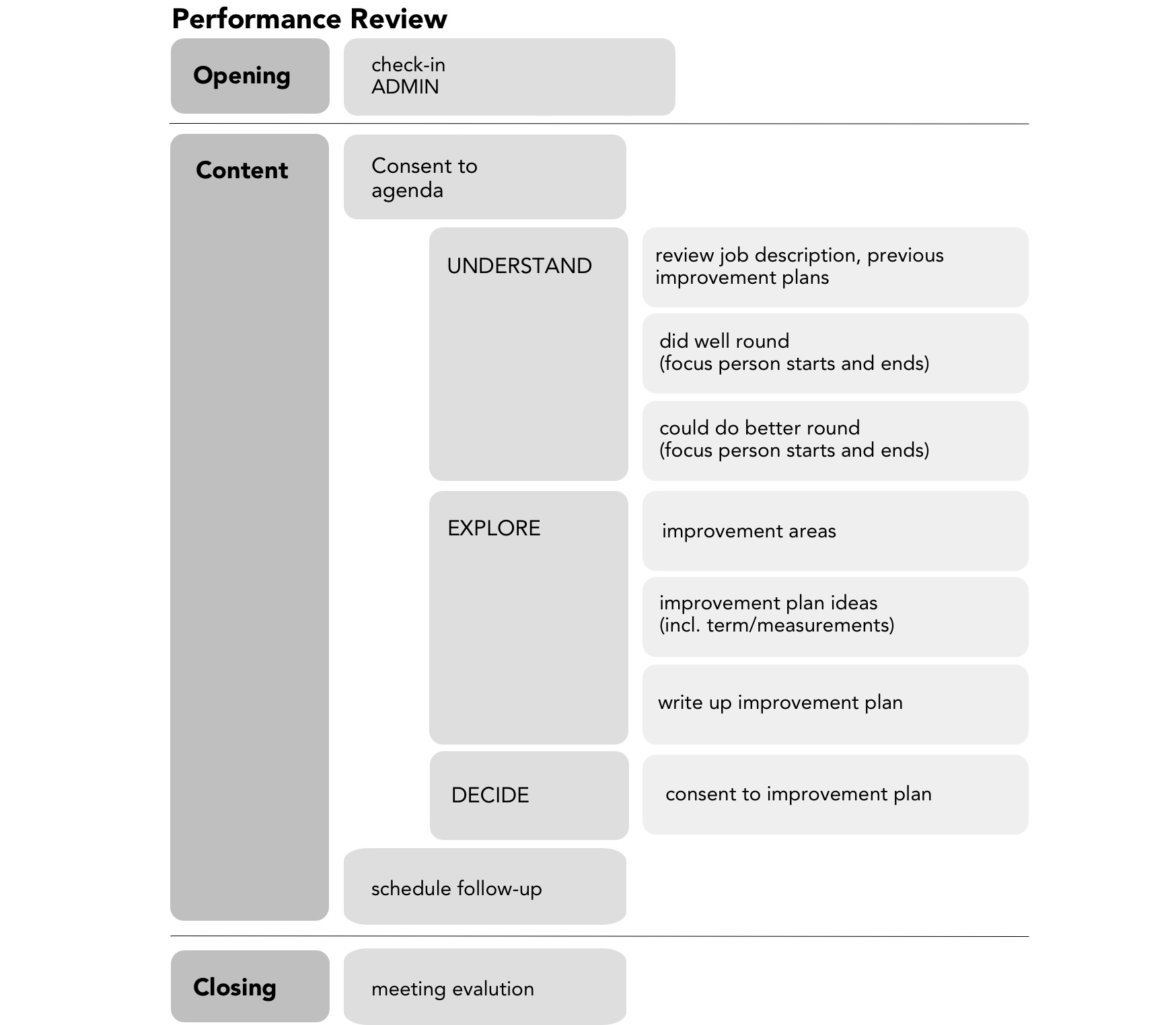 |
We will see that in the meeting sheet for facilitators in the appendix on page Figure A.4, “Meeting sheet for facilitators”, there is a more general format that can be done as an agenda item within a meeting.
In the understand phase, we review everything that needs to be known
We’ll do two rounds that provide more input: what has the focus person done well, and what could they have done better?
The focus person speaks first about what they have done well in the areas of production or service, process and interpersonal interaction. Then each person in the performance review circle shares their perspective on what the focus person has done well. The focus person speaks last in the round and summarizes what they heard.
Below are some possible statements that would include effective feedback in that round, both by the focus person and by the other participants of the performance review. Good feedback in a performance review includes general assessments (while making it clear that they are no absolute truth) and specific examples for illustration. We can describe the impact the focus person’s actions and way of being has on us.
“I enjoy your leadership style. I experience you as reliable, for example when it got forgotten to call the electrician and you noticed that on time and were able to intervene successfully.”
“I appreciate your voice in the circle. What you say always seems to add to the discussion. I very much admire how you always pass when you do not have anything new or relevant to say. To me, that just makes your voice more valuable because you seem to choose wisely what needs to be said without taking yourself too seriously.”
“I think your energy is great. I feel your attitude as positive and genuine, you seem to give this circle a sense of ‘we can do this’. I loved when you pulled out that diagram a few meetings back that showed all the ways of dealing with an objection. What I noticed was how important it was for the circle, and certainly for me, to be aware that we have options. You really moved the circle forward there in my view.”
‘‘I like how you seem to be the calm center of the circle. Even when people are stuck or excited and want to do everything at the same time, you keep calm, and in my opinion that contributes so much to the group because you’re a needed counter-part to us. That gives me some peace of mind because I know we might drop things but you will notice. That also shows in your writing minutes, they are correct and thorough and organized. That supports us in doing our work.”
Feedback on what a focus person has done well is an implicit request to continue or even do more of what they do well.
Again, the focus person speaks first, then the others take turns and the focus person summarizes what they heard. Both saying and hearing what someone has not done well can be hard to do. It is particularly helpful here that the focus person goes first. This sets up the context where the other speak as allies to the focus person who is welcoming feedback. We encourage kindness, honesty and self-responsibility.
Below are some examples of what is traditionally called ‘‘negative’’ feedback (which, in this case, is not negative feedback but expresses someone’s need not getting met sufficiently).
“I have a hard time staying engaged during meetings in general, and it helps me when a meeting is structured so I know what’s going on. I would love for you as facilitator to support me in that by saying more often, what the frame is for a round and where we are in the process. Maybe we could put a poster up of the different steps, and then you and we could refer to it? That is my request of you because it would help me be more relaxed in meetings.”
“I appreciate that you are carrying so much of the load when it comes to our finances. I would like to express some concern because we don’t seem to have any redundancy, which also means no one can help you, I would like to have some basic understanding of how our coop is doing financially to give me some peace of mind. I trust you but any role should have some redundancy. I would like for someone to learn from you so it does not always have to be you doing our finances.”
“I have something to say that might be a little hard to hear because it is clearly judgmental from my part. It is important to me to feel comfortable in all our meetings, and I am not comfortable when we talk about IT tools. I pick up a sense of impatience on your part, like all the IT is easy to understand for you while I am really struggling. Just taking care of myself for a second, I would like to know that I am seen for my intentions which are to be productive and to be doing my best to learn the new tools. I am curious how my judgment that you get annoyed and brief when it comes to that topic lands on you and how you look at this. My request would be for you to be a bit more gentle with me because I get anxious when I do not feel competent, and I would sense judgment even where there is none. This is hard for me and it is impacting how I participate in our work here.”
“There is something that is not working for me. I often come in for my shift after yours and find food on the counter that belongs in the fridge. I am worried about safety and sanitation here. I’d love to hear what comes up for you hearing this.”
Being specific in our feedback makes improvement plans doable. Again, at the close of this round, the focus person summarizes and interprets what they have heard, and circle members can confirm that they have been heard as intended.
It’s time to be creative again. What could be done (by the focus person or elsewhere) so performance could be improved? Before jumping to solutions, we distill from the input we have gathered previously.
In the explore stage, we now proceed the way we would for policy-making. We now have a complete image of what is relevant to know about the focus person in this context. Where do we see areas for improvement? (Not how do we want this to be improved?) This is very much like picture-forming in regular policy-making. Examples of dimensions could be:
communication
response time to email
tech support
public speaking
flex time
This can also include areas where the improvement would be that we want to see more of something the focus person is doing well! This step probably only takes a few minutes or less and is complete when everyone consents to the list of dimensions.
The next step is to brainstorm action step ideas. How would people like to see improvements in those areas? Make it specific and doable. The improvement ideas could be tied back to dimensions. Examples could be:
‘‘For communication, I’d like you to get some training in NVC, for example an online class of your choice, by this fall.”
“I’d like for you to respond faster to email, like within 24 or 48 hours. I’d love to hear from you whether there is a way to organize that in a way that would work for you.”
“You’re such an awesome resource for tech help, I’d like to see you bring that in more. I am also concerned about over-loading you. So I’d like for you to reserve 2h per week for that and be intentional about not doing more. I’d like for you to track it. If we find out it takes considerably more time, we should look at that and maybe hire someone for that. We can’t just rely on you for tech support. I want to make sure your skills are used well, and that’s more than just tech support.”
“Since you mentioned public speaking yourself as an area for improvement, I suggest you commit to doing 3 public speaking events by the end of the year and getting more coaching to support that.”
There could also be improvements that affect more than just one person and need to be addressed elsewhere, for instance policies around work time.
“We have identified flex time as an issue. Since that seems to be a bigger issue since it does not only affect you, I’d like to send this to work schedule circle to look at.”
Proposal ideas can also be contradictory (as they could be in any proposal shaping process). As usual, we just write them all down.
“Yes, you mentioned public speaking as an area of growth but I do not think this needs to be a focus area right now.”
“I’d like to modify your role description to include more IT support work.”
If it is easy and straightforward, we can now turn the proposal pieces into a proposal for improvement. The proposal ideas do not only cover actions in the domain of the focus person. They can also be sent somewhere else. As usual, the evaluation can bubble up information that is relevant in a broader context, like a change in the job description or like the flex time policy in this example. This information might not come up anywhere else, so make sure to harvest it here.
Remember, any good policy also has a term. Making a date for a review -- and/or the next performance review -- is an intentional decision that might depend on the pieces of the proposal (that might each have a timeline, like ‘‘3 public speaking events by fall’’). The policy will also have measurements and metrics, depending on what we want to measure.
Someone – most likely but not necessarily the focus person – will organize the proposal ideas into a proposal. This might all happen within the meeting or after the meeting. Regardless of when the proposal is being written up, the process continues: the proposal requires the feedback circle’s consent. Possibly, it can also also require the consent of all of the circles in which the focus person is a member. (It depends on the focus of the performance review. Find a reasonable balance between a focus that is too wide and a focus that is too narrow. The decision of who is going to have consent rights on the proposal should be made before the performance review begins.)
The proposal needs to be stated clearly and distributed to everyone with consent rights. Then it needs to be approved, by consent by (at least) the performance review circle – including the focus person – and/or all the circle with whom the focus person works. The improvement plan will be kept in the records in written form (public to the organization) like a policy but not in the policy agreements since it only affects one person.
Once the term gets close, the focus person will start planning another performance review and the cycle begins again. The next performance review acts as a measure for whether the improvement plan has been put into practice, and at the same time as the beginning of a new cycle.