 | A.3. Resources | |
|---|---|---|
| ↢ | Appendix A. Appendix |
| A.3. Resources | |
|---|---|---|
| ↢ | Appendix A. Appendix |
Buck, John and Sharon Villines (2017). We the People: Consenting to a Deeper Democracy. Second edition. Sociocracy.info.
Eckstein, Jutta and John Buck (2018). Company-wide Agility
with Beyond Budgeting, Open Space & Sociocracy: Survive and
Thrive on Disruption. See
https://leanpub.com/bossanova
Charest, Gilles (2007). La démocratie se meurt, vive la sociocratie! Edizioni esserci. (French)
Endenburg, Gerard (1998). Sociocracy as Social Design: Its Characteristics and Course of Development, as Theoretical Design and Practical Project. Eburon, Rotterdam.
Endenburg, Gerard (1998). Sociocracy: The Organization of Decision Making. “No objection” as the Principle of Sociocracy. Eburon, Rotterdam.
Romme, Georges (2016). The Quest for Professionalism: The Case of Management and Entrepreneurship. Oxford: Oxford University Press.
Romme, A. Georges L. and Gerard Endenburg (2006). Construction principles and design rules in the case of circular design. Organization Science, 17: 287-297.
Romme, A. Georges L. (1999). Domination, self-determination and circular organizing. Organization Studies, 20: 801-832.
Romme, Georges L, Jan Broekgaarden, Carien Huijzer, Annewiek Reijmer and Rob van der Eyden (2018). From competition and collusion to consent-based collaboration: A case study of local democracy. International Journal of Public Administration, 41: 246-255.
Rosenberg, Marshall (2003). Nonviolent Communication: A Language of Life. 2nd edition. PuddleDancer Press.
Wineman, Steven (2003). Power Under. Trauma and nonviolent social change.
(See
http://www.traumaandnonviolence.com)
You want to learn more! Great!
Since the sociocratic landscape is changing and evolving all the time – as it should! The most current information will always be online. Globally, there are more and more sociocratic consultants and trainers, communities and parts of the movement.
Sociocracy For All. http://www.sociocracyforall.org. A
non-profit committed to spread sociocracy and make it accessible
to everyone. Resources, networking, training, consulting.
The Sociocracy Group.
http://www.thesociocracygroup.com/. A consulting
group focused on sociocracy, mostly in Europe.
The Sociocracy Consulting Group.
http://www.sociocracyconsulting.com/. A consulting
group focused on sociocracy, based in N. America, Australia and
Canada.
Governance Alive.
http://www.governancealive.com/
Sociocracy 3.0.
http://www.sociocracy30.org/
We invite you to explore how you could do sociocracy instead of learning about sociocracy. What can you do that is a small step toward implementing some of the ideas and tools? How can you become a more experienced facilitator? Where could you take this to make it come alive? Could it be, for instance, an online class on facilitation to become more familiar and to bring more positive change to your immediate community?
Join a community of practice, within SoFA or outside of SoFA.
The list serve in sociocracy.groups.io is a popular place
for ongoing discussion of sociocracy and is open to new members.
SoFA’s Facebook group
(www.facebook.com/groups/SociocracyForAll/) is another
place where you can post questions and meet people. Sign up for the
SoFA mailing list and you will receive several emails a month with
references to new articles and videos, and upcoming webinars and
training. Check out the SoFA youtube channel
(www.youtube.com/c/sociocracyforall) and the SoFA website
sociocracyforall.org for a virtual library of videos,
articles, visuals and sample documents – most valuable for download
free with creative commons license. We have a study group curriculum
that you can use to try out sociocracy formats.
The reason we decided to write a book is that we wanted all the information in context and in one place. We try to update our materials while staying aligned with terminology and basic patterns to remain our content coherent and accessible.
The materials that are or will become available with this book are:
The meeting sheet (see page Figure A.4, “Meeting sheet for facilitators”) in high resolution and with translations into different languages.
Links to translations of parts and entire versions of the book – talk to us if your language is missing and you would like to help out. For SoFA, accessibility also means offering as many resources as possible in people’s own languages.
Digital versions of the feelings list and needs list (see page Figure A.2, “Feelings and needs list”).
In planning stage, as of June 2018: governance agreements repository (a collection of governance agreements, by-laws etc.), videos of the skits in this book etc.
Please see www.manyvoicesonesong.com to
access these resources.
Figure A.2. Feelings and needs list
Get a high-resolution image on our website under
www.manyvoicesonesong.com.
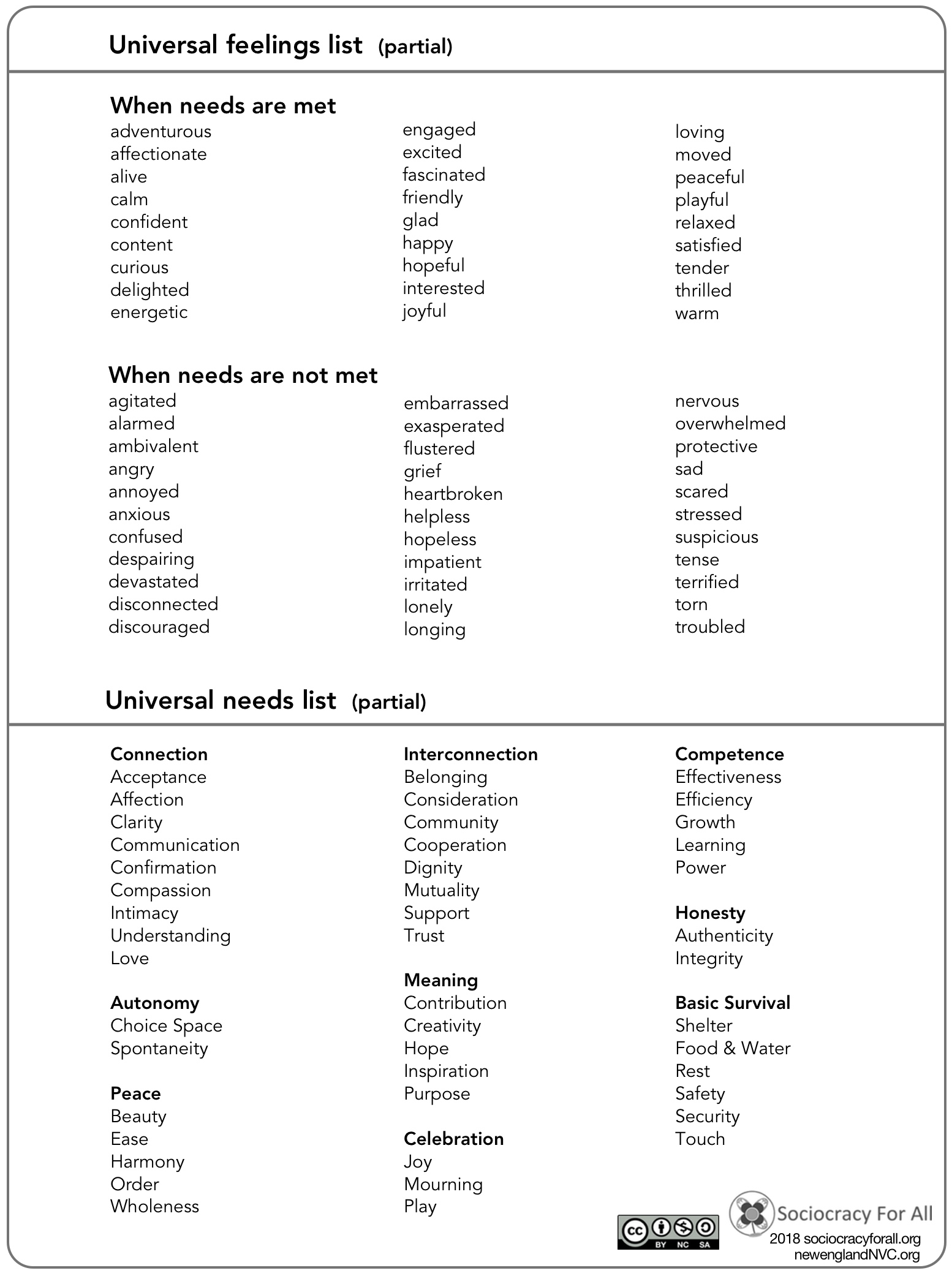 |
Figure A.3. A sample version of a feedback form
Get a high-resolution image on our website under
www.manyvoicesonesong.com.
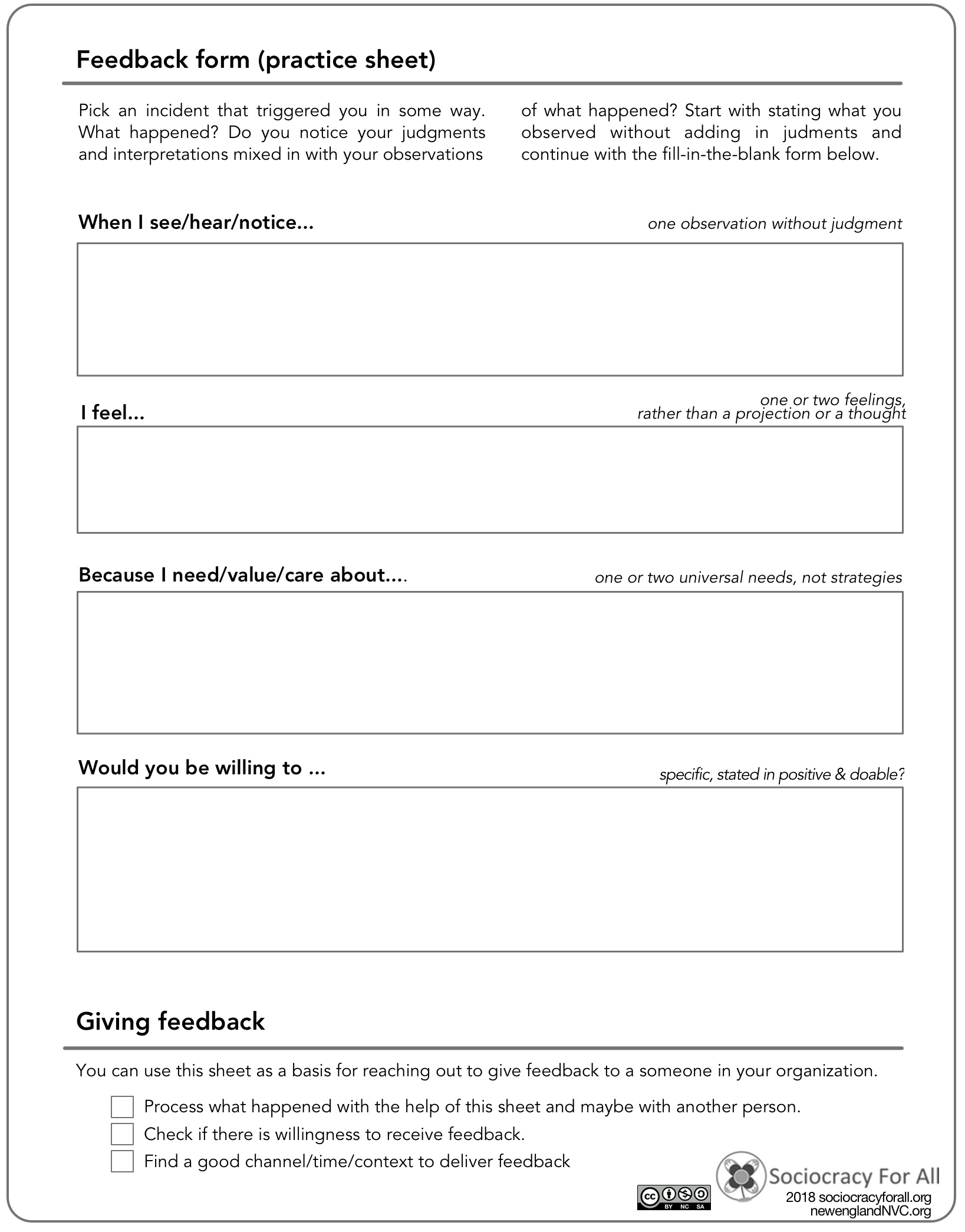 |
Figure A.4. Meeting sheet for facilitators
Get a high-resolution image on our website under
www.manyvoicesonesong.com.
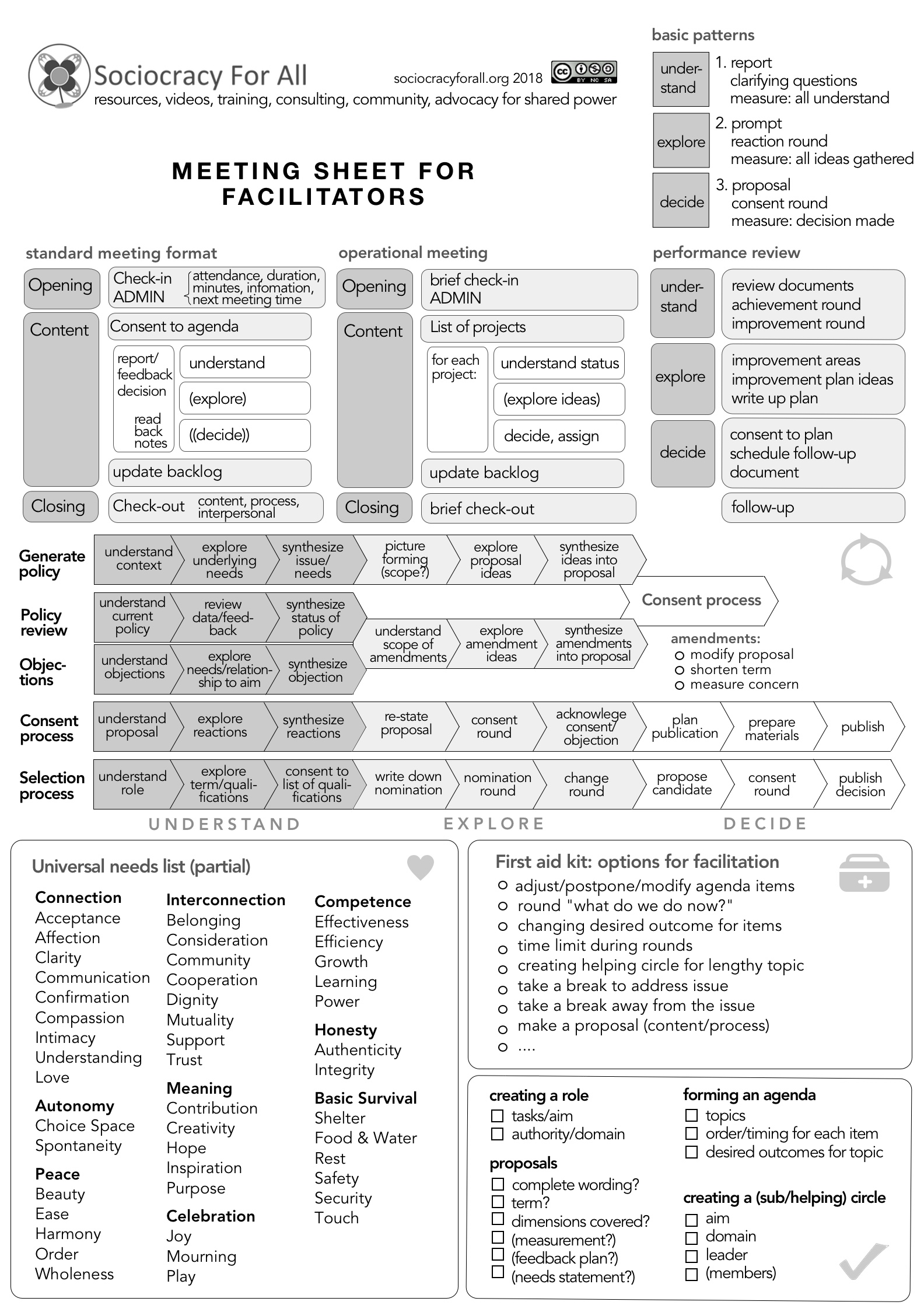 |
Figure A.5. 3x3 matrix for the selection process
In this matrix, you can see each step used in the selection process in the context of input–tranformation–output and understand – explore – decide. Each step has a quote to make more tangible what is entailed in each step.
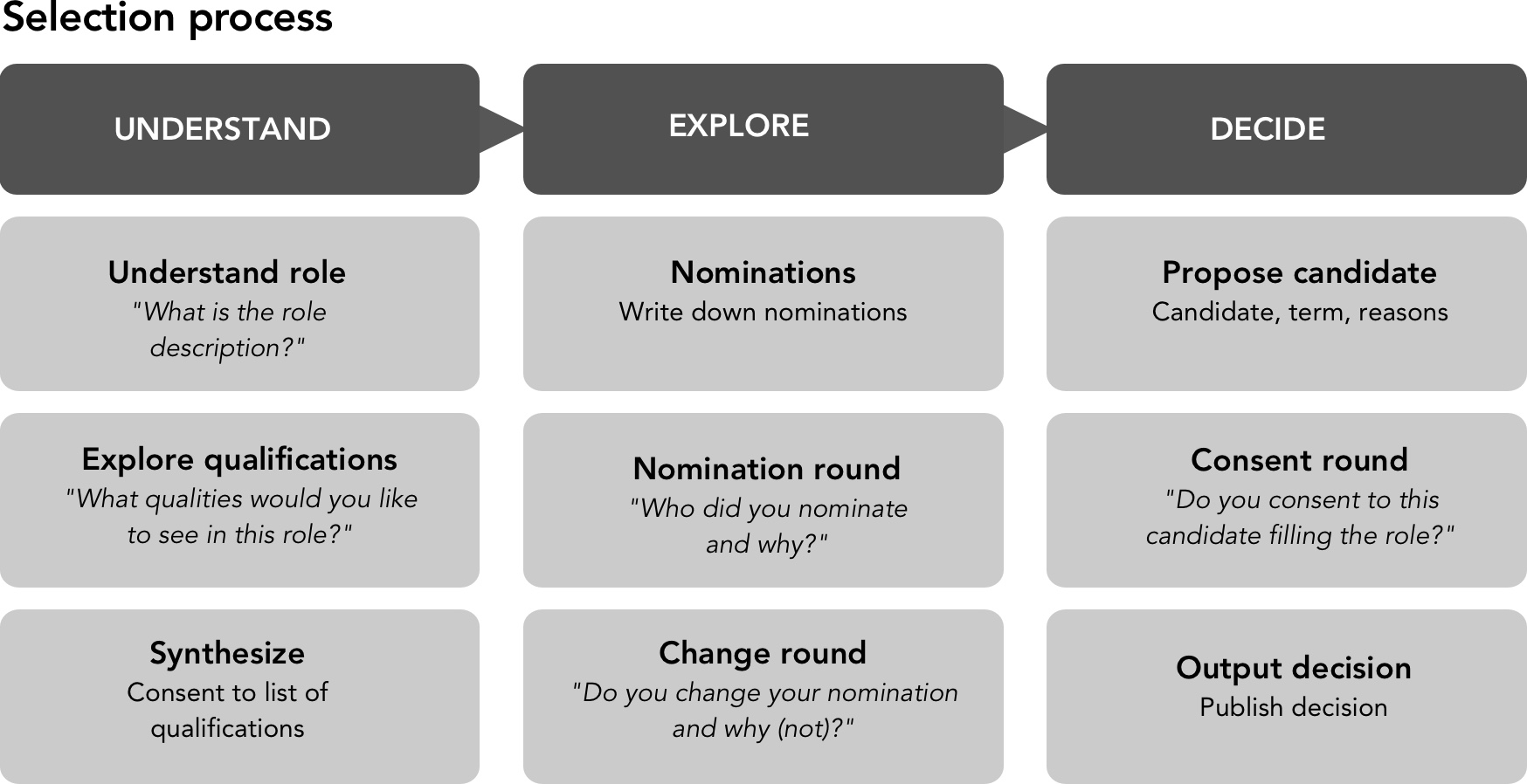 |
Figure A.6. 3x9 Matrix for the selection process with skit
This is a more detailed version of Figure A.5, “3x3 matrix for the selection process” – the most reasonable level of detail for the selection process. The columns in Figure A.5, “3x3 matrix for the selection process” are now arranged vertically to allow the reading flow. Each step in Figure A.5, “3x3 matrix for the selection process” now falls into three steps (lead-do-measure). We also added the framing statements for each part as they would sound like in natural language.
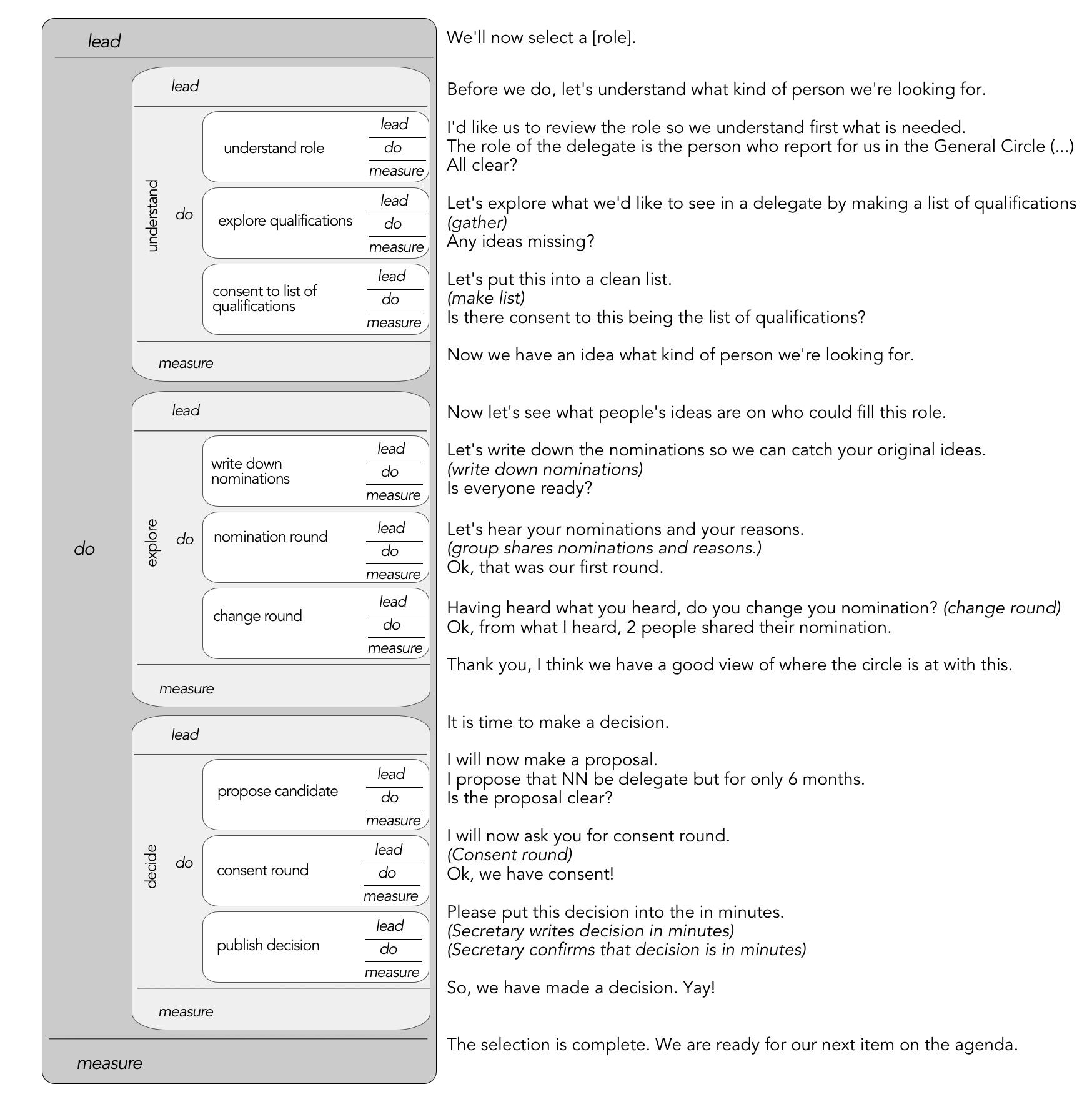 |
Figure A.7. 3x3 matrix for the policy process
In this matrix, you can see each step used in the policy generation and decision process. Figure A.8, “3x3 matrix for the consent process” is the more detailed chart of the last third of this chart.
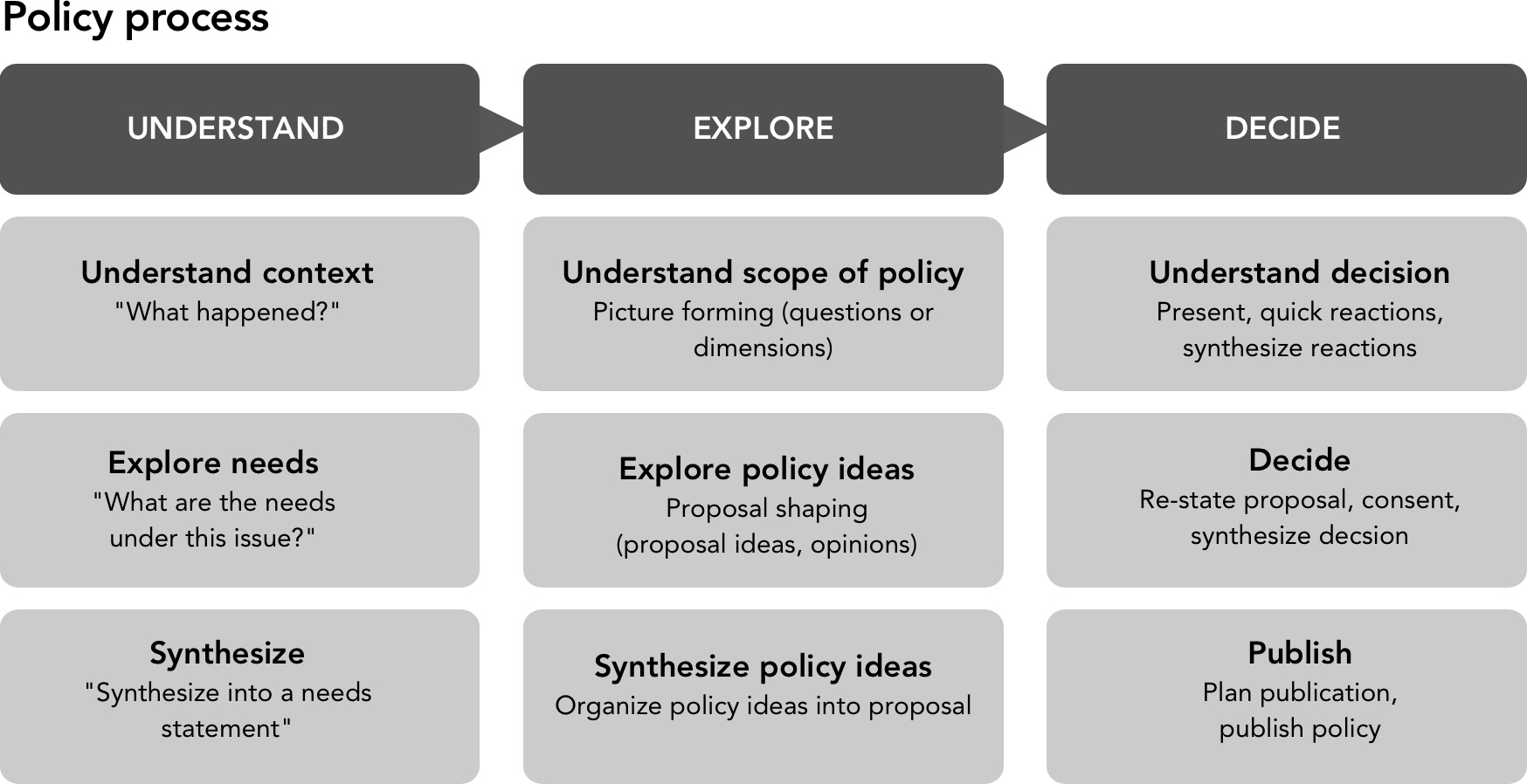 |
Figure A.8. 3x3 matrix for the consent process
In this matrix, you can see each step used in the policy generation and decision process. This is the more detailed version of the last third of Figure A.7, “3x3 matrix for the policy process”.
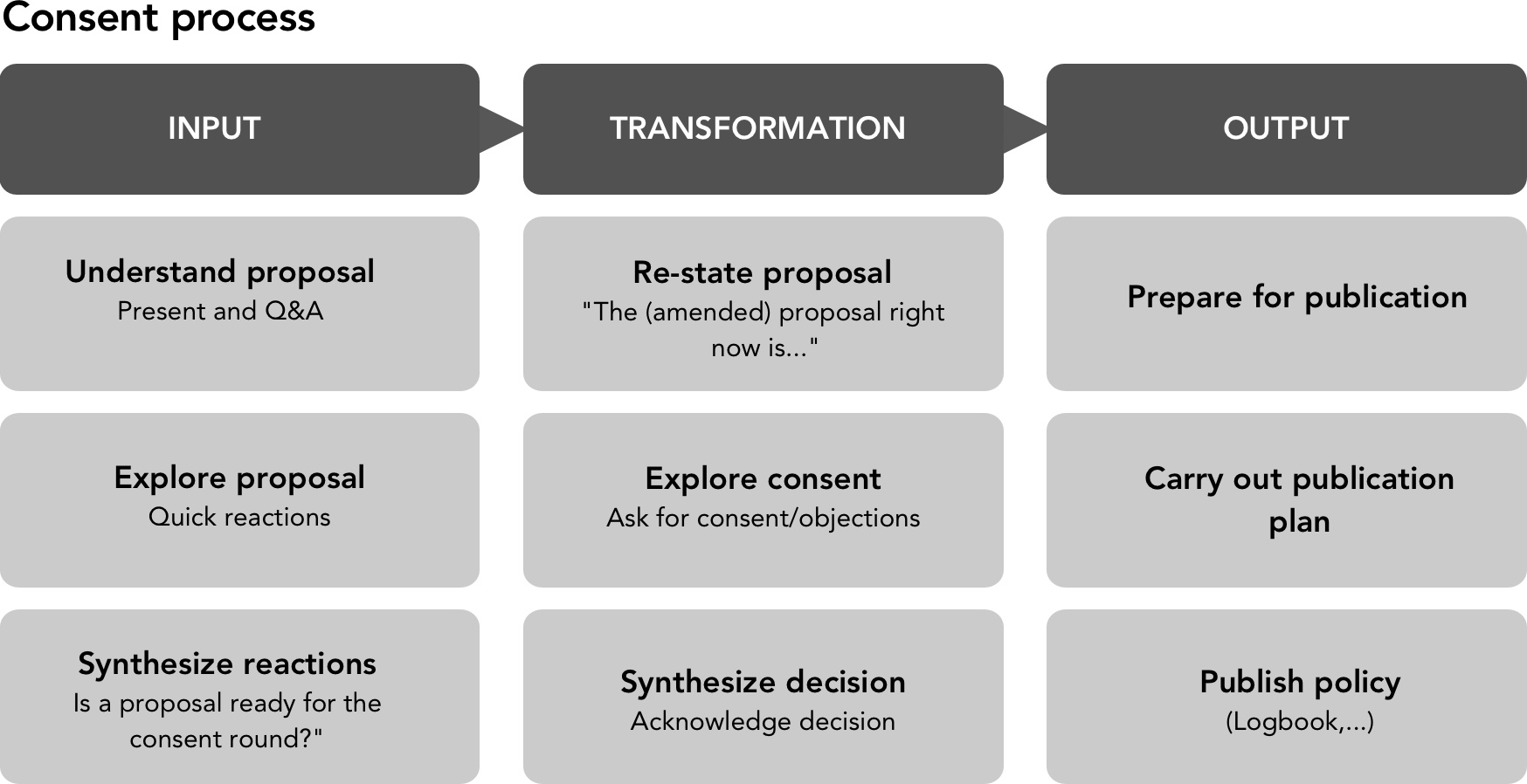 |
Figure A.9. 3x9 Matrix for the policy process with skit
This is the flow of understanding the need, generating policy and decision about policy. The last third, the decision process, is shown in more detail in Figure A.10, “3x9 Matrix for the consent process with skit” on page Figure A.10, “3x9 Matrix for the consent process with skit”.
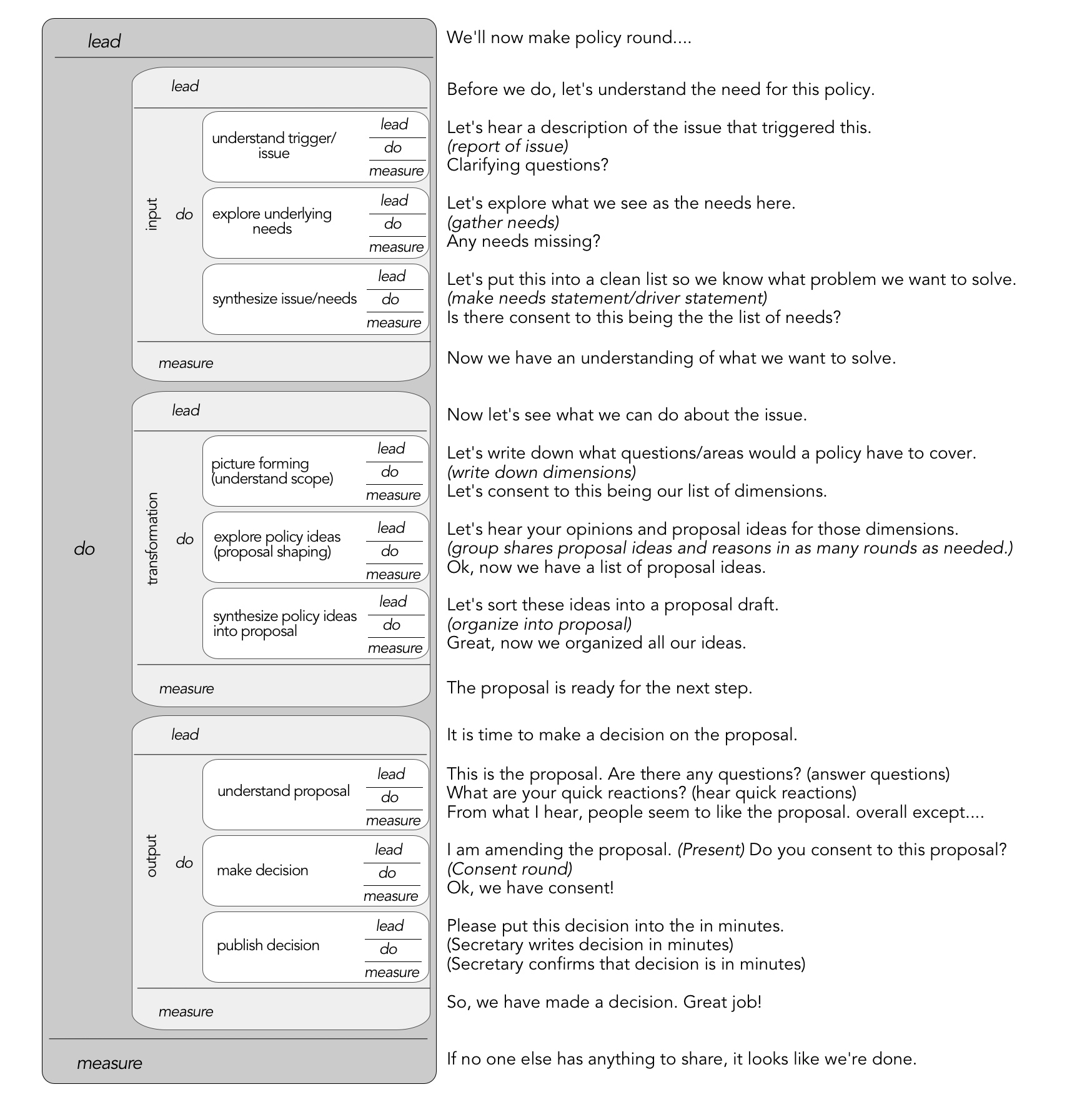 |
Figure A.10. 3x9 Matrix for the consent process with skit
This is the more detailed version of the last third of Figure A.9, “3x9 Matrix for the policy process with skit”. Note the level of detail needed in the decision-making process. The output phase might be much simpler in a small organization.
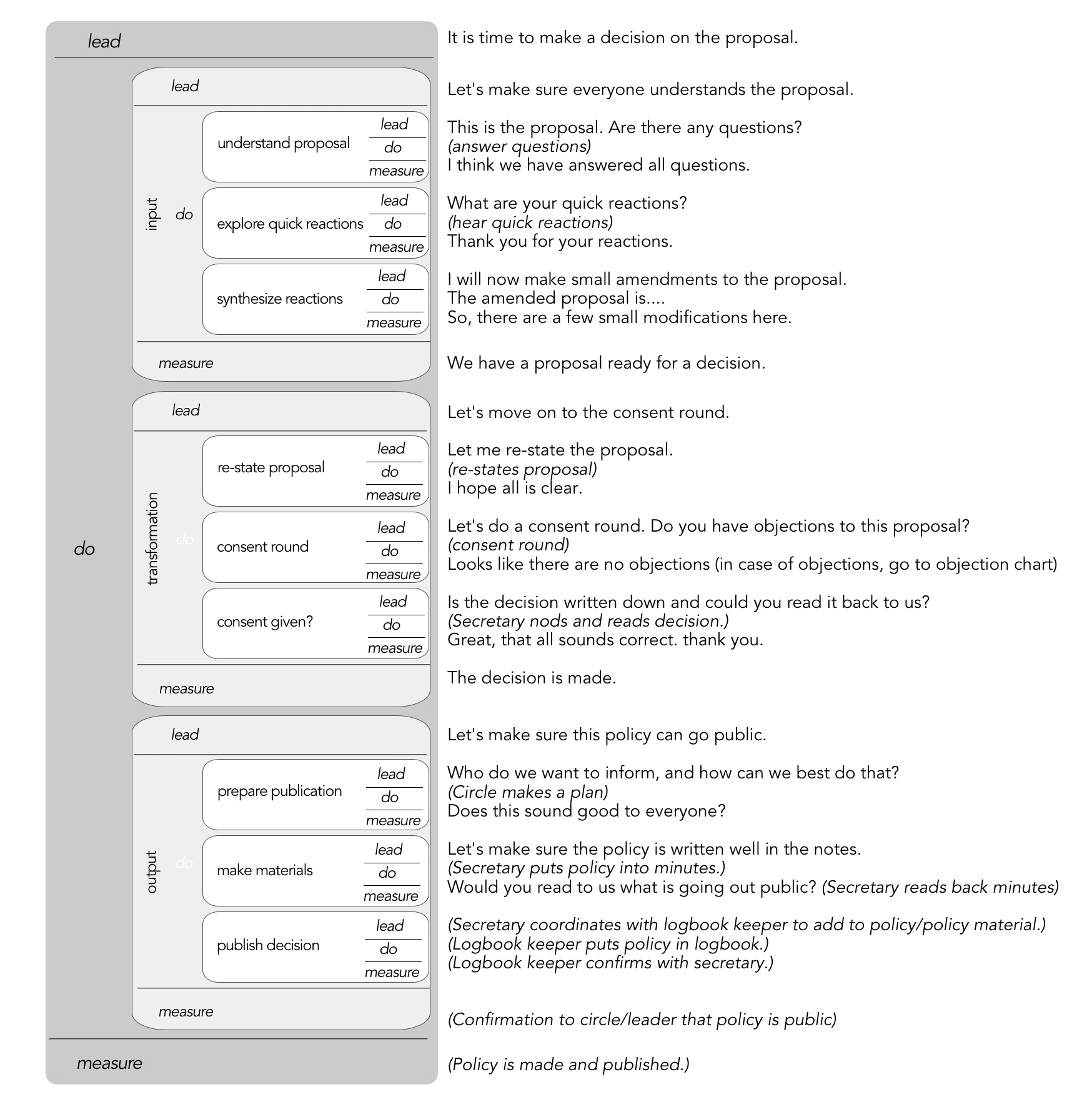 |
Figure A.11. 3x3 matrix for the dealing with objections.
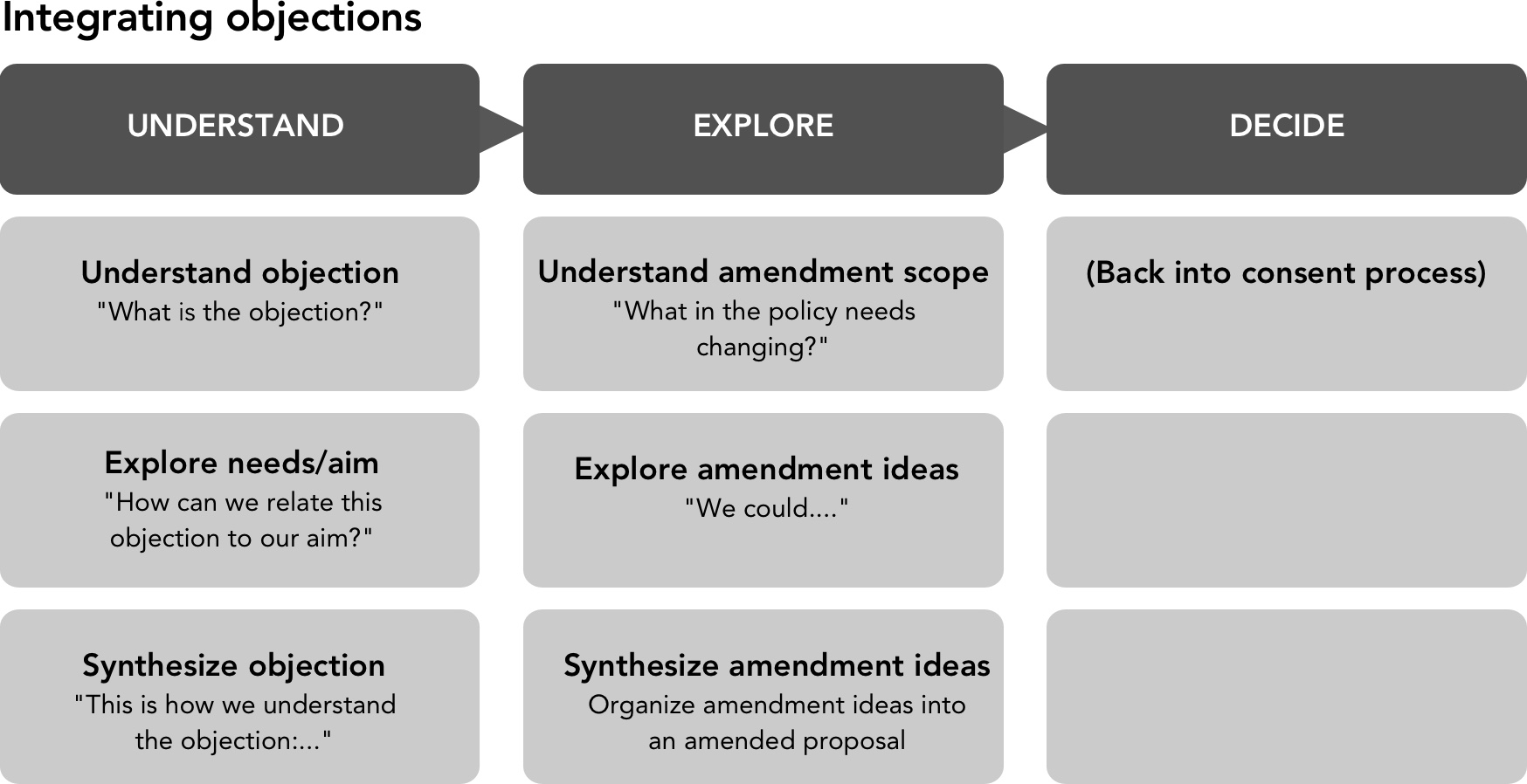 |
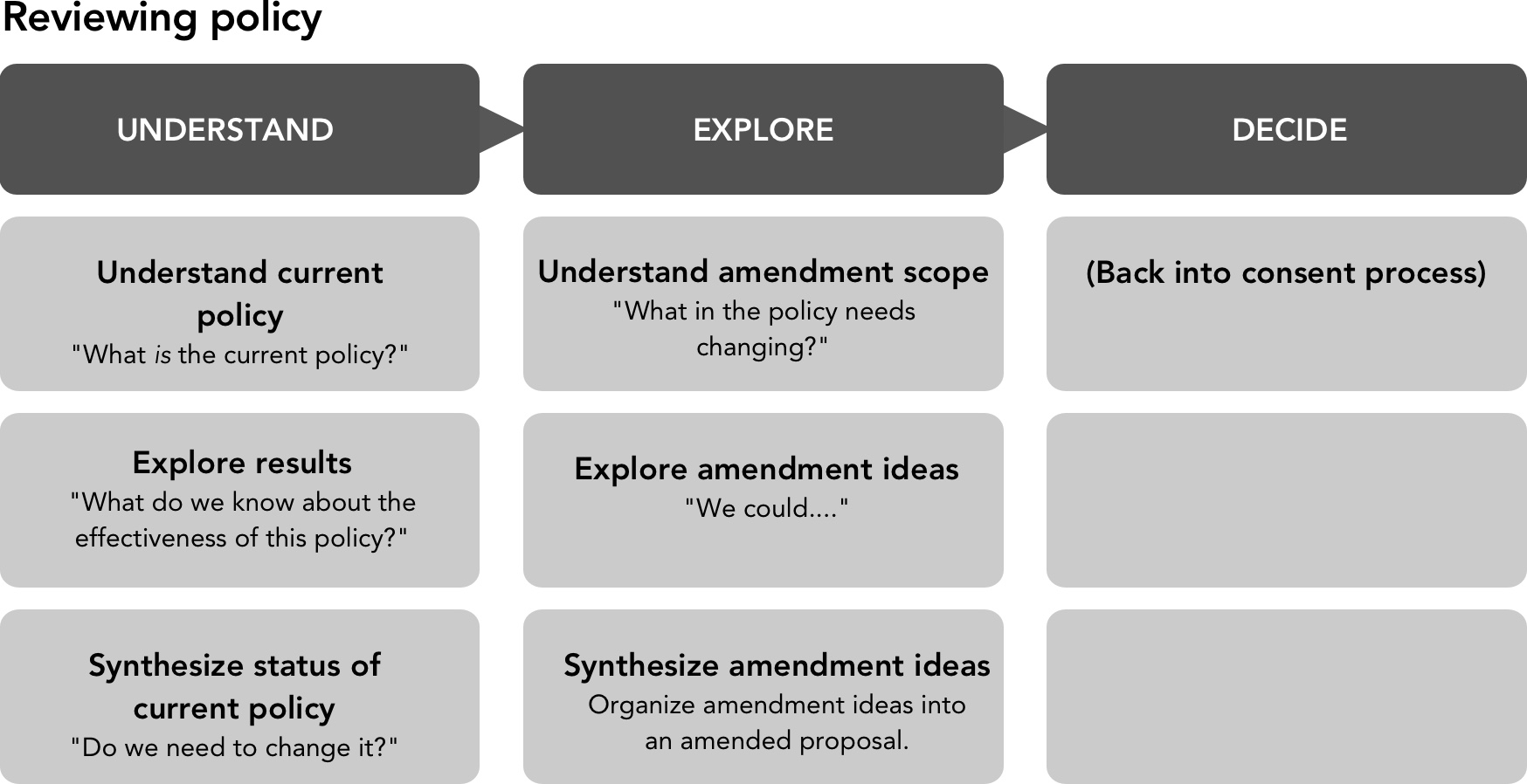
Figure A.12. 3x3 matrix for reviewing policy.
 |