 | Appendix A. Appendix | |
|---|---|---|
| ↢ | ↣ |
Table of Contents
Sometimes we can feel it when the insight sinks in for people. It tends to happen when training participants experience the sociocratic circle structure with their own bodies, standing in linked circles. They experience how sociocracy embodies interdependence. How it ensures transparency. How no one can be overpowered anymore. How sociocracy requires self-responsibility. Some training participants get silent, while their minds and hearts are taking in what they see and feel. Sometimes they say things like “ …but …that’s…big” – expressing how deep and how wonderful of a change sociocracy would mean to their company, their community or their volunteer organization. They become filled with hope and excitement. A few get tense or sad, as they lack confidence that their own organization might ever embrace a system like sociocracy.
We all have had our share of experiencing oppression. Our extractive and divisive system hurts everyone. That’s why, in sociocracy training, there is never just practice. The power structures that are out there in the world are ingrained in us and therefore they are always in the room, very close to the surface, and with it our pain, sadness, fear, hope and longing.
Sociocracy is not a superficial tool to make workers feel like they have more power so they gladly put in more effort into a system built on power-over. It’s not another management method. It’s deep change. It’s real. To us, sociocracy is a tool so powerful it can be the operating system for a new paradigm and economy: based on connection, consideration and care. In boardrooms and in living rooms. In classrooms and in community buildings. Our vision is a world outside of the paradigm of right and wrong, winners and losers. All of us know that a more beautiful world is possible, we feel it and we long for it. We are equipped with what it takes to live it. AND we need to create an environment that brings out those strengths. Systems that allow us to work from the longing for connection instead of stuffing it. Systems that are built on trust, instead of systems that reward divisiveness and ridicule or outlaw consideration.
Pretty words won’t make it happen. Good intentions won’t be enough, and neither will awareness or individual action. Taking on a system ingrained in mainstream culture requires more than that. More people need to know that there are options. More people need to have access to skills and information about those options. People who already know about the tools and use them need to find each other so we can be companions for each other. To troubleshoot together and to celebrate together. Since there are still so few of us, we need each other so we can be support if one or some of us struggle and deals with disappointing setbacks. Culture change requires places where we can recharge our batteries.
In Gandhi’s model for social change, we need political action (intervening where there is injustice), personal transformation, and a constructive program. We see sociocracy in the constructive program, showing what the alternative for governance could look like. A good model and relevant skills. That’s the area that we’re most invested in. Superficial sociocracy won’t change culture. Talking about it won’t. The revolution needs skills in a lot of people so the new paradigm can be a lived reality everywhere. The ultimate goal will be to put trainers out of business – because every child learns how to listen, speak and collaborate. Until sociocracy is the new normal there will be need for learners to build the skills and experience it takes to use sociocracy in the real world.
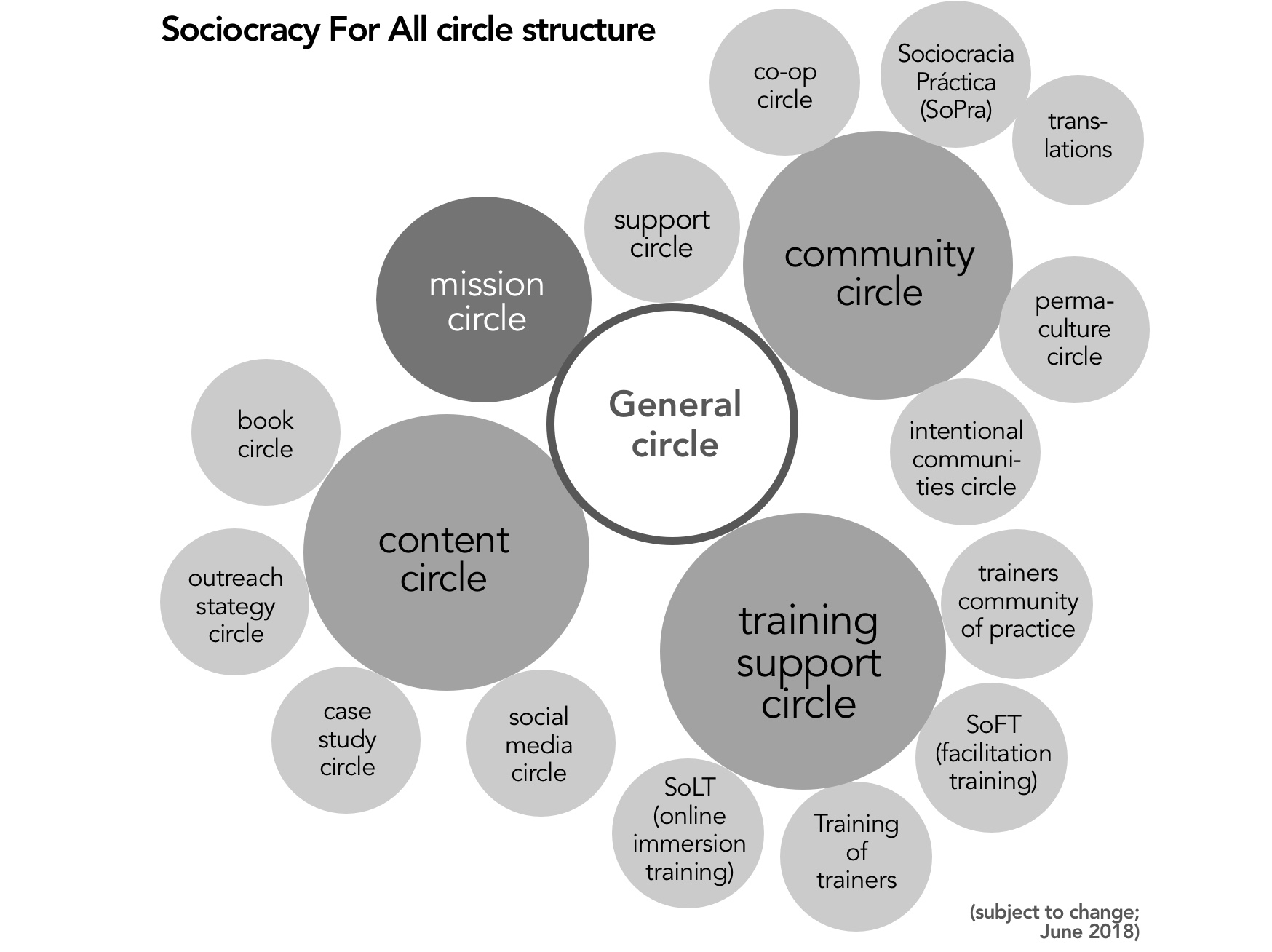
That’s where SoFA comes in. SoFA was founded in 2016 by the authors of this book, after years of previous experience with sociocracy, with the mission of spreading sociocracy widely so everyone – everyone! – benefits. Our current circle structure is shown in Figure A.1, “SoFA’s organizational structure (as of early June 2018). Note that especially on sub-circle level, there continue to be changes as we continue to incorporate new people and projects, and adjust the structure to best meet our needs.”.
Figure A.1. SoFA’s organizational structure (as of early June 2018). Note that especially on sub-circle level, there continue to be changes as we continue to incorporate new people and projects, and adjust the structure to best meet our needs.
 |
SoFA members have a lot of ideas and projects in the pipeline that we’re already working on as you are reading this manual. So if you have an idea or something you’re wishing for, chances are there are others wanting to join in with you. How can we make onboarding easier? How can SoFA collaborate with research more? How can sociocracy benefit families and children, how can towns be governed sociocratically? What’s needed for social change towards more egalitarian societies? (Please note that membership in SoFA requires some experience with sociocracy because it is a working organization.)
Content Circle produces accessible resources and creates opportunities for people to engage with those resources; this includes webinars, twitter feed, Facebook page, medium articles and youtube channel. Everything we say or write, we try to make accessible to everyone, so the next wave of people can be inspired by the hope that better systems are possible and available.
Community Network Circle makes sure people using sociocracy in similar contexts can find each other and exchange their experiences or create content that works for their particular sector. We are working in the areas of cooperatives, permaculture, intentional communities and we have an ambitious project of bringing sociocracy more comprehensively to Spanish-speakers.
Training Support Circle holds attention for training, training formats, training of trainers and evolution of training. This includes a study group curriculum (Empowered Learning Circles, ELC), the Sociocracy Leadership Training SoLT and advanced training programs.
SoFA is also a network of like-minded people. Many come to SoFA for training and want to make sociocracy an integral part of their lives. They also become members for the companionship – many of us share the chronic experience of having been the naively hopeful person in a broken system, looking for meaningful ways to find more alignment of our longing and our lives. Many of us have looked for fellow travelers for a long time, drawing hope from the deep intuition that there can be better ways. To us, our members are our dear companions, our tribe. They turn social change into pleasure.
SoFA can be a place for you if you are able and willing to put time into sociocracy, to use it, to spread it, to teach it and improve it. And of course SoFA is a place to get resources and help. SoFA is primarily a volunteer organization. If you want to contribute to this effort, let us know!
If you are part of a sociocratic organization, you are invited to
contact us! That way, we can understand how we can support practitioners
better. We can support each other in learning more. See
www.sociocracyforall.org/sofa to see our current circle
structure and membership processes.
SoFA is a US based non-profit and we see ourselves as a movement service organization. Our funding is based mostly on fee for service. If you are inspired by our mission and would like to contribute to SoFA’s capacity, we are inviting you to donate to SoFA.
Click on the donation link on our website.
You can send us donation checks to our mailing address. (Sociocracy For All, Unit 8, 120 Pulpit Hill Road, Amherst MA 01002, USA)
If you consider making a major donation and/or contributing in the form of stock or bequests, please contact us.