 | 6.11. Continuing education | |
|---|---|---|
| ↢ | Chapter 6. Implementing Sociocracy | ↣ |
Governance is not something one learns in one day or in one weekend workshop. Neither is it something one can learn just by doing it. We need some shared language and some explicit training so we can make good choices and discuss them.
A group might do some intensive training before and during implementing sociocracy in their organization. But there is ongoing tweaking, refreshing and reminding to do.
People do not take in everything during an initial training. If one teaches everything at once, they either reach overload from too much information, or they have gaps because you answered a question that they had not asked yet. Bottom-line: one needs to review, more than once. It is best to do some intensive training, let people experiment and then review parts bit by bit as they are using it.
One needs to do some adjusting. People might remember some of what they learned, and they will fill the rest in “creatively”. They might come up with their own style which may or may not be effective and might benefit from some feedback.
Many people focus on the how-to in the beginning. The why might not be in their focus. In the long run, they need both, which means one has to review the why of processes. To us, the why is just as important as the how because only when we know why we do something, we will honor the process and be able to adjust it and make it better.
See section Section A.3, “Resources” for more resources.
How can a group keep learning, without spending too much time on it? One way is to schedule extra training where individual topics are covered. Another way is to do a refresher class once every two years.
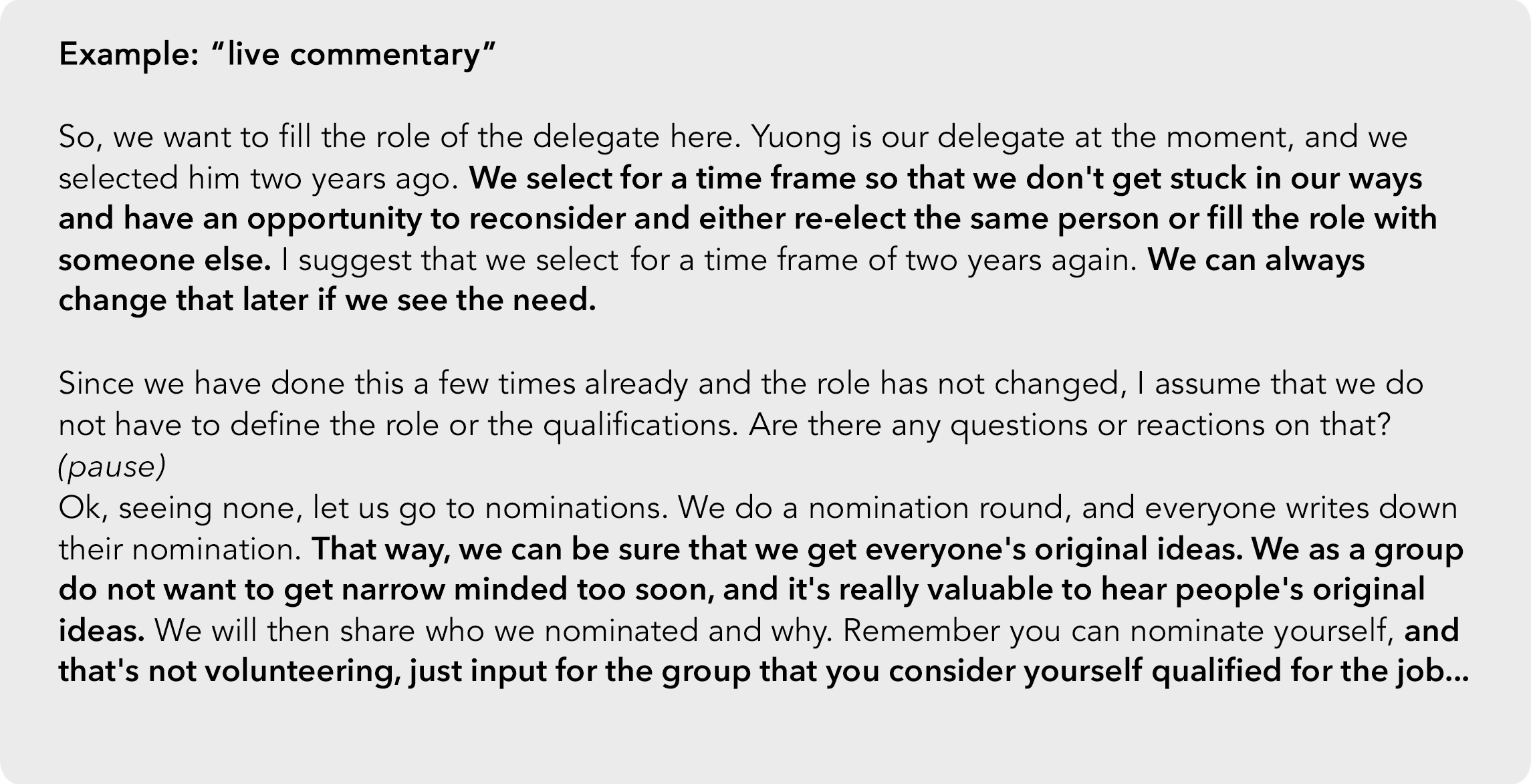
There is a low-maintenance way, however, that we highly recommend: train your facilitators to give a live commentary during meetings. For example, if we have an election, it is helpful if the facilitator gives some explanations on what is happening. See the example in Figure Figure 6.12, “A selection process with some elements of “live commentary” for educational purposes”, with all live commentaries in bold.
In an inexperienced group, this style would be very helpful. Every piece of information is delivered right when it is needed. It will also train newcomers right away!
Figure 6.12. A selection process with some elements of “live commentary” for educational purposes
 |
If we are about to join a sociocratic organization, there might be a process already, a basic training everyone might have to go through to become a member.
If an organization expects new members to just be trained on the fly, they might be in for an unpleasant surprise. Imagine only half of the members being trained well enough to be active promoters of the governance system (after all, we join an organization because of its mission or aim, not because of its governance method). If the membership increases by 50%, the people who are trained and active supporters will only be a third of the members. Some circles may even wind up without any members well-trained in sociocracy. They will probably just ‘‘go and do’’ instead of asking for training because they might not be aware that sociocratic self-governance is in parts significantly different from traditional systems. It is very unlikely that the unintentional changes coming from lack of attention to governance will be in favor of both effectiveness and equivalence. Things might get stream-lined for effectiveness, compromising on equivalence, or they might tread water because they don’t know how to integrate effectiveness into egalitarian organizations.
New members will feel more connected and empowered through training as they understand how the governance system works. Here are some ways of bringing new members up to speed. Most of these ideas can be combined to find the mix that works for a given context, and including ‘‘old’’ members in this does not hurt:
open Q&A for governance questions
training during all-member meetings
sharing short training videos
study group whenever there is a new group of people
an in-house library with books like this manual or “We the People”
posters and charts in the meeting room (see resources)
a buddy system
a written overview of your governance system
your own in-house video about sociocracy and your specific implementation (ask SoFA for resources)
a list of recommended videos for onboarding new members
New members come 15min early and/or stay 15 minutes after every meeting to be briefed on process before the meeting, and can ask questions after the meeting.
Integrate governance education into the general orientation to the organization.