 | 6.10. Typical pitfalls in implementations | |
|---|---|---|
| ↢ | Chapter 6. Implementing Sociocracy | ↣ |
Learning about sociocracy is very different from running a sociocratic organization. And implementing sociocracy is very different from having a well-running governance system in place. At any stage of the implementation, there can be pitfalls that are unexpected for the novice. After seeing many organizations implement sociocracy and sometimes struggle, we can identify some typical pitfalls. After all, offering this manual poses a risk for its authors: the risk that people take this book, implement sociocracy in an organization, fail, and then broadcast a claim that “sociocracy does not work”.
We have seen sociocracy work and many others have too. But like a perfect human body sometimes needs help, organizations are organisms with a lot of complexity that might need support. Organizations are self-repairing, but only in the ideal case of everyone having full expertise and perfect awareness (i.e. no blind spots of their own). Reading through this manual so far is like reading a book about biology – now it is time for some first aid education! We want to tell readers the typical symptoms of an “ill” organization to enable them to self-diagnose. Depending on the gravity of an issue, practitioners might be able to “treat” the issue themselves, or they might consult with governance “doctors”.
What are the most common diseases? The tricky thing is that one symptom of stuck governance is that we get triggered, for example we get stressed, overwhelmed, upset, overworked or burned out, maybe scared. That might interfere with your ability to say “oh, that’s a governance issue. We have been giving the general circle too much power and that’s why we feel this way”. Many typical struggles that upset people are governance issues: people who talk too long, lack of accountability, people stepping on each other’s toes, tasks falling through the cracks – the list is long. Remember how feelings are pointers to met or unmet needs? (See section Section 4.1.3, “Feelings: you can’t make me angry”.) Whenever someone gets upset in the context of an organization, consider that there might be a governance issue one could address. Did someone give feedback? How can similar issues be prevented next time?
If we could wave a magic wand, we would have readers review this chapter on a regular basis. Practitioners would read it every few months in a new implementation, or they would read it every year to make sure they are still on track. Some of these “diseases” develop slowly over time. Once they are chronic, it gets harder to treat them. Groups can decide to check in with a “governance doctor” on a regular basis (i.e., a retainer arrangement), like a yearly physical for the health of your organization and the well-being of its members. An organization’s governance is part of the organizational culture and the interpersonal relationships, which are a core asset of any organization.
Sociocracy can support member involvement and effectiveness (potentially leading to a more stable financial situation), ideally leading to a self-governed organization that can identify weak spots. It will be resilient and innovative, and heal itself. However, implementing sociocracy does not solve issues that are outside of the scope of governance. If the business plan is not viable, or funding is not solid, then a sociocratic organization will fail just as any traditionally governed organization. If communication skills are low, then those need to be addressed, or the organization may fail.
Sociocracy will not help if an organization is already having very deep issues. It is not a magic bullet. To stay in the metaphor of diseases: surgery can be life-saving. However, when a patient is very weak, the life-saving surgery can be too much and can kill the patient earlier than he would have died without surgery. Or, as a colleague said, in reference to our analogy of learning how to swim, “when someone is drowning, it is not the time to teach how to swim”. Changing the governance system in times of crisis can add another level of complication that brings the organization over the edge.
When implementing sociocracy, it’s good to ask whether this is a good time or whether there are other serious issues not related to governance that need to be addressed. If one ignores other serious issues, the implementation will fail just as fast as the organization will.
We know from experience that struggling organizations often have more than one chronic issue. We can, with outside help, identify areas where tools from sociocracy might be helpful. Training facilitators in sociocracy, for example, can give a lot of benefits with only little investment or change.
Sociocracy shifts the power-structures in organizations. Some have to give up power, some have to step into power and leadership. In consensus organizations, some individuals often have disproportionate power over the group. Since sociocracy equalizes power, these individuals may resist, oppose, or try to undermine the implementation of sociocracy. The combination of individualism and victim mindset can be toxic for community and for sociocracy. In majority rule organizations, different factions may be accustomed to manipulating for control of power and they may see sociocracy as another system to be manipulated. In for-profit organizations, the distrust based on the historical management-labor divide may be quite a barrier to overcome.
Some organizations implementing sociocracy start with a trial period. They want to try out sociocracy for 6 months and then evaluate. This sounds like a good idea, and sounds even very much aligned with sociocracy – try out a proposal for a certain time frame, evaluate and then decide how to proceed.
There is a subtle difference between ordinary proposals in a sociocratic organization and implementing sociocracy in a trial version. Since with sociocracy, we also change the method used for decision making, it has to be very clear what the decision making is, with which we decide whether or not to extend or end the trial. What does the organization fall back into? Imagine a consensus-run organization implementing sociocracy for half a year. What decision-making method do they use to decide whether they are continuing -- consensus or consent? How are we going to treat objections to using sociocracy as a governance method? Especially in a consensus situation where some people might still be attached to the powerful position of the minority, one can end up in a position where those who feel threatened by the concept of consent decision making will undermine the trial period, making it impossible to experience how consent could be, and then using it against sociocracy’s case when the time for evaluation has come. In a way, even if we wished it were different (given that short-time experiments are our favorite tool for dealing with objections!), we have come to the conclusion that there is no trial for governance systems like sociocracy.
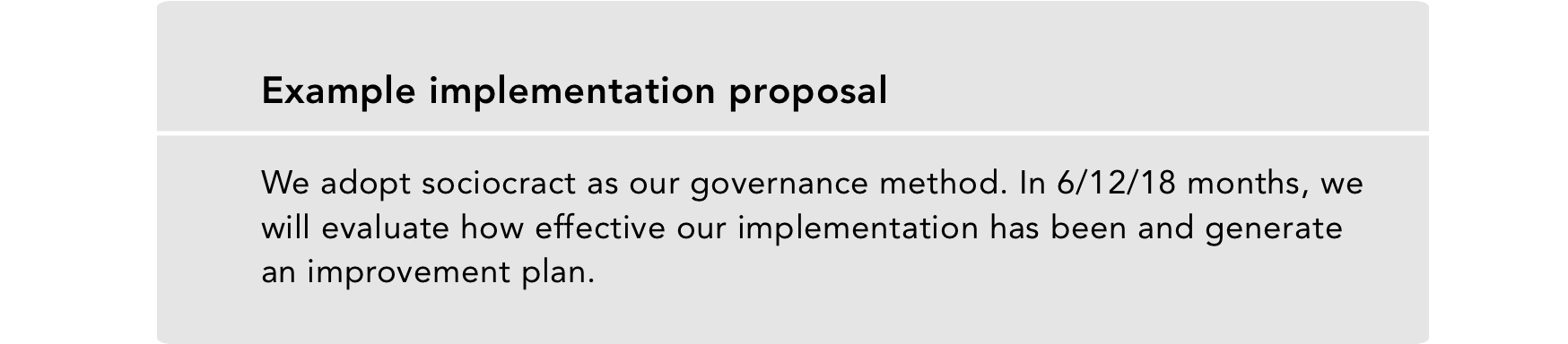
Instead of a trial period, do a proposal like figure Figure 6.10, “Example implementation proposal.”.
Figure 6.10. Example implementation proposal.
 |
This is something we have learned from experience. Referring back to the preconditions of consent: sociocracy requires willingness to talk until objections are integrated. In a trial period, we are leaving a back door open. We will not be truly open to working things out which means the organization’s members are going to engage in a self-fulfilling prophecy of “consent does not work”. Putting an entire organization through a yes/no trial period may not provide realistic data. Consent only works when we accept that working things out as equals and with honest curiosity is the only way of relating to each other. If the group is not ready to accept that, one might have to find the small-scale experiment that the group can say “yes” to. It will provide the data that is needed so everyone can say “yes” to consent decision making for the whole organization.
Implementing sociocracy has to be aligned with the values of sociocracy. One of them is that circles need authority over their domain. What is meant by that is full authority. The circle needs to be the only and ultimate decision-maker in their domain. Imagine a sociocratically run department in a big corporation that itself is not run sociocratically. They might be able to pretend to be in power but they do not have ultimate decision-power. The corporation can close down the experiment, or the company sold, without the department having any say.
Sociocratic organizations own themselves. As long as anyone else has power over the organization, it cannot own itself. Shifting power is not cosmetic, and in our world, it is not just a fad for squeezing more productivity out of happier employees. This is not (only) about productivity. It is about deep change, and not all environments might be suitable for it at first. We do not discourage sociocratic experiments in corporate departments or in non-profits where the board – or the founder – is not buying in on the governance system. We are just aware of the experiment’s vulnerability and ask departments to protect themselves from that uncertainty. In our view, this is also true if a single owner has the power to install (and therefore also to withdraw) a governance method.
In sociocracy, circle membership has to be clearly defined. We have to know who is in and who is out. If we do not, we will have people dropping in and out of circles. For decision-making groups, this is a problem. If we do not know who is a member and who is not, we also do not know who needs to consent, which means we won’t be able to hear all the objections or we will be distracted by objections from people who are not members.
There is more: we will not know who has access, for example to money in the circle’s budget. Lack of defined membership makes it hard to be transparent (we do not know what they are thinking because they are not there, and they do not know what we are thinking), effective (we risk waiting for them because we think they might come back) and to speak with equal consideration. We cannot make a decision with every circle member in mind if some of the circle members are frequently absent – to an extent that we do not know whether they still consider themselves a member.
Lack of defined membership is a problem mainly for volunteer organizations. In paid contexts, often, people are hired to fill a role which automatically puts them into a certain circle. However, the following scenario can happen almost anywhere. Imagine a circle that has worked on a proposal, with one circle member being absent (unexcused, maybe) for three meetings. The circle is led to believe that this member has dropped out but lacked the intentionality to follow up to hear what is going on. Now the proposal is ready to be consented to, and our missing circle member shows up, still considering herself a member – and objects to the proposal. This can be frustrating and disheartening and can easily lead to volunteers losing their interest in working in the organization. In short, defined circle membership is a must for all decision-making groups.
Excusing absences and follow-ups if someone missed a meeting has to be part of the organization’s culture. The person to follow up on this will be the circle leader and the person who missed the meeting. A circle can decide to put a circle member on leave. (In that case, they might stay informed but not have consent rights for that time period), for example for health reasons or extended travel. Intentionality and clarity: we have to know what our agreements are and who our members are.
A new governance method requires some attention. We have seen organizations declare sociocracy hoping for easy transition. We do not see this work. This section outlines the typical areas that require attention.
Sociocracy means culture change. Especially in existing, hierarchical organizations this cannot be underestimated. That culture change includes questions of identity, power-over and power-under. There is a huge learning to do for everyone as we question how we have been doing things, who we are, and what is driving us. Be prepared, eyes wide open, for intense feelings around topics of power!
There are some judgements that are held as truths very widely and that make it hard to accept sociocracy as an option.
Judgment: “People do not want to/cannot take on responsibility.”
Although it is true that some people find peace in not having too much responsibility from time to time, it is easy in sociocracy to keep the scope of responsibility at a level that works for members. We disagree with the original statement in that we assume that everyone wants power in their world, even this ‘‘world’’ is just a piece of the organization. It is about the hat we wear: while I might be executive director in my day job, I might want to just hammer nails in my volunteer work, without shouldering too much responsibility. That is fine. We tend to think of some people as ‘‘natural’’ leaders but it not realistic for every ‘‘natural leader’’ to be leader in all their organizations and contexts. At the same time, an organization needs more than ‘‘natural leadership’’. Through the layers of circles, everyone can operate at the level of abstractness or specificity that works for them at that moment and in that part of their life. It is also possible to wear multiple hats. In our own community, we hold roles as cartwright (very specific) and cleaning windows of the community building. We also have very abstract jobs, such as member of the General Circle or as leader of the Governance Improvement Circle. In the role as window-cleaner, I do not want to have the well-being of the community over the next 5 years on my mind – I am cleaning windows so all I think about is how to clean them, as service to my community.
Roles and circles give us a more fine-grained, dynamic way of working together. We can be flexible in our personal development. We can start small and grow into leadership, or we can let go of responsibilities. Our commitment and the specificity of work we choose will fluctuate over time, making it possible to give up responsibility when life pulls us in a different direction for a while. This commitment can be shaped according to our needs and the needs of the organization. A dynamic organization lets us be flexible. This flexibility is the strength of the dynamic governance system, and it makes it uniquely human as well.
Judgment: “We need experts to decide this.”
We consider this half true. We can rely on input and data from experts but we have to strive to make an informed decision about matters that affect us. Just a good, compassionate doctor will help us make an informed but empowered decision about our health, “experts” on any topic can be asked for their input – sociocracy does not limit flow of information. The decision still remains in the circle.
Judgment: “Hearing everyone is slow and tedious.”
This might be true in the moment – an autocratic decision is always the fastest decision, in the short run. But it is not the most sustainable one. This concern comes up most often in organizations that tend to make decisions in large groups. In small groups rounds increase clarity and reduce debates. Just learning rounds, some find it hard at first, and then they fall in love with the level of insights it gives them into other people’s perspectives. Over time, people appreciate the input we gain from hearing from everyone, and how it makes decisions better over time. The mutual respect leads to a more pleasant organizational culture which pays back over time.
Judgment: “Too much process/too artificial/too constrained.”
Some people are turned off by the presence of structure. It can be a problem if people are slowed down because they are monitoring everything they say to see whether it is ‘‘right process’’. Typically, however, this is a matter of practice and gets much easier very quickly. We can support this by offering more education on a continuing basis. Let us consider the alternative: no process -- ‘‘absence’’ of power. But power is never absent, not in a world where people have grown up in a system of power. The tyranny of structurelessness is real. We want to think of power as something positive. With intentionality, this power can be harvested, shared and steered, to everyone’s benefit.
Consent is not a guarantee for shared power. There are always power dynamics: privileges of all kinds are either on the surface or very close to it. We all carry our experience of power. Most people, especially those who have had less-than-average access to privilege, carry internalized powerlessness. It is hard to work through that and impossible to just “strip it off”. We can start noticing it. For example, there are circle members who, in a round, will add preambles or postscripts to their contributions: “well, I do not know, my ideas are always not as good as yours”, or “yeah, that’s just what I think, this was probably not useful for you”. A combination of awareness, communication skills and practicing equivalence can do a lot. If we hear circle members making their own contribution small, we often speak up and let them know how we appreciate their contributions. That is probably not going to change their internalized patterns immediately but it might be a step toward awareness.
The opposite is true as well. If we notice that someone is speaking with a sense of superiority, it might be useful to bring it up. Some people are not aware of it and might be grateful for that to be brought to their attention. In general, we find that most people want to talk with a sense of equivalence but they lack the awareness or skills to do so.
Sociocracy requires people to claim their power. Sociocracy does not address directly internalized experiences of privilege! A way to address that is by doing personal work on awareness of privilege and power. What sociocracy does is to provide space so everyone can speak as equals. Rounds are crucial here because rounds embody the sense of everyone’s voice mattering. As we get to know each other more, stereotypes and power-over/power-under patterns recede. (See “Power Under” in references on page Section A.3.1, “Literature”.)
Anecdotally, sociocratic elections seem to run counter to the mainstream patterns at least to some extent. We have seen numerous elections where the person elected was not the typical leader – at least in comparison with majority vote.
There are a few biases that seem to be baked into sociocracy, and we are aware of it:
Sociocracy is biased toward people who speak compellingly.
Sociocracy is biased toward people who can form and express ideas with little preparation.
Sociocracy is biased toward people who are able and willing to follow formats.
We can be aware of these biases and try to work around them. For example, a good facilitator can summarize what someone has said to make sure the group can harvest the wisdom in it. Circle members may request to go last in a round because it takes them a while to think something through. If we own and acknowledge these challenges, we can be allies to those who have a harder time expressing themselves and find creative solutions together. Another creative solution we have found. If there is someone who prefers having time to think before speaking, start a round by a minute of silence for everyone, and during that time everyone plans what they are going to say. Over a round of 6 people each speaking for 1-2 minutes, we can easily save time by taking a minute for people to sort their thoughts.
The last bias, the advantage of people who are able and willing to follow a format, we address with support, charts, posters on the wall and clear prompts. Rounds are useful to harvest people’s ideas and seem to neutralize (not marginalize) people whose contributions do not seem constructive. But if someone is “off” very often, it is hard to include their voice. There have been experiments with substitutes. For example, the actual circle member is not at the meeting but someone else takes their viewpoint and speaks for them. We know it can be done – but it takes quite some effort to do so.
Holding on to power is a mistake that is very easy to make. We have seen it many times in superficial implementations. What people forget is that power has to be passed on to the work/department circles as much as possible.
Flat organizations shifting to sociocracy sometimes have issues around giving trust to small circles. Everyone wants to involved in deciding everything. They create a structure where the general circle has many members (with many first-level department circles). We have seen new implementations with 7 department circles represented in the general circle. That makes 15 people in one circle -- leaders and delegates from 7 department circles plus a leader or 14 people if a general circle member is selected leader of that general circle. With that many people in the room, it is hard to hear everyone because every round is long. It also becomes almost impossible for the general circle to attend to every sub-circle. Decision making will be slow and the benefits of small circles of decision-makers lost. These groups have to be reminded that the magic is to separate decision making from giving input. A small circle can get feedback from as many people as is reasonable, possibly the whole organization. Being able to be heard on a decision does not mean having to have consent rights. Being transparent means being forthcoming with information and proactively asking for input.
Hierarchical organizations are used to having a top-down structure. They want circles to do their work, but they often want to have a finger on it. This is understandable and might happen with best intentions. But it undermines the purpose of distributed leadership and will grow resentment in the work circles. The ones who have the knowledge and do the work in any given domain have to be the ones to make decisions in that domain. The main concern is that we deprive the work circles of the opportunity to fully step into power, action and leadership.
The antidote is awareness. Everyone in the organization has to embrace decision making power distributed out to the most specific level possible. One has to ask the question – is it that the general circle wants to hold onto power, or is it that work circles are shying away from power? One might have to train the circles on how to make policy. Depending on your context, there might be hesitancy to take full charge of policy. Once a group successfully unleashes the power in the most specific circles, they will notice the difference.
The irony of this pattern is that both very flat and very hierarchical organizations can be equally stuck in the paradigm of centralized power. What we can do:
Define the domain of circles and ensure that circles (and holder of roles) actually act on their authority.
Educate about how holding on to power slows down the organization. Educate about the difference between feedback and decision making and about how trust is earned and decisions made better by feedback.
If it is still hard for an organization to let go of a centralized notion of power, run a small-scale experiment. Ask for permission for a circle to hold a certain domain for a certain time period with some defined requirements for getting feedback. (Readers might recognize it: this is the standard approach to deal with objections – making it smaller and specific enough so a decision-making body feels comfortable about giving consent: “Let’s give this circle the authority to make decisions about their internal budget and on this particular project for 6 months and have them track their progress. We are asking for a monthly report by email and a follow-up meeting in 6 months where we evaluate what it was like to pass authority to that circle.”
We have seen implementations struggle when only a small fraction of the people were trained. Only when everyone (or a significant fraction) feels empowered through understanding the governance structure, can we reach equality.
Education has to be available over time (see section Section 6.11, “Continuing education” for continuous education), and it has to include not only how we do things but also why we do things. People are busy doing their work, and it is the aim, not the governance method, that drives the work. They might not hold the information on the how and why of processes because it is not in their focus. That is why we explain “in the moment” and educate only on what is relevant to people. For example, the more the members of an organization know about why we do elections the way we do them, the more likely they are to stick to a format. They will be more willing to teach it to each other. They will be more skilled in adapting processes to their context because they will know which pieces are important and why.
If we fail on educating enough members on governance, this can lead into power struggles when the group falls into camps (those who know and those who do not) which can lead into those who do not feel comfortable in the process fighting the new governance system. We will then find ourselves in the same difficult situation of people questioning processes and slowing things down. It can cost an incredible amount of energy to be dealing with that kind of disruption.
We sometimes observe a victim mentality around governance – as if one was constrained and “at the mercy” of the governance system. The governance system is for the members, offering tools and options to harness the power we have.
It has to be clear to people that processes are not there to constrain them but to free them. Education has to be stating the positive: The reason for doing rounds is not to constrain people. We do rounds so we can support each other in speaking and listening. The language we use in explaining processes is extremely important because it can either support victim mentality (“That’s how it’s done. Just accept it, it’s the rule.”) or empowering (“This is a useful idea for us because it helps us…”).
The importance of education is not because sociocracy is hard to understand or to learn. It is because it is easy to slip back into unexamined and unchallenged old habitual patterns. Culture change requires intentionality, practice and some effort. Here is an example from one of our organizations.
I found a note in a room taken care of by a certain circle. The note was a complaint about something in the room. The member was not well familiar with the circle structure and certainly left the note with best intentions. However, it is unclear whether this note will ever be seen by the circle that is in charge. The more effective way would have been to send an email to the circle leader.
This example shows how information about the governance system and how it works can either empower people or leave them voiceless. The voice of the person leaving the note cannot be heard as well as the person who knows the best way to contact decision-makers. Knowledge is power, once more.
In new implementations, what happens here and there is that groups get into arguments over what is “right” process. Instead of focusing on content, there is obsession with how to do things the “proper” way. The important thing to understand here is that if it is rigid, it is not sociocratic! The intention behind the tools and patterns is to ensure effectiveness while making sure no one is ignored. The tools and methodologies, almost everything in this book, are just good practices that we and the global sociocratic community have seen work well for everyone who values effectiveness and equivalence. We recommend staying close to those best practices until there is enough experience to experiment. Diverting from best practices when groups are inexperienced often leads to trouble that could have been avoided. On the other hand, it’s good to keep your eyes wide open right from the beginning – groups might have to tweak and adapt from the first moment on.
We integrate effectiveness and equivalence. The time-efficient solution may compromise on equivalence. The “formally accurate” process may mean to compromise on effectiveness.
For example, if a group seems to want a second change round after the regular change round in a selection process, there is no law that they could not do that. Every group is free to choose their own process in every moment. There is no right and wrong, there are just more effective and less effective strategies to integrate effectiveness and equivalence. What’s hard is if there is no intentional shared decision.
The metaphor of steering works well here. Steering is not fully predictable, as there might be bumps in the road. Steering is also never just going straight. We might have to adjust a little left and right even when we are driving straight. We need a sense of direction that is our “best practice” but we also need to be able to react to our circumstances – otherwise we might crash despite doing everything “straight”.
If there is an argument over process and it is a matter of personal preference, the facilitator decides. If there is still resistance, switch to curiosity: what might they, “the governance police”, be feeling? They might be anxious, concerned, or overwhelmed. They might be needing ease, effectiveness, acknowledgment. They are certainly acting the way they are with best intentions. Get curious. Ask them. Listen to them.
The sociocratic processes are not rules. They are best practices. They are the best way we know to do things. If some people in your group hear them as rules, keep your focus on the intention. “I understand that you want to do things right and stay true to our values of equivalence and effectiveness. I am looking to tweak things here and adjust so we can move forward – all without compromising those values.”
We have already talked a lot about feedback in Chapter Chapter 4, Feedback and Learning. Getting to a point where most of the people in an organization feel comfortable with feedback can take a long time. We have heard of groups who implement sociocracy and get rid of all the elements around feedback, even meeting evaluations. Especially in volunteer organizations, performance reviews are often dropped, because of the fear that is associated with feedback. Those organizations are not only missing out on an opportunity to improve, but also risk getting stuck.
We have heard many times from struggling organizations that do not work effectively because there is this person who always…(fill in the blank). There is a standard question we ask in response: “Have you told them about the impact this behavior has on you?” More often than not, people had not engaged in an honest conversation. How can we expect people to change without feedback? Feedback is the magic power we all have, and it can shift us from finger-pointing to stepping into responsibility. The world opens up when we get to a point where we realize that we have power in our world because we have the option of giving feedback. We are shifting from a fixed, blaming mindset (“This is never going to work because of her.”) to a growth mindset: “There is something I can do.”
This cannot be said enough: everyone has to give feedback about what is going on. The vast majority of struggles can be dealt with. It is silence and sometimes willful looking the other way that keeps organizations from moving forward. We are aware that some people might not change, even with kind and specific feedback. Still, feedback can provide a lot of opportunities for positive change.
When someone’s behavior makes it impossible to carry out the aim of the organization or circle, they have to be removed. There will hopefully be a number of (defined) steps and a lot of feedback, one-on-ones and similar measures before that step. We can engage, be curious, be transparent and explicit about our own needs and the other people’s impact on us.
If an organization does not do meeting evaluations, start doing them. If we do superficial meeting evaluations of the “good meeting” kind, it can help to model making them more specific. “When you made that proposal, my mind went completely blank because I had the judgment that you were trying to undo all we had worked for in the past 3 months. I am sure that’s not what you are trying to do but I honestly have no idea where that proposal was coming from. I’d appreciate if you could explain what led you to make that proposal because I feel a little irritated here leaving the meeting. I regret not speaking up earlier; it took me a while to get back on my feet.”
If an organization is not doing performance reviews, depending on the nature of an organization, we can introduce them by modeling ourselves. “Hey, can we take 10 minutes in this meeting and look at my contribution to this circle? I have been wondering about how you perceive me in this group, and I’d love to hear what you think.” We can then do the simple format of understand/explore. Ideally, this will be enlightening and might inspire people to do the same. Of course, putting in a proposal that performance reviews be done every year might be another approach. Another idea is to attach it to elections. When someone (or you) is selected to fill a role, request that a performance review be done half-way through your term. “I am excited about being facilitator but I am also wondering whether my style works for people here and I want to learn more about facilitation. Can we put in the backlog or on the calendar that half-way through my term, we do a quick round where we talk about how my facilitation is working for me and for you? That would give me enough time to learn on the job and you some time to experience me in this role. Then I’d have the second half of my term to make adjustments. I’d be grateful for that.”
Giving and receiving feedback, even positive feedback, can be very uncomfortable. But being completely stuck as an organization, that is also uncomfortable. Better be uncomfortable and growing than be uncomfortable and stuck!
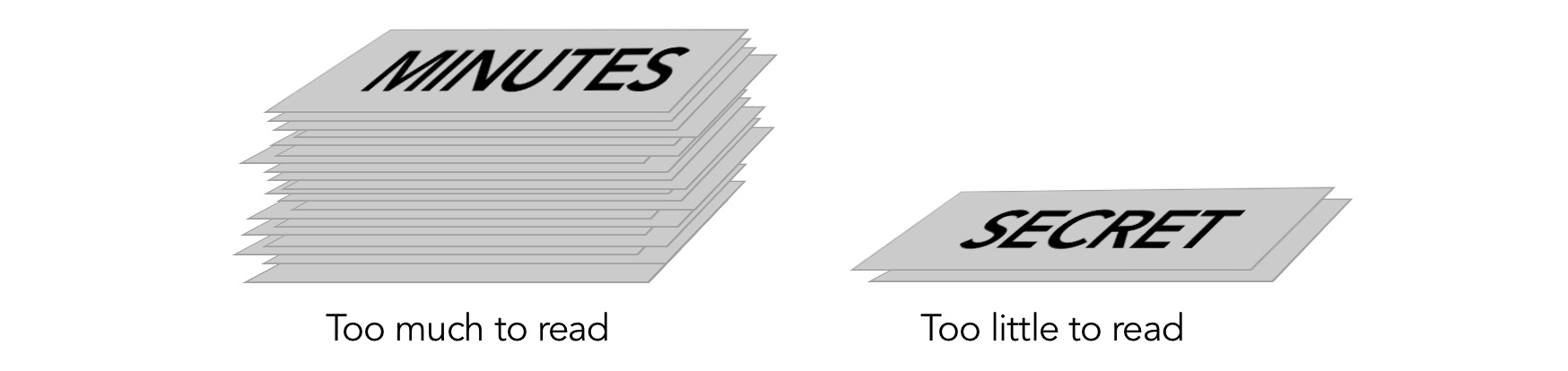
Circles have to find the “just-right” level of information to be transparent. If people are overwhelmed by information, they will not even read the most important email anymore. If your office kitchen is full of signs and reminders, people will likely not read them all. If we send out requests for feedback too rarely, we might be missing out on good information. It is always a balance.
Figure 6.11. Too much information overwhelms people; too little information does not provide enough
 |
We also have to find a mix that works with regard to the channel and frequency we use to spread information. Do we send out emails, make announcements in meetings, invite public hearings, a newsletter, social media, posters, a file system? Do we invite feedback by direct contact, online surveys, paper etc? Most people have experienced that the just right level of information depends on the context, it depends on what people are used to, how tight-knit the community is, and many other factors. It seems important to use more than one channel. Some people respond to emails, some people tend to read signs. What works well is to put information as close as possible to the situation we are regulating. The circle made a policy about how to use the community garden hose? Laminate a short version and hang it next to the garden hose. The circle made a policy on how to clean up after renting a room? Include the policy (short and in understandable language) in every rental confirmation email, or automatically send it out to people on the day they are renting. If people tend to use too much dishwasher detergent, put a spoon into the detergent that has the capacity of detergent you want people to use. If you want people to use unscented detergent in the laundry machines, a sign on a door might be ignored – it might be good feedback to put the sign right where the detergent goes. Information is not enough, one needs to say it in the right way, with the right timing and location. It helps to be a little creative here.
The most important thought to remember: As the policy-maker in that domain, your priority is to be helpful. Do not operate from “well, I am right because we made the policy, and you are wrong because you did not follow it.” If people are not being accountable, we can try to think what we can do as a circle so that it will be easier for others to be accountable. Think of the users of your domain as your customers, even if they are your co-workers, family members or neighbors.
One can also gamify it – making it fun to follow a policy. There is a famous example of public toilets and with stickers in the shape of flies that opened my eyes to this aspect of accountability. It was observed that men peeing miss the toilet – sitting in resentment and righteousness did not change anything. There was a brilliant experiment of putting little stickers in the shape of a fly into the toilets, visible for everyone peeing while standing up. People were playful and had the urge to pee on the fly. The side-effect of aiming better was less clean-up. Those stickers were much more effective than any sign or system of punishment.
A very helpful change we made in our own community was to offer the full minutes of a circle meeting in our online logbook, and to only send out a brief email containing the circle name, members, date, and a summary of decisions with a link to full minutes. Everyone can skim a user-friendly 6-line email. Most people trust the other circles, so as long as nothing unexpected happens, all is good and easy. If there is a new policy and a circle is expecting some reactions, they will put a draft into the minutes and direct people’s attention to it.
It is the people’s job to take information in, but it is your responsibility as a circle to get information out in a way that can be taken in.
One job of a parent circle is to take care of their sub-circles. Calling it “parent” circle is completely on point here! The child-circle reports to the parent circle, but the parent circle has to listen and reach out. When the child circle stops reporting because the circle fell apart, the parent circle has to notice.
A very simple system to support circle care is to keep a list of sub-circles and to check on them at least every other meeting. This can be a quick “all is well”, or it can be longer, depending on your context. Ideally, we will have the leader and the delegate of every child circle present, so there should always be someone present to give a status report. If the child circle falls apart, all responsibility falls back on the parent circle. (For example, the parent circle could then appoint a new leader.)
SoFA supported an organization with geographic circles nationwide in the US. Local groups were connected, forming regional groups, and regional groups into a national general circle. One of the regional groups had collapsed. The general circle was too busy with strategic thinking and was not paying attention to all of its department circles. The issue was not discovered for quite a while.
When circles turn dysfunctional, they often go silent. Although it is the circle’s responsibility to reach out for help and let the parent circle know, it is also the parents’ circle responsibility to check on the child circle.
Another typical pitfall is starting an organization with too many circles (and too many meetings). The organization has to be developed according to the work that needs to be done (and the people available to do that work), not around wishful thinking. The danger is that we stretch ourselves too thin. We can only populate as many circles as we can populate. Work circles are formed to focus our attention to a certain domain, so the equation has to include (1) the number of people to do the work (2) the amount of work to do.
Instead of starting a new circle, we can define an operational role (see section Section 2.3.2, “Operational roles” on page Section 2.3.2, “Operational roles” @@TODO@@: Figure out page references.) and leave policy-making in the circle. Operations can be taken care of by one or two (pair) members. That way, work and attention are taken off the plate for the circle, but there is no new circle to be sustained. That also reduces the time spent in meetings.
Another misconception is that every meeting has to happen with all circle members every time. This is certainly true for policy meetings but not for for operational meetings. Often, delegates do not need to attend operational meetings. Policy requires the whole circle’s consent. We can work with subsets of that group for other meetings, whenever it makes sense. Form helping circles with only part of the circle as often as possible to reduce the amount of time everyone has to sit through a meeting.
Also, the circle decides how often policy meetings are. Nothing is set in stone – it is helpful to be on a regular schedule because it is easier to track but meetings don’t have to happen with the same frequency all the time. One circle might meet weekly, another one monthly, another one monthly in summer and twice a month in winter. Whatever makes sense in a context will guide our decision.