 | 2.2. Empowering the circle: aims, domains and members | |
|---|---|---|
| ↢ | Chapter 2. Organizational Structure | ↣ |
What do we need to make something happen? We need to have a clear understanding of what it is we are getting together to do; the aim is the invitation. We need the authority and resources to get it done (domain), and we need to be clear who is a part of the effort (members). Sociocracy provides clarity on all three of those aspects as shown in diagram Figure 2.3, “A circle: members, aim and domain”.
Figure 2.3. A circle: members, aim and domain
 |
People can only work together effectively if they are clear about what they want to do together. Aims describe and guide the work. Collaboration requires explicit and specific sharing of ideas and resources to fulfill the aim.
The written “purpose” of the circle is our aim. The more specific and clear your aims are, the easier your decision making will be. A clearly stated aim will stimulate focused action, producing tangible and measurable outcomes. A few examples for aims are “producing and selling baked goods in Amherst Massachusetts, brewing gluten-free beer and selling it online, providing an online platform to increase connection between people in neighborhoods in Mexico city”.
How is the aim different from visions or missions? In an aim, we define what it is we are doing. Aims are what we need to do to get us closer to fulfilling our mission, and working toward our vision. Someone wants to end homelessness? If that is the mission, then the vision might be a world with adequate shelter for every human being. Visions and missions are helpful to create a set of shared values, but it is more important to define the aims of the organization. The mission informs the aims, but the aims will be the backdrop for every policy decision one makes in the organization (see section Section 3.2.4, “What are objections?”).
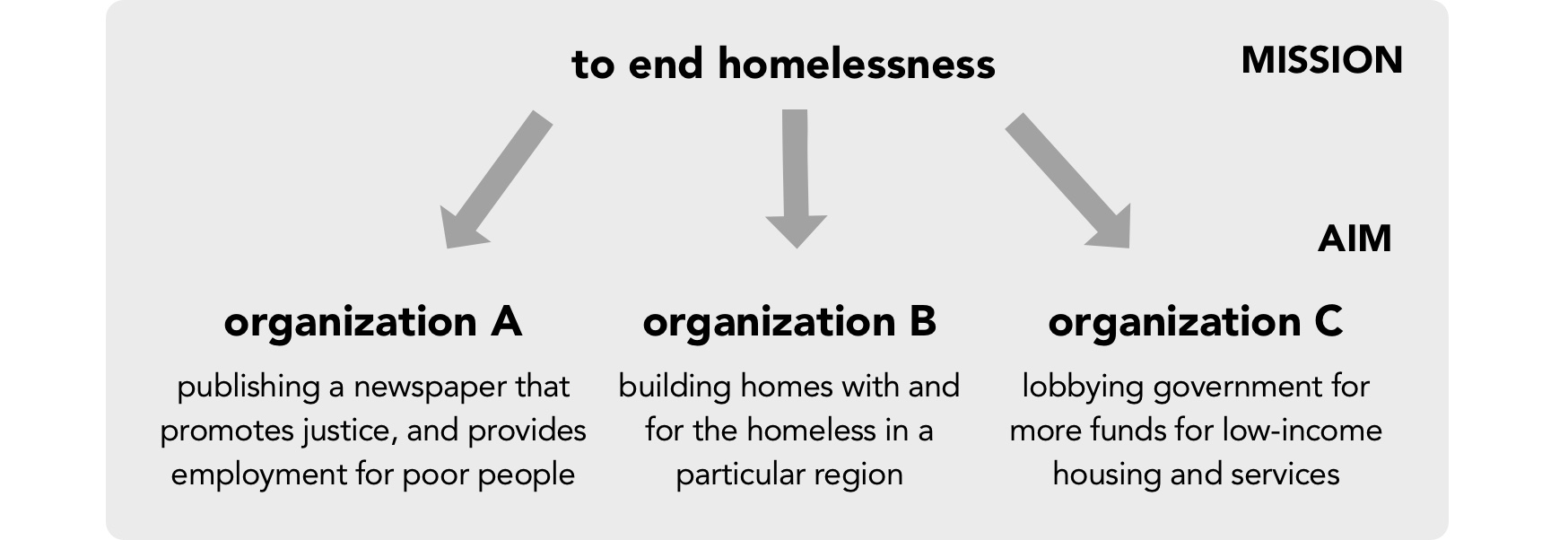
It is not enough to only define the vision and mission. Organizations with the same mission and vision might have very different aims. The mission of “ending homelessness” can be accomplished by different aims which are the strategies we are using, as shown in Figure 2.4, “Example: same mission “to end homelessness”, different aims”.
Figure 2.4. Example: same mission “to end homelessness”, different aims
 |
On the flipside, we might have very different visions and still be able to get behind the same aim. (To some extent, this is probably true more often than we realize!) For example, for volunteers at a vegetarian soup kitchen, the motivation might be health, or environmental or ethical concerns. The same strategy can be in support of very different needs.
The more homogenous an organization is in terms of vision/mission/aim, the easier decision making will be. If an organization is more diverse in its views and perspectives, then we need more clarity on our vision/mission and aims. Here are some more examples of missions.
“to end hunger”
“to provide educational opportunities for children from working-class families”
“to provide role models for young men in the UK.”
We phrase missions as to-infinitives. Aims tend to be expressed in -ing forms, or whatever their counterpart might be in your language. One can also try the fill-in-the-blank statement for a specific organization in figure Figure 2.5, “Vision, mission, aims”. Another example would be “I wish this world was a world with nutritious and fresh food for everyone. Our mission is to provide healthy and fresh food in Madison County and we intend to begin by baking and selling baked goods at a storefront in Huntsville”.
Figure 2.5. Vision, mission, aims
 |
Our mission is our overall strategy to get closer to our vision. Aims describe in a simple way what needs doing to stay true to our mission – the action strategy that we hope will contribute to fulfilling the mission.
Let’s look at Sociocracy For All (SoFA), the organization to which the authors of this book belong.
Figure 2.6. Sociocracy For All vision and mission
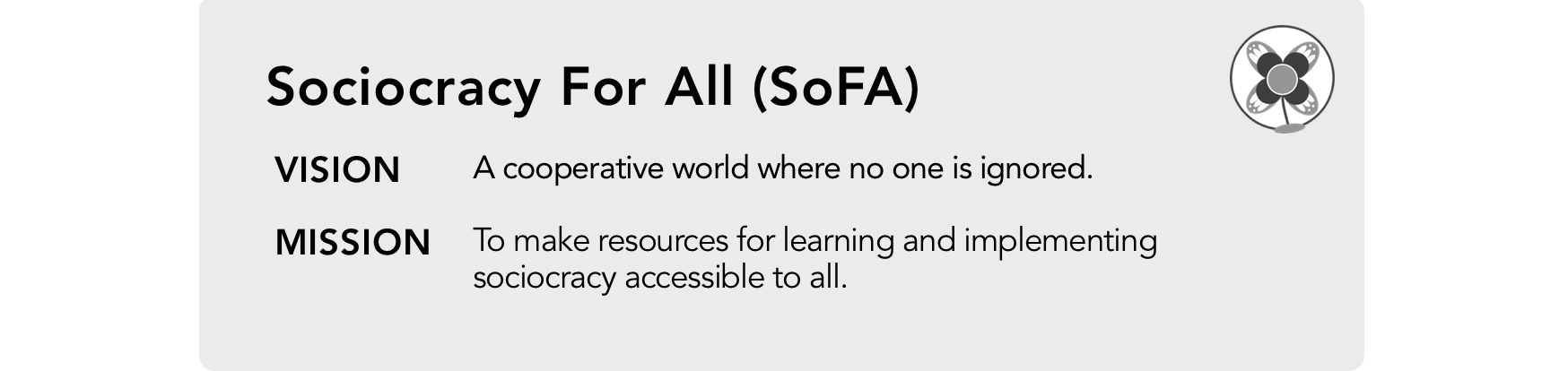 |
As shown in Box Figure 2.6, “Sociocracy For All vision and mission”, The vision is an inspirational place where we want to be. The mission is our contribution of how to get there. In SoFA’s case, it is about making knowledge accessible. We want to live in a world that works for everyone (no one is ignored) and we are guessing that making sociocracy accessible is a way to contribute to a world where everyone is considered.
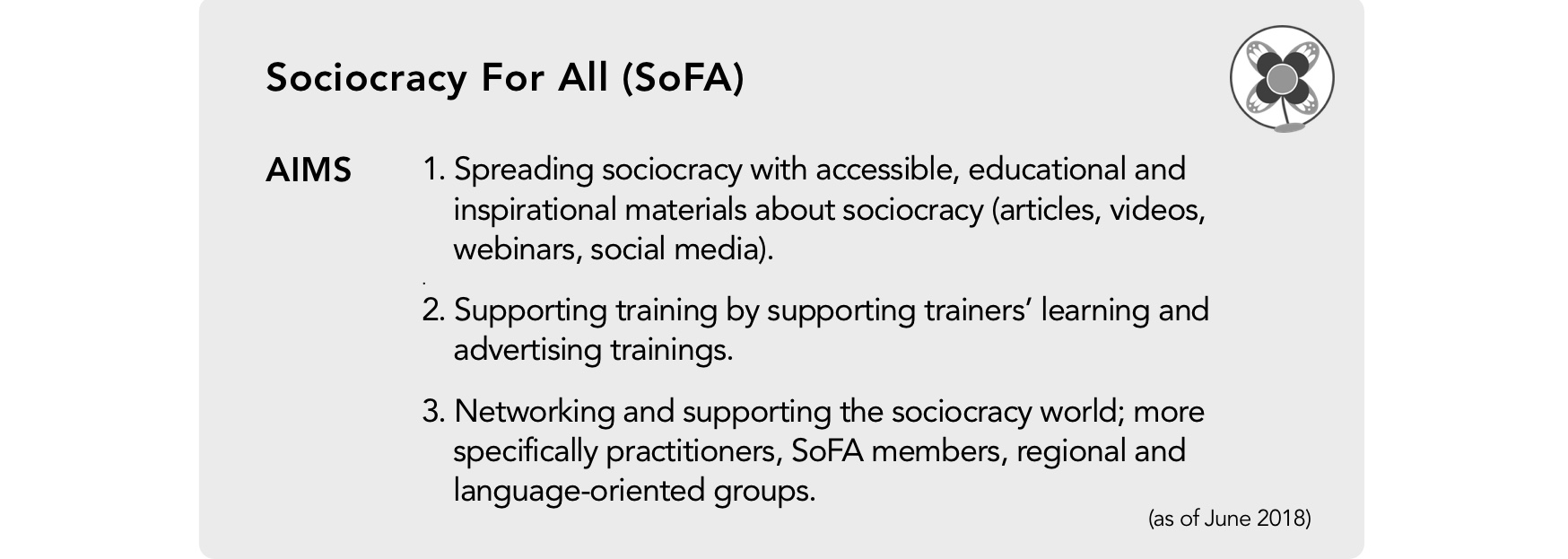
What we choose as reasonable strategies to act on our mission are the aims. If SoFA decides that something we are not doing yet is a good way to work toward our mission, another aim might be added. The current aims of SoFA are listed in table Figure 2.7, “Sociocracy For All aims”.
Figure 2.7. Sociocracy For All aims
 |
Define the aim as early in an organization’s life as possible. What is the organization actually going to do? Clearly state what the product or service is, who the audience is, how the product will be delivered, and what the exchange will be (for example, product or service in exchange for money) in a way that is understandable. If it is clear what the aim is and how it is distinct from the aim of other organizations or circles, the organization is ready to start working. Everything members do in the organization, they will do to carry out that aim.
An informal way to understand what an aim is is to imagine being at a party. If someone asks “So, what do you do?”, most people want to hear the aim of your organization (or circle). “I make gluten-free beer and we sell it in an online shop” would be a satisfactory answer. If we say “Oh, I end homelessness” or “I support the cooperative movement”, it will most likely provoke further questions. Those are missions. An aim has to be something anyone understands because it is concrete.
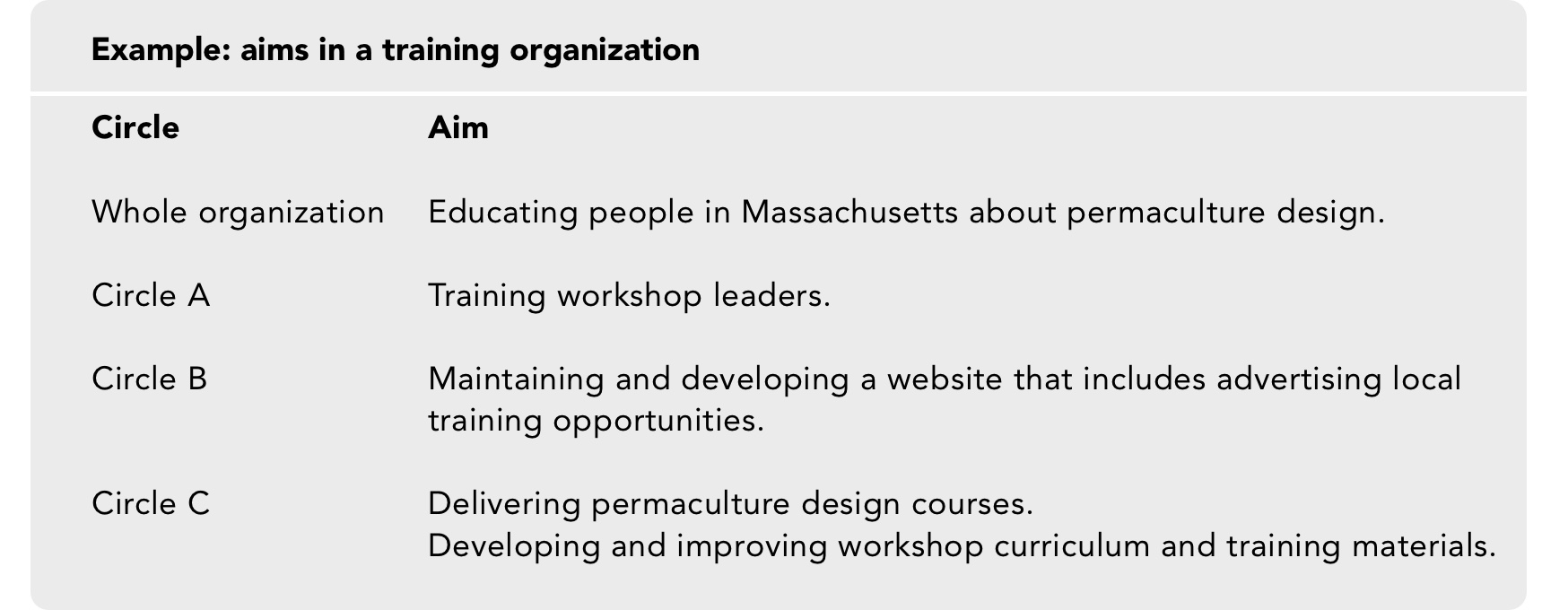
Every circle within your organization will have its own aim that will be a more specific sub-aim than the organization’s overall aim. How we define the aim determines the nature of the product or service. We can see how an aim breaks into sub-aims in table Figure 2.8, “Organization aim and circle aims”.
Figure 2.8. Organization aim and circle aims
 |
If we want to build a housing community, we need clarity on our aim. In order to be specific in our aim, we will have to make a few decisions:
Does this project include housing only or also businesses or an education program?
Nice neighborhood or social change demonstration project? Level of ecological focus?
Density level: one building, clustered, or dispersed?
Location: Urban? Rural? North or south of the city?
Balance between priority of affordability and amenities?
Expected unit/house price?
What forms of governance and decision making?
For example, if a group is planning to build a cohousing community in Toronto, it is helpful to narrow down where the community might be built. If some of the founding members can only live in the northern part of the city, while others cannot work with that, it is wiser to split up early and each group pursues their aim. How we answer those questions will change who our customers (potential home buyers) are. If these aims are not agreed upon, it will be hard to move forward as a group. It might be painful but in the long run, it is better to split groups and have clarity about shared aims than to suffer. If we do not define whether we want to form a rural or an urban community, your Site Search Circle will probably be in a deadlock situation: every site will be either rural or urban, and for each one, someone in the group will object and we won’t be able to settle anywhere. Think of the aim as the invitation: this is what we are doing; and if you like what we are doing, please join us. The more specific the invitation is in the beginning, the less disappointment and friction there will be in the future.
There might be adjustments on the level of aims from time to time. This is true for the organizational level and for the individual circles.
We might change the overall aim. A year and a half after SoFA was founded, we realized that networking among people who were practicing and sharing sociocracy was a key contribution SoFA was making to the spread of sociocracy. It was then that we added the last aim in figure Figure 2.7, “Sociocracy For All aims” on page Figure 2.7, “Sociocracy For All aims” @@TODO@@: Again, need to figure out page references here. to our list of aims. We might also add or dissolve circles or change the aims of an existing circle. For example, this handbook was made by a Manual Circle within the organization Sociocracy For All (SoFA). Now that the handbook is published, the Manual Circle will dissolve or become dormant until the next edition will be worked on. Instead of a Manual Circle, there might be a Manual Distribution Circle to manage orders and shipping or Translation Circles to make this handbook available in more languages.
The mission circle (MC) is responsible for making sure the organization’s aim contributes toward the organization’s mission.
Each circle has an aim to carry out. They also need the authority to act. They will need resources, and the right to change and shape their environment in a way that serves the aim.
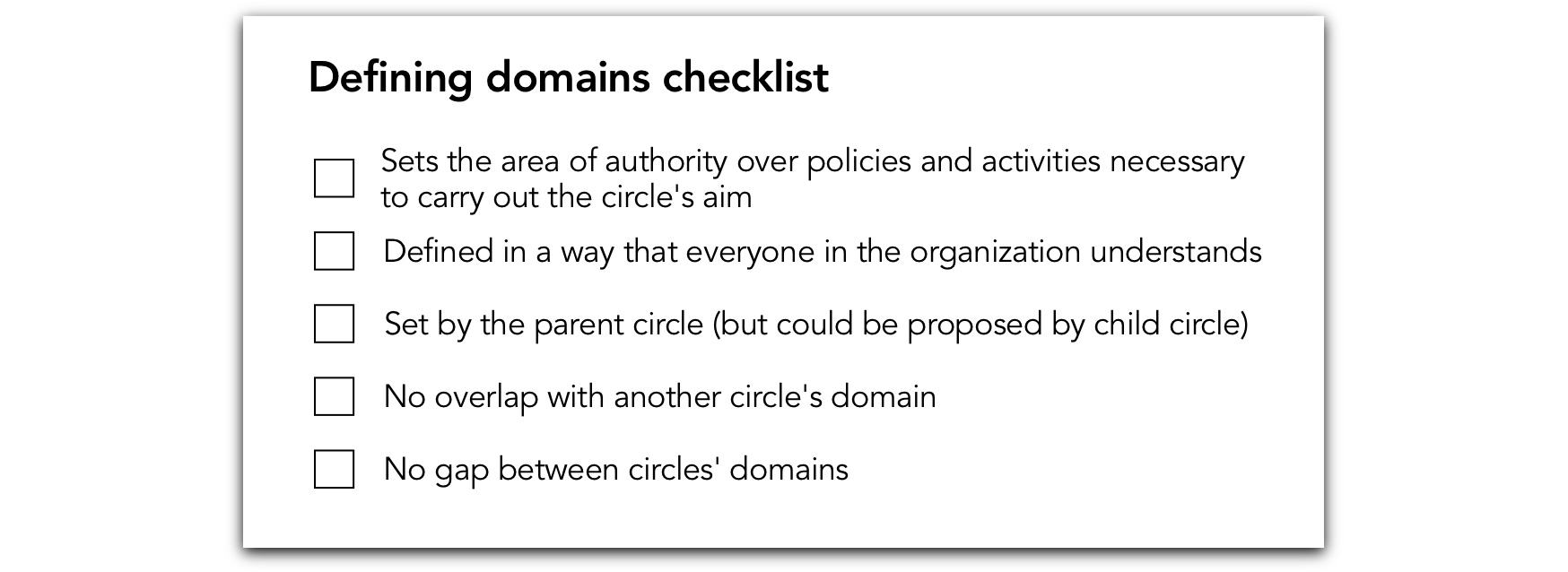
A domain defines a circle’s area of responsibility for policy making and operational activities. A circle is granted the mandate to work toward their defined aim; in exchange, we entrust them with the authority that is required to perform the tasks that come with those aims.
Figure 2.9. Properties of a well-defined domain
 |
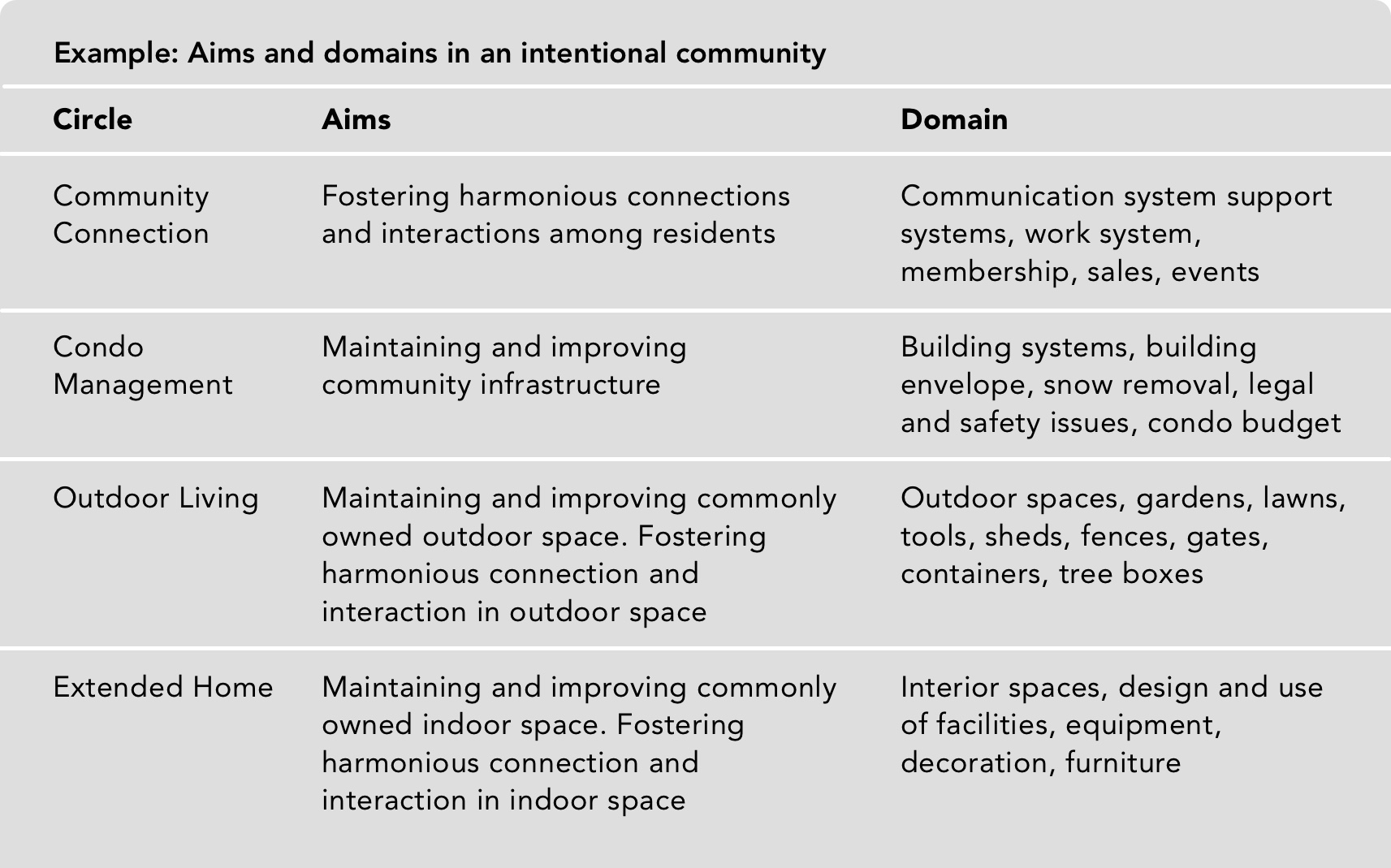
We have given circles power, and the power is purposefully distributed outwards to the most specific circles -- the most localized level possible. Authority has to go along with that so those circles are free to act. Aims and domains always parallel each other indivisibly. Imagine a Website Circle that has to ask for the password for every change they make. That would slow this circle down. Instead, we want to hand over the authority to manage the password completely (if they are the only ones needing access). The idea is full empowerment: by default, a circle will have the power to act in their domain. The only reason to restrict their authority is because a different group might need some authority as well; not out of a desire to maintain control. The same is true for labor and financial budget: a circle has a budget which is agreed upon by the next-higher circle. Within the limits of their own budget, the circle has full authority over how to spend the money and allocate labor hours. See table Figure 2.10, “Circle, aims and domains in a bakery” and Figure 2.11, “Circle, aims and domains in an intentional community” for a examples of (department) circles, aims and domains in food production (bakery) and in a community.
Figure 2.10. Circle, aims and domains in a bakery
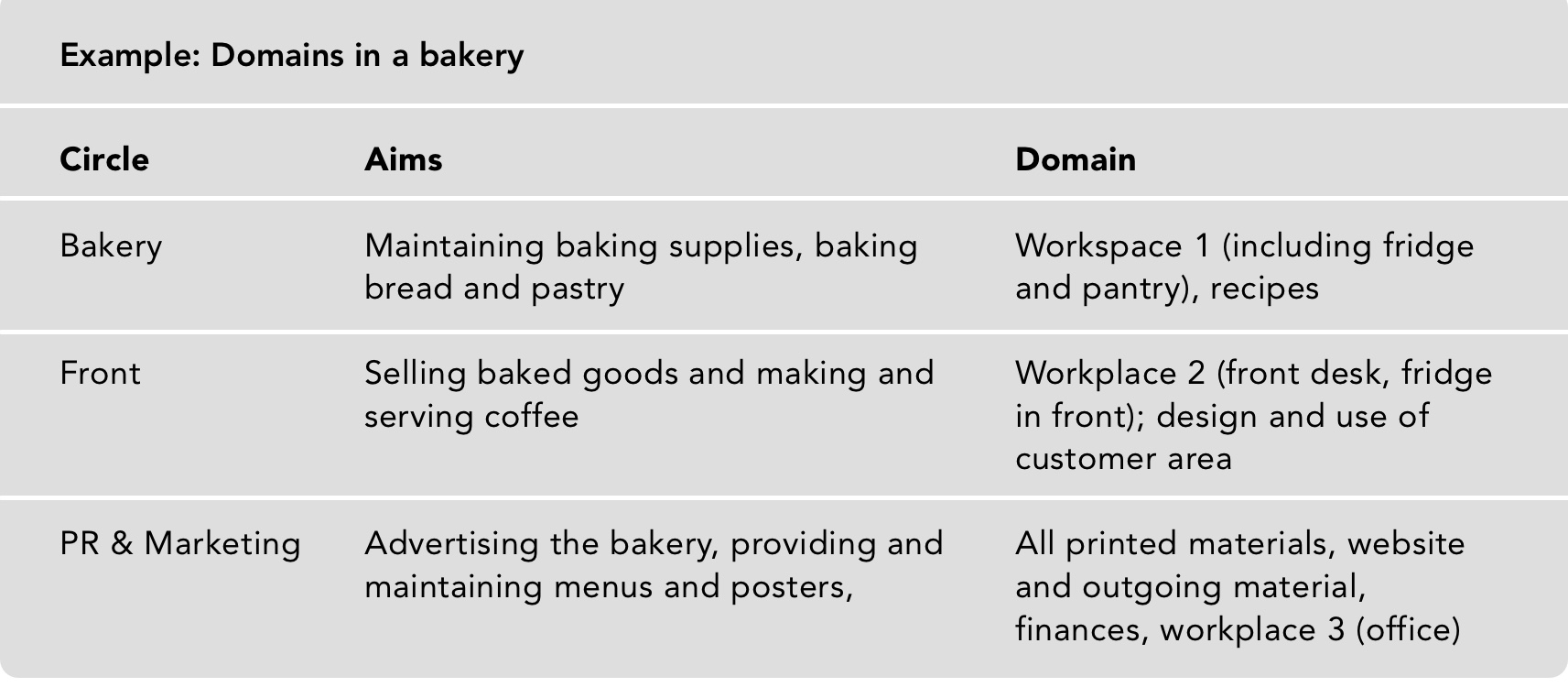 |
Figure 2.11. Circle, aims and domains in an intentional community
 |
The overall domain of the organization is the sum of all areas of responsibilities that serve the aim of the organization. We can nest domains by forming sub-domains. Sub-domains live within sub-circles. In that case, the sub-domain is being handed over to the sub-circle and the sub-circle now has full authority in that domain.
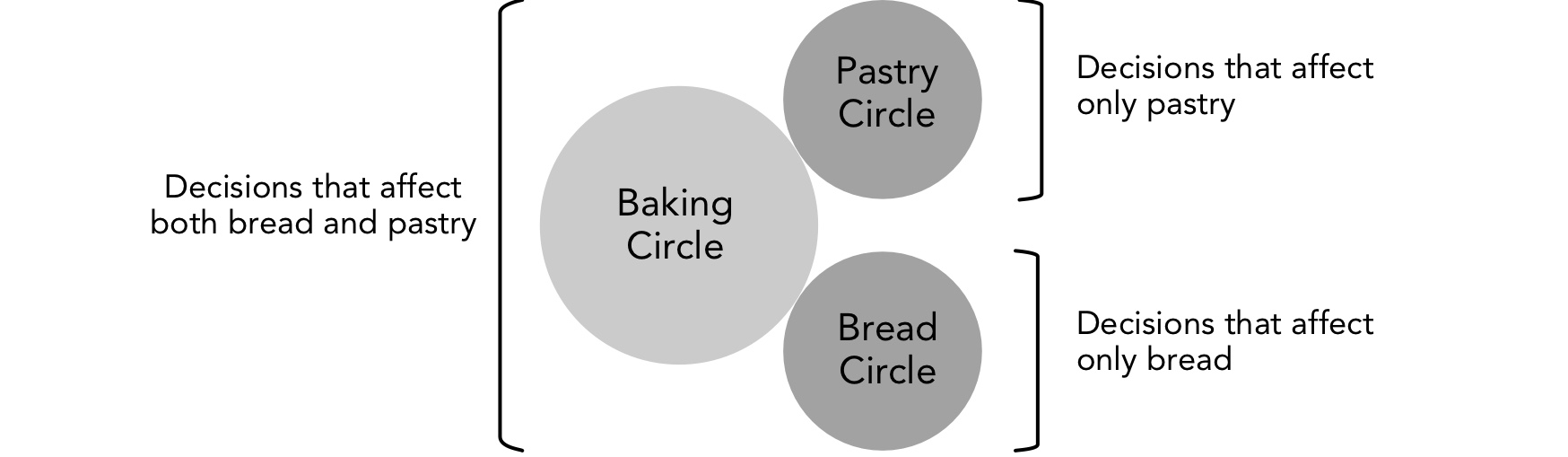
Example: Imagine pastry makers in a Pastry Circle. Pastry Circle is a sub-circle of a circle called Baking Circle. Its sibling circle is Bread Circle. Only decisions that affect both circle’s domains are made in the parent circle (see figure Figure 2.12, “Nested domains”). We try to make as many decisions as possible in that Pastry Circle. Pastry Circle does not need Baking Circle’s approval for decisions in their own domain as long as they are within their own budget.
Figure 2.12. Nested domains
 |
A parent circle can pass on distinct subsets of its domain to sub-circles, while some pieces remain in its domain. A circle like that will both be functioning as coordinator between sub-circles but also have “business of their own”. This also has the advantage that the parent circle serves as a catch-all for issues and will be able to assign them to sub-circles or take them on itself. For every issue, we try to address it at the most specific level we can find for it.
Each sub-circle has full authority over their sub-domain. Only decisions that involve both other domains (for example shared equipment) are being made in the parent circle. That means we ‘‘bump up’’ an issue into a parent circle only if this is necessary because the topic affects more than the original circle’s domain.
What sounds simple here can be quite a change in mindset for groups: a circle is free to act in their domain. As mentioned above, this is also true for decisions that affect people outside of the circle, as long as these decisions are within the circle’s domain.
A Membership Circle might have authority over policy that defines membership status for the entire organization. In a community, a Buildings and Grounds Circle might have authority over the roads for every house in the community. In a business, the IT Circle might decide what application is going to be used organization-wide for internal communication.
Domains are pivotal for the entire governance system as they guide not only how power is distributed, but also how smoothly the organization will run. This has an implication that sometimes catches new students of sociocracy by surprise. If a domain affects everyone in the organization, a small circle will have authority to make decisions that affect everyone in the organization. A circle makes decisions about their domain, and that can be organization-wide, depending on the domain.
Distributed power requires trust. Trust can be earned by gathering feedback from a wide range of people outside of the circle, by transparency and good quality work. The organization runs like an organism with many small self-controlled interdependent system (as opposed to a machine controlled by one big gear in the center). The advantage of small group mandate is focus: not everyone in the organization has to take care of everything. With distributed autonomy and flow of information, more can be accomplished than one person’s mind could hold.
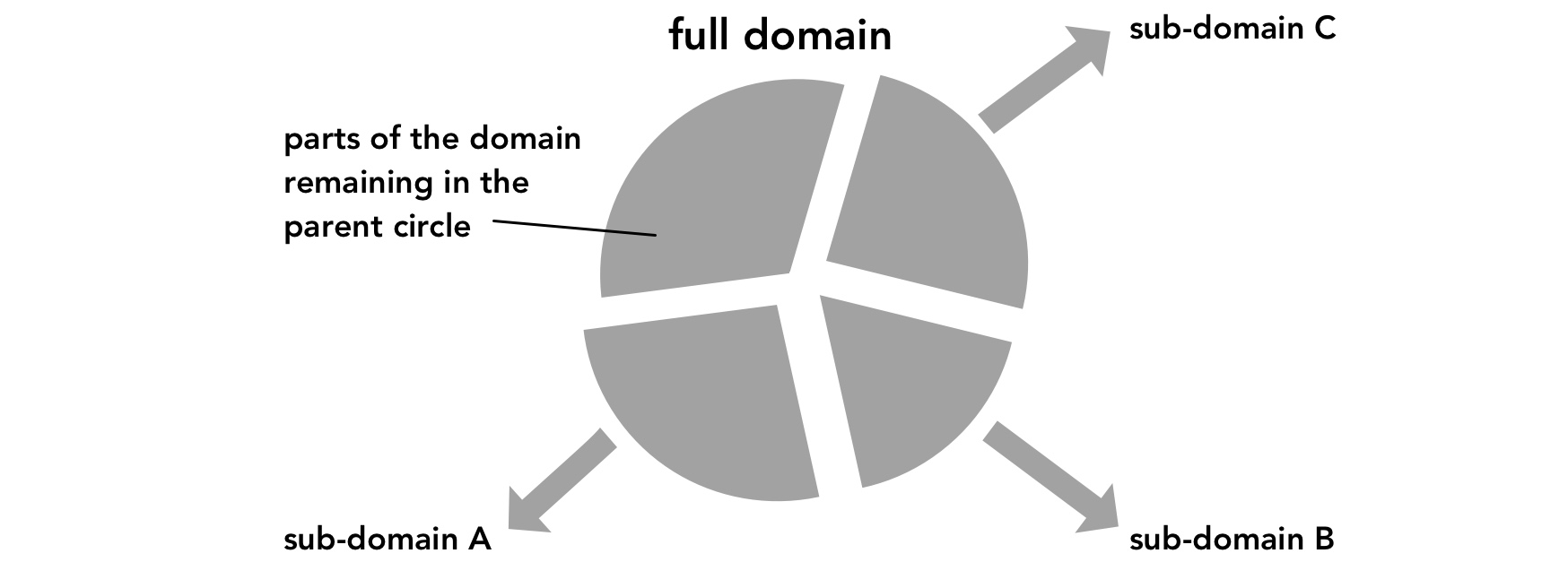
When a circle passes on parts of its domain to a sub-circle, anything that is not taken care of by a sub-circle still belongs in the domain of the parent circle. For every issue, we try to address it on the most specific level (i.e. at the “lowest” level we can find for it).
A way to visualize this is figure Figure 2.13, “A parent circle passes on parts of its domain to three sub-circles”. The domain of the parent circle gets split up ‘‘emptied out’’ as we form sub-domains. The parent circle is responsible for supporting each sub-circle and will be the default circle to deal with the work or decision in case the sub-circle breaks down or if sub-circles need support. The authority follows the principle of what linguists call an “elsewhere condition”: something will always be in a circle’s domain unless it is held in a functioning sub-circle’s domain.
Figure 2.13. A parent circle passes on parts of its domain to three sub-circles
 |
Example: A school divides up a Teacher Circle into 1-6th grade and into 7-12th grade. All coordination work between the two lies in the domain of the next-“higher” circle. Every issue or task that affects curricular work beyond those two groups will remain within the Teacher Circle as business of their own. Example: A music store that sells string and wind instruments forms a sub-circle for each. The store’s focus is not on percussion but they do sell drumsticks as they are high in demand. There is not enough need to form a Percussion Circle, and all percussion-related work can be coordinated by the parent circle.
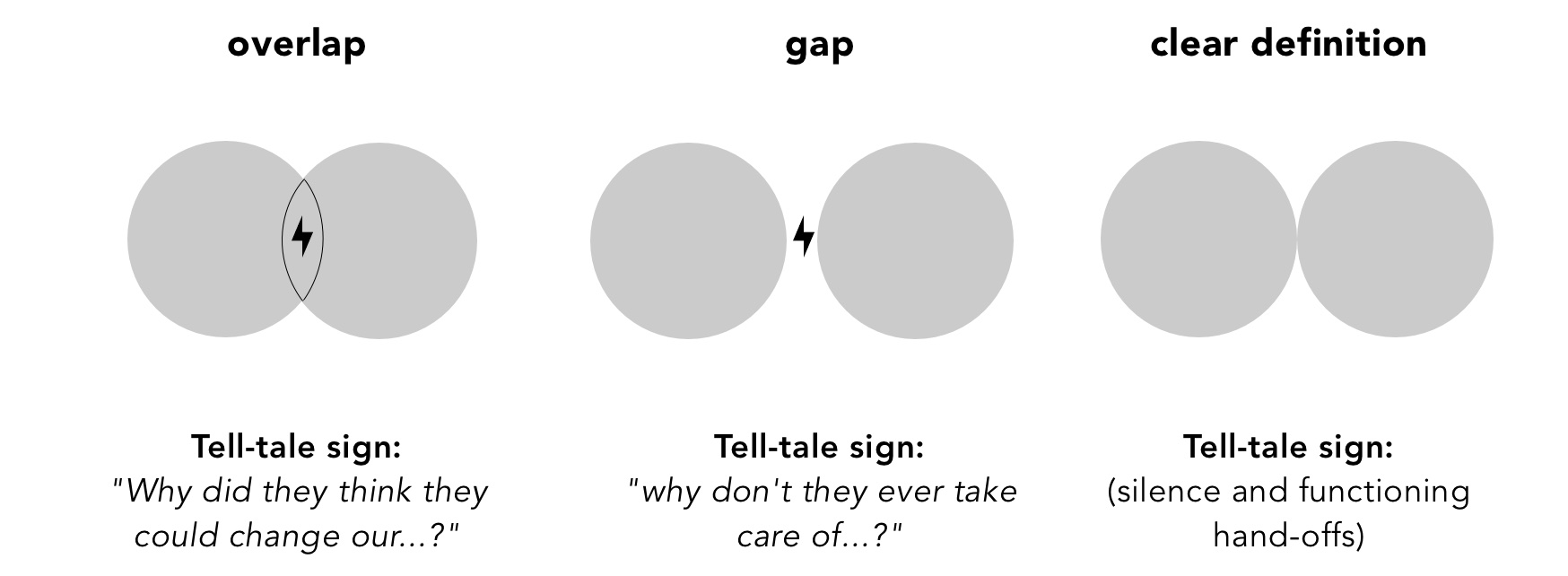
When we define the aims and domains and how they relate to each other, we have to be careful to make sure there is a good fit. Figure Figure 2.14, “Overlap, gap and good definition of domains and tell-tale signs” shows the cases of gaps and overlap. If there is overlap between the domains of two given circles, the circles might step on each other’s toes. How do we notice if they do? Every time there is an argument following one of the patterns below, then we know that there is overlap between domains or lack of education on what the domains are.
Why did they do …, even though we already did…? Why did they change our…?
Why aren’t they taking care of…? Why don’t they ever…? Do they not know they should…
The simple answer might be: “because there was not enough clarity on how the domains are defined.”
In both cases (overlap and gap between domains), there might be feelings stirred up. The most constructive response, however, is curiosity: “I wonder whether our domains are defined well enough.”
Figure 2.14. Overlap, gap and good definition of domains and tell-tale signs
 |
See this in action, on the example of a Community Building Circle:
Imagine a circle that takes care of the building called Community Building, Community Building Circle. Their domain is everything in the physical sphere of the community building. The circle decides to divide up that domain by forming two sub-circles: one circle takes care of the basement of the Community Building where there is a laundry room, bike storage and a meditation room. Another circle takes care of the first floor of the Community Building.
Figure 2.15. Two domains: first floor and basement of a building
 |
As easy as this seems, there might be friction. For example, in this example of a First Floor Circle and the Basement Circle – who takes care of the stairs?
Figure 2.16. Creating clarity between two domains
 |
Two domains with stairs in undefined domain
 |
Two domains with stairs in defined domain
In a situation where we have a gap between domains, no one is taking care of the stairs. The issue might remain uncovered for a while, and members of the community might complain about the dirty stairway. Eventually, First Floor Circle might get upset with the Basement Circle (“After all, it’s the stairs to the basement, right?”), and Basement Circle is upset with First Floor Circle for being accused (“After all, when we agreed to take care of the basement, no one was talking about the stairs”). Feelings point to unmet needs, and the need here is a need for clarity and mutual understanding. There is no right or wrong solution here; all we need is an agreement, a clarification of domains. We might come to the conclusion that Basement Circle should take care of the stairs and we adjust the domains which now include the stairs for Basement Circle. Or we might have reason to assume that First Floor Circle should do it because their clean team cleans more often and the stairs get rather dirty.
What if they assume overlap between the domains of the two circles? Let’s assume both circles assume that the stairway is in their domain.
Basement Circle decides to put an anti-slip carpet on the stairs because there have been reports of people slipping on their way down. Now First Floor Circle is upset because the stairs are visible from the first floor, and the aesthetics are not what First Floor Circle had in mind for that space. They say the stairs now look like shop floor stairs, but they wanted the community building to have a ‘‘living room’’ look. Both circles assumed they had a say; both circles assumed the stairs were in their domain.
Once we see how the confusion is born out of lack of clarity, solutions are relatively easy to find. The clarification of domains might happen by consent in the parent circle (in this example the Community Building Circle).
Part of a well-defined set of domains of circles is also to define the hand-offs between circles. This is different from overlaps or temporary handovers of authority. With hand-offs, there is no passing on of authority. It is more like a relay race where the baton is passed from one runner to another. See more on domains, handovers and hand-offs in section Section 2.6.3.1, “Hand-offs”.
Aims and domains of a sub-circle (child circle) come from the parent circle. If a circle forms a new circle, then that parent circle brings the circle to life by coming up with a way to populate the circle and by defining what the new circle’s aim and domain will be. A circle cannot change its aim unilaterally, but it can propose a revised aim to its parent circle for consent. When a circle’s aim and/or domains are changed, both parent and child circle must consent.
When switching an existing organization to sociocracy, we recommend that the group consent to a governance document that identifies the circles the organization is starting out with, and their aims and domains.
Over time, there might be adjustments to domains and aims, as we clarify and adjust our organization to changing needs. Keep in mind that the written-down domains and aims are policy like any other decision. They represent the bigger “frame” of how we divide up our work. Aims and domains are your foundational policy. They are not cast in stone; instead, they are in place to support your work.
As we write down aims and domains, go by what makes sense to people in the organization. One does not need a lawyer to define aims and domains. If it is clear enough for everyone who is involved, it will likely be good enough for a start – safe enough to try and good enough for now.
We have been talking about ‘‘sub’’-circles and ‘‘sub’’-aims. Does that mean sociocracy is hierarchical? If so, how does that go together with the idea of governance as equals?
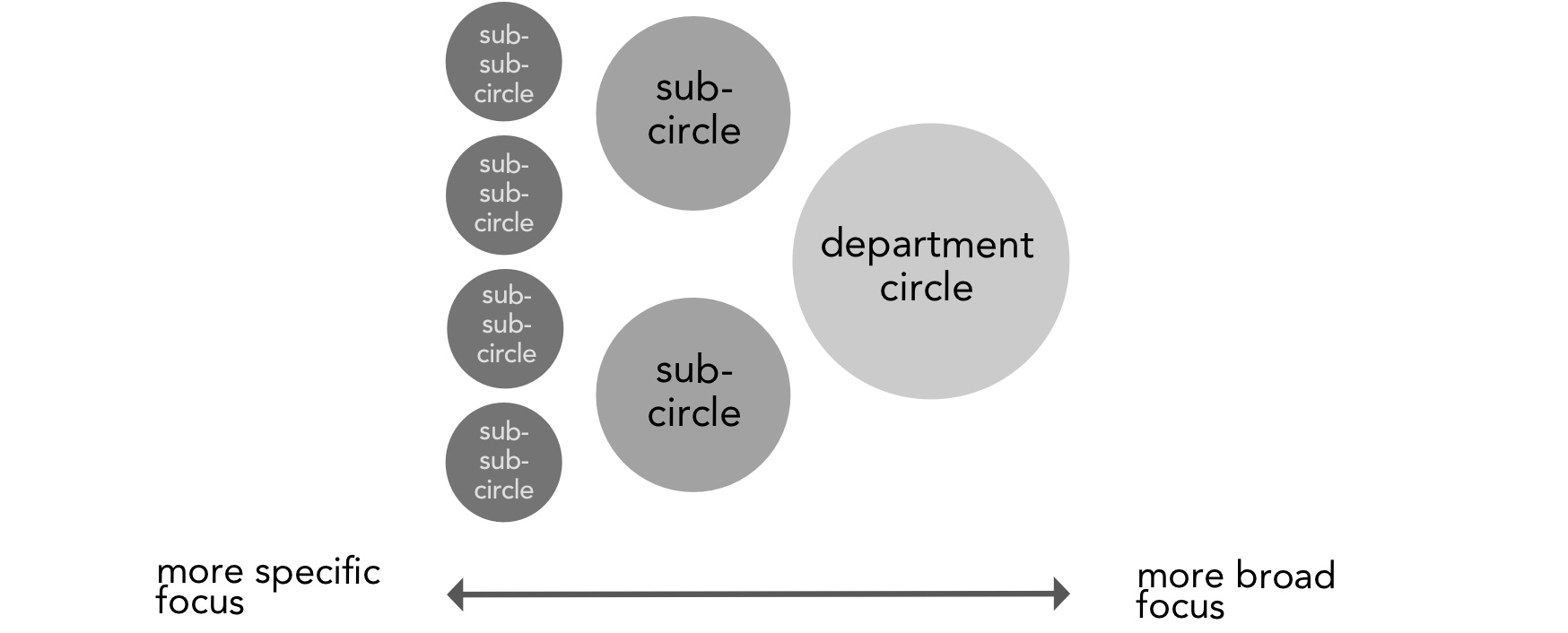
The hierarchy in sociocracy is a hierarchy of specificity of aims and domains, not a hierarchy of oppressive power. A Dishwashing Circle makes very few policies and does a lot of specific, operational work (the dishes!). A Board of Directors does little operational work and spends most of its time on long-term planning and the abstract level of overarching organizational policies that are not made by individual circles. In the original development of sociocracy, the Board of Directors Circle was labeled ‘‘Top Circle’’. People are attracted to sociocracy because of how it embodies egalitarianism. Words like top circle, higher circles, lower circles and even the word leader can trigger discomfort and the assumption of the existence of an oppressive power structure. So we look for different ways to describe the continuum of circles from specific to abstract. For example, instead of Top Circle or even Board of Directors, we use the term “Mission Circle”.
Figure 2.17. From broad to specific. From specific to broad.
 |
Organizations can choose the wording they prefer. For sheer simplicity, we often talk of “high” vs. “low” among people who are aware of the lack of oppressive force in sociocracy. To create clarity for those new to sociocracy, we chose to use “sub” as a prefix – the way we also encounter it in power-neutral systems, for example in “submarine” and “subcontinent”. It would never occur to us to assume that people in submarines do less valuable work than people in a ship. In the same way, the requirements and the aspects to pay attention to are different for dishwashers than for kitchen planners, although their domains are related.
We often use “broad” vs. “specific” (as in Figure Figure 2.17, “From broad to specific. From specific to broad.”) in training contexts where we have more time to explain and can avoid confusion around the terminology. But those terms seem cumbersome and chances are, people might be driven away because it sounds complicated. Our overall aim is to make sociocracy accessible, not to make it sound complicated.
Whatever words an organization uses, here are three ideas to consider. Every organizational structure can be drawn in different ways. The structures in diagram Figure 2.18, “Circle structures shown in different ways.” describe the exact same organizational design for an organization, some looking more hierarchical, some less so. We can avoid a perception of linear hierarchy by drawing a more circular structure – but even that comes with connotations (periphery vs. center, peripheral being interpreted as “marginal”).
Figure 2.18. Circle structures shown in different ways.
 |
Hierarchy in sociocracy is not a hierarchy of people. Since every circle comes with a piece of the overall aim and domain, and aims and domains are nested, it is not people that are in a hierarchical relationship to each other but it is aims and domains that stand in hierarchical relationships to each other. Those aims and domains are tied to circles which are filled by circle members and holders of roles.
In a sociocratic organization, it is likely that the same individual can be part of a more specific circle and a broader circle. The same individual may fix bikes and, at the same time, be part of a circle that does long-term planning. The point is that the circle that oversees bike repairs has very tangible and specific work, while a board deals with abstract long-term planning. Any person might do either job, but the focus is different depending on what we are paying attention to in that circle. (More on power dynamics and how sociocracy challenges the power structures we are used to, see for example Section 6.10.5.1, “Underestimating the prevailing culture” on page Section 6.10.5.1, “Underestimating the prevailing culture”. @@TODO@@: Figure out page references.)
A circle is defined by its aim and domain. We also need to know who is a member of that circle. Good decisions depend on deliberation among people who have a shared understanding of their work.
A good default group size is a group of 5-7 members. In a group of that size, it is possible to hear each other and to pay attention to each other. Groups can also be smaller or larger. Considerations:
Policy: How much policy does the circle make? Policy making is easier in a small circle.
Frequency: If a circle meets often, then a larger circle is doable.
Duration of meeting: If meetings tend to run long, then a smaller circle is preferable.
Familiarity and complexity: How much does the circle work together? If workers spend a lot of time working alongside with each other and their operations are alike, they know each other well and meet very often, a larger circle size is possible. If operations are complex and ever-changing, smaller groups and more meetings are recommended.
Circles make policy decisions by consent. Consent is the default decision-making method in sociocracy that will be described in detail in section Section 3.2.2, “The concept of consent”, starting on page Section 3.2.2, “The concept of consent”. The definition of consent is that a decision is made if no circle member has an objection.
Consent decision making only works if we know who those circle members are. In a situation where people drop in and out of a group, we will not know who can be counted on and who needs to be asked for consent if we want to make a decision. Protection of any decision-making group is a high priority in sociocracy, so defined membership is an essential feature of sociocratic organizations.
Defined membership does not mean closed membership. A circle can be open to new members while still requiring the clarity of formal membership.
(See more on lack of defined membership in section Section 6.10.3, “Lack of defined membership” on page Section 6.10.3, “Lack of defined membership”. @@TODO@@: We need to work on making the page reference work (in contexts where that makes sense).)
In sociocracy, no one can be forced into a circle, and no one can be forced out of a circle.
A circle consents to an individual joining a circle. When an individual expresses interest in joining a circle -- no matter whether it is through hiring or a volunteer position -- it is a proposal to become a circle member. To accept this proposal, we do a consent process to welcome the new member into the circle (see Section 3.3.2.3, “Making a decision: the consent process” on page Section 3.3.2.3, “Making a decision: the consent process” @@TODO@@: Figure out page references. on the consent process).
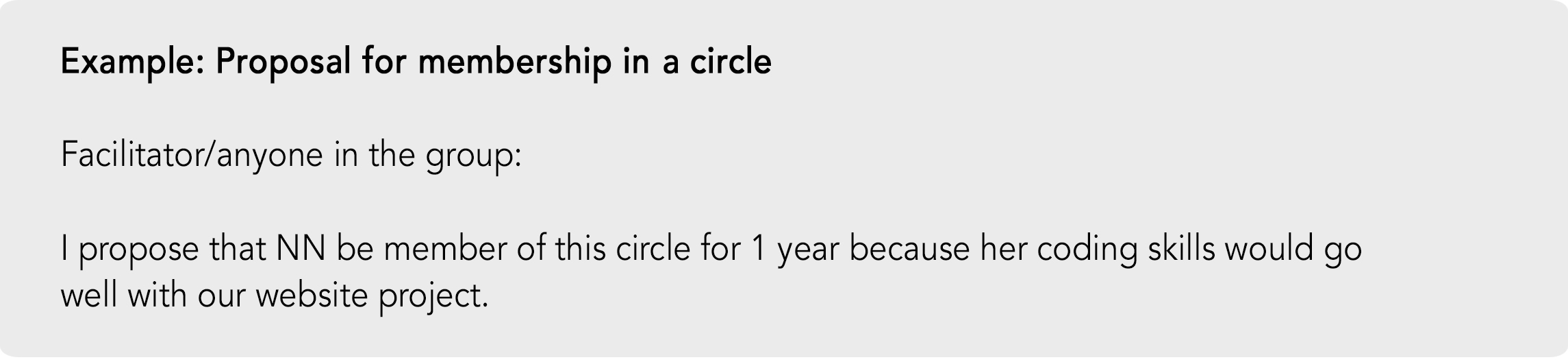
The proposal to accept someone as a member is simple, as shown in figure Figure 2.19, “Accepting a new member into the circle”:
Figure 2.19. Accepting a new member into the circle
 |
One can do a clarifying questions round, a quick reaction round and a consent round. Questions could be “I am curious what brought you into this circle”, or “what’s your experience with…” Quick reactions could be welcoming expressions. This can be a sweet ritual and very affirmative for the incoming member of the circle. Or it can be crucial to be honest to protect the functioning of the group – for instance, someone who wants to join a circle for a meeting just because an issue is hot for them. In that case, do not consent. We use our right to choose with whom we work. We might also have to work through objections.
Imagine a Curriculum Circle in a school. A member -- Natalie -- would like to join the circle and there is a consent round on that person’s membership. A current member of the Curriculum Circle objects to Natalie’s membership. The concern is that Natalie is so busy that she might not be able to attend circle meetings on a regular basis which would interfere with the circle working productively. This objection would need to be addressed and resolved for Natalie to join the circle.
If you have ever been part of a group where some people just dropped in from time to time, you know how that can make the circle’s work unsteady. In that example, we can see how important it is to have clarity about a circle’s members.
There are cases where a member of an organization is not part of a work circle. For some types of organizations, this will be more common (like in platform cooperatives); for others, it will be ruled out (most for-profit businesses). It depends on the requirements for membership in the organization whether or in what way this is possible. Membership in the organization, with its privileges and responsibilities, may be separate from circle membership.
For example, in an intentional community, an individual can be part of the community and do work (dishwash, code, mow the lawn) without being part of any of the corresponding policy-making circles. In a platform coop, not every contributing member will be part of a work circle that makes policy of how the platform is run. If we imagine a sociocratically run town, we would not expect every resident to be part of the administration. (See more thoughts in section Section 6.7, “Organizations with few workers and many members” on page Section 6.7, “Organizations with few workers and many members” @@TODO@@: Figure out page references..)
The tricky point here is that we have to be aware that sociocracy was not designed for cases of many members that are not connected to the circle system. We have to make sure to hear their voice and consider their needs for all decisions – which is harder if someone is removed from policy making. To give a short answer to a complex topic: no, not every member of the organization has to be part of a circle, but it is easier to run an inclusive organization if as many organizational members are part of at least one circle as makes sense in their context.
There is also the option of removing a member from a circle. It is crucial to have that option because working together only works if all the circle members are productive in the way that the circle requires. If a member is not able to work well with others (for whatever reason) then making decisions may be challenging for the circle. For example, a member’s sarcastic and blaming style of communication may interfere with the well-functioning of the group. If constructive circle members leave a circle because they dislike someone’s behavior, an open conversation is overdue. If a circle member’s behavior keeps a circle from being functional, that is a clear example of ‘‘we cannot work with this’’, hence an objection to a circle member’s circle membership. Sociocracy, while strengthening individual power, also protects groups, and for consent decision making to be possible, groups have to be protected from dysfunction.
Excluding someone from a circle, on the ‘‘process level’’, is easy. It is a proposal “I propose that XY be removed from the circle” (with a rationale and term). For example, a member may continually take action outside the aim/domain of the circle or continually push for favorite projects without consideration for the perspective of others.
After presenting the proposal, we can invite clarifying questions and quick reactions. The circle member that is potentially removed from the circle can ask questions and give their quick reaction. In the consent round, that person does not have consent rights. This last aspect makes it slightly more specific from a regular proposal where every circle member has consent rights.
We are aware that removing someone from a circle will be near the end-point of a lot of emotional struggle. We all care about the people we work with and we strive for harmony. It is crucial to know of this option and how to perform it. We highly recommend defining the steps that would lead up to this process before it happens. Ideas could be:
Sometimes groups engage in discussions around ground rules. We have not seen this as effective, especially when those ground rules are made with only one person in mind. Direct feedback is more effective than vague ground rules, especially since, most likely, that particular member, sees themselves as well-intentioned - and they probably are. Hardly anyone would doubt that respect is a basic requirement, but not everyone agrees on what respect looks like, and under what conditions it is appropriate to prioritize, for example, honesty over respect. Make an effort to understand what their self-conception looks like and find good balance on how much time your circle is willing to devote. (See some more comments on “firing” volunteers from only one circle on page Section 6.5, “Volunteer organizations” @@TODO@@: Figure out page references., and more on how to give feedback in chapter Chapter 4, Feedback and Learning.)