 | 2.6. Transitions and variations | |
|---|---|---|
| ↢ | Chapter 2. Organizational Structure | ↣ |
The structure of an organization is designed to help carry out the organization’s aims. No organizational structure is set in stone. The structure has to adapt to the people/mission/needs of the organization, not vice versa.
How do we know when it is time to grow our organizational structure? Below are some typical signs, including some suggested solutions.
Symptom: The circle is overwhelmed with detail. Possible solutions:
Reassign responsibilities among existing operational roles.
Define one or more new operational roles (see section Section 2.3.2, “Operational roles”) to take on some of the circle’s responsibilities.
Form helping circles to review the circle’s aims and domain and bring back a recommendation for creating one or more sub-circles.
Symptom: Many agenda items affecting only a fraction of the circle members. The expectation is that most agenda items are relevant to all circle members. Possible solution:
Separate out tasks and/or authority into operational roles, helping circle or sub-circles so that most agenda items are relevant to all circle members.
Symptom: Many members in a circle say that hearing everyone is hard. Possible solution:
Form a sub-circle especially if the circle is responsible for a lot of policy making and has more than 7 members.
To form a sub-circle, define its aim/domain and select the convener or leader. See the checklist in Figure 2.53, “Checklist for forming a sub-circle” for forming a sub-circle.
If a sub-circle has a convener but no leader, the sub-circle can select its circle leader in their first meeting. The new sub-circle then needs to review and confirm acceptance of its aim and domain.
If a sub-circle is formed and the leader of that sub-circle cannot attend the meetings of the parent circle, find a way of gathering the information either through a delegate or by assigning a liaison who checks in with that sub-circle.
Insist on the sub-circle having a full-fledged internal structure with a facilitator, delegate, secretary and meeting schedule. That helps keep the circle on track. None of these roles can be skipped without good reasons. For example, sub-circles are often tempted to “keep things informal”. However, having the roles of a facilitator, secretary, leader and delegate are not implemented for the sake of formality, they are implemented for accountability, full transparency, to save time and to keep good records. (See box in Figure 2.52, “What practitioners say”.)
Planning for future growth is fine. However, we don’t want to create circles that we can’t support in the present moment. Wishful thinking might be informative but acting on it can stretch groups too thin.
Figure 2.52. What practitioners say
 |
How would we know that we need to dissolve a circle?
There might be difficulty populating circles.
Members do not seem to have the drive it takes to run the circle sustainably.
The organization cannot afford to pay staff in that circle.
Every parent circle is always responsible for the well-being of its sub-circles. Are the sub-circles getting their work done? Are they making/reviewing policies needed? Are the sub-circle members working well together? We don’t want a circle to fall apart without noticing. If a sub-circle decides to fold, the domain and the aim automatically fall back to the parent circle as shown in Figure 2.54, “Folding a circle into an operational role: aim and domain are re-absorbed into the parent circle”.
Figure 2.54. Folding a circle into an operational role: aim and domain are re-absorbed into the parent circle
 |
It is ok if a circle only meets from time to time, as long as this works well for the circle members guiding their work. For example, a circle that prepares the spring and fall fundraising events for a school might meet frequently as the event approaches, once afterwards and then not at all for a while.
What can we do if we need to close down one or more circles? It is easy to do so if we drop the work at the same time. For example, your company decides to drop the line of bathing suits and only to sell goggles. That’s fine. Now we do not need the bathing suit circle anymore.
But what if there is still work to do but it is too hard to keep the circle running? We can turn the tasks into an operational role into the next-broader circle. Terminate any ‘‘zombie’’ circles (circles that should be ended because they are not meeting/working but are still kept alive on paper).
What’s the relationship between sibling circles? There should not be any overlap between their domains. But we might want to strengthen the connection between sibling circles when domains seem to interdepend. Let’s look at an example.
Let’s say we have two circles in a land shepherdship context. One circle takes care of the paths, roads and infrastructure – Infrastructure Circle for short. Another circle takes care of the trees and bushes, Tree Circle.
Figure 2.55. The circles with (supposedly) well-defined, non-overlapping domains
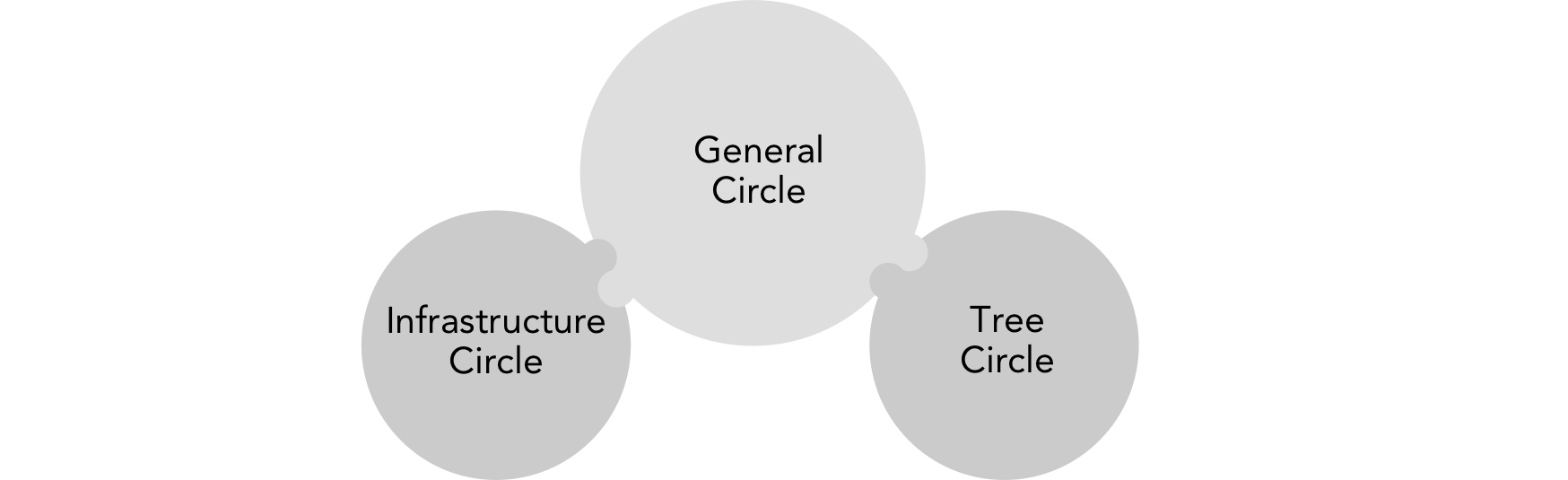 |
It seems that the domains are very well defined. Everything that is a road is in the Infrastructure Circle, for example repairs or cleaning and clearing the paths. Tree circle’s domain is also very well defined because we know the piece of land and we have a clear sense of what a tree is. If a tree is damaged, tree circle is going to look into it.
Now, what happens if there is a storm and a branch breaks off the tree and falls onto the path? Who cleans up? There is no right or wrong here, but what we need is clarity between domains. Someone will have to be in charge, make policies around how the clean-up happens and what the budget is for additional machinery that might be necessary etc. This group might decide that the branch is in Tree Circle’s domain as long as it is on the tree. Once a branch is not attached to the tree anymore and blocks a path, it falls into Infrastructure Circle. It would be responsible for clean-up because it is in its domain to keep the paths usable. So far, this example is well along the lines of what we have said about clearly defined domains in section Section 2.2.2, “Domains”.
If this is a big piece of land and tree branches fall often, shouldn’t both circles be involved in policy around that? Shouldn’t they be connected diagonally so that Infrastructure Circle is well-informed which trees are already weak and might fall soon? There are good reasons to create a connection between circles for sharing information, but not shared decision making.
While domains define the area of responsibility, hand-offs describe how information (or goods or services) flow from one circle to the other. Domains have to do with decision-making authority, while hand-offs have to do with workflow.
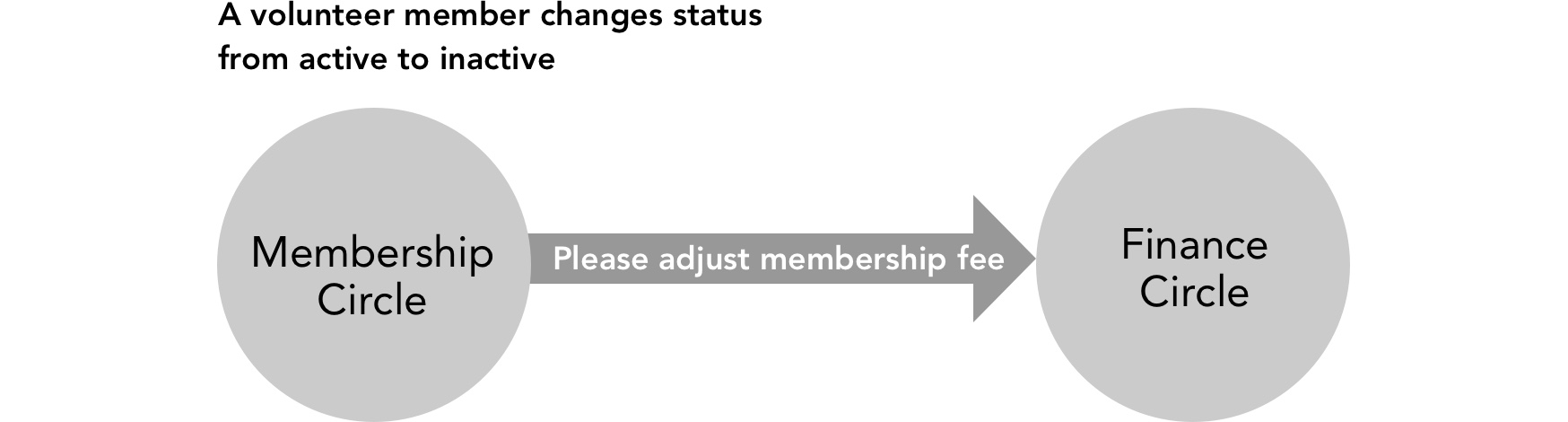
An example of a hand-off would be the transition of a member from active to inactive. The difference in membership status might come with a change in the membership fee (inactive members paying a different amount than active members). The change in status would have to have a clear hand-off from the circle that handles membership to the circle that handles finances so the new membership fees can be tracked correctly.
Figure 2.56. Handoff between two circles I
 |
Another membership-related example from a school context could be the transition from prospective student to an actual member.
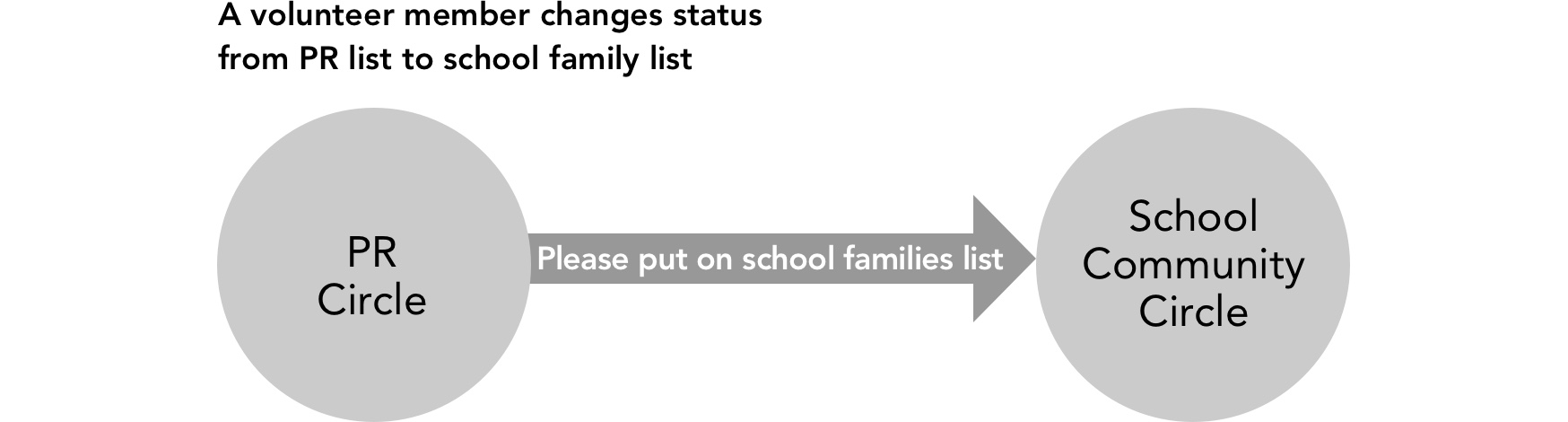
Let’s imagine a school has a Public Relations (PR) circle that does PR and curates a mailing list of people who are considering sending their child to that school. The school also has an internal mailing list of news for parents of the school. We do not want the prospective parents to keep receiving irrelevant emails, and we do not want school parents to be hit by promotional emails. That means, as a prospective parent turns into a school parent, someone has to take their name off one list and add it to the other. The mailing list for prospective school families might be in the domain of PR circle, and they would have to take the name off and let the curators of the school internal list know that a family has joined the school community.
This is what we call a hand-off. A hand-off is different from a gap between circle domains because it is always clear who can decide what.
Figure 2.57. Handoff between two circles II
 |
Hand-offs can be defined between any circles, no matter where two circles are in the organizational structure. If necessary, a helping circle with members from both circles can be formed to develop policy and procedures for the hand-offs to be approved by both circles or their parent circle.
It is easy to confuse hand-offs with handovers. What’s a handover? A handover is when authority is being transferred to a different circle, on a temporary or permanent basis.
For example, let’s say fallen branches are in the domain of Infrastructure Circle. A big storm happens and there is a lot of damage to the property. Infrastructure Circle might want to hand over the authority for all the broken branches and fallen trees on the paths to the Tree Circle. Now, on a temporary basis, Tree Circle consents to dealing with the clean-up while Infrastructure is busy doing other things. They are helping out but they have all authority to do so. Obviously, this requires trust and good coordination. If a handover is permanent, it will be manifest in a change of domains. In such a case, the definition of the aims would be changed so that all fallen trees and branches are now in Tree Circle’s domain.
Figure 2.58. Hand-off vs. handover
 |
The term ‘‘linking’’ usually refers to linking through member(s) being full members with consent rights in both circles. This is not the case in a hand-off. There is no member of Infrastructure Circle that gets selected to be on Tree Circle. Diagonal ‘‘linking’’ is unnecessary since we can use hand-offs. Diagonal linking also waters down the advantages of sociocratic circle structures and creates unnecessary confusion. One of the advantages of small, linked circles is that everyone is part of the circle who matches the domain and the specificity of their work. If we link diagonally (full members of sibling circles), we might end up with a situation where that link does not find the entire meeting of the sibling circle relevant because their work is not in that circle’s domain – they are just there to listen in case “their” topic comes up. That is not an efficient use of time. Nothing keeps us from inviting the delegate or leader of another circle to visit a circle if necessary, and that way, we can make sure we can keep things relevant for that visitor (for example by putting ‘‘their’’ agenda item first so they can leave after). A visitor does not have consent rights in your circle. If we have a visitor from the same circle often because their presence is important for many meeting agenda items of your circle, then your domains might need some refinement. Another option is to set up a helping circle that supports the interaction between two non-related circles.
We may have some diagonal cross-pollination here and there might be people who are members of more than one circle. They have consent rights in each of their circles, which means nothing prevents double membership. That is different from formal linking. For flow of information, having a few cross-pollinators can be a good idea, and it will often be the reality in contexts where some people have roles in multiple circles.