 | 2.7. Other groups that meet | |
|---|---|---|
| ↢ | Chapter 2. Organizational Structure | ↣ |
It can be useful, within organizations, to have gatherings that serve for skill building and information sharing. They can meet once or they can be permanent groups. We call any cluster of people within an organization that shares an interest (in addition to/separate from their circle work) an interest group or community of practice. The participants of an interest group may come from multiple departments or external interest groups. They can be formal, like a caucus that is lobbying or raising awareness within the organization, or they can be informal like an annual gathering of all single dads among the parents of a school. They can also be more like communities of practice – a group of people with similar roles that meets on a regular basis. What all gatherings have in common is that they don’t have a domain. Confusion can arise from the lack of clarity about the difference between circles and gatherings/communities of practice. Diagram Figure 2.59, “Circle vs. interest group” shows the difference between an interest group and a formal circle.
A gathering or interest group/community of practice cannot make decisions that impact the policies in the organization; of course, they can provide information and work out proposals to hand to the circles that hold the relevant domain.
Figure 2.59. Circle vs. interest group
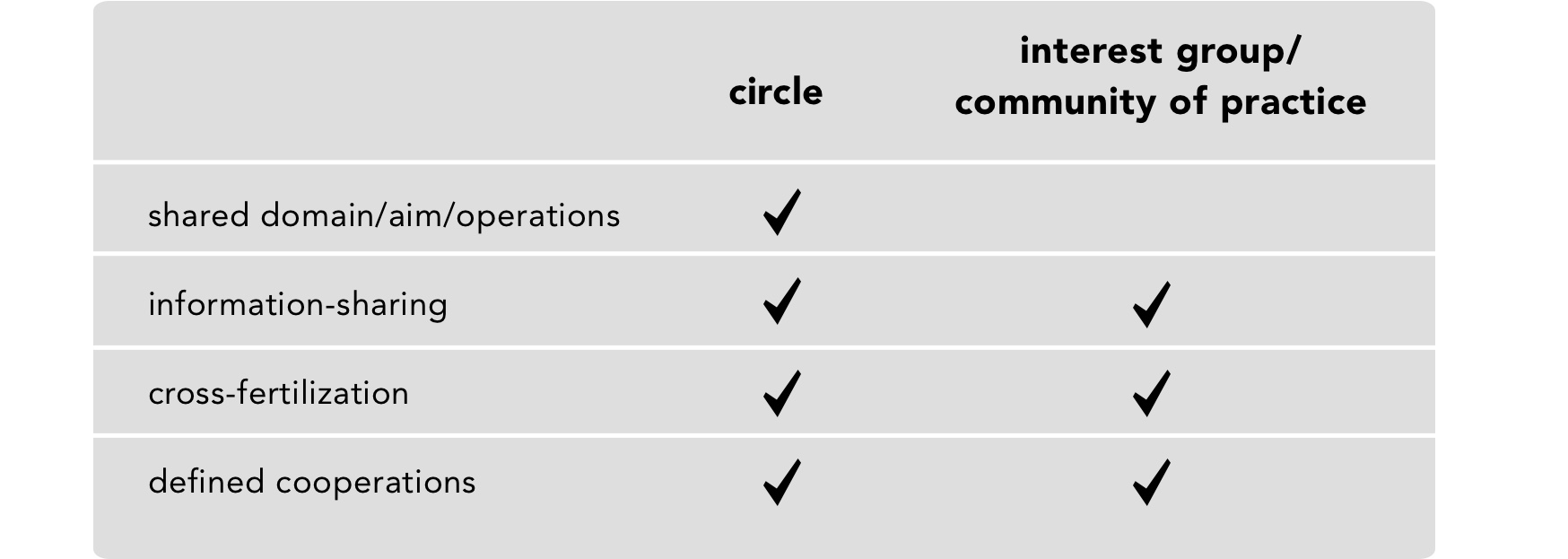 |
Figure 2.60. A community of practice might give input to the organization
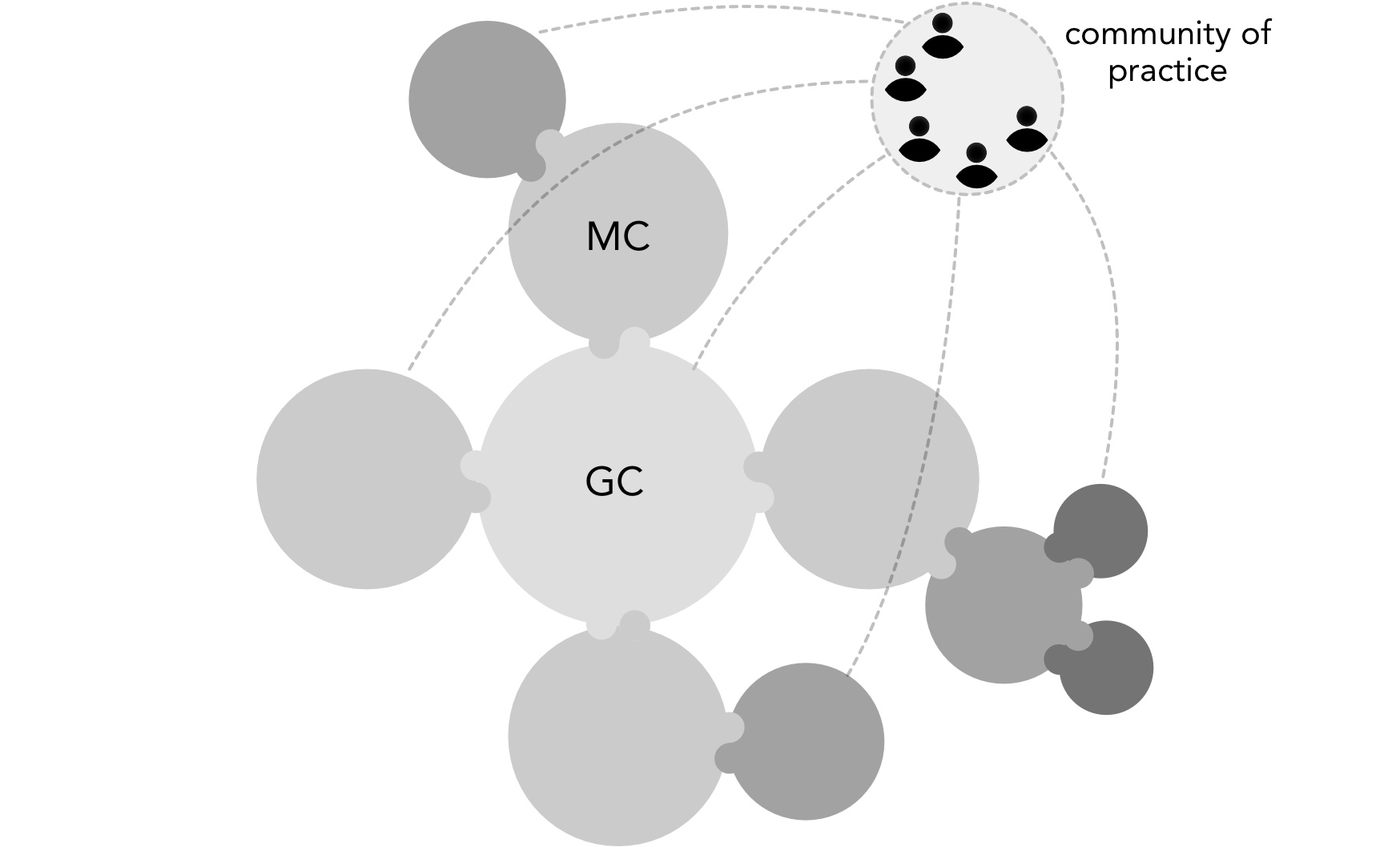 |
A good example of a community of practice within an organization that is beneficial would be a gathering of all the facilitators. Let’s imagine all facilitators of one organization meet to exchange experiences and techniques or guidelines as shown in figure Figure 2.60, “A community of practice might give input to the organization”. This group cannot make decisions about how any of the circles would be run, even in the domain of facilitation (because that can only be decided by the circles themselves or by the circle that holds this domain in the organization). They can decide for themselves how they meet, but not for others outside their interest group. What they can do is work out a recommendation together that might be consented to by each circle. They can train each other or learn together.
A community of practice might meet and gain momentum. They could visit individual circles and bring up their recommendations or learnings as they relate to that circle’s domain, or write proposal drafts to submit to individual circles. However, we do not want to turn our interest groups into ‘‘shadow’’ circles or secret clubs. If we meet half-formally outside of the circle structure (and therefore possibly lose out on strategies supporting transparency like linking, reporting, a requirement for meeting minutes, roles etc.), our recommendation is we pay a lot of attention to being transparent and forthcoming. If there is a lot of energy around a topic, groups can consider making it a sub-circle or helping circle with all the usual features so they can benefit from the accountability and transparency that sociocratic design principles bring.
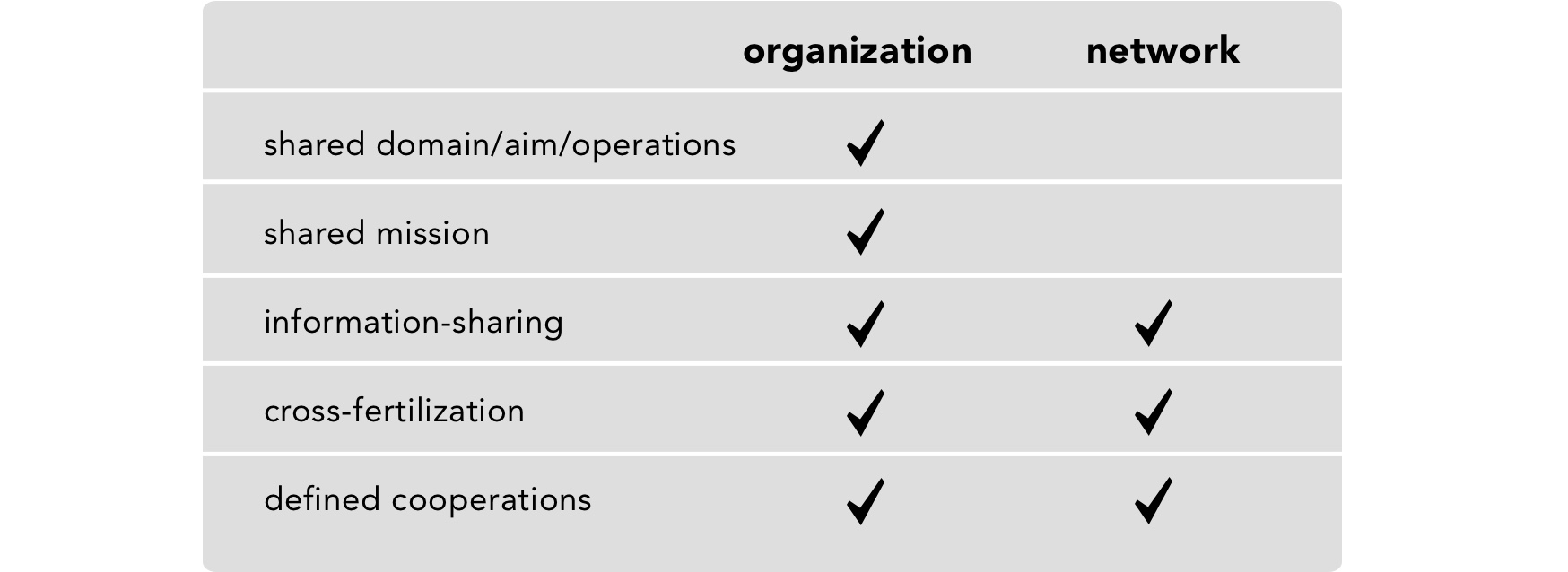
When we form networks, we form networks among sovereign organizations. The network cannot make decisions for organizations. The difference between a network and an organization is whether resources and authority have commitment. Networks make recommendations with the overall goal of mutual influence, organizations make decisions and work toward their aim. Note that some groups that call themselves networks really are organizations and vice versa. Organizations are ‘‘complete’’ organizations: they have their aim, domain, mission and members. See the comparison between organizations and networks in table Figure 2.61, “Organization vs. network”.
Figure 2.61. Organization vs. network
 |
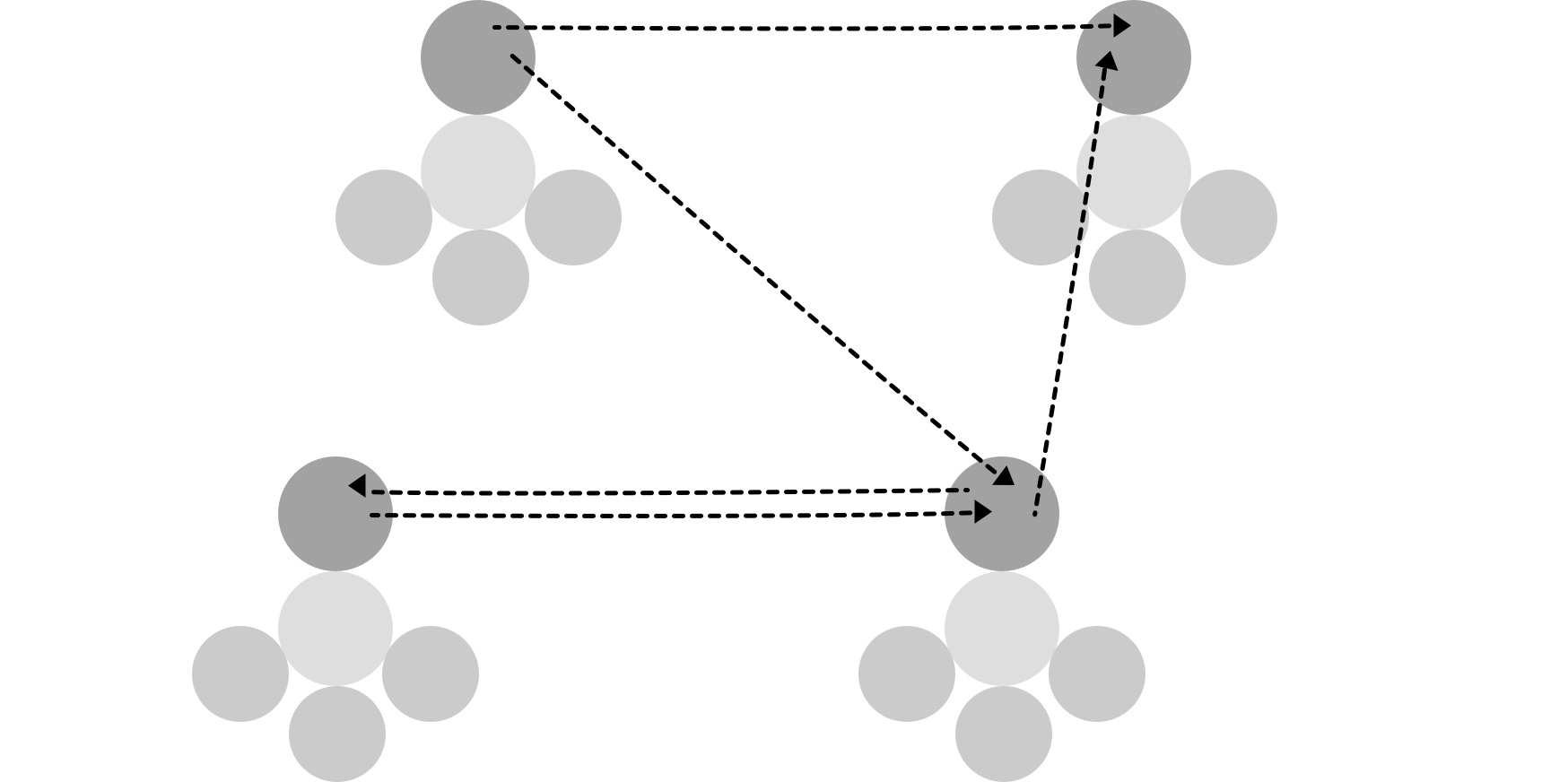
There are different ways to design networks. One way is to use the existing organizational structures and connect their mission circles.
Figure 2.62. Two sovereign organizations with connected mission circles. Connecting two mission circles is useful when the two organizations are in related fields.
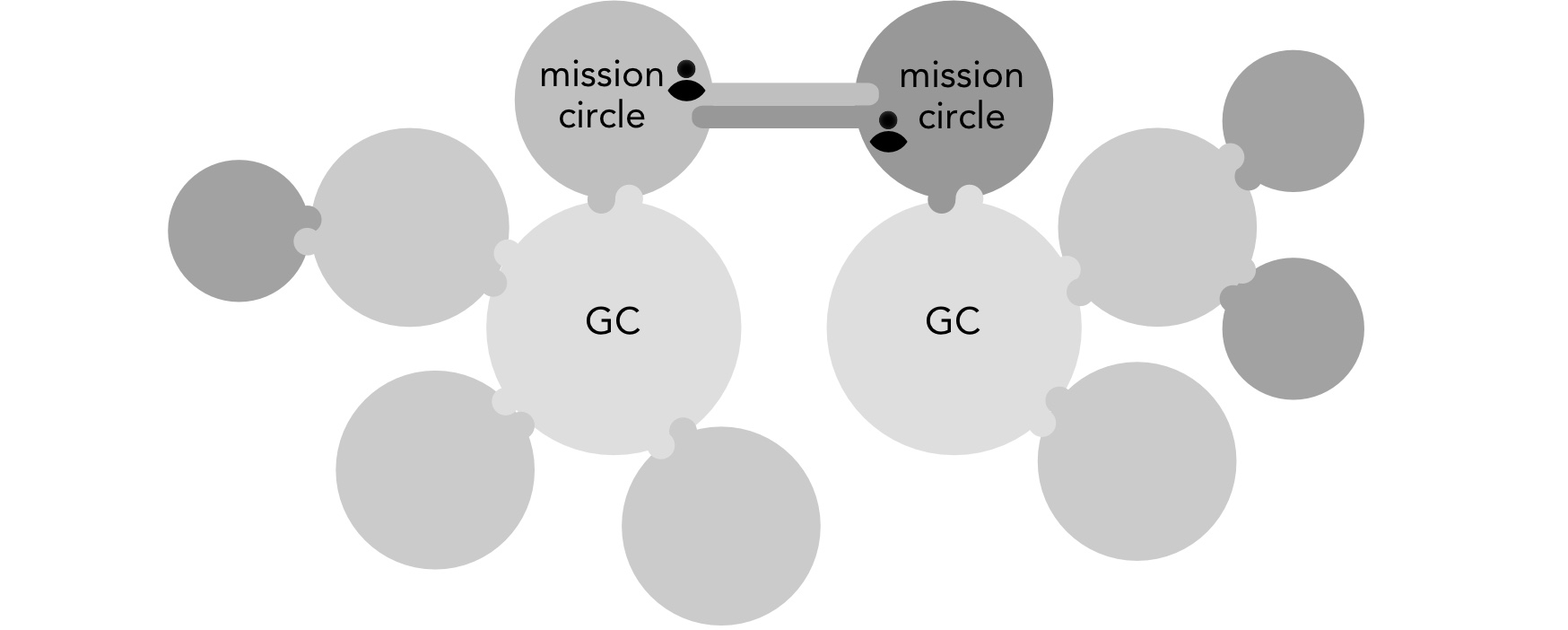 |
Now every organization has information on what is going on in the other organization. (We have already looked when addressing external MC members, see section Section 2.5.3.5, “Stakeholder representation in the mission circle” on page Section 2.5.3.5, “Stakeholder representation in the mission circle”.) Connecting two mission circles is useful when the two organizations are in related fields or for example in a supplier-distributor relationship. Some examples:
A for-profit organization has a network association with another for-profit organization that distributes their product.
Two or more intentional communities in the same region want to be connected.
A private high school networks with elementary schools in its area that are feeder schools to the high school.
Figure 2.63. Clustering by connecting mission circles
 |
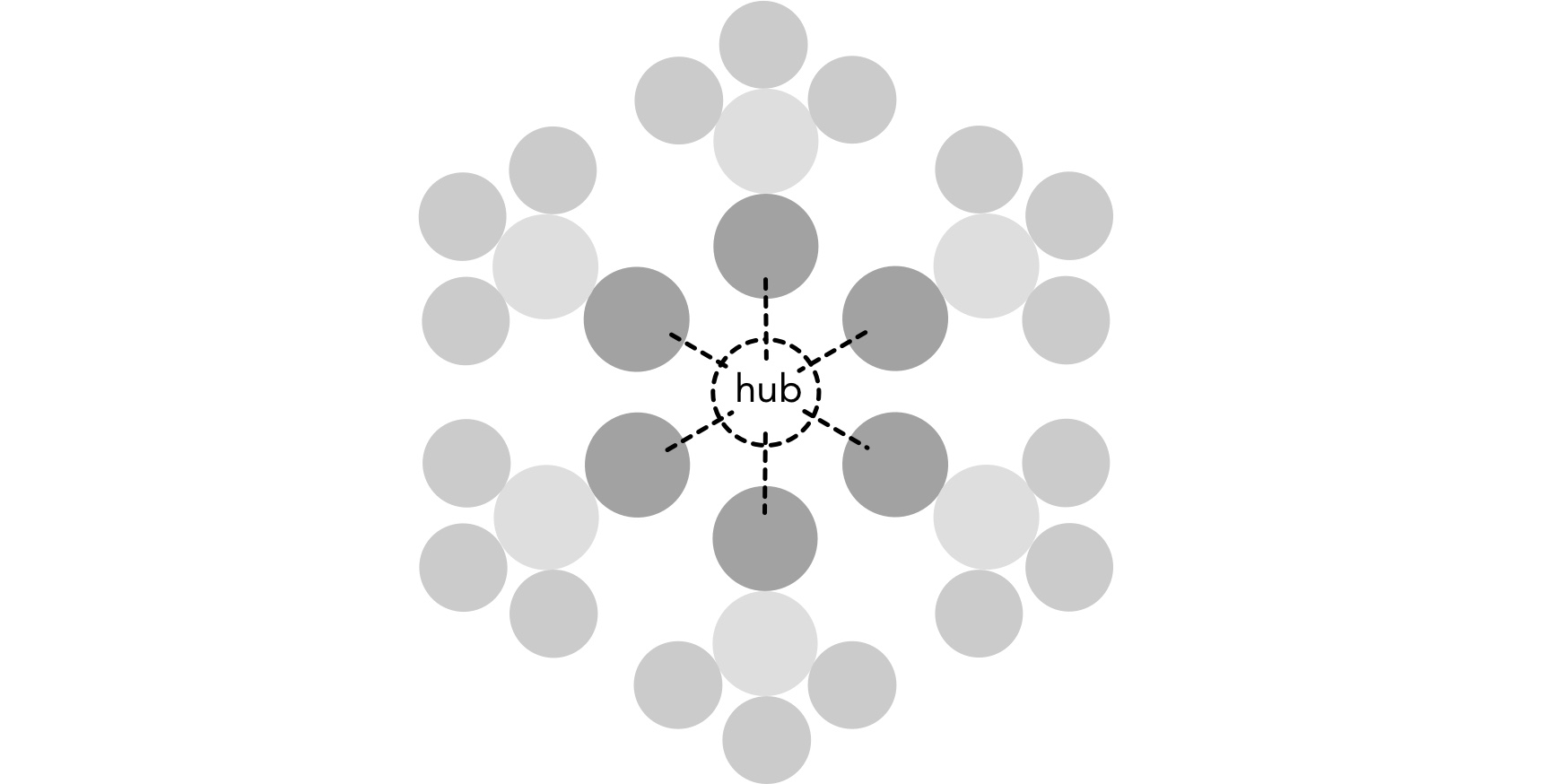
We can also form hubs, for example for collective impact efforts (see figure Figure 2.64, “Organizations building a network with a hub: no shared decision making but a central place for sharing information”). A hub is a gathering (i.e. not a decision-making group) on an inter-organizational level.
The pattern looks like the example of the facilitator circle in the previous section. We can, for example, send the operational leader of the general circle (Executive Director, CEO or whatever the name for that role is in your organization) and/or any other delegate from different organizations to form a circle. However, the same restrictions apply: this is not a decision-making circle to begin with. Since there is no decision making involved, there is no top-down link.
The organizations involved do not all have to be sociocratic to do this. The hub could be running sociocratically (in which case a double representation into the hub would be desirable to hear and speak with two perspectives), and make their own decisions by consent. The organizations connected in the hub would have to commit to making an effort to follow the guidelines developed in the hub.
Figure 2.64. Organizations building a network with a hub: no shared decision making but a central place for sharing information
 |
The success of those efforts is highly dependent on the level of commitment in every organization. The decisions they make can be recommendations for the connected partner organizations. If those partner organizations are sociocratic (meaning they cannot be controlled by the hub through top-down decision making because even the CEO of a sociocratic organization who might be part of the hub cannot make policy decisions top-down), then those partner organizations are autonomous. If the hub works out a plan that is in line with the partner organization’s aim, and the effort seems worthwhile, there will probably be support to adopting recommendations by consent within each partner organization.
International agreements work that way: representatives of nations commit to following climate guidelines, for example, but the actual implementation of these guidelines depends on the decision of the participating governments. Some examples of hubs.
Non-profits in a state that all work around food justice form a hub for coordination of their efforts.
Intentional communities in a region form a hub.
Schools within a school district form a hub around one particular topic.
While networks are for information-sharing and collective strategizing, things are different with member organizations. Networked organizations do not have to negotiate domains as they are each autonomous. If different organizations decide to become member organizations of a bigger organization, then they will share aim and domain and become semi-autonomous. Organizations now play the role of circles or of members in circles. In this set-up, there will be shared decision making. For example, once a set of sovereign countries passes on authority to an umbrella entity – like it was done when the European Union was formed – they are not a HUB but a federation because there are decisions that an EU decision-making body can make that is binding for the member countries.
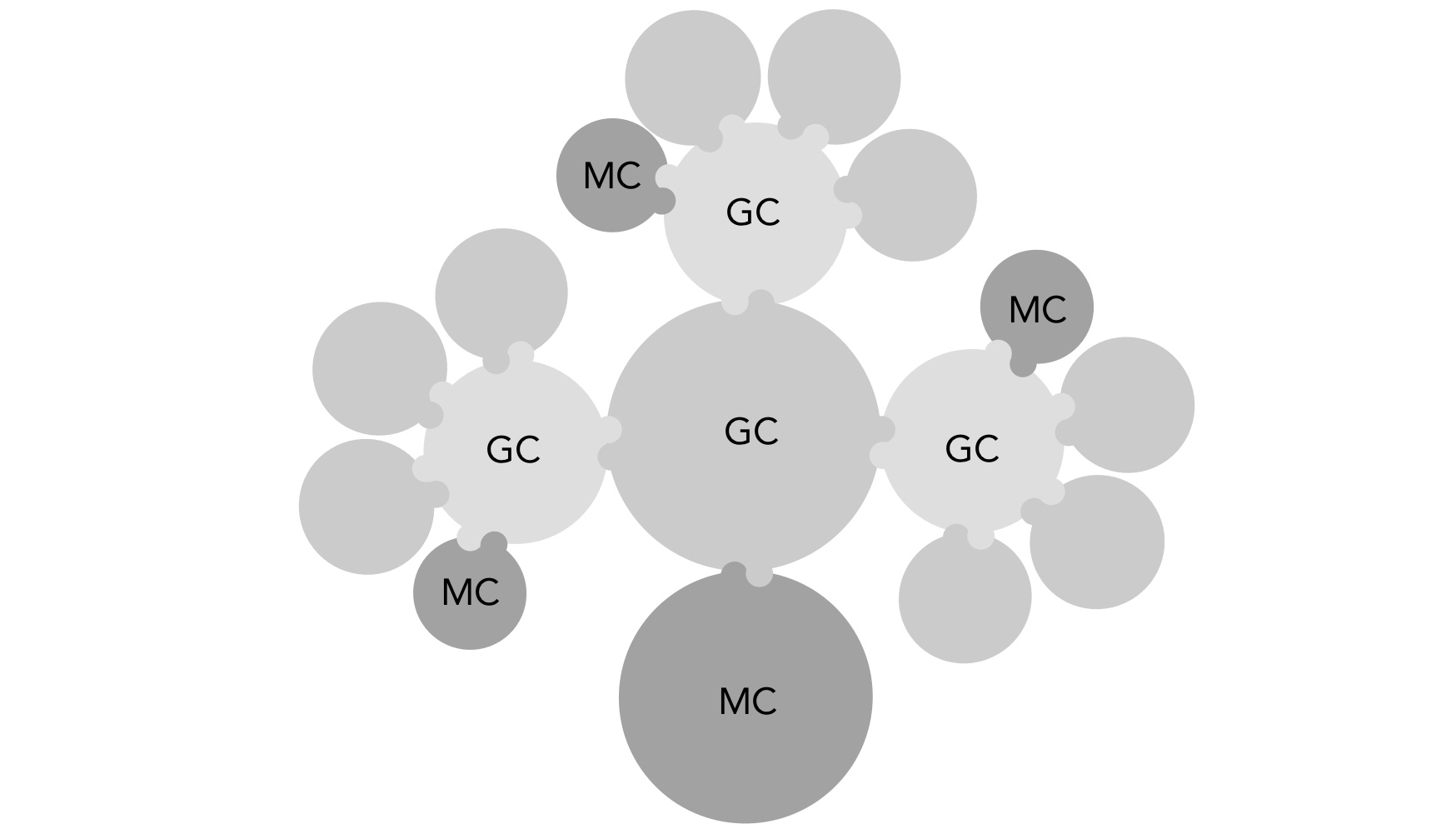
As another example in the realm of organizations, we could have a global organization of geographically based organizations. Now the general circles of the geographically based organizations act like department circles of a standard organization, and they send a leader and delegate to the general circle of the global organization. Each of those department organizations can have its own mission circle to make sure every organization stays true to its mission. (See diagram in Figure 2.65, “Organizations as work circles with a general circle”.)
Figure 2.65. Organizations as work circles with a general circle
 |
Organizations can also serve as sub-circles. Note that, for example, sub-circle 1 in diagram
Figure 2.66, “Organizations as sub-circles.” cannot make decisions about
organization D.
Figure 2.66. Organizations as sub-circles.
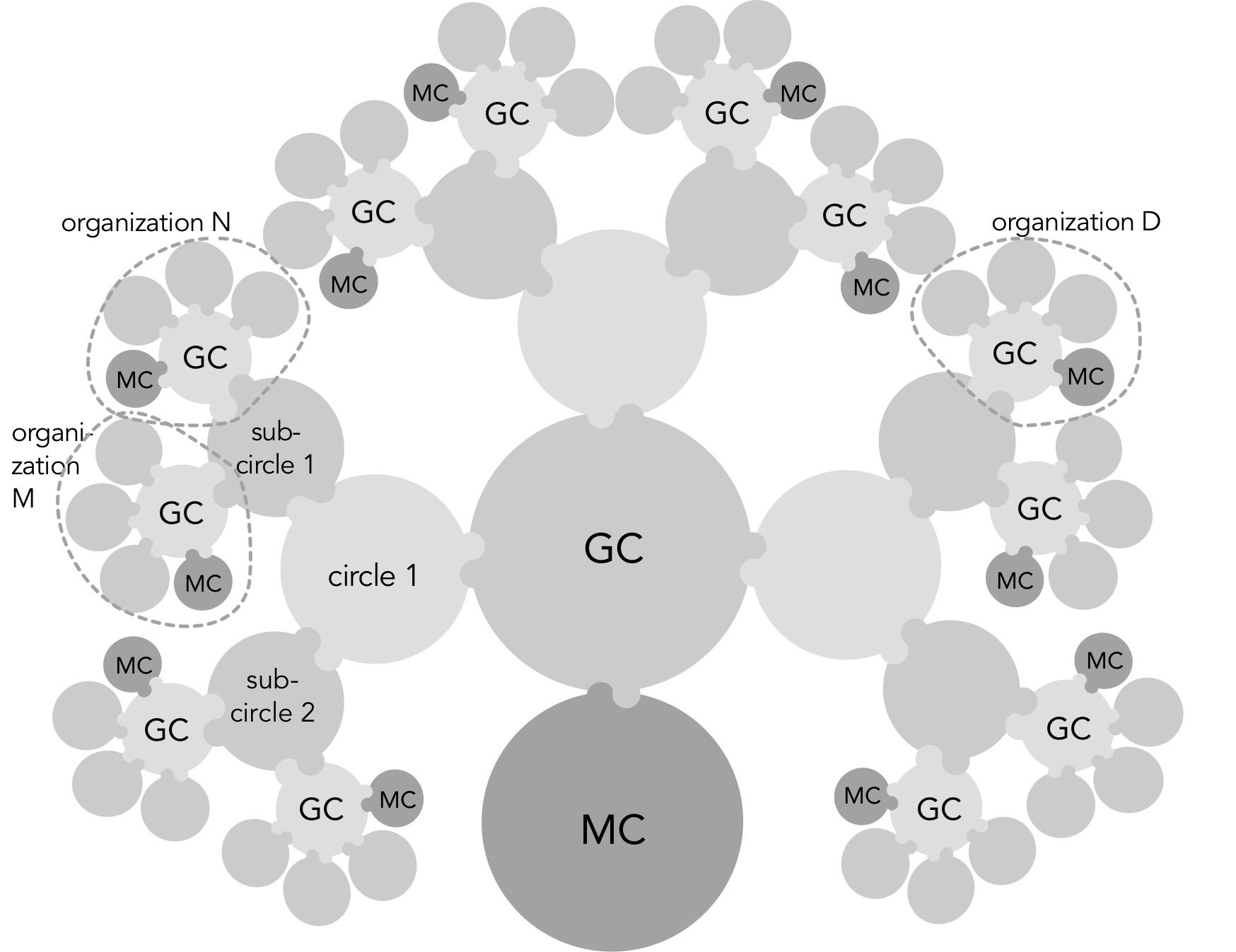 |
If we have several organizations linked together as member organizations, then we have to be clear about domains so that we know who makes which decisions. Let us imagine that the organization in figure Figure 2.66, “Organizations as sub-circles.” is a global organization. Each department circle has as their domain achieving the same aim in three different parts of the world. Circle 1 might be North- and South America, for example. Sub-circle 1 might be the Spanish-speaking, while sub-circle 2 might be English, Portuguese and French-speaking. Within sub-circle 1, there are two organizations, organization N and organization M, supporting, for example, different Spanish-speaking consulting businesses in the Americas.
Those organizations are all autonomous but they might choose to form bigger organizations. There is no limit to the number of levels we can link together. The structure works like fractals. We can apply the same rules again and again and through recursion, we could, in theory, build a world organization.
This is the power of the fractal nature of sociocratic principles. The rules to build them are uniform. That makes them versatile and adaptive. We can apply them to meet our needs, and we will be able to shift, adapt, and grow. By consent, we can make any changes that make sense in our situation. And we can do all that without ever having to change the basic rule set. No one organization will over-power another organization, and yet, it is possible to form clusters without any restriction in size.
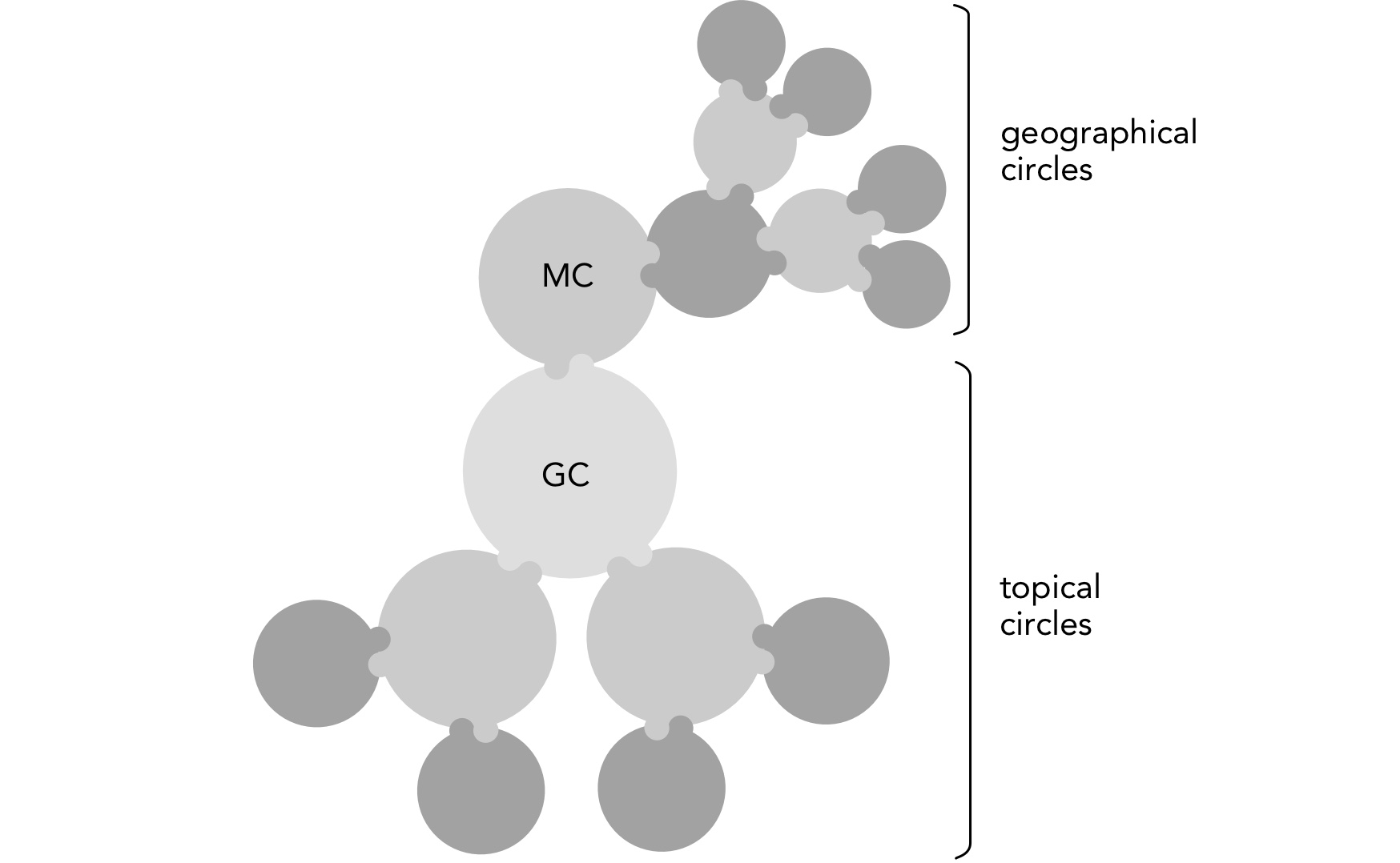
Global organizations often want a geographical structure mixed with a topical structure. A structure that balances two factors:
We want to strengthen the bond within and between local, regional, and national groups.
We want to build expertise on topics, independent of the location of the members interested in those topics.
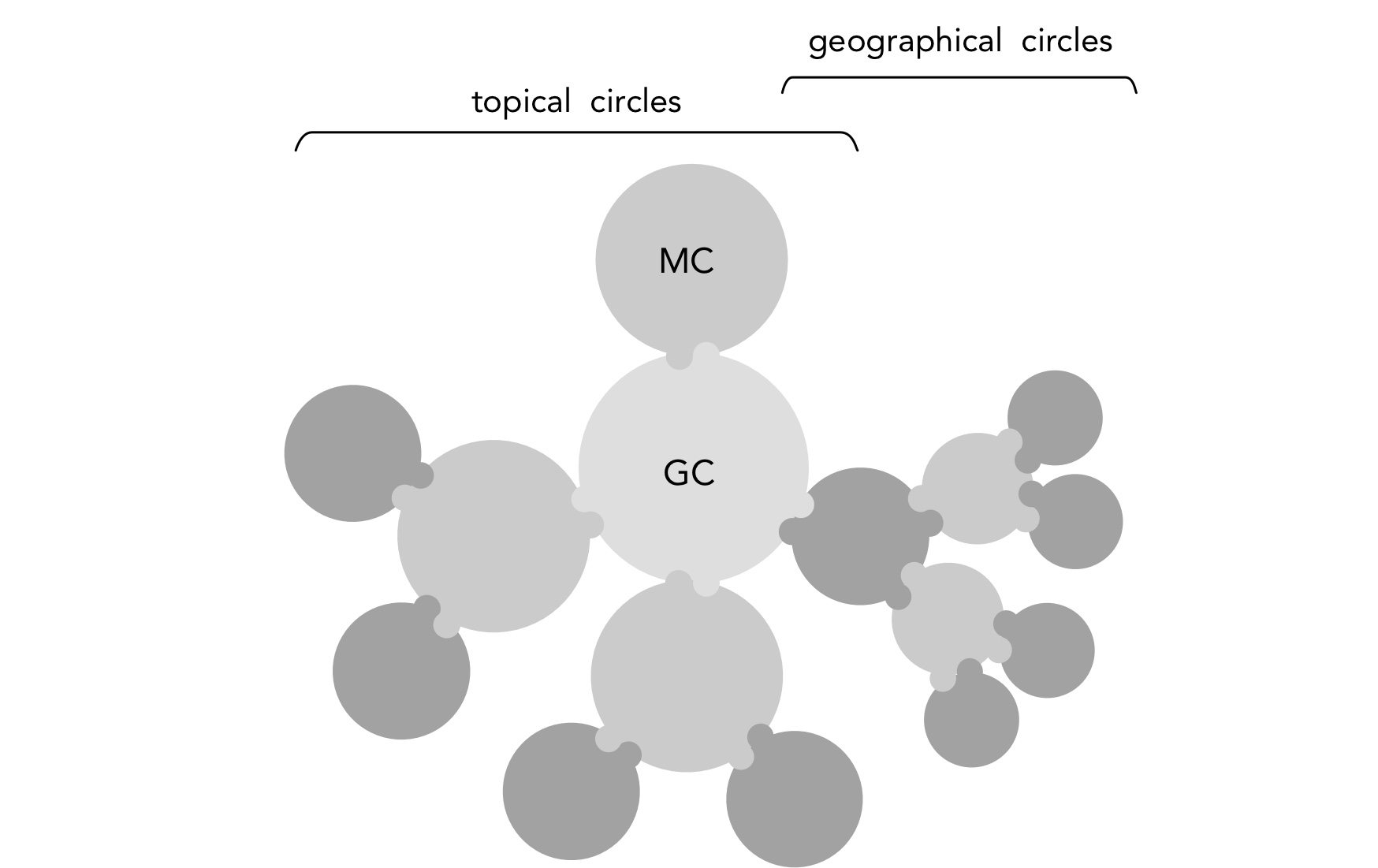
What we need then is a combination of topical and geographical circles. The geographical circles are either sub-circles under a geographical department circle (in Figure 2.67, “Geographical circles as a stakeholder circle”), or a stakeholder circle (in Figure 2.68, “Geographical circle as department circle”) depending on how much interaction there is between and momentum in, the topical and the geographical circles. To strengthen cohesion, we can make a requirement that at least leader and delegate from every geographical circle at a certain level be a member of a topical circle as well.
Figure 2.68. Geographical circle as department circle
 |
The idea behind these structures is to pay attention both to local peer support and to building expertise. Staying in geographical silos can mean doubling work and re-inventing the wheel (e.g. if every regional organization has to come up with their own mailing list). Topical representation can add experience that can spread into all the circles (e.g. in shared databases supported by the topical circles but open to all member organizations). People with a strong interest on a topical level but without a local group can still join. People with a strong interest on the local level will benefit without being isolated.