 | 2.8. Operations – doing the work | |
|---|---|---|
| ↢ | Chapter 2. Organizational Structure | ↣ |
Every purpose-driven organization has a mission that translates into organization-wide aims and sub-aims into circles. The aim of any meeting, operational or policy meetings, is to support the clarity and coordination required to do work. The operational work itself does not usually happen during meetings.
The principles for coordinating operations in sociocracy are the same as for all other parts of governance: effectiveness and equivalence. Equivalence is ensured as roles are described and filled by consent, with a clear commitment to feedback and transparency. Effectiveness is supported by putting operations in roles (including the role of a circle member). We strive to give individuals enough authority to do their work well and semi-independently, creating policy to give them freedom within limits.
Sociocracy can be compatible with many ways and tools for coordinating operations and we can pick the tools that are most suitable for our context -- the different ways of organizing operations are too different and beyond the scope of this book. By the way, how an organization sets up workflow is a decision about how they do work in general, which makes it policy (see chapter Chapter 3, Making Policy Decisions on policy making for creating workflow).
If there are people collaborating on the same task or on interdependent tasks, operational decisions might need coordination. For example, let’s imagine a construction business where people need to share tools. We cannot just grab the tool when we want to. It requires coordination. We do not need policy to figure out that member 1 can have the tool at 8.30am and member 2 will pick it up at 11.45am to bring it to the second construction site unless this is a decision we make often (in which case we might want to make policy as a “bulk” decision, see section Chapter 3, Making Policy Decisions on page Chapter 3, Making Policy Decisions @@TODO@@: Figure out page references.).
Any members who are directly affected by a decision in their work will be part of an operational decision. We do not have to involve the entire circle to do this, and we do not have to wait for a circle meeting to coordinate operations. How many people we want to involve and how we want to keep people updated depends on the nature of our organization. The circle leader will be key for coordination. The design principles informing our own workflow are:
Clarity and balance of power. We want to have clarity about the authority of individual circle members. Define operational roles (see section Section 2.3.2, “Operational roles”) so individuals can act freely within circle policies. The circle shapes how to distribute authority among circle members.
Effectiveness and equivalence. Transparency is a precondition of equivalence and effectiveness. (If we do not have access to full information, then we cannot contribute as well, and it goes along with a loss of power.) Everyone needs to have access to all the relevant information. Technology makes it easier to be transparent.
We want to keep our eyes open for feedback. If coordination requires too much effort it may be time to give a role more authority. To name a concrete example, if a holder of a role has to come back to the circle for budget requests, maybe it is time to write some defined budget authority into the role description (a policy decision!) so that coordination will be easier in the future. We want to stay on the lookout for places where more clarity and intentionality can make operations smoother.
If we meet as a circle (or a subset of a circle) exclusively for coordinating operations, we are holding an operational meeting. “Is everything happening? Does anyone need help doing their tasks? Is there anything acute keeping them from doing their work?” These meetings are only for information sharing and case-by-case decisions (if they are not made by the circle leader) to make sure nothing blocks the work of the circle. Depending on the nature of the circle, this can be a daily or weekly meeting, or as-needed. A group of workers in a for-profit will probably meet more often, while a work circle in a community will meet only if there is a workday or a repair to take care of.
Equivalence is core to circle policy meetings so it is important for delegates from child circles to be present at circle meetings. Operational meetings do not depend on equivalence so delegates do not need to attend except in the context of operational roles they may fill in the parent circle.
We can decide to use any process we feel comfortable with, but the diagram in template Figure 2.70, “Keep your operational meetings short and relevant” is a simple and versatile structure to work with.
Figure 2.70. Keep your operational meetings short and relevant
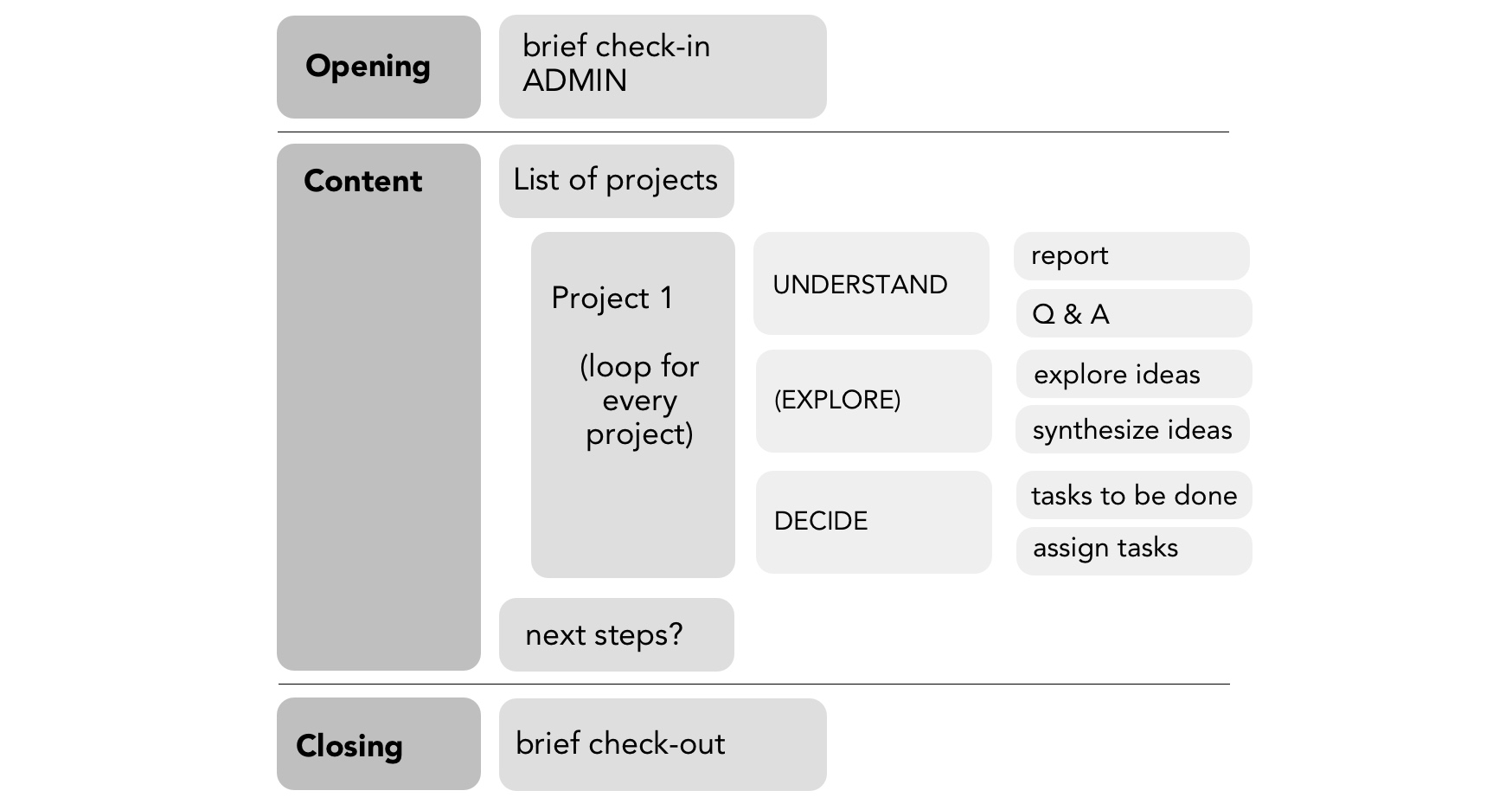 |
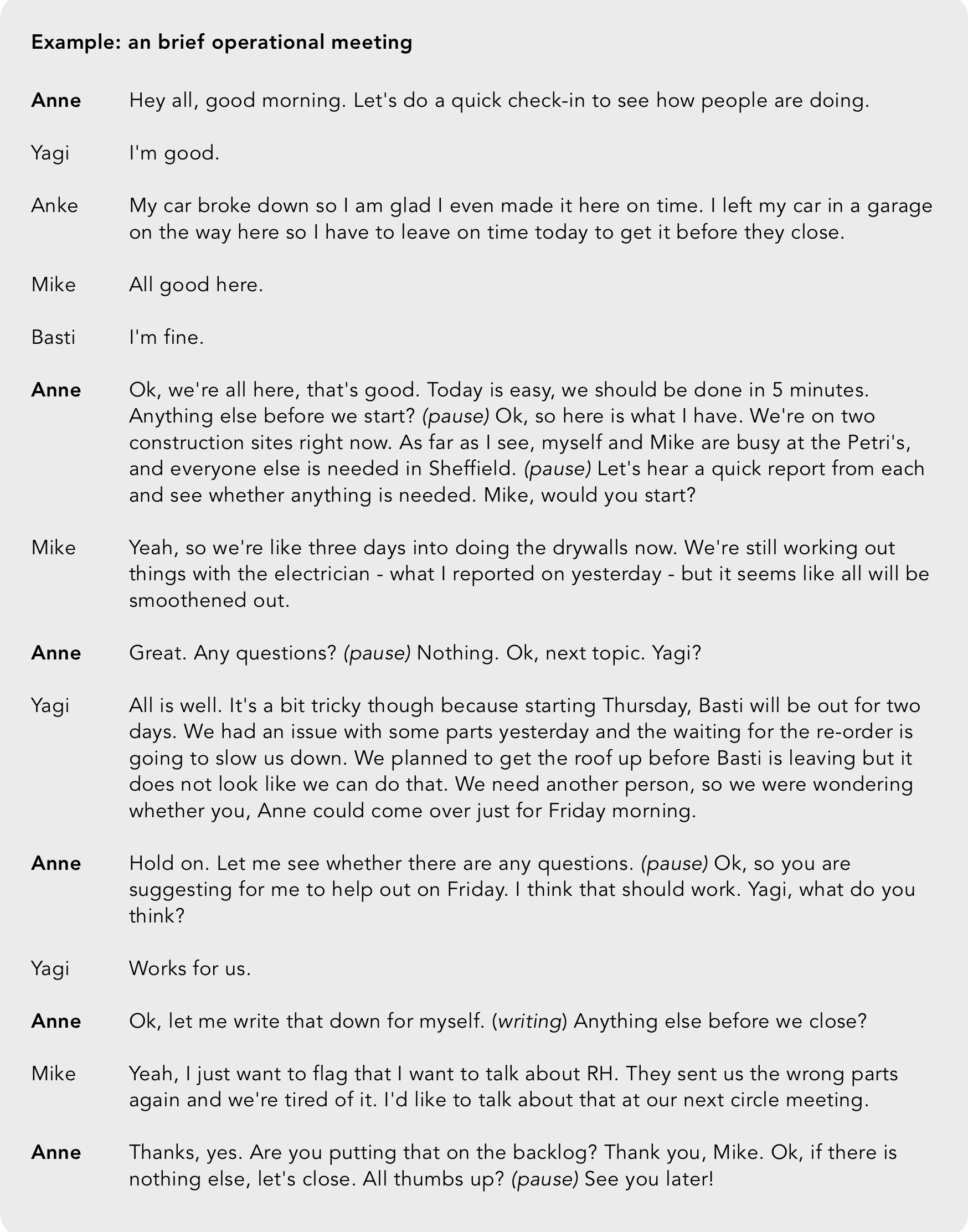
Start every meeting with a brief check-in (shorter than for circle meetings). Then go through your projects and report out so everyone is informed. Make sure to give everyone a chance to ask questions necessary for understanding. After hearing an update on a project, a reflection round can be useful to problem-solve but is not necessarily needed. Depending on the context, the leader of the circle can assign tasks. If there is any need to modify this system, we might make policy on that topic. If a circle notices themselves arguing or getting sidetracked into a discussion, we can make note of the topic in the backlog as a potential policy issue for the agenda of a future circle meeting (as in example Figure 2.71, “An example of an operational meeting”).
The length of an operational meeting varies considerably. For example, if we plan an event, we might work on coordination of operations for hours; other operational meetings could take minutes.
Figure 2.71. An example of an operational meeting
 |