 | 4.3. Compassionate governance is effective | |
|---|---|---|
| ↢ | Chapter 4. Feedback and Learning | ↣ |
It is the basic, revolutionary, insight from NVC that in using strategies to meet universal needs, there is no right and wrong, only more or less effective strategies. Since needs are not right or wrong (they just are a part of being human), attempts to meet them cannot be wrong or right, they are just more or less effective. Effectiveness is the measure in governance and in non-violent communication. Feelings provide data on how well strategies that we choose meet the needs of the people who are affected.
The key to continuous improvement is feedback. Feedback is the information we need to learn, adapt, improve, change. Whether it’s feelings or click rates, good governance will strive for effectiveness by taking in all the accessible data.
We form organizations in order to meet needs as stated in our vision and mission. The strategies we choose to work towards that mission are our aims.
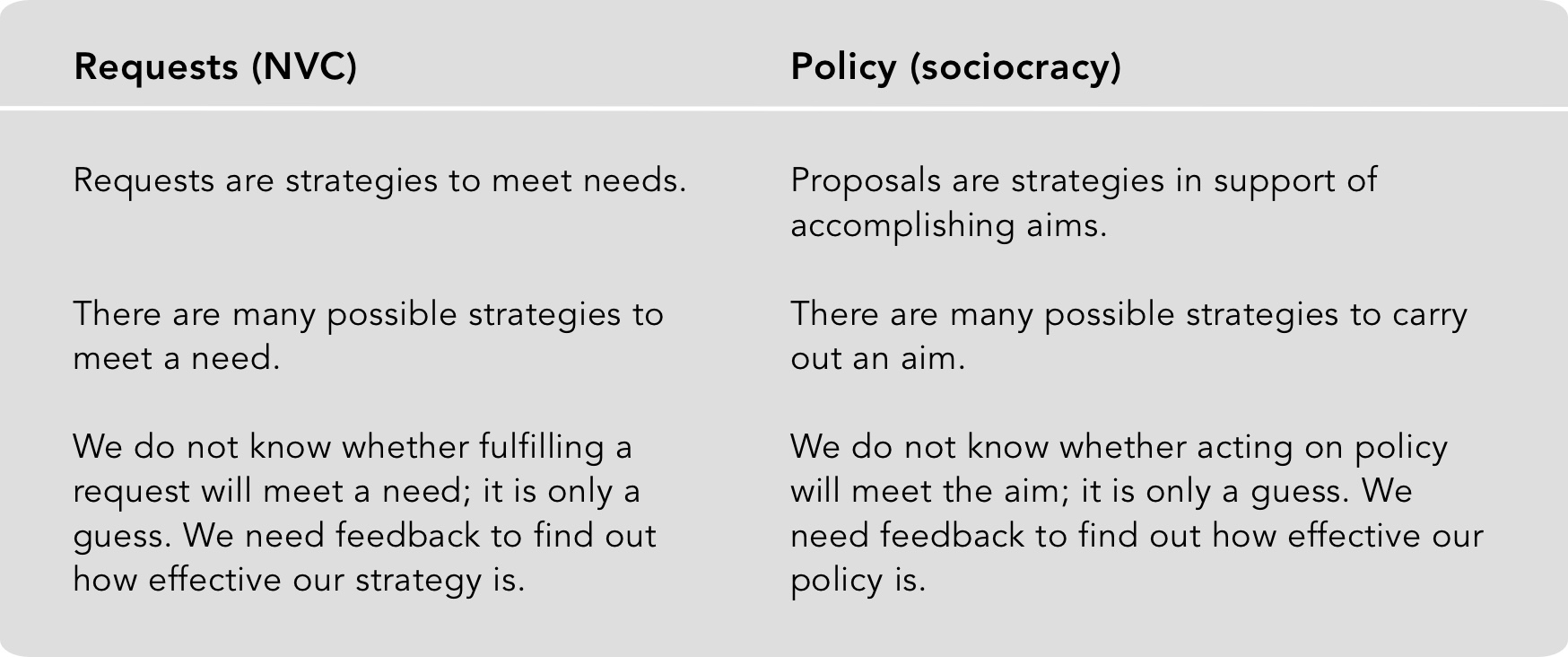
Proposals, like requests, are proposed strategies to meet needs. When people commit to the requests, they are policies. Examples are “please put all recycling into this bin. Upload your files to this folder. Go through these steps to approve a new member.”
Only feedback (data) can tell us whether policy achieves what it is intended to do.
Figure 4.7. Requests and proposals
 |
It is interesting to think about how the organization’s need and people’s needs relate to each other. In joining an organization, we respond to a need of ours. Getting paid for our work may help meet our survival needs. But there are other needs at play. It could be wanting to contribute, or the need for connection. The ‘‘need’’ of the organization is to contribute to the organization’s mission. Every strategy -- every operation and every policy – serves the organization’s aims. We often ask people about their personal aims in an organization to explore the relationship between their personal aims and the organization’s aims. The more they are in alignment, the easier it will be for the individuals to work at fulfilling the organization’s aim.
Organizations are complex organisms. Many sub-aims are at play. For example, two circles might be wanting their budget increased. Although they serve the same overall aim, they disagree on strategy-level. This is similar to a person who might be at the same time experiencing a need for connection and a need for peace and quiet. As such, an organization can be just as innerly torn as a person. All needs can be taken seriously, but not all needs can be met. Personal aims and organizational aims sometimes are in synch and sometimes not. We celebrate needs met and mourn needs unmet. With transparency about both personal and organizational aims, we have the potential to work effectively toward meeting both personal needs and organizational needs.
If the strategy someone is proposing does not work for everyone, this is the basis for objections. Instead of calmly stating an objection, it may happen that someone gets upset. Imagine a proposal like in example Figure 4.8, “A proposal and a reaction”.
Figure 4.8. A proposal and a reaction
 |
Figure 4.9. Upset and still easy to listen to
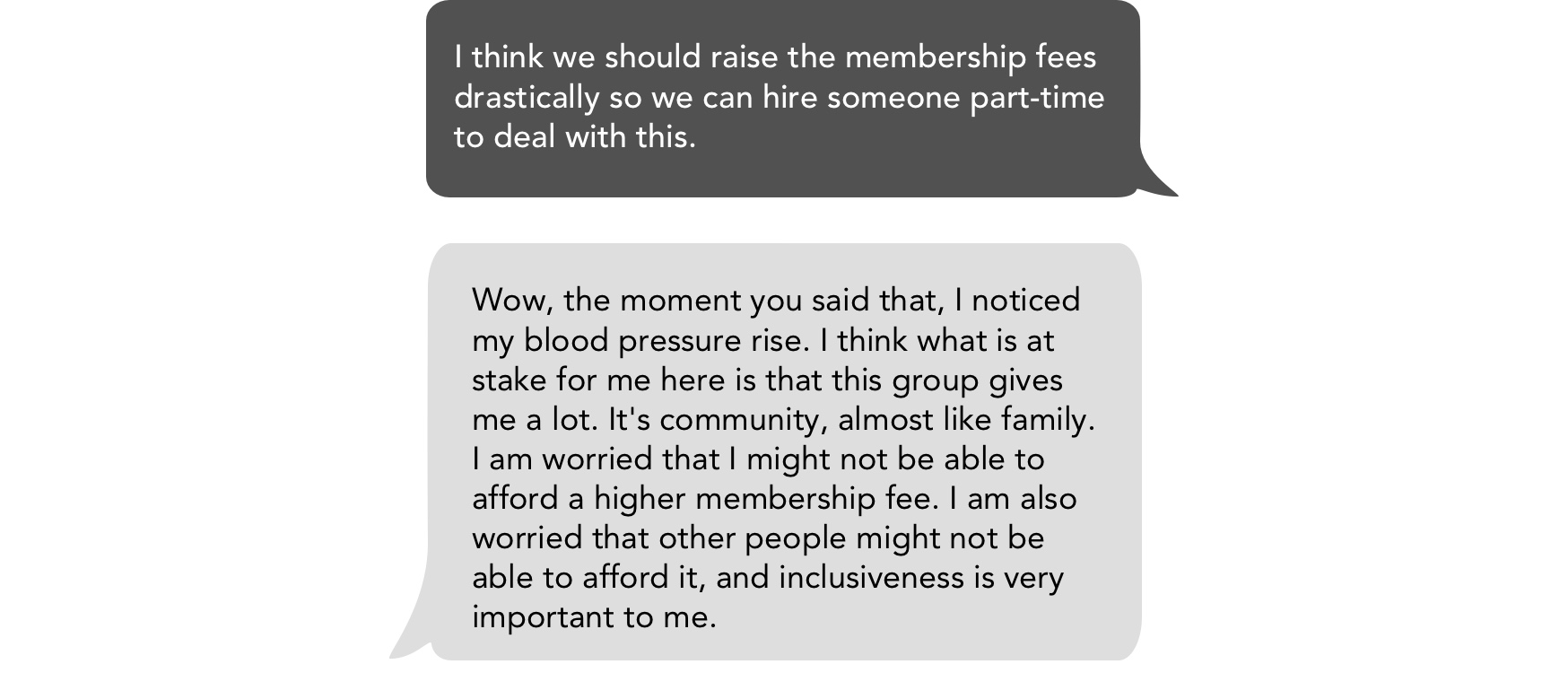 |
If we fear we may have to leave the organization because we cannot afford the membership fees, we might get sad, anxious or upset because our need for belonging would not be met. Once we identify the need(s) that are unmet, we will be able to object and put the unmet needs on the table so they can be considered.
What is the difference between example Figure 4.8, “A proposal and a reaction” and Figure 4.9, “Upset and still easy to listen to”? In the first example, there is no inner distance from the feelings. They are interpreted as absolute truth, not as data to work with. The opportunity to use the feelings as an indicator of a need gets concealed, and we have to restore trust and respect in the group. Since restoring trust and respect takes time, we have lost time and energy in two ways: by losing track of valuable data, and by creating ‘‘social-emotional debt’’ that is likely to negatively impact the quality of connection in the future.
We call social-emotional debt the many micro and macro interactions where people experience their needs not considered. Whether or not that is true is not relevant. Unaddressed, this debt builds up over time and creates more and more interpersonal friction.
Everyone is responsible for the social-emotional debt – the people who chose not to speak up or did not speak up effectively, and the people who chose a strategy without considering more people’s needs and did not ask for feedback.
It is a reality of humanity that feelings come up. If we ignore them, they will leak. People will be sarcastic, discouraged, disengaged. They will withdraw, lack accountability, work to rule, slow down, or undermine the system. Ignoring needs, ignoring feedback has a high long-term cost.
We may not get input from circle members that is as clear as in example Figure 4.9, “Upset and still easy to listen to”. But we can work together to complete the picture. A skillful group will be able to deal with “something here leaves me anxious but I can’t put my finger on it” and will guess the underlying needs. A more advanced group will be able to deal with the raw feeling, will help the group member to center, identify their needs and formulate their concern. The question is not whether feelings are allowed in organizations but how we make use of them.
Are group members able to be respectful and responsible even if they are emotionally triggered?
How effectively can we go from experiencing feelings to naming our underlying concerns?
Are we able to let our decision making be informed by concerns or objections people bring up, so we can make better decisions?