 | 4.2. Creating change | |
|---|---|---|
| ↢ | Chapter 4. Feedback and Learning | ↣ |
Change comes from evaluating past actions and experimenting with new approaches we hope will be more effective at meeting needs. This is the lead function in the lead – do – measure cycle. Feedback useful for the change process emerges much more from curiosity about universal needs underlying behavior than from unexamined right-or-wrong thinking.
When we are friends with someone, we want to hear when their need for connection is not met and they feel lonely (or whatever they might be feeling). It is not anyone’s “fault” if they are lonely. Everyone’s needs are their own, and the responsibility to meet them is no one’s but theirs. They have a need for connection, and there are many strategies to meet that need. One of the strategies would be to call a friend and talk. Another strategy would be for them to look at old pictures. Or to spend time on social media, go out to dance or call their sister. Only they can pick and choose what might work for them in that moment.
If you want to live in absolute hell, believe that you are responsible for what other people feel. | ||
| --Marshall Rosenberg | ||
Let’s say a coworker calls. I do not like talking on the phone. Talking on the phone for me simply does not work as a strategy in most cases. Maybe it is because my hearing is not good, so listening without visual cues is straining. I am also concerned that talking in my shared office space will interfere with my colleague’s focus. I also don’t like being interrupted because I enjoy the flow state of focused work. What works well for me is messaging. So I do not answer the phone but I message back. My coworker, however, prefers talking on the phone. For her, not a fast typer, it is more effective to talk on the phone than to message back and forth. She might get annoyed when I don’t answer the phone but message back. Did I make her upset? No. Her being upset is her reaction to her own needs for connection. My messaging instead of answering her phone call is my way of meeting my needs for ease, flow and consideration. Now what?
If we have no awareness of needs, both sides might be rolling their eyes and have thoughts like “why doesn’t he just answer the phone instead of making it so complicated by messaging back and forth?” and “why is she interrupting me by calling all the time. Does she think she is the only person working here?” What can we do to meet our needs more effectively? We can give feedback based on our needs. The first step is to share our experience.
Figure 4.4. Sharing your experience with reference to needs.
 |
In example Figure 4.4, “Sharing your experience with reference to needs.”, notice how both people are able to share their experience without labeling the other person or even talking about the other person. Once that first step of mutual understanding is complete, the path is open to a shared decision. With everyone’s needs on the table, a strategy may be found that works for everyone. Maybe arrange a time to talk on the phone? Leaving the office to talk on the phone while the co-worker needs space? If the issue comes up more often, maybe re-thinking the shared office space?
We are rarely short on strategies once we have clarity about needs. The more information we have, the more we are in choice about what strategy works best in that moment.
What other people do affects how well our needs can be met. This is important feedback for others. In sharing your observations and interpretations, we are sharing what the impact of someone’s actions or words is on us. If we tell other people that they are “wrong” or “mean”, they will probably stop listening.
Instead of saying “you make me upset when you don’t answer the phone”, saying something like “when I try to call and don’t get through, I get upset and anxious when I am not productive when my questions aren’t answered” is more adequate to what happened. In the latter version, the person is talking about their own experience. Constructive feedback is feedback that
No one has access to absolute truth, thus we strive not to present what we say as absolute truth. What we all do have access to is what we can observe, what we interpret or project (both needs to be marked as such) and what the impact is on us. All of those are data that the other person can work with.
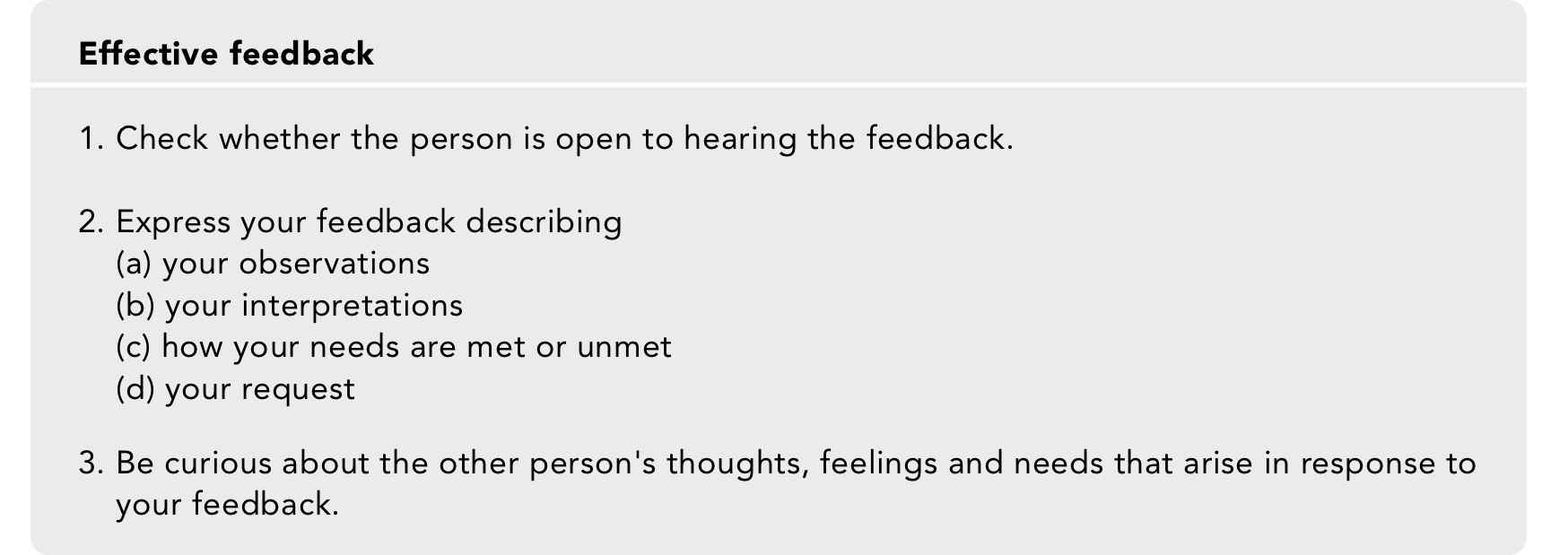
Feedback that can be heard is feedback that is free of blame. Any added layer of blame will cover up the data we want to be known. Making sure that the other person is in a good enough place to receive the feedback is part of that as well. An easy way to do that is to ask something like:
“I am sitting on some judgment here. Are you open to hearing it? And if yes, now or at another time?”
“I have been observing something. I might be wrong but I thought maybe it might help you to hear what I have been thinking. Do want to hear it?”
Keep in mind that although what we say matters, just saying the words will not be enough. Only when it is truly felt, will it be genuine and effective. People have a very fine radar and can sense judgment underneath anything we say, no matter how “nice” our words might be.
Figure 4.5. Effective feedback
 |
If done skillfully (and received with an open heart), feedback between people can be a way to foster connection in two ways.
Contribution. If it is mutually acknowledged that the more information we have, the more easily and successfully we can collaborate, then giving someone feedback is a way to contribute to their well-being.
Mattering. If someone shares how my behavior has an impact on them, it shows that we are connected and interdependent. What I do matters to someone else, and what they do matters to me.
Do not use recommendations to act as ‘‘NVC police’’. A statement like “what you said was not good NVC” undermines everything NVC stands for. A statement like that serves to judge and criticize, and it shuts people down.
If we feel like we are in a good enough place to receive feedback in person, we have to remember that the other person has to be in a good enough place. Check whether they are able and willing to receive first. Then we say what we want to say.
A feedback form can provide a frame for giving feedback in writing. Then begin the dance of mutual understanding. “I want to make sure I am communicating clearly. Would you be willing to tell me what you heard me say?” If the reflection is inaccurate, say “thank you for letting me know what you heard. What I was trying to say was a little different. Can I try again?” Then “thank you, that is what I was trying to say. Now I am curious. Would you be willing to tell me what comes up for you having heard what I said?” You might then confirm what you heard. “So, this is what I heard you say…Is that right?” Notice that you are confirming that message sent is message received in both directions. This back and forth communication can continue until both have a sense of being understood.
Once mutual understanding is present, then the space is open for making requests of each other that could improve communication and connection going forward.
Box Figure 4.6, “A feedback form. See page Figure A.3, “A sample version of a feedback form” for a template” is an example of a feedback form that was used in an organization (slightly changed for privacy). Every organization can agree on additional ways to give (and receive) feedback. If using a feedback form is already an agreed-upon strategy in an organization, it will be easier to do it when we want to actually do it.
Figure 4.6. A feedback form. See page Figure A.3, “A sample version of a feedback form” for a template
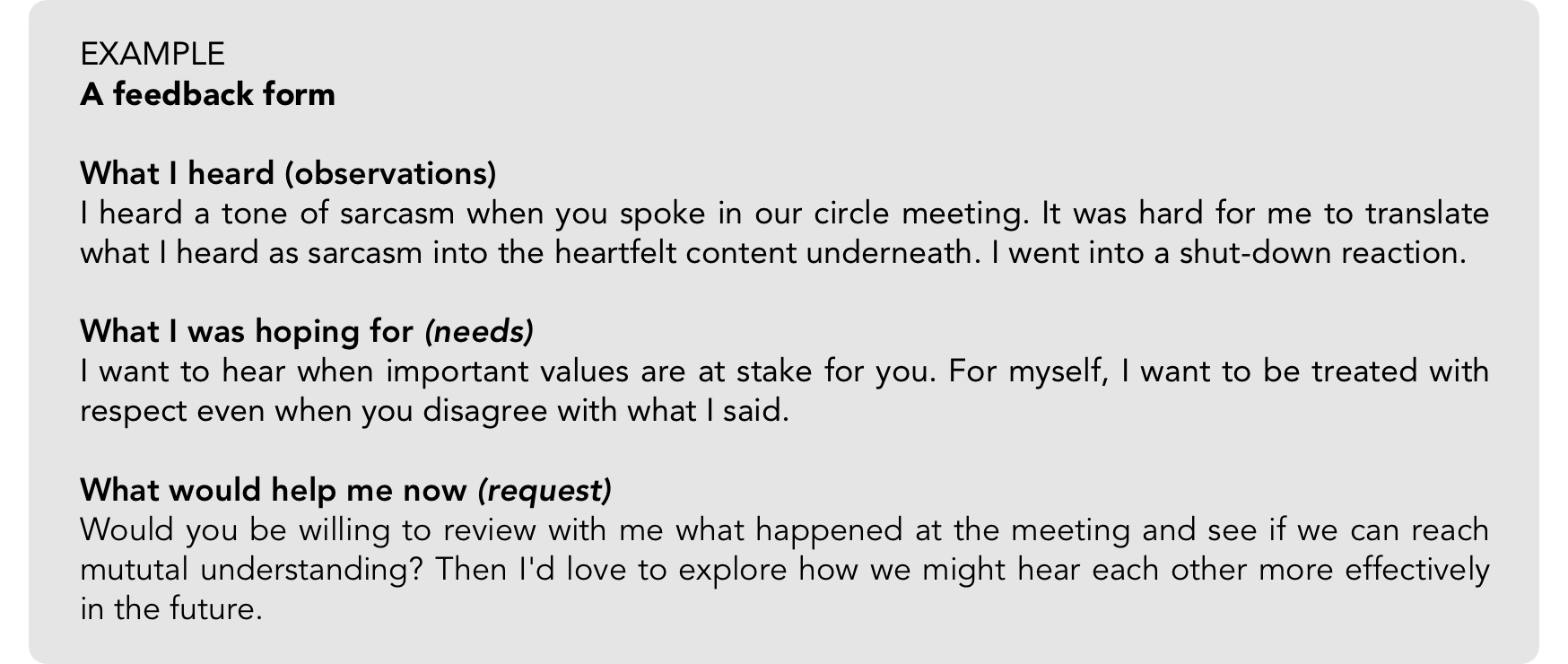 |
In the appendix on page Figure A.3, “A sample version of a feedback form” is an example of what a practice sheet and feedback form could look like. Any organization might want to design their own. It is a good idea to put the pointers about what to keep in mind for filling out a feedback form right on the form. Remember that everyone who fills out a feedback form will be in a triggered state in some way, so making it as easy as possible for them to act in an effective, constructive manner is key here.
Even if the person is not ready to receive your feedback, it still makes sense to put something in writing and share it. In that case, the inner peace and clarity may come with exploring and expressing our unmet needs. Our clarity may have a positive effect on your interaction with the other person even though they have never seen our feedback.
Being able to give feedback and to do it skillfully comes with practice. We can practice by starting with only appreciations and expressing how your needs have been met -- for example when someone fixes a computer problem for us. What need did that meet? Ease because we were able to access our emails? Integrity because we were able to meet a deadline because of the computer help? Or consideration because that coworker noticed how urgently we needed help?
Practice giving feedback, in person or in written form. It might be a good idea to use a feedback form for the next small incident so that we can reduce anxiety about using it for bigger issues. Giving feedback is like a muscle that can be trained. Do it!