 | 4.4. Increasing feedback | |
|---|---|---|
| ↢ | Chapter 4. Feedback and Learning | ↣ |
We need to check on our data frequently enough to be able to steer successfully. On a social level, short feedback loops reduce the building of social-emotional debt. For our operations, the same is true to be effective. Once feedback is nothing but data, all ways of gathering and receiving data and personal feedback are the same. We have already talked about the process of lead -- do -- measure and how it forms feedback loops that support the evolution: we make a plan, we carry it out, and we evaluate what we can learn. Steering falls into countless loops of lead – do – measure. A few examples are in Figure 4.10, “Examples for feedback loops”.
Figure 4.10. Examples for feedback loops
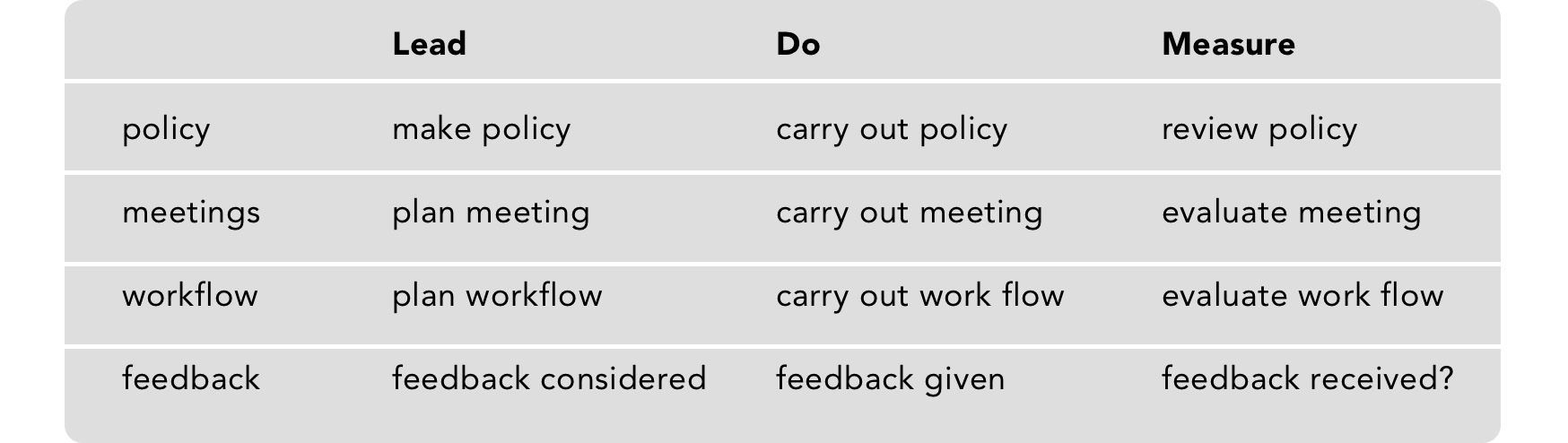 |
Figure 4.11. Lead–do–measure-loops continue indefinitely as we work toward the aim
 |
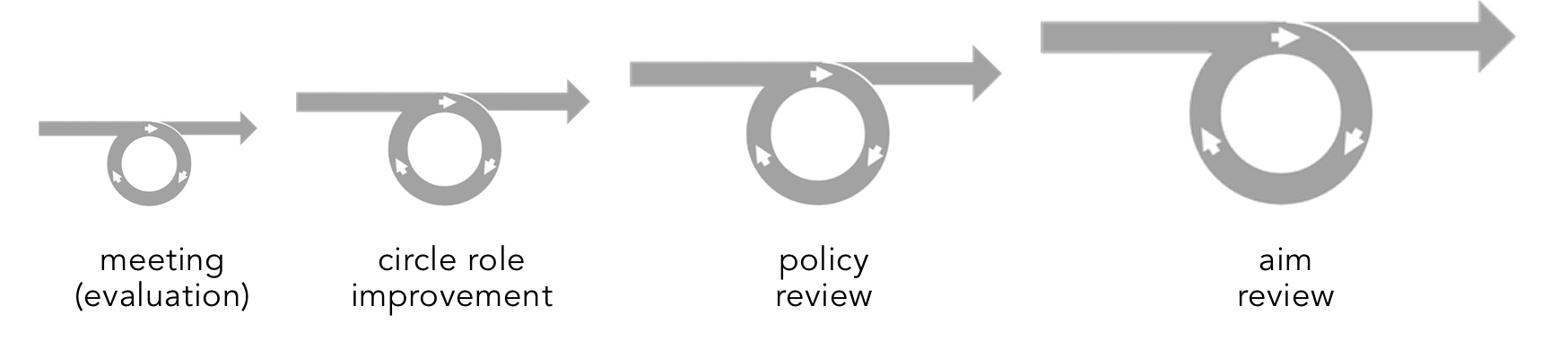
Sociocracy highlights the importance of feedback and evaluation; to steer, to lead is to continually make new plans based on the data analysis. Out of lead -- do -- measure, we typically do a good job on the doing. We can often get ourselves to lead/plan – but taking the time to evaluate is done too seldom. The diagram in Figure 4.12, “Lead – do – measure happens on different levels of scale ” shows how lead – do – measure happens on very different scales but its nature is always the same. Sociocracy creates habits around giving feedback, which we fledge out as milestones in this book – intentional stops to make sure we have shared reality. We showed how in policy-making, a group can move swiftly from one phase to the next if we measure whether a phase or step is completed.
Figure 4.12. Lead – do – measure happens on different levels of scale
 |
In sociocracy, we want to learn as much as we can and work with all the data we can access to feed into our decision making. We also try to keep the groups who make decisions to a reasonable group size so that all member voices can be heard. A critical aspect of sociocracy is clarity about membership in policy-making circles: every circle has authority over who its members are. Decisions are made through deliberation among people who have made a commitment to work together toward a shared aim. It is crucial to understand the difference between “hearing everyone’s feedback” and “including everyone in the decision making”. Sociocracy clearly says yes to getting as much feedback as your circle can handle, while keeping decision making within the circle that is responsible for the particular content.
What’s the difference between being able to give feedback and being a decision-maker? If a membership circle makes a decision to significantly raise membership fees, they might want to hear from people outside the circle about that. They might even want to survey their entire membership. However, that only means that this circle now has more information. They are not bound to anything but to inviting and taking in the feedback they get.
In an organization that is new to sociocracy, be very clear on the difference between “being heard” and “being involved in the decision making”. Sometimes when we ask people for their input, they take it personally if you decide different from their advice, even if you have honestly considered their input. That’s where transparency comes in: why did we decide the way we decided? It helps to let people know the rationale for our decisions if we think it is relevant and that it could be contributing to people’s understanding. The strength of sociocracy comes with the ability to make decisions effectively in small groups while including a lot of data through gathering feedback.
The path from issue to action does not have to be walked alone by the circle, it can include many people or only a few, varying for each step, depending on what’s needed. The process is extremely flexible because at any stage (except the consent decision), any number of people can collaborate. We can get input from hundreds of people, or a proposal can be written up by one single individual.
On a general level, in the understand–explore–decide (also know as more generally input–transformation–output) pattern, it is the easiest to include many people in the input/understanding phase, only a few people in the explore phase and fewer people in the phase of decision or synthesis. A circle moves a policy along the path from assessing the need to making a decision. We can use a wider group for input and to craft a proposal in a small helping circle.
In the input phase, we want the input from many perspectives to get a good idea of what is going on. We want to gather data, survey and so on. However, we also want to be focused on our question, otherwise we will get a lot of noise to work through. For example, if we ask a group of 200,000 users “tell us whether you see issues with our new website”, we will get a lot of unstructured feedback. If we ask many people, we have to focus on few, specific questions, for example, how long users stay on the new website compared to the old one. If we only ask three test users, we can process much more detailed data but we will only get to hear few perspectives. (See next section for more.)
In the exploration phase, we want deliberation to happen. Deliberation requires trust in a group of people who know each other well. If we want to deliberate and build on each other’s thoughts, we have to be in relationship with each other. That’s why the transformation phase works best in a medium-sized group like a circle of 4-7 people. This circle is going to process the input and build on it, based on trust and on hearing each other.
Output often requires writing. It is easiest to write along or in a small group. Form a helping circle or delegate to an individual tasks like:
writing up a proposal
writing up a needs statement
synthesizing ideas
The consent round is the only phase where we are firm about who gets to be included and who does not. All circle members are included in the consent round and no one else. If you have non-circle members present for a consent decision and you are willing to spend extra time, you could to ask the visitors “If you had consent rights on this proposal, would you consent or object and why?”. Have the visitors speak before the circle members – they may have valuable input for the decision. Sociocracy has an intent to include as many voices as possible for input but it is clear on who the decision-makers are.
If a circle would like to get feedback about a decision (before or after the decision), options are:
Interview key individuals inside or outside the organization; key because of their knowledge, their strong opinion, their role in the organization etc.
Survey a segment of the membership or people outside the organization that might have relevant input. Use qualitative questions, quantitative questions, or a combination of both.
Invite non-circle members to add dimensions in picture forming or clarifying questions about proposals. Do this in open organizational meetings, on bulletin boards or on online documents.
They can ask another circle for input (see diagram in Figure 4.13, “The circle-internal support and feedback system – any circle can be asked for help”).
Figure 4.13. The circle-internal support and feedback system – any circle can be asked for help
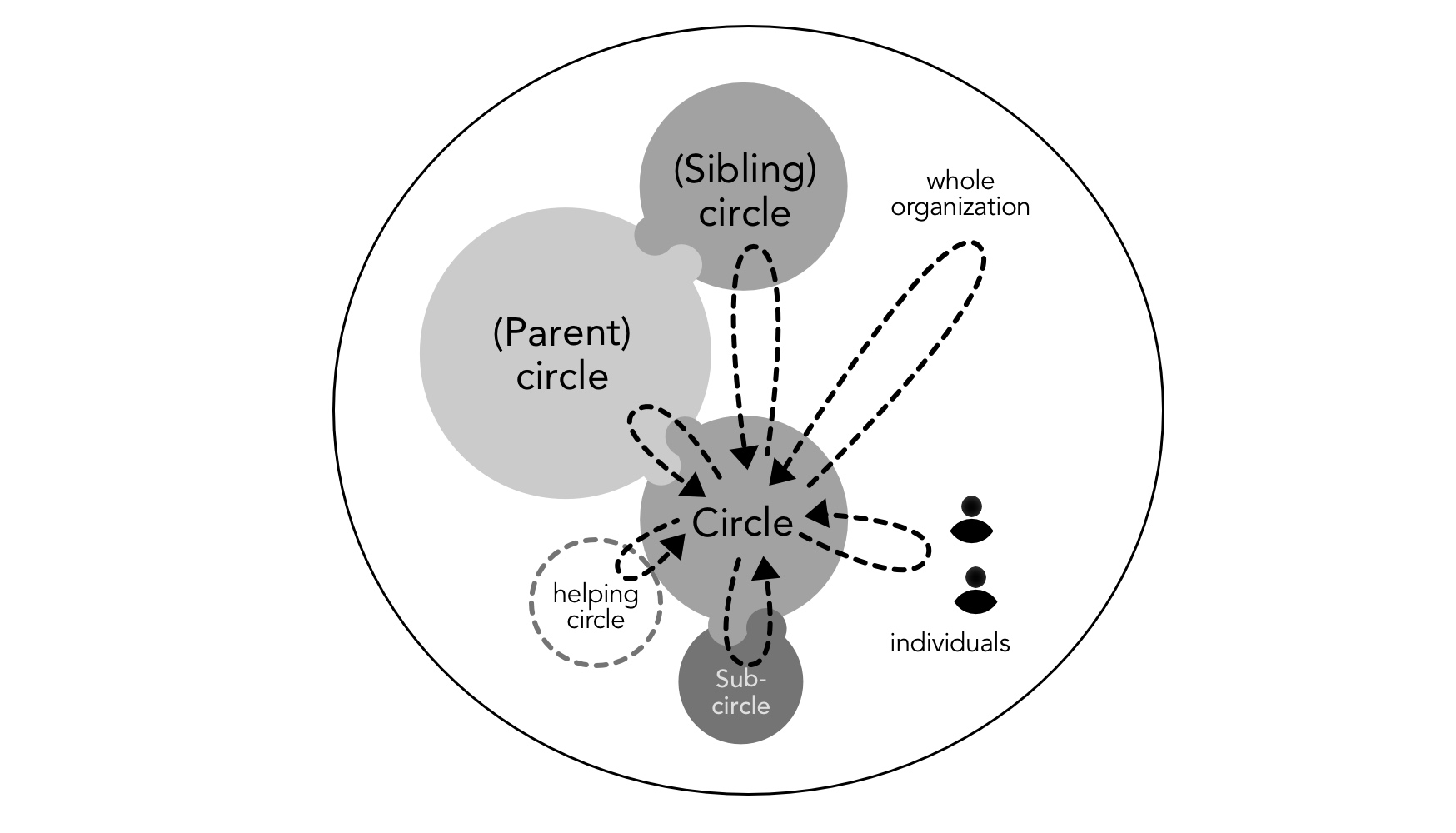 |
We encourage every circle to make use of the internal support system but also to reach out outside the organization – we do not have to know everything ourselves.
Surveying the membership is not about involving everyone affected by a decision into making that decision. The circle who holds the domain makes the decision. But it is about gathering enough input to make a good decision. The small group mandate is based on trust -– an organization trusts a small group of people to make decisions in their domain for everyone. This trust is earned through decisions that take input and feedback from other people in the organization into deep consideration.
During the policy process, there are good moments to include voices from outside of the circle. Diagram Figure 4.14, “Moments to gather input from outside the circle during the policy process; best moments in bold.” shows the policy process.
Figure 4.14. Moments to gather input from outside the circle during the policy process; best moments in bold.
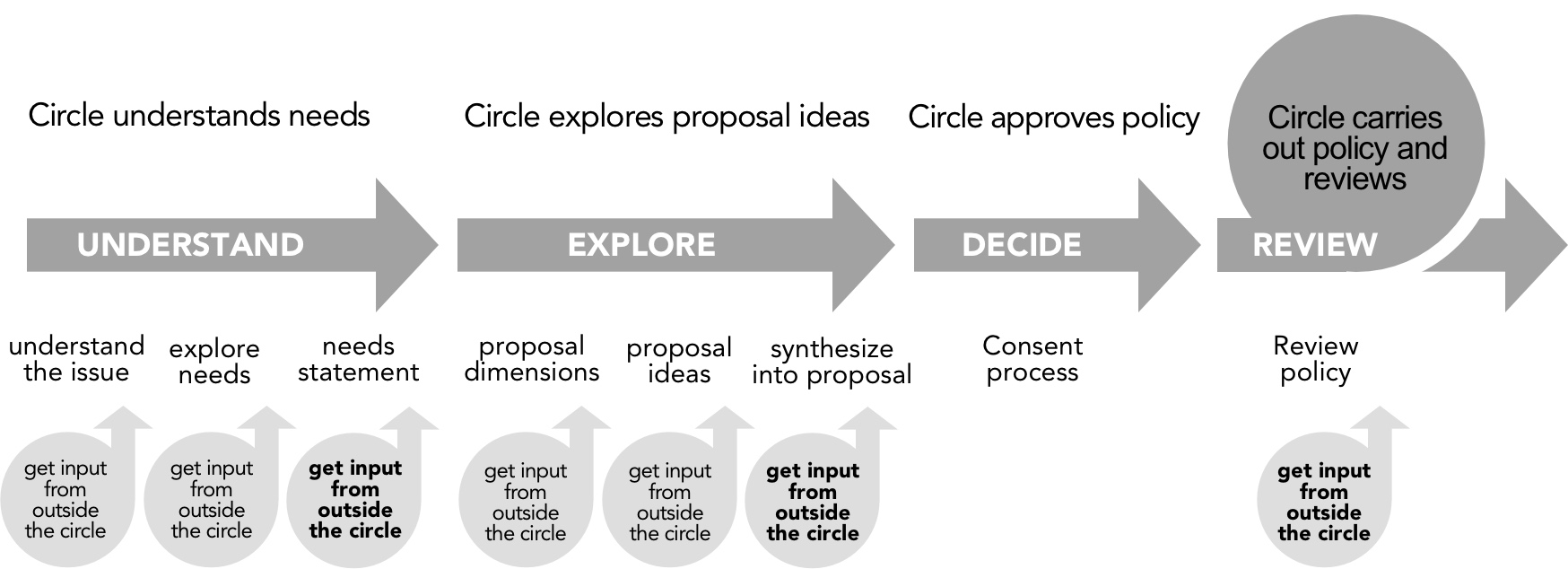 |
Theoretically, we can get input all along, every step of the way. A circle will only choose to do so when that is reasonable.
For a big decision, it might make sense to get input from outside people on the context and the needs statement to make sure the circle is stating the issue in a comprehensive way.
Gathering dimensions (either in the understand phase or during picture forming) is also a good moment to ask for outside help, especially if the circle does not feel confident to have a clear understanding of the scope of the issue and the policy needed.
The most important time to get feedback is when there is an actual proposal on the table (at the end of the explore phase). The more concrete something is, the easier it is to give feedback on it, so the proposal draft is ideal for getting specific input. Of course, in order to ask feedback, there must be a way to ask clarifying questions as well (since that is part of getting feedback).
During the consent process, the circle is best on their own, holding all the input they have heard leading up to this phase in their consideration. After the policy is approved and carried out, the circle will gather feedback on how the policy contributes to the circle’s performance.
Any intentional decision on “how do we do our work” is policy. How do we evaluate policy? The metrics depend on what kind of policy it is. If the policy is around workflow, we can measure production or lead time, quality, count inputs and outputs. If the policy is more in the realm of “code of conduct”, we can count complaints, survey happiness and so on. We have already talked about metrics in section Section 3.5, “Integrating objections: process” on measure the concern around objections.
Become intentional about metrics and make a measurement plan. (See also page Section 3.4.1, “Measurement”.)
We think about what metrics we want to measure (and if necessary, we start collecting the data). We collect the data that we think is useful. Examples:
If we make a landing page to drive website traffic to our main site, we make sure the flow of website visitors from the landing page to our main page will be tracked right away. That way, we will be able to evaluate the effectiveness very early.
If we are trying to reduce the hours you spend scheduling phone calls, we can count the emails sent back and forth for the sake of scheduling to see if buying scheduling software would be a benefit.
We ask for the feedback we want: we can tell people (1) what the policy is, (2) what we are seeking input on, and (3) how/when to give feedback. The people in our organization are good “sensors” for anything that can be measured qualitatively.
For a new membership policy that puts in place a three-month provisional membership, tell people who to send the feedback to, by what day/time feedback would be useful, and what we need to know. (“We’re particularly interested in how this new policy affects our prospective members so please let us know of reactions when you recruit new members: do they still feel welcome?”)
Every policy decision in sociocracy has a term end when the policy will be up for review. It keeps our policies up to date, fresh in our minds and it encourages to strive to improve in every aspect of our organization. It is like a regular check-up of our tools. All in order, all working and doing what we intend them to do?
We can be intentional about term ends and tailor them to our needs. For example, we could make new policy and consent to reviewing it again in 3 months. Or in 10 years. What an appropriate term might be for a piece of policy depends on the nature of the organization. In general, we try to make the cycles long enough to not overload our circle meetings with policy reviews. Sociocracy is about getting work done, not only about talking about work!
We want to be sure to keep our policies current. If we only review our policies every 10 years (or never!), we will most likely not keep them current. How many organizations have policies that they are not even aware of? We don’t have policies to have them. Policy is made to support us in doing our work. Therefore, every policy has to reflect the current state of how things are being done, otherwise the organization becomes stiff and ineffective. Putting a term end on policy is just a reminder to review policies. If no one sees need for changing a policy, then reviewing a policy can be done in minutes.
Policy is made to help people in the organization do their work. If how things are done interferes with the ability of people to fill their roles and do their work, then they need to be changed. This can happen at any time. If there is a reason to change policy, there is no reason to wait until a term is up.
The revision process depends on the feedback gathered on the effectiveness of the policy.
If it is not a lot and this is just a ‘‘standard’’ revision because the term is up, just start with the beginning of the consent process (present the proposal, clarifying questions etc., see Section 3.3.2.3, “Making a decision: the consent process”) and work your way toward consenting to a new term, possibly with modifications. If there are many objections and comments and things seem to be getting more complicated with every turn, it’s good to back off and either delegate the review process to a helping circle or accept that we need a deeper evaluation.
If the review process has to be deep because there is a lot of new data, then we treat the proposal and the data as input for a new policy-making process. We can ask a helping circle to analyze the feedback and make a recommendation on the policy. We then enter the consent process with the helping circle’s proposal.
If we have a sense that our policy is not working at all, we can start from scratch. The original proposal and the data collected is now just data for the initial description of the issue. We will now have to look at underlying needs (met/unmet), generate a new needs statement, and go into policy-making. We let the current policy inform our process. We might come up with a completely new approach, given the new information and more experience gained, or we might just make tweaks to the existing policy. A 3x3 chart of this is shown in chart Figure A.12, “3x3 matrix for reviewing policy.” in the appendix.
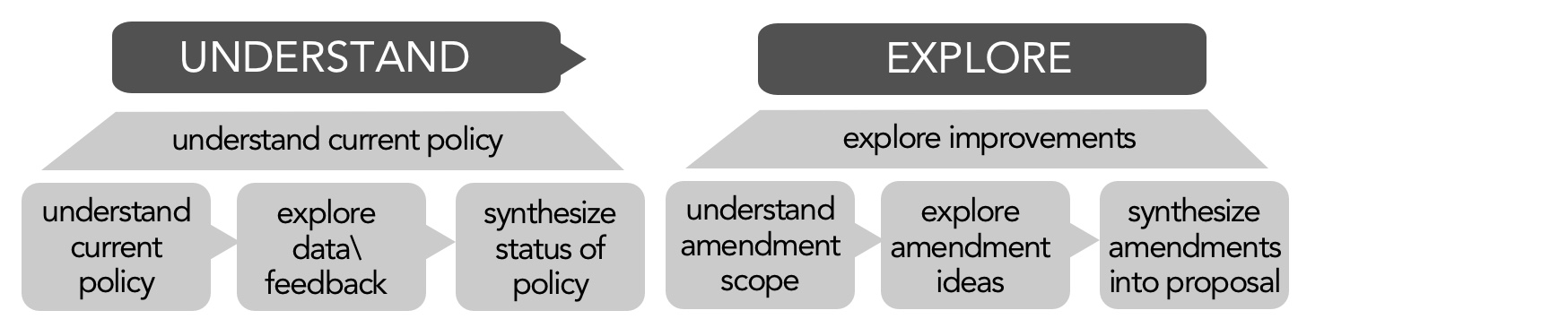
Reviewing policy follows the familiar steps of understanding current policy, exploring possible amendments and consenting to the modified policy, as shown in diagram Figure 4.15, “Understand - explore applied to policy review”.
Figure 4.15. Understand - explore applied to policy review
 |
Expressing an objection with reference to a need also gives the circle information on how to address the objection because it points toward a direction: “How could we amend/change/test the policy to be sure your need can be met?” Here are a few examples, similar to the ones already mentioned in section Section 3.5, “Integrating objections: process” on objections
“I am concerned that if we form another sub-circle, we might be stretched too thin. I am worried that we won’t be able to do our work well when our plate is so full.”
“I object to this proposal because it lacks information about how we will be able to get prepared on time. I want to make sure I have peace of mind that we’ll be able to complete the project on time.”
“My objection to this proposal is that if we require bike helmets on scooters and not only on bikes, then no one will take it seriously which will undermine the purpose of this policy. So I have a concern about practicability and ultimately about safety.”
“I object because I see no sense in adding a bureaucratic layer. The advantage of this step does not justify the extra work for everyone.”