 | Chapter 5. How To Run A Sociocratic Meeting | |
|---|---|---|
| ↢ | ↣ |
Table of Contents
Circles hold meetings in order to create clarity for their work. While operational decisions can be made by anyone who is authorized and within the limits set by policy and aims/domains, policy decisions are made by consent by the circle that has this area of responsibility in its domain. Both policy-making and operational coordination may happen during a circle meeting.
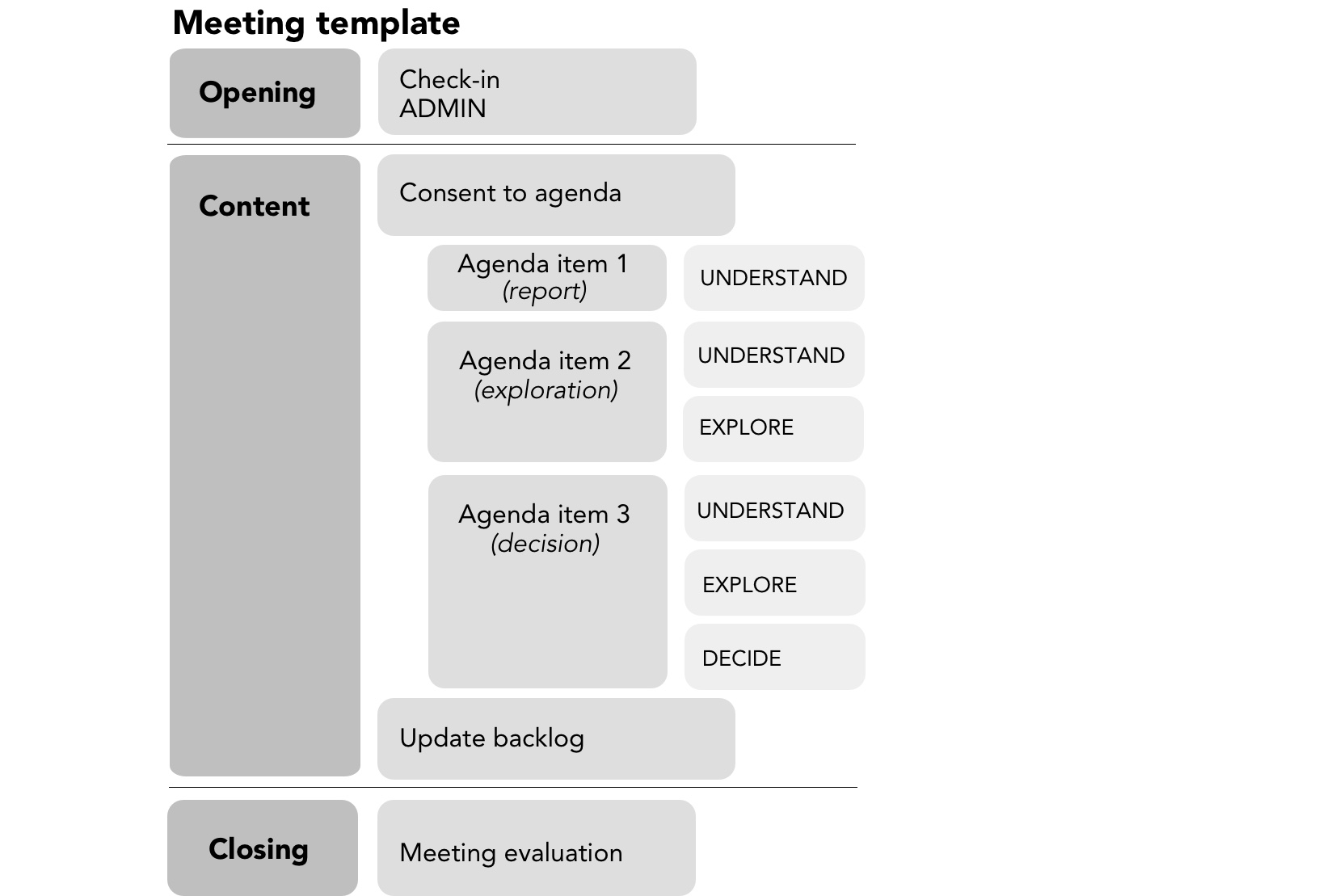
Every sociocratic circle meeting follows the same pattern which ensures forward motion while keeping equal voice in all circle decisions. Any meeting falls into three parts: opening, content, and closing. Same as the steps in generating a proposal, each phase in a meeting has lead -- do --measure loops. It helps to know what the intention is behind every phase of a meeting, what the appropriate tools are and how to measure completion of the phase.
Figure Figure 5.1, “A basic meeting template with example agenda items” shows a schematic diagram of a typical meeting. It will boost the effectiveness of your meetings significantly if facilitators visually share the diagrams with their circle because it will make it easier to follow for everyone, increasing every circle member’s sense of empowerment and trust.
Making the meeting sheet in Figure A.4, “Meeting sheet for facilitators” in the
appendix visible to everyone in the circle, is a good way of achieving a
shared understanding of the process. (See also downloadable sheets on the
book page www.manyvoicesonesong.com.)
Figure 5.1. A basic meeting template with example agenda items
 |
The aim of the opening round is to enter the meeting and be ready for the content of the meeting. The reason there are two parts is because we want to show up as both human beings and as circle members. Although we are always both humans and holder of our roles, it is easier to focus on them separately.
The intention of the check-in is to mentally and emotionally transition into the meeting. Everyone is entering the meeting having left some other activity or mental space. Possible ways to introduce the check-in are:
(most neutral) “How are you coming into this meeting?”
“What do you want to say so you can be present with us, and we can be present with you?”
(new group) “What would you like us to know about you?”
Intention: Transitioning into the meeting and getting ready for the meeting
Tool: An opening round.
Depending on the group and on how often the members of the group see each other, check-ins can be between two and ten minutes total. (For example, a board of directors of a new organization that only meets 6 times a year might want to do a longer check-in so they can give more background in a self-introduction. In a circle that works together in the same space and meets weekly, a long check-in will not be necessary.)
Even if it seems tempting, do not skip check-ins! Check-ins are essential to transition into the meeting. No matter what your meeting is about, human connection comes first. And connection will ease the flow of the work.
A formal check-in is an intentional transition marker from chatting to meeting time.
An alternative to a round is popcorn style; make sure everyone speaks before moving to administrative content.
We can add a “turn and talk” (everyone talks with a partner for a few minutes) before a meeting, especially if we want people to get to know each other more or if the group is large.
We do not recommend replacing the check-in of everyone hearing from everyone in a circle of a regular meeting because (a) we want a sense of the whole before continuing and (b) everyone checking in reaffirms equivalence -- everyone matters.
Check-ins can be timed! If we time check-ins, we are putting the minds of those at ease who are only half-way listening because they are anxious about meeting time ticking away.
A meeting does not need to get hijacked by someone’s personal life. If someone shares something heavy, do not go into problem-solving or advice-giving. This is not the place for it.
Complete when: Everyone has spoken and nothing is in the way of starting the meeting.
The context in which circle members find themselves might affect how present and generous they are with their time and energy, and how willing they are to take risks. As we get to know each other more, we are able to see each other in context, be more compassionate and caring.
Themed check-ins (having people check-in responding to a quote or a question/topic) can be done but always leave some space for people to share what might be going on for them. For example, someone in the group could be care-taker of an elderly mother, and possibly alarmed by a health scare – confining them to a well-intended prompt might fail to include them where they are in that moment. Someone could be anxious about an agenda item, or upset about something they experienced last meeting. There could be a personal tension between circle members. Someone could be dealing with relationship issues. All these circumstances, and countless more, are meaningful to share if we choose to.
If the interpersonal tension or anxiety is circle-related, we might choose to put it on the agenda or on the backlog. Or we might invite a member to share more after the meeting. If someone seems distressed, appoint a person to check with the member after the meeting. We have been to meetings where we lovingly sent someone home after the check-in (with their consent, of course) because given where they were emotionally, that seemed like the only appropriate thing to do to hold them with care.
Remember, all human collaboration starts from connection, and connection can only happen when we are authentic and show up as who we are and how we are.
In the administrative section, we talk about everything that concerns the self-administration of the group. Not only people but also the circle as such has to be ready to enter the meeting.
All the little steps that need doing and are easy to forget form the acronym ADMIN (attendance, duration, minutes, information, next meeting) so we can memorize them more easily.
Intention: Getting ready for the meeting. Overall, the ADMIN phase makes sure we can focus entirely on content and nothing holds us back or distracts us.
Tools: Going through all ADMIN items (see below).
Complete when: Nothing keeps us from entering the meeting.
Acknowledge the attendance of all circle members. Welcome visitors and the function in which they are present. Make sure the circle is aware of who has what role. Most essential in this moment is to make sure the secretary is present and is taking notes, starting with noting the attendance in the meeting minutes. Make sure to notice who is missing and the implications this has for the meeting.
When all roles are filled or there is a plan for how they can be replaced, the meeting can continue.
Intention: Acknowledging who is present and who is absent.
Tools: This depends on the circle’s context. The facilitator could introduce visitors and summarize (or ask someone to summarize) who is absent and whether all roles are filled.
Complete when: All roles are accounted for.
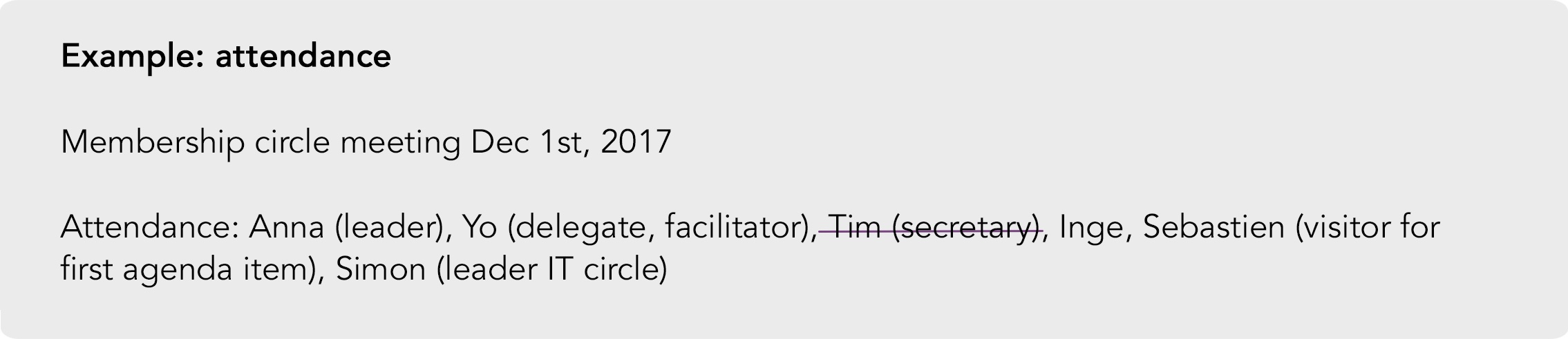
Example Figure 5.2, “Example of taking attendance in the meeting notes. Make an agenda template that includes a list of all circle members including their roles. Then cross out (but keep visible) who is absent. In this example, the secretary is absent.” shows a tiny but useful tweak that makes this step much easier in the minutes.
Figure 5.2. Example of taking attendance in the meeting notes. Make an agenda template that includes a list of all circle members including their roles. Then cross out (but keep visible) who is absent. In this example, the secretary is absent.
 |
Have you ever been to a meeting where some people thought it was a one-hour meeting, and some expected it to be scheduled for 1.5 hours? Have you ever been to a meeting where the group was unable to make decisions because so many members had to leave early? Talking about the length of the meeting helps circles avoid those situations.
Intention: Acknowledgment of duration of the meeting.
Tools: Say how long the meeting is scheduled for. We can ask whether everyone can stay for the entire length of the meeting. People who have to leave early will be reminded to say so. This information will be relevant for planning/adjusting the agenda.
Complete when: There is clarity on how long members are able to stay at the current meeting.
Make sure the meeting minutes of the previous circle meeting are known and have been consented to. We are only ready to move forward when we have agreement on the status quo.
Consent to minutes can be given between meetings – see section Section 5.4.6, “Approving minutes” on page Section 5.4.6, “Approving minutes”. Within ADMIN, we only acknowledge whether or not consent has been given and whether extra action needs to be taken during the meeting.
Intention: Acknowledging consent/lack of consent to the meeting minutes.
Tools: The facilitator might have to check with the secretary on the status of last meeting’s minutes. If there has been an objection to the minutes or if consent has not been given yet, it belongs on the meeting agenda as an agenda item.
Complete when: There is clarity about the status of last meeting’s minutes.
Since all circle members are part of the same context of the organization or of several related organizations, there might be announcements from their organization or network. This includes special meetings, decisions, events, celebrations of successes or requests that can be shared in this part of the meeting. While this is an integral part of organizational life, keep this part brief and only report-style.
Any report that lies within the domain of the circle should be given as a report during the regular meeting as an agenda item! The clarifying questions and, if applicable, feedback to the report go beyond the scope of the ADMIN phase.
Intention: Hearing announcements relevant to the wider community within the context of the organization.
Tools: The facilitator asks whether there are announcements or any other information to share with the circle. Do a round or allow anyone with an announcement to speak.
Complete when: No one has more information to share.
Announcements that generate discussions should be ended or moved into the agenda so we can use our meeting time intentionally.
When is this circle meeting next? Many circles and even entire organizations fade away because they miss this step! This agenda item serves to remind groups to pay attention to whether they know when their next meeting time is. Do this now so we don’t arrive at the end of the meeting without a next meeting plan – when everyone is too tired or distracted to schedule (and some may leave early).
Intention: Having clarity on the next meeting time.
Tools: If your circle has a regular meeting schedule, name the next meeting time and encourage everyone to check their calendars. If it turns out that there is a conflict, make either a new date, acknowledge that one member will be absent, or make a plan (appointing someone to take care of scheduling).
If the next meeting time depends on a decision in the meeting, we might have to push the topic of the meeting time into the meeting in which case we would have to put it on the agenda.
If we do not have policy on when your meetings are (i.e. you decide case by case in an operational decision), schedule a time now or make a plan. A circle can consider making policy about their meeting time (“meetings happen every other week on Wed at 2.30pm”, for example) to save themselves time in the future.
Complete when: There is clarity on the circle’s next meeting time.
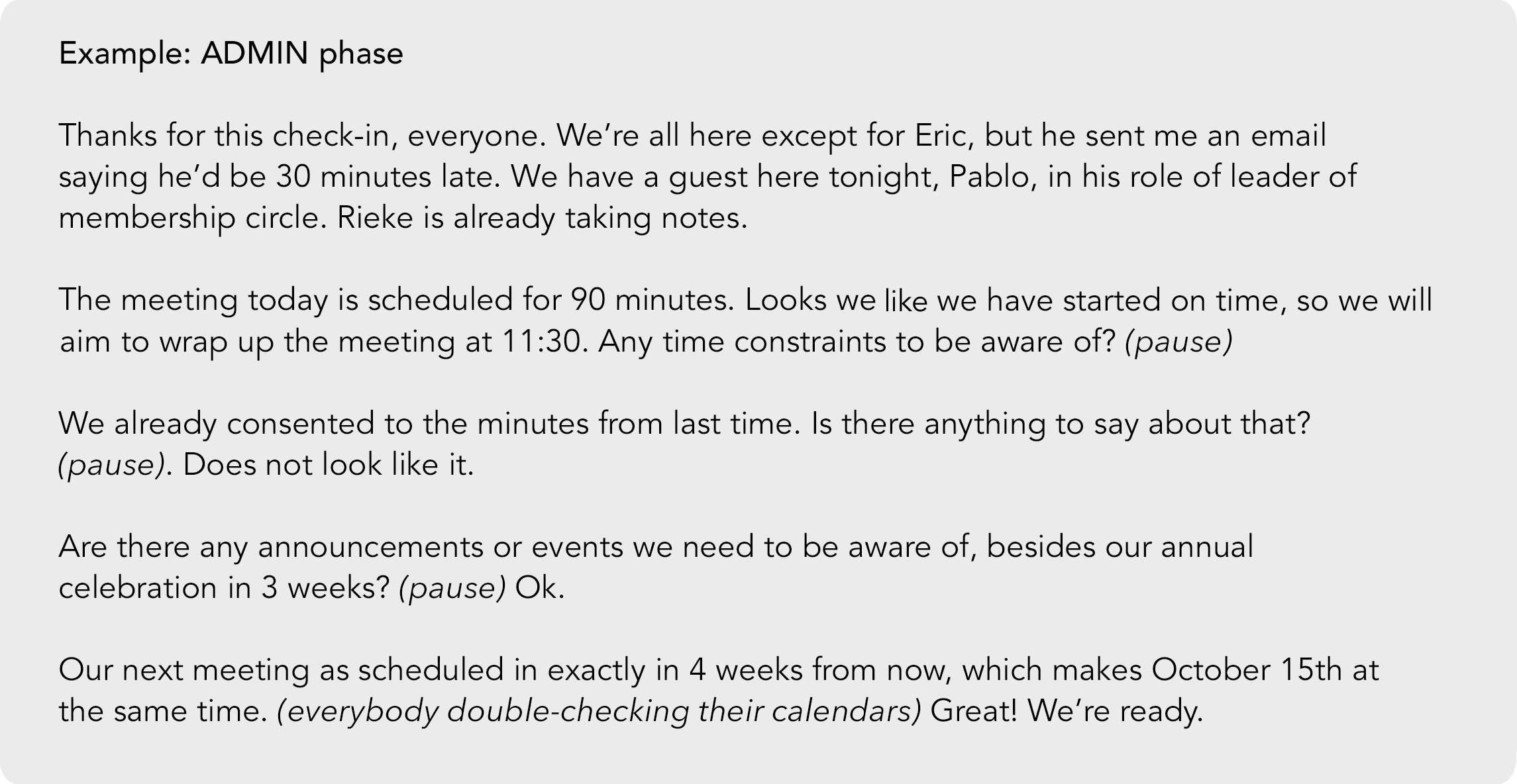
Going step by step through the ADMIN phase is much more time-efficient than not doing it. The confusion and straightening out we have to do if we miss these simple steps will cost us much more time in the long run. That said, this phase does not have to take long. It could just sound like in example Figure 5.3, “Briefly going through all the steps of the ADMIN phase.”. The acronym (ADMIN) helps us be consistent, even with no meeting sheet present.
Figure 5.3. Briefly going through all the steps of the ADMIN phase.
 |