 | 5.2. Content | |
|---|---|---|
| ↢ | Chapter 5. How To Run A Sociocratic Meeting | ↣ |
We are ready to jump into the content of our meeting! Now we will hear reports, gather feedback, make operational decisions, policy decisions, run elections and make other decisions that will help us do our work together with as much clarity, efficiency, and forward motion as possible.
The content part of the meeting also falls into 3 phases. First we plan and consent to the agenda – deciding which items from the backlog we intend to talk about. Then we go through each agenda item. The third phase is when we assess briefly what agenda items we have completed, what to-do items remain and what carries over into the next meeting, which we summarize as “updating the backlog”.
The decision of what we are going to talk about in a meeting is significant. The agenda proposal may have been prepared by someone in the circle, for example the facilitator (see section Section 5.4, “Supporting documents: backlog, agenda, minutes”), or it might be created in the moment.
Before we start talking about agenda items, we consent to the agenda. This is relevant because there is power in deciding what makes it on the agenda of the day and what does not. Is the circle going to address a challenging topic, or is it going to table that topic again and again? If meeting time is limited, which agenda items have priority over others? How much time is the circle going to give each agenda item? We make those decisions by consent, and in doing so, ownership of the agenda is transferred from the person who prepared the agenda to the circle. Even throughout the meeting, any significant change in the agenda requires consent! Everyone in the circle is equally responsible for the agenda.
The how of talking, for example, when we do rounds or in what steps a group approaches a topic is in the domain of the facilitator. Suggestions and feedback to the facilitator may be welcome, but the facilitator decides how to run the meeting.
The agenda names all agenda items, gives a sense of the timing for each agenda item and identifies what the desired outcome is (understanding, exploration, decision – see section Section 5.2.2, “Content block: 3 desired outcomes” below). A checklist for complete agendas is given in figure Figure 5.4, “Checklist for a complete agenda”.
Intention: Deciding what will be talked about in the meeting, and how much time will be allotted to each agenda item.
Tools: Presenting the agenda proposal, answering questions and consent round.
Understand: present the agenda and answer questions. (Never consent to an agenda you do not fully understand!)
Explore: are there any changes to the proposed agenda?
Decide: ask for consent and incorporate objections.
Complete when: There is consent to the agenda.
Figure 5.4. Checklist for a complete agenda
 |
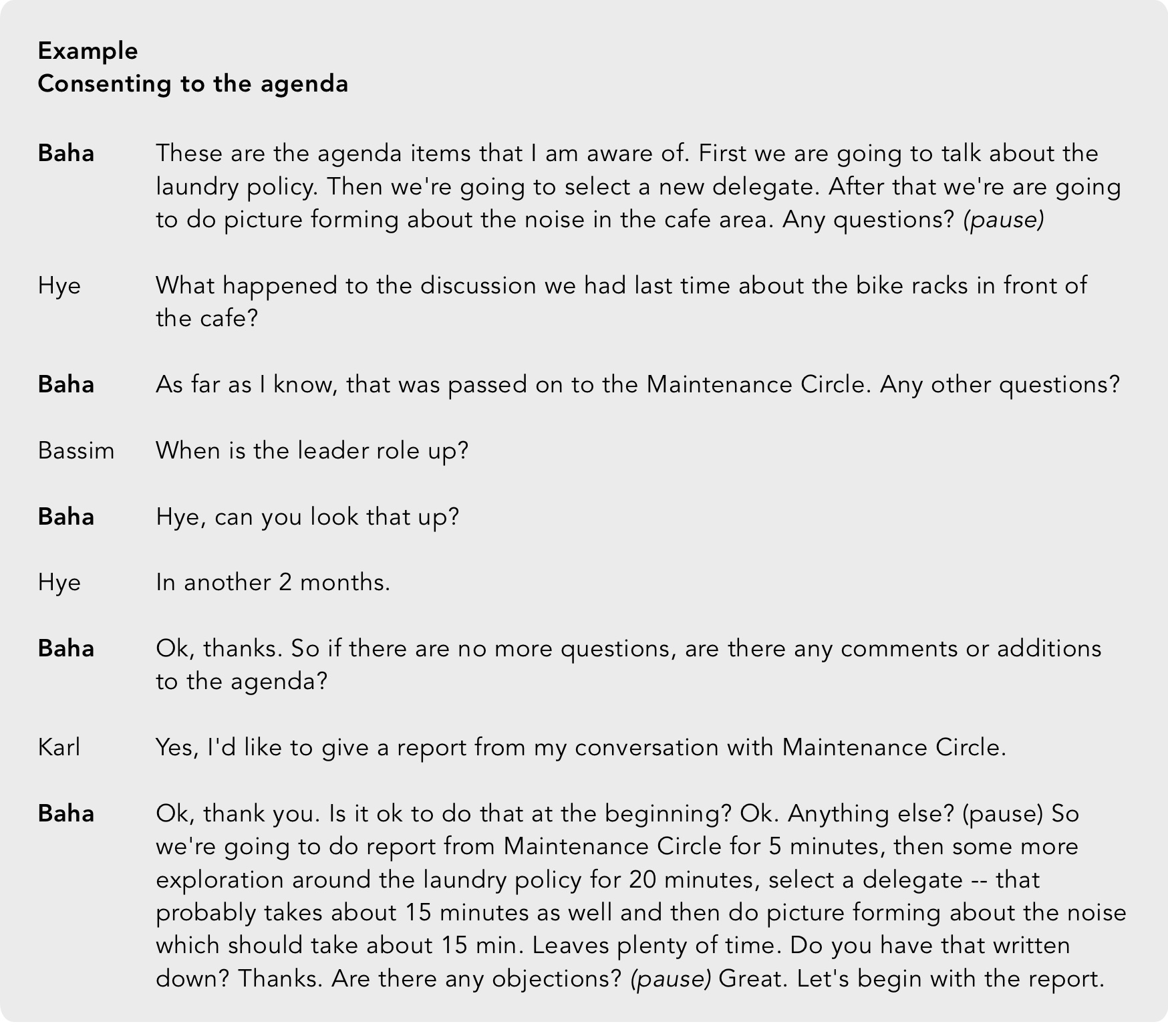
What would objections to proposed agenda look like? For example, we could decide to table a topic because a circle member whose presence is essential to talking about that topic, is absent. We might decide to postpone an agenda item because we do not have enough information or because we are prioritizing other agenda items. The example in Figure 5.5, “Consenting to the agenda” shows that this does not have to be a complicated process and that it benefits from all minds put together.
Figure 5.5. Consenting to the agenda
 |
A side-note on co-created agendas: Some circles meet and make their agenda together, at the beginning of the meeting and without use of a backlog. While this works well enough in some groups, all groups would benefit from a thought-through agenda proposal. It is too easy for agenda items to fall through the cracks and to lack intention and forward motion. In a situation where we start without a prepared agenda proposal, we can make an agenda “on the fly”. Steps in co-creating an agenda:
Understand: Getting an idea of what agenda items need to be talked about (in a round).
Explore: Any constraints on order, length and priority?
Synthesize: The facilitator either turns the agenda ideas into an agenda proposal or asks someone to do so. The facilitator presents the agenda and continues as soon as there is consent.
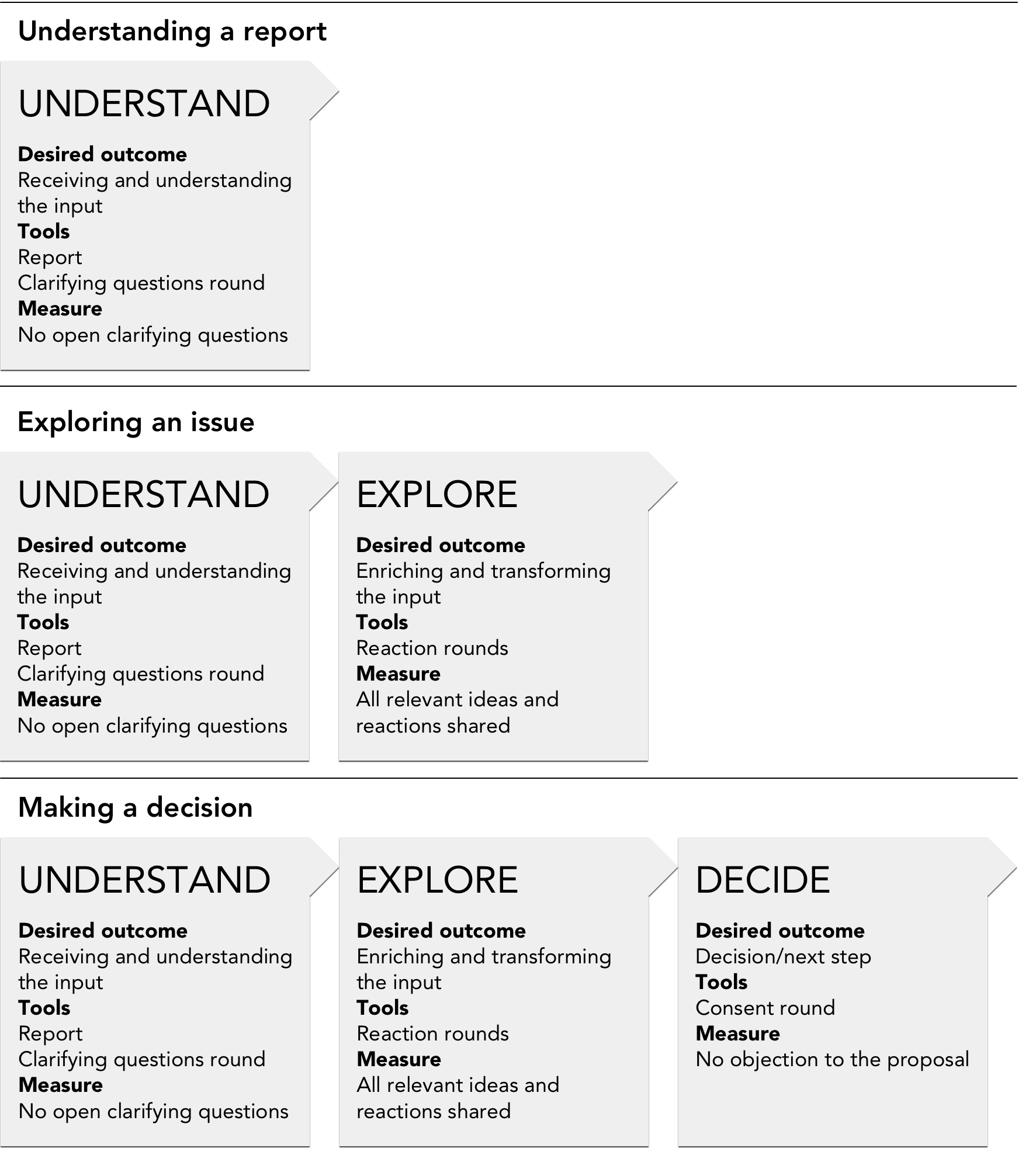
For every agenda item, there are exactly three possible outcomes as shown in figure Figure 5.6, “Three possible outcomes from an agenda item” on page Figure 5.6, “Three possible outcomes from an agenda item”: understanding a report, exploring an issue or making a decision. That means that any agenda item will be one of those three, and it’s best if a group is able to name which one it is before talking about the agenda item.
As one can see in diagram Figure 5.6, “Three possible outcomes from an agenda item”, the desired outcomes build on each other. Every agenda item starts with understanding, and for a report that is all we do. If the desired outcome is to ask for feedback, the understanding phase is followed by a phase of exploration. If we are aiming to make a decision, we go through understand and explore and then toward a decision.
Here are examples of how it is helpful to know your desired outcome:
If an agenda item is to report to the group of a decision that has been made elsewhere, then there is no need to go into a discussion. If circle members are aware of that, this agenda item is not going to get out of hand.
If the desired outcome is to hear feedback and explore, we will have clarity on the scope of this agenda item – no one will expect a decision and we will not waste time trying to come to convergence if that is not what has been asked of us.
The desired outcome might change while we are talking about it. For example, we might notice that we cannot come to a decision during the meeting. In this case, we have to either formally drop this desired outcome (which requires consent since everyone consented to the agenda) or we have to make a plan on when/how the decision can be made. For example, do a round of feedback and then delegate to a helping circle for more research and a recommendation in the next meeting.
Being aware of what kind of agenda item we are dealing with also gives a clearer understanding of what kinds of tools might be useful to get to that desired outcome. The most important ones are mentioned in figure Figure 5.6, “Three possible outcomes from an agenda item”. These steps align with the different kinds of rounds we use but there is no 1:1 match – there are different ways to hold these agenda items.
Extra clarity can be gained if, for every agenda item, we end by measuring whether we have achieved the desired outcome. Facilitators can make it a habit to pause before moving to a new agenda item by assessing whether the desired outcome has been achieved and by asking the secretary to read out loud what has been written in the notes.
Figure 5.6. Three possible outcomes from an agenda item
 |
During reports, the circle is being informed. A report is complete when all clarifying questions have been answered. A report does not require exploration. The reporting member might be a circle member, a written piece of input or a report from an attending visitor. Examples are:
Reports from operational steps. For example, a circle member was asked to talk with someone outside of the circle to hold that member accountable to policy. After doing so, the circle member reports.
Reports from decisions made elsewhere. For example, the delegate of the Membership Circle reports that they decided to change the membership fees. In this scenario, there might already have been a lot of feedback given in the process and there is no need for feedback, or feedback can happen outside of the meeting.
If the desired outcome for everyone is solely to understand the information given, then this circle does not have to go into a discussion of the subject.
Intention: Everyone hears and understands a piece of information (report).
Tools: Present all the information. Allow for clarifying questions and answer them.
Complete when: There are no open clarifying questions.
If we are asking for shared exploration, we start by giving input (a report, an idea, a request) and making sure that this input is understood. Therefore, the first block in asking for feedback is reporting and answering questions. The second step is inviting feedback. This can take as long as is considered necessary and productive. Examples:
A child circle is asking for help. The delegate of the child circle reports, makes sure everyone understands what is going on before the parent circle responds to the request. The feedback is being taken back to the child circle and a decision is made there.
A circle is taking in new information, for example because an outside member wrote an email to the circle complaining about something in the circle’s domain. The circle will first try and understand the complaint and then explore their reaction to the complaint.
A circle hears a report from a meeting of their parent circle. The parent circle is about to make a decision. After the presentation on the matter is understood, the circle does a reaction round to gather some feedback for the parent circle.
Intention: Generating ideas and feedback in relationship to the input.
Tools: (1) Report. (2) Do one or more reaction/generative rounds where circle members collect their ideas, and reflect on each other’s ideas; write them down.
Complete when: All relevant ideas and reactions are shared.
To make a decision means to go through the entire cycle of understanding, exploring and deciding. Not all of it has to happen in one meeting. Examples:
An operational decision (a case-by-case decision) that does not completely follow from policy.
For example, imagine a meals circle of a community has been asked to make a decision on whether or not there will be a regular meal on New Year’s day. The circle decides not to make a policy (i. e. making a general decision on meals on national holidays) but to make a case-by-case decision of skipping that particular meal.
This decision follows the same steps: report what the request was and make sure everyone understands the issue (understand), explore what circle members are thinking about it (feedback), making an operational decision (decide).
A policy decision. For example, a circle could be making policy on meals on holidays in general and plans to come to a decision in a meeting.
A selection process. (Following the pattern of understand, explore, decide.)
Intention: Making a decision to create clarity.
Tools: (1) Report (2) Explore (3) Go through the consent process.
Complete when: There are no objections to the proposal.
In some frameworks, operational meetings are strictly distinct from policy meetings. Here, we are assuming they both can happen within the same meeting because the circle decides what to decide in operational, case-by-case decisions and what to make policy on. There can be agreements on doing operational-only meetings, but most policy meetings will contain some talking about operations. (See more on operational meetings in section Section 2.8.2, “Operational meetings” on page Section 2.8.2, “Operational meetings”.)
That said, the first agenda item of a meeting might be finalizing policy around topic A and assigning tasks. The second agenda item might be exploring a topic. The third agenda item might be a report from a new issue. The fourth agenda item might be to assign circle members tasks around an upcoming event, and the fifth might be a review of a policy.
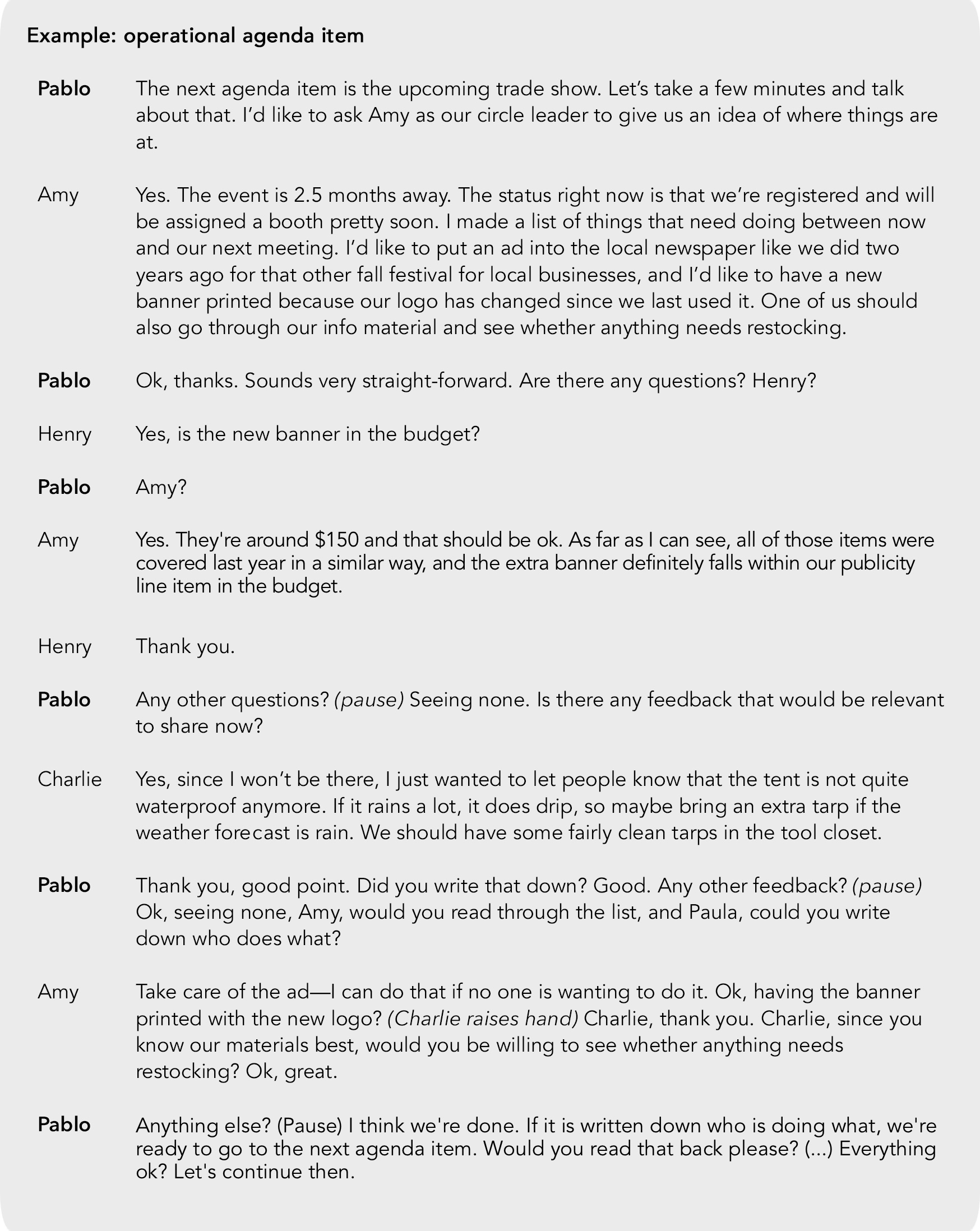
An operational agenda item can be very brief (see Example Figure 5.7, “Example of an operational agenda item within a circle meeting”).
Figure 5.7. Example of an operational agenda item within a circle meeting
 |
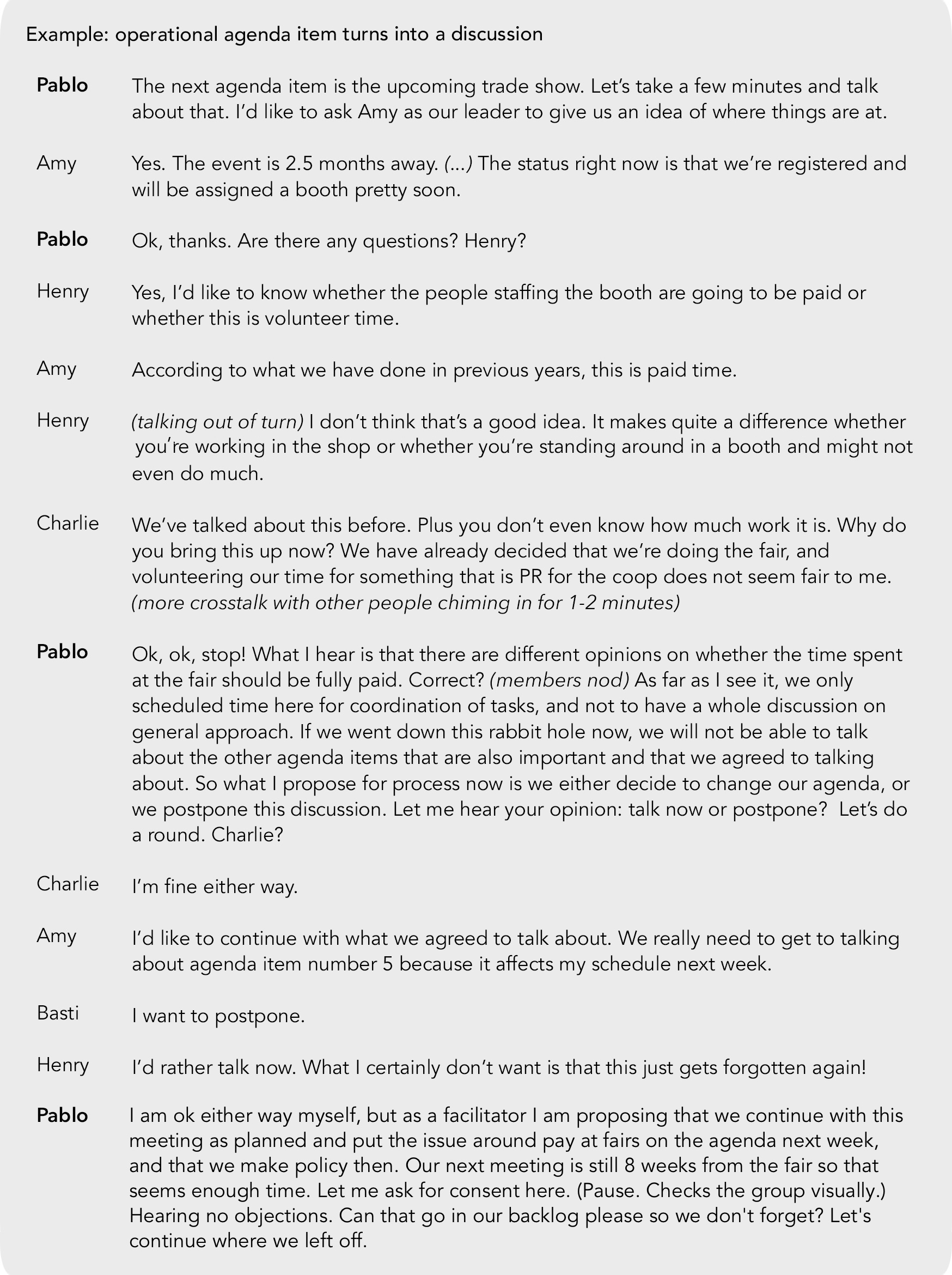
If a discussion about an operational tasks triggers the need for more talking and maybe policy (you can tell by the fact that there is a discussion flaring up, see Ex. Figure 5.8, “How to deal with a discussion coming up in a meeting”), remain intentional in your process. Many decisions can be made as a one-time decision. If it seems worthwhile to make a guideline for operations (i.e. policy), decide together (by consent) whether to modify your meeting agenda to fit in a policy decision or whether to put the policy decision on the backlog.
For example, the circle could create a role for a publicity manager that would take all the kinds of action steps discussed. Thereafter, the person filling that role would take off those activities and this topic would not show up on future agendas. New items sometimes arise in the middle of meetings. It is important then not to let the new item take over the agenda without consideration. The facilitator can guide the circle whether or not to change the agenda that was consented to at the beginning of the meeting. If there is no consent to change the agenda, the new item is added to the backlog. The circle may also identify and assign any next steps needed to prepare that item for future discussion.
Figure 5.8. How to deal with a discussion coming up in a meeting
 |
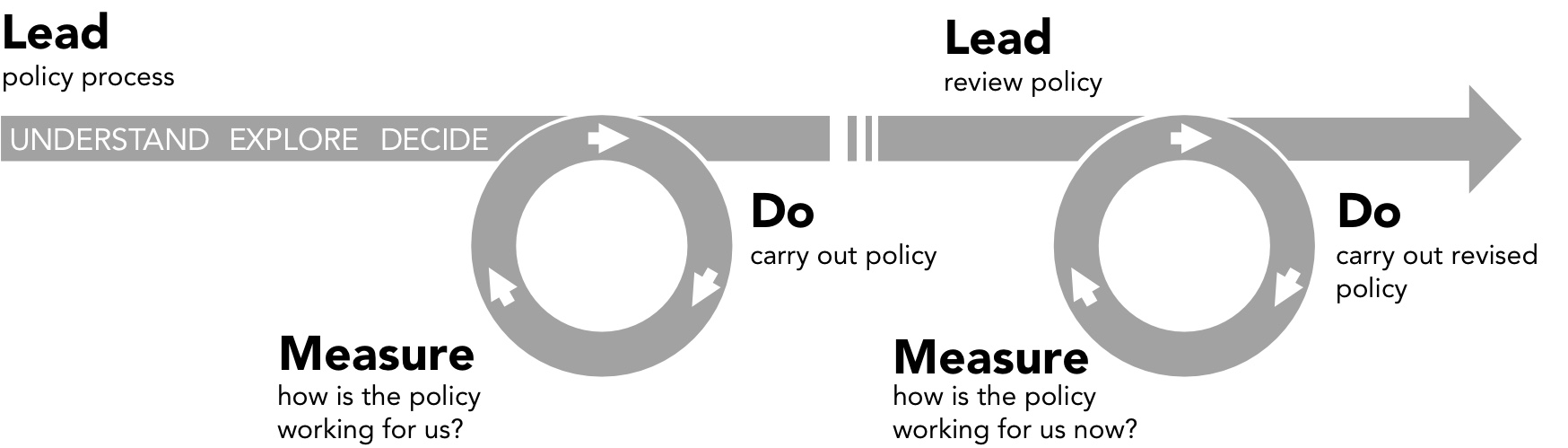
Remember that a typical policy decision-making process (as described in section Section 3.3, “Making policy – step by step”) goes through different phases: (1) understanding the issue, (2) generating a proposal, (3) making a decision. How a group spreads out those phases into meetings is entirely up to the circle. One can go through all the decision-making steps in one meeting, or spread them out over several meetings. Then we see what happens as we implement the policy. Once we review it we make changes if needed, following the same consent process (see figure Figure 5.9, “Life cycle of policy”).
All policy decisions in sociocracy have a term end, which forces us to review policy instead of letting it go stale. We might just briefly revisit a policy and decide to leave it as is or do a deeper review.
Figure 5.9. Life cycle of policy
 |
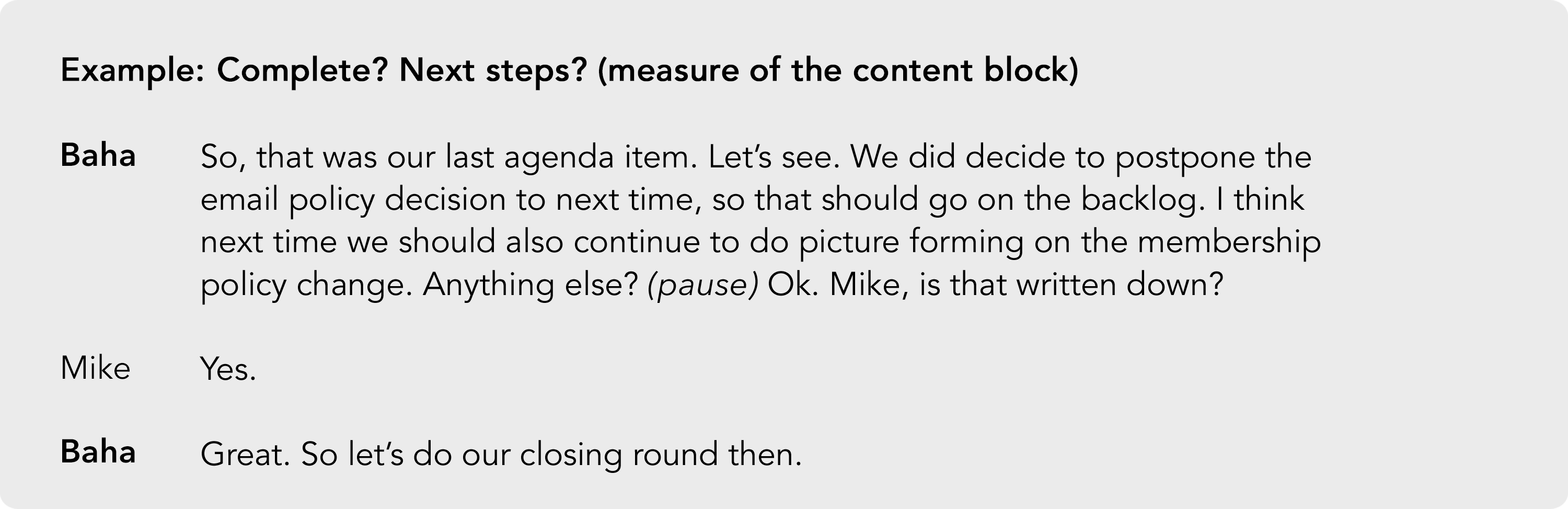
The backlog is a list of topics that require reports, explorations or decisions to gain the clarity needed to do good work. (More information in section Section 5.4.1, “Backlog”.) At the begining of the content phase of a meeting, decided what to address. We might generate new backlog items, postponed items or completed topics. Now, at the end of the content block, we assess where we are at. What remains to be done? Within a few minutes, we note this down in the backlog while it is fresh on our mind.
Intention: Assess whether all agenda items have been addressed with regard to the desired outcomes.
Tools: Depending on the complexity of the situation, we can
Let the facilitator ‘‘think out loud’’ on where there are gaps (agenda items that got skipped or not covered correctly), and do a reaction round
Do a round. “What needs to happen next time?”
The secretary either updates the backlog right away or after the meeting:
Some groups like doing a review of action items generated in the meeting.
Complete when: The information to update the backlog is collected
The backlog is vital data to use for the planning of the next agenda. Think of your updated backlog as the hand-off from one meeting to the other. (See section Section 5.4.1, “Backlog”.)
Figure 5.10. Measuring the content phase of the meeting
 |