 | 5.3. Closing: meeting evaluation | |
|---|---|---|
| ↢ | Chapter 5. How To Run A Sociocratic Meeting | ↣ |
Make sure to wrap up the content part of your meeting about 10 minutes before circle members have to leave. Meeting evaluations are an integral part of every meeting. We end the meeting with one or two rounds on:
“What worked well in the meeting?”
“What could be improved in future meetings?”
“Is there anything you are carrying out of the meeting that you’d like to get off your chest now?”
Meeting evaluations are an opportunity to learn from our meetings. We can either talk about content, process, or interpersonal dynamics.
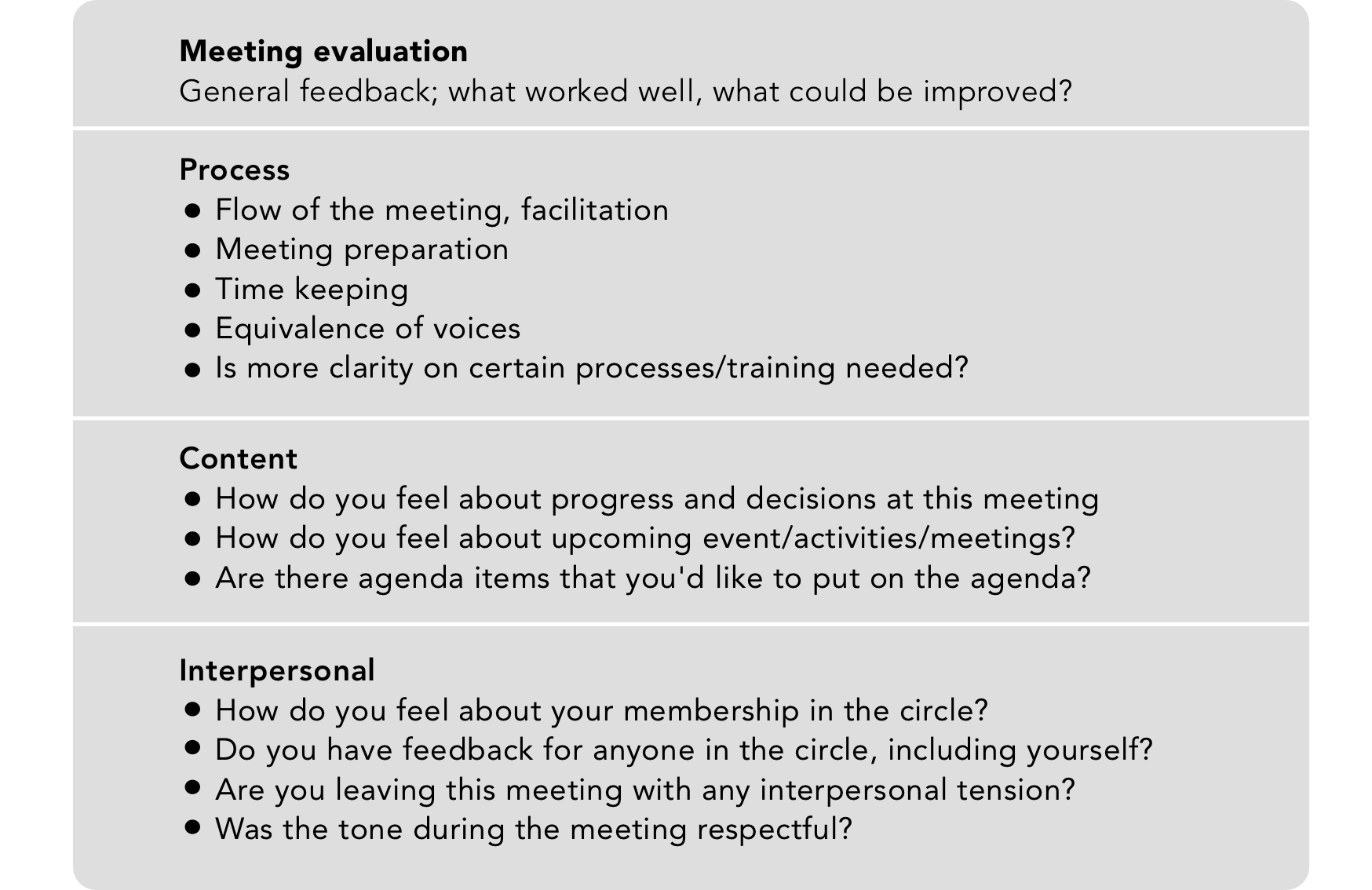
The diagram in Figure 5.11, “Ideas on what to evaluate in the meeting evaluation/check-out” illustrates what people can touch on during the evaluation round. The intention is not to cover all those areas but to show the variety of topics to evaluate.
If we want to address something interpersonal, remember that effective feedback is feedback that is easy to receive, specific, and blame-free. Of course, a meeting evaluation is not a magic fix. A governance method cannot fix what people have to do: speak up and take action. If there is a circle member that behaves in a way that makes it hard for us to participate, we share the responsibility to speak up. There are many ways to address behavior, but the meeting evaluation can be the first and easiest one. More examples of things to say during meeting evaluations can be found in section Section 4.5, “Meeting evaluations” on page Section 4.5, “Meeting evaluations”.
If something needs attention, the circle will set some time aside in a future meeting to address it; for example if the circle meetings go significantly over time on a regular basis, we need to make time at a future meeting to talk about it. In that case, put the evaluation (“observation: meetings go over time a lot”) in your backlog right away during the meeting evaluation so that facilitator and leader can decide whether and how to address it before or in a future meeting. Other strategies for improvement might also go into the meeting’s notes for later consideration. This could be the need for more training on process, a mediation, or a policy around circle admin matters. Overall, inhabit a mindset of growth: how can these meetings be better next time? Or, even better, what will make our circle meetings awesome? Remember to be specific. Meetings would work better for you if they started on time? Say that! Groups sometimes seem to accept that meetings would be lengthy or irritating. Sociocratic meetings, if well-run, are refreshing, connecting and energizing. That is the benchmark we are aiming for.
Figure 5.11. Ideas on what to evaluate in the meeting evaluation/check-out
 |
Intention: Learning from the meeting around how the circle deals with and learns about content, process and interpersonal relationships.
Tools: A round where everyone speaks.
We can divide up content, process and interpersonal evaluations into separate rounds.
The secretary puts items that might translate into an agenda item on the backlog.
If we get a sense that someone is not sharing relevant data, we can choose to share the impact on us. For example, if there was a lot of tension between two circle members during the meeting and they do not acknowledge that in their evaluation, nothing keeps us from sharing what the impact was on us.
Something is brought up in the closing round that triggers strong reactions. In that case it is best to do a reaction round to that and consider if any next steps need to happen operationally or if items need to be added to the circle backlog.
Complete when: Everyone has spoken. Evaluations that require an action step are written in the minutes or in the backlog.