 | 6.4. Implementing sociocracy in start-up organizations | |
|---|---|---|
| ↢ | Chapter 6. Implementing Sociocracy | ↣ |
With success, a simple start-up organization can grow in complexity quickly. Suddenly, we need a website, a social media outlet, a logo, design guidelines, an HR department, accounting …and it never stops. The step from a beginning organization to a running organization is huge. That is why we recommend starting sociocratic governance right away. The easiest way to implement sociocracy is in a start-up. The easiest way to grow is with sociocracy or related, dynamic, decentralized systems.
A sociocratic organization grows from one small circle to a full-fledged structure with many circles. (See section Section 6.4.1, “Structures for small groups” on sociocracy in growing organizations.) Starting sociocracy in a new organization means one will have to convince fewer people in the beginning when introducing sociocracy because there are not as many decision-makers yet. In this context, it is important to be open and transparent about your governance system. For some young organizations, the effort of onboarding new members is significant, given that it is unlikely that new members come with experience in sociocracy. One can have the best implementation in the world but if trained members are outnumbered by new members who do not know enough about it to care, the organization will slowly drift back toward the mainstream culture. It takes intention and action to keep a new governance system alive.
It’s possible to start an organization with one circle of members that share the work. There is no necessity to have a full circle structure in the beginning. As the need arises, the groups will differentiate. For example, the group will notice what topics are only affecting some in the group. They might also, quite naturally, outsource tasks that are best done by an individual or a pair in an operational role, for example bookkeeping or maintenance of a specific machine.
If there is just one circle, is that a work circle, or the General Circle? At the early stage, there is no difference. Think of it in terms of domains. The General Circle is the “super”-circle for all the work circles and “owns” the overall domain for the overall aim. When the time is right, we create sub-circles and pass part of the general circle aims/domains to them.
Figure 6.1. Early life cycle of a young organization starting with a work group
 |
Everyone decides on policy level; everyone does everything
 |
Everyone decides on policy level; differentiation on operational level
 |
Differentiation on policy level; differentiation on operational level
The figures in Figure 6.1, “Early life cycle of a young organization starting with a work group” show how an organization can start out as one circle. This, for example, is the scenario of 6 people getting together, forming a group and deciding to start a business. At first, they might all more or less do the same tasks. Quickly, however, they will each have their work area of preference or expertise. One does marketing, one builds the website, one writes pitches to find investors, two build the product. They might still make all the policy decisions together. “Should they pay for ads, should they build the website themselves or hire it out? Who needs to be asked before someone can spend money?” On the governance end, this means they all still hold all the domains together, they just define “ok, you go ahead and carry out our marketing plan” or “ok, you go and find someone who will build our website and make sure it happens.” They might decide together how they are going to go about interviewing potential customers to find out what their needs are, but only one or two of them are going to work on it. The policy is made together in the whole group, while the operations are “packaged” into roles and assigned to individuals who fill those roles.
The next step is to distribute authority. This is often a painful step because we have to let go of power. For example, the Marketing Circle will now make all the decisions on marketing and does not require approval from the General Circle. Many groups fail because they are not able to take the step of delegating. If founding members still want to keep their fingers in everything, they will run into the typical “founders syndrome.” Founders have to let go or they will inhibit growth. The organization in Figure 6.1, “Early life cycle of a young organization starting with a work group” successfully forms department circles with aims (subsets of the aims of the whole organization) and domains (activities and policy areas they are responsible for). We encourage groups to distribute full power as soon as possible.
If you are designing an organization structure, we recommend
finding the design of a sociocratic organization that is already doing
something that is similar to what you are planning to do. (See our
website www.sociocracyforall.org/resources for examples and
for a contact form to ask SoFA about existing related sociocratic
organizations.)
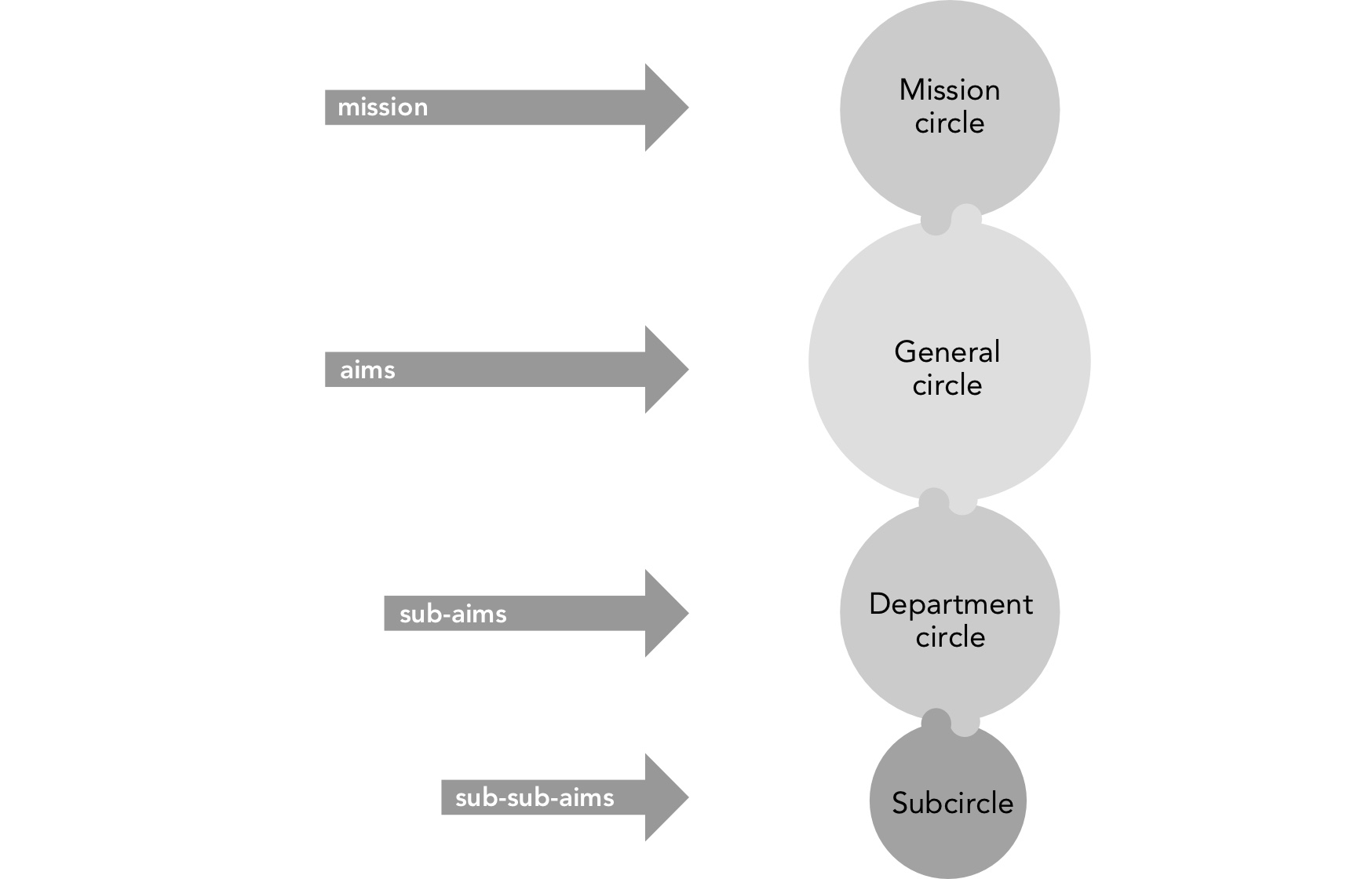
If you start from scratch then begin with the aim in mind. What are the products the organization will produce? What are the services it will deliver? If we build in a lack of clarity at the birth of the organization, it may struggle with that conflict for the rest of the organization’s life because that conflict will be rooted in the personal aims and expectations of members (see section Section 6.10.4, “Clarity of domains/aims”). From the overall organization’s aim, we go to sub-aims. What are the different elements of what needs doing, so we can work toward that overall aim? Each aim translates into a department circle.
Figure 6.2. Forming circles from your aims
 |
We do not start to draw a circle structure until we can write down a rough draft of the circles’ aims. Groups new to sociocracy sometimes struggle to generate an appropriate circle structure.
Typical pitfalls:
Some groups over-emphasize operations that seem important but do not need much policy work (for example IT and finances, depending on the nature of your organization).
Some groups orient themselves too much to individuals that are doing work (or are planning to do work). For example, if one member currently does task A and task B, this does not necessarily mean that both tasks would fall into the same domain. That individual may end up being a member of two circles in the new structure.
Some groups overestimate how much work can be done – which will stretch a group too thin. Better to start small and grow as the need arises.
Organizational structure is policy. Use the proposal generation process (see chapter Chapter 3, Making Policy Decisions on page Chapter 3, Making Policy Decisions @@TODO@@: Figure out page references.). Understand what the needs are for your particular organization and then what the dimensions are. What are the considerations for a circle structure? Readers might add more for their particular context, but this is what comes to mind on a generic level:
Aims and Domains - how they can be subdivided?
Operations and policy-making - how much of each expected?
Number of workers (informs the number of circles)?
Hand-offs - where does one circle’s work ends and another’s begin?
Who are our stakeholders, and do we include them in our mission circle?
What kind of outside experts, if any, do we want on our mission circle?
What are ways that our products and services can be organized? By type of product or service? By geographical area served?
In the early stages of a start-up, or forming an organization, the workers might be at the same time the members of the general circle and the mission circle. How can we form an MC without stretching ourselves too thin? There are different options.
The same members of the GC will be members of the MC. This can work, however, one will have to make sure the group spends enough time on big-picture thinking. Strategies are (illustrations in diagram ???):
Scheduling a separate, extra meeting. This might be the best option. The potential downside is over-burdening leaders and delegates. In the start-up/beginning phase, leaders will have their hands full. Attending the general circle is already an extra meeting outside of their core work as circle leaders.
Separating out 30 min (or any other time frame that makes sense to the group) for overall planning in every general circle meeting – the circle will probably have to protect that time well because what urgent day-to-day matters tend to over-ride the less pressing future planning. Those 30 min have to be reserved for MC thinking!
Making every fourth (third, second,…) general circle meeting a mission circle meeting. Disadvantage: too much time between meetings and therefore no flow within the mission circle topics – and missing out on one general circle meeting turn.
Adding just one or two more external members to the general circle. The advantages are that it is more likely that the mission circle topics will not be over-ridden by the general circle topics -- the GC members will not talk about general circle business if the mission circle member carved out the time to join them for a mission circle meeting. The mission circle member, an external member, will keep the GC “on good behavior”. John Buck says it is like “inviting a guest for dinner and seeing how well your kids can behave”. In our personal experience, we have made use of that in a very early start-up phase. The external member will be able to provide some outside perspective. When the trees right in front of us make it hard to see the forest, the external mission circle members’ perspectives might help. (See diagram ???.)
Another hybrid option: sending more than one delegate from the general circle to the mission circle. This can seem safe to a group from a very horizontal context where there is skepticism on whether the mission circle would be operating in the organization’s interest or whether the MC would drift into a power-over attitude. (See diagram ???.)
The fourth option is the standard solution: a mission circle separated out from the general circle and double-linked. The leader of the general circle is the top-down link, and a delegate from the general circle is the bottom-up link to the mission circle. (See diagram Figure 6.4, “Early life of a young organization starting with one work group II”.)
Mission circle members may also include delegates from stakeholder circles (parent for a school, customers of a product, funders for a non-profit, see section. Section 2.5.3.5, “Stakeholder representation in the mission circle” on page Section 2.5.3.5, “Stakeholder representation in the mission circle” @@TODO@@: Figure out page references..
Figure 6.3. Early life of a young organization starting with one work group I
 |
GC = MC
 |
GC with at least one more member forms the MC
Figure 6.4. Early life of a young organization starting with one work group II
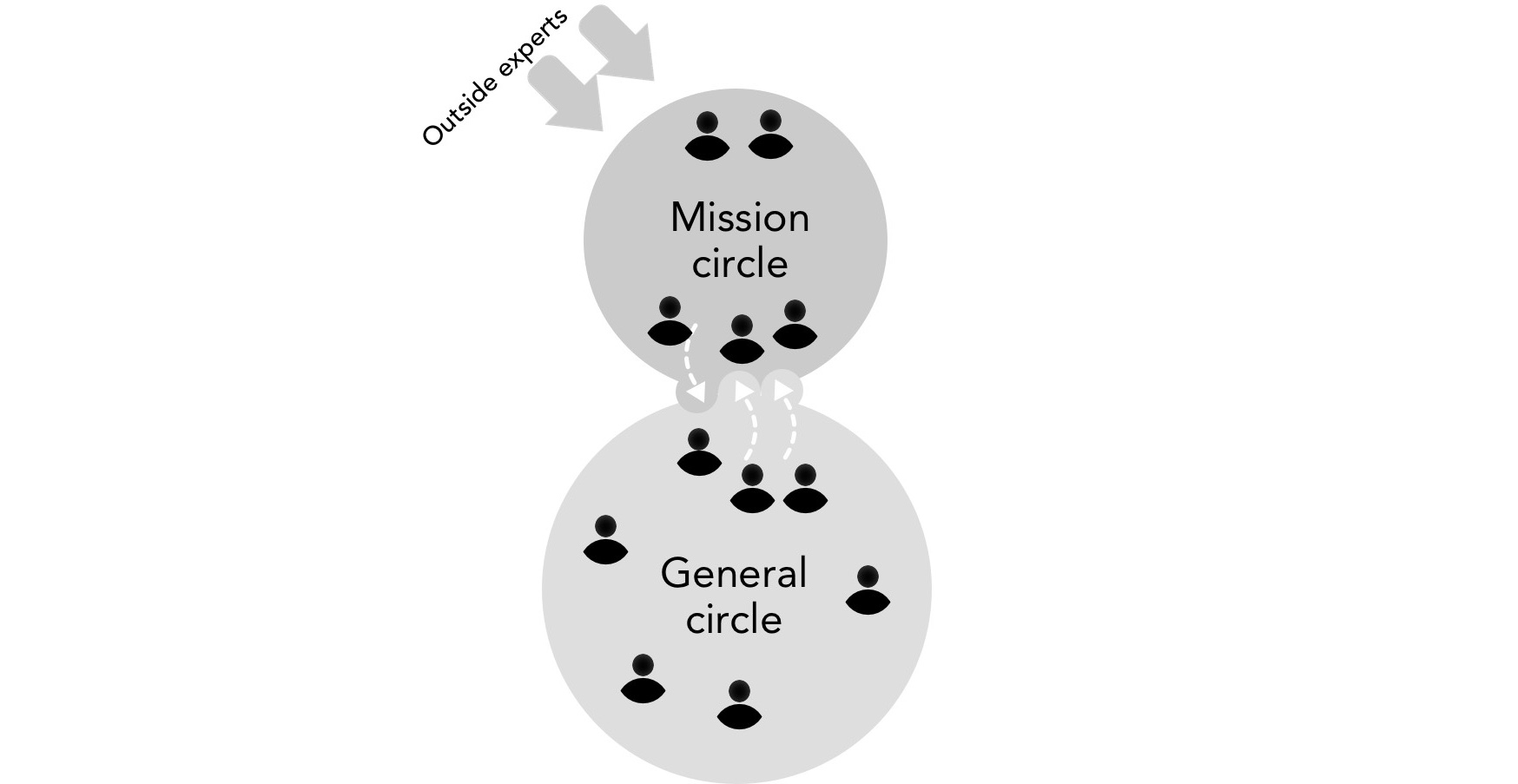 |
GC and MC are linked with a triple link
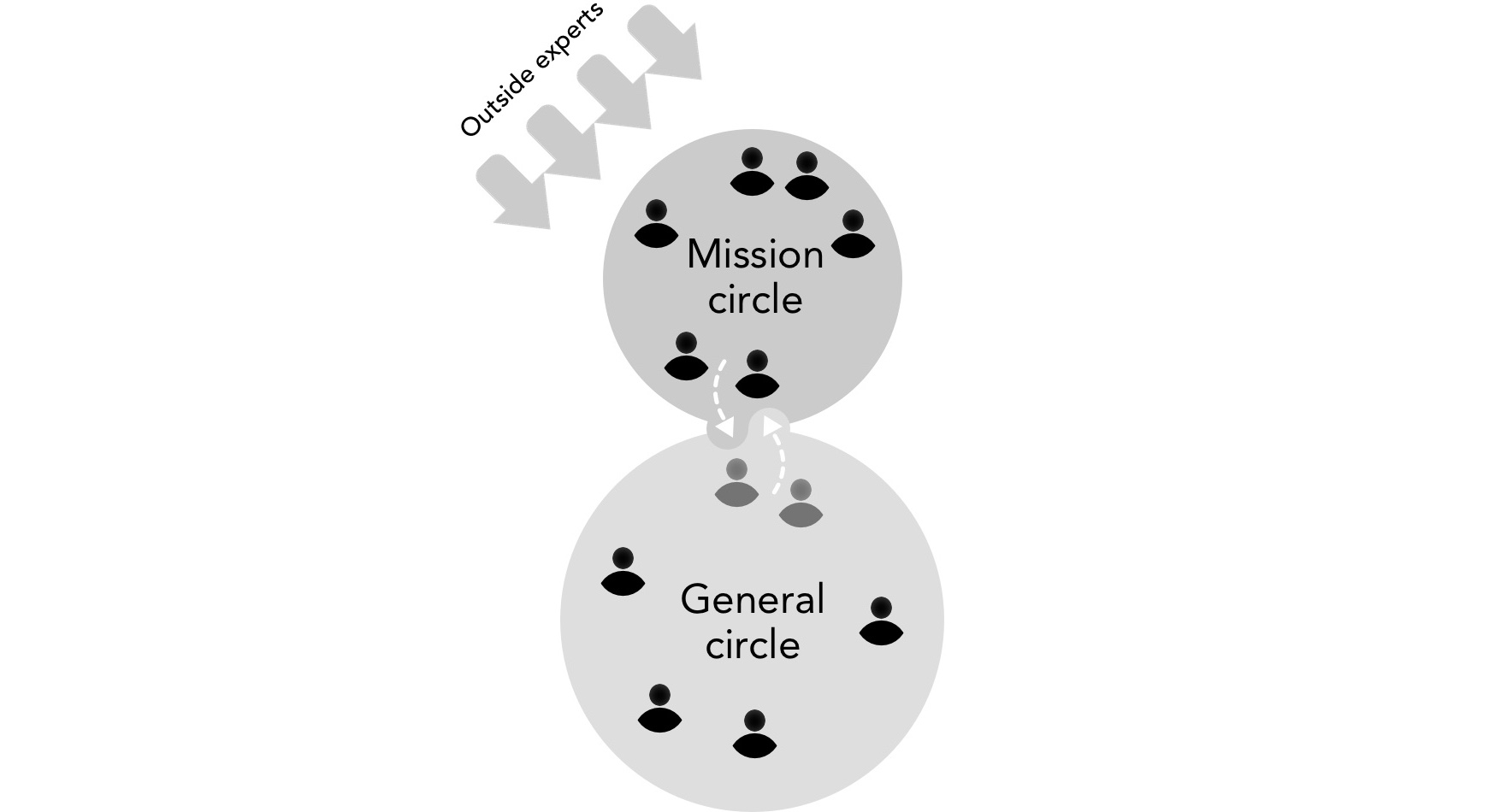 |
GC and the MC are separate and double-linked
If an organization starts out from a board/mission circle: In some cases, it might be the mission circle starting an organization. They would mandate the leader of the general circle (ED or CEO, depending on the type of organization) to form a work team. This is what is shown in diagram ???.
If the organization grows, the general circle would create department circles, assign them aims and domains and appoint leaders. As soon as the work circles are established, those department circles send delegates back to the general circle. The general circle will send a delegate to the mission circle.
Figure 6.5. What others say
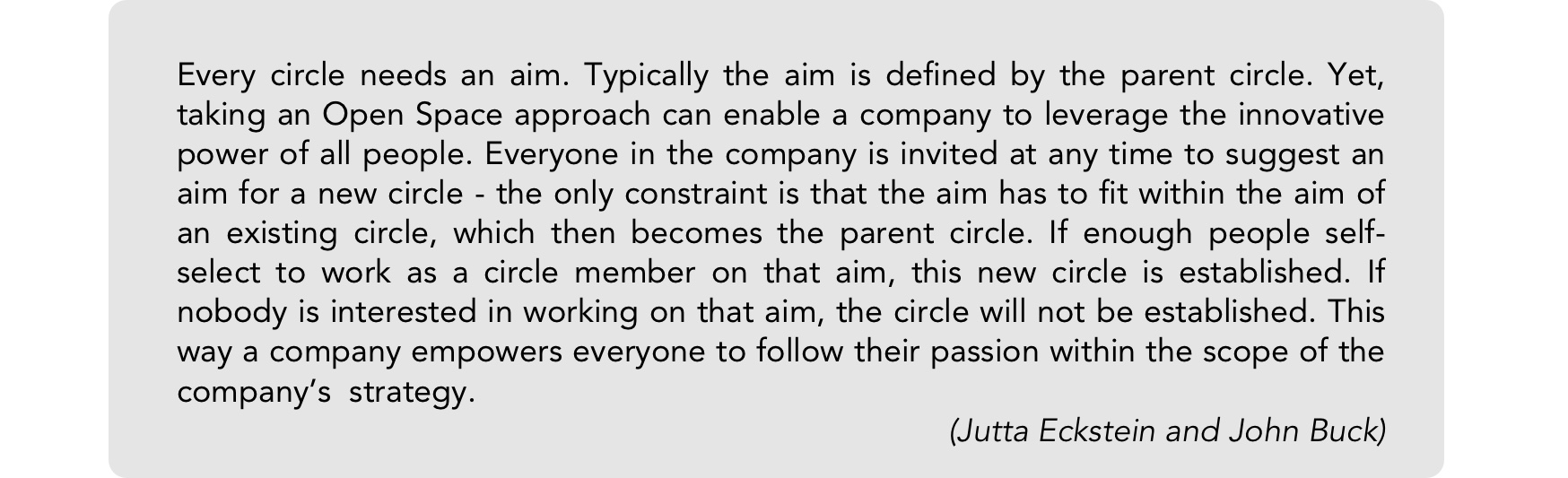 |
Figure 6.6. Early life cycle of a young organization starting from a mission circle
 |
MC form the GC by appointing a GC leader
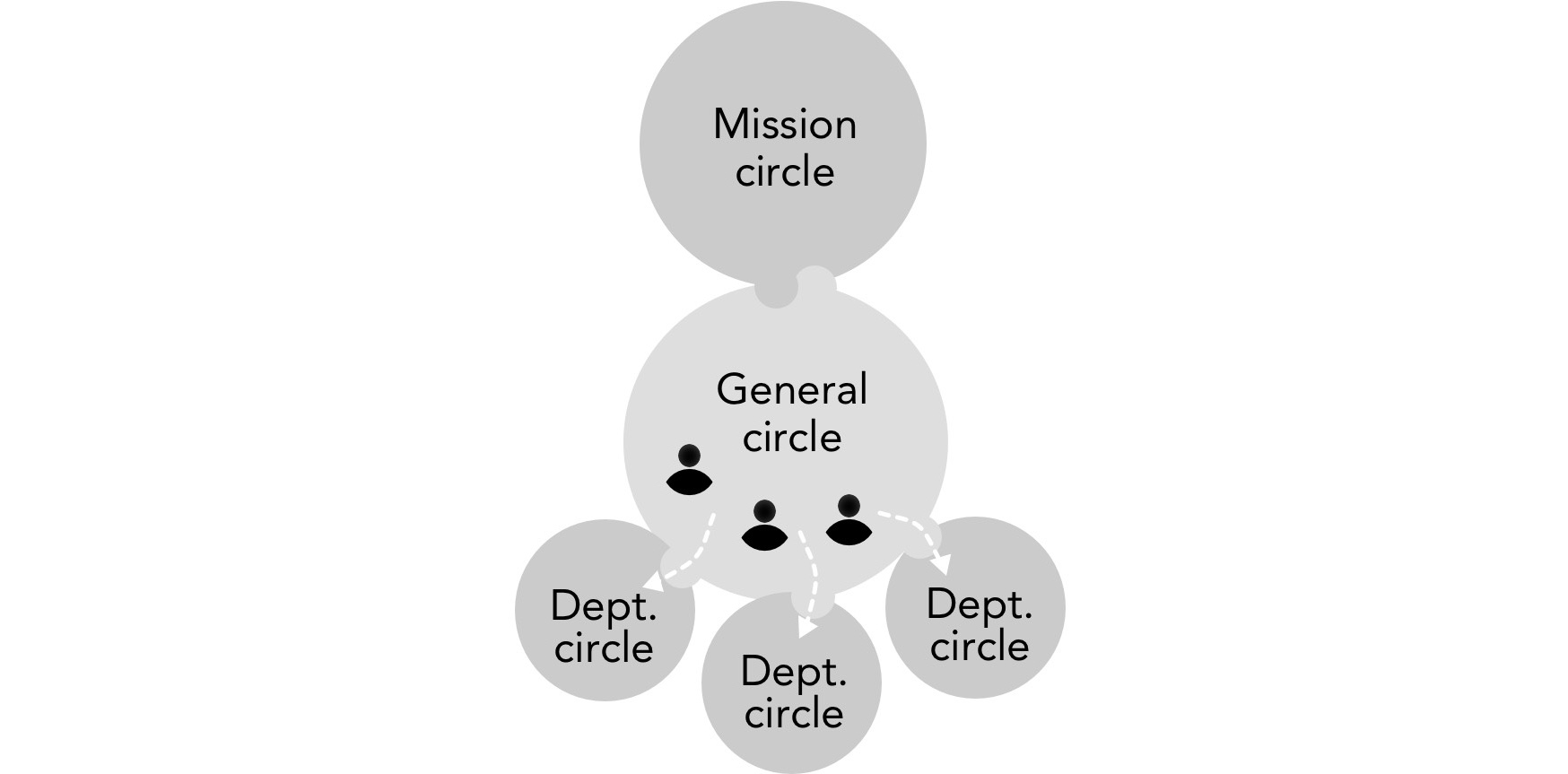 |
GC forms work circles by appointing department circle leaders
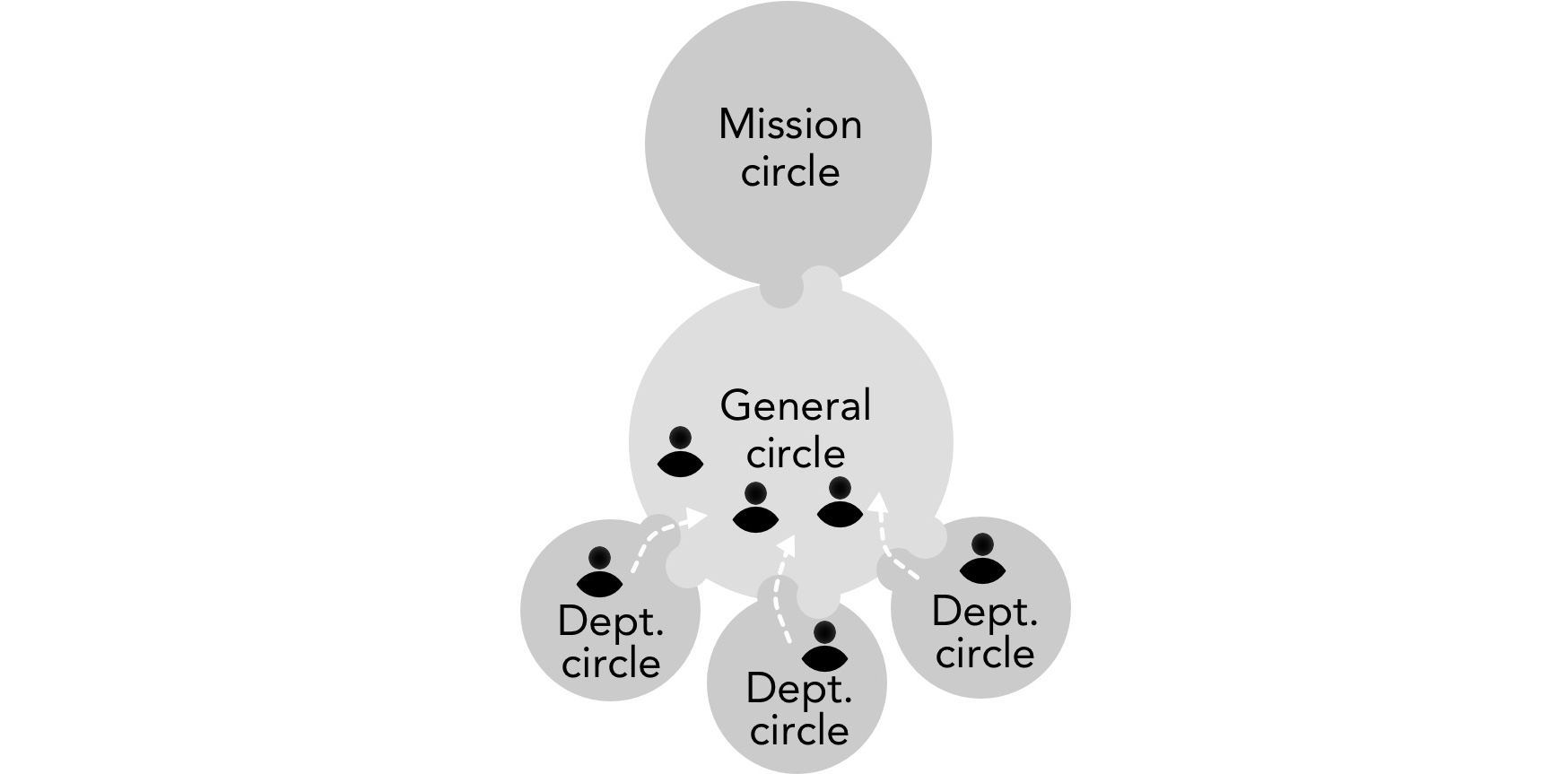 |
Department circles are fully formed and link back to the GC
Find more information on implementation in new organizations in section Section 6.4, “Implementing sociocracy in start-up organizations” on page Section 6.4, “Implementing sociocracy in start-up organizations”.
Some organizations only implement some elements of sociocracy. While there is nothing wrong with that, the advantage of implementing sociocracy more holistically is coherence. Some features and tools in sociocracy depend on each other. For example, we can only have a general circle if we have leaders and delegates. Having a delegate only makes sense if there is a general circle, and all of those features only work if there is a circle structure. Having a working circle structure only works when circles actually have authority in their domains. (Otherwise they would only prepare proposals for a different decision-making body to decide.)
A huge factor in implementation is training. Everybody has to understand the new governance system enough to operate in it. Ideally, training comes before the moment of implementation so everything and everyone is ready to go. There is some level of chaos that comes with any organizational change.
Not all ‘‘standard’’ pieces of sociocracy are being used in the organization. One can use consensus decision making or even majority vote within a sociocratic circle structure. One could use consent for selection processes but not for other decisions. Any piece one leaves out, without a comparable tool in its place, will be missed. As in a human body, every system has its purpose. For example, an otherwise fully sociocratic organization that never does performance reviews might miss out on improvements on an individual level. An organization that is sociocratic but does not have a board or any equivalent mission circle might miss direction for its long-term trajectory. An organization that never does check-ins at the beginning of a meeting might experience their own meetings as impersonal, without the sense of connection and belonging that improves performance.
Only some departments or units in the organization are running sociocratically. This might work well if those units’ aims and domains are well-defined and well-linked with the rest of the organization. The inherent risk of implementing sociocracy in one unit or division of a larger organizations is that changes in leadership at higher levels of the organization can force a return to the command and control form of management.
The implementation is incremental. The intention over time is to add more sociocratic elements and tools. The challenge here is that it is hard to find a linear order of features that provide a coherent set. Sociocratic practices are like puzzle pieces that build on each other.
At the core, two things must be in place for any sociocratic organization: a clear aim and a commitment to equivalence, regardless of whether an organization ends up being ‘‘purely’’ sociocratic or borrows from related frameworks or invents an even better version of governance. From a shared aim and a shared process, one can continue a sociocratic journey by choosing tools: consent, linked circles, sociocratic elections. Rounds are a good strategy for including everyone’s voice early. Having at least agreement on who will be the facilitator for the initial processes will solve the initial chicken-egg problem of any implementation (as in, who will facilitate the selection process to select the first facilitator?).
Chart Figure 6.7, “How some of the sociocratic features build on each other” on page Figure 6.7, “How some of the sociocratic features build on each other” @@TODO@@: Figure out page references. shows how sociocratic processes and tools build on each other - the related puzzle pieces. The flowchart assumes that existing organizations will have facilitators, aims and a decision-making method in place.
Figure 6.7. How some of the sociocratic features build on each other
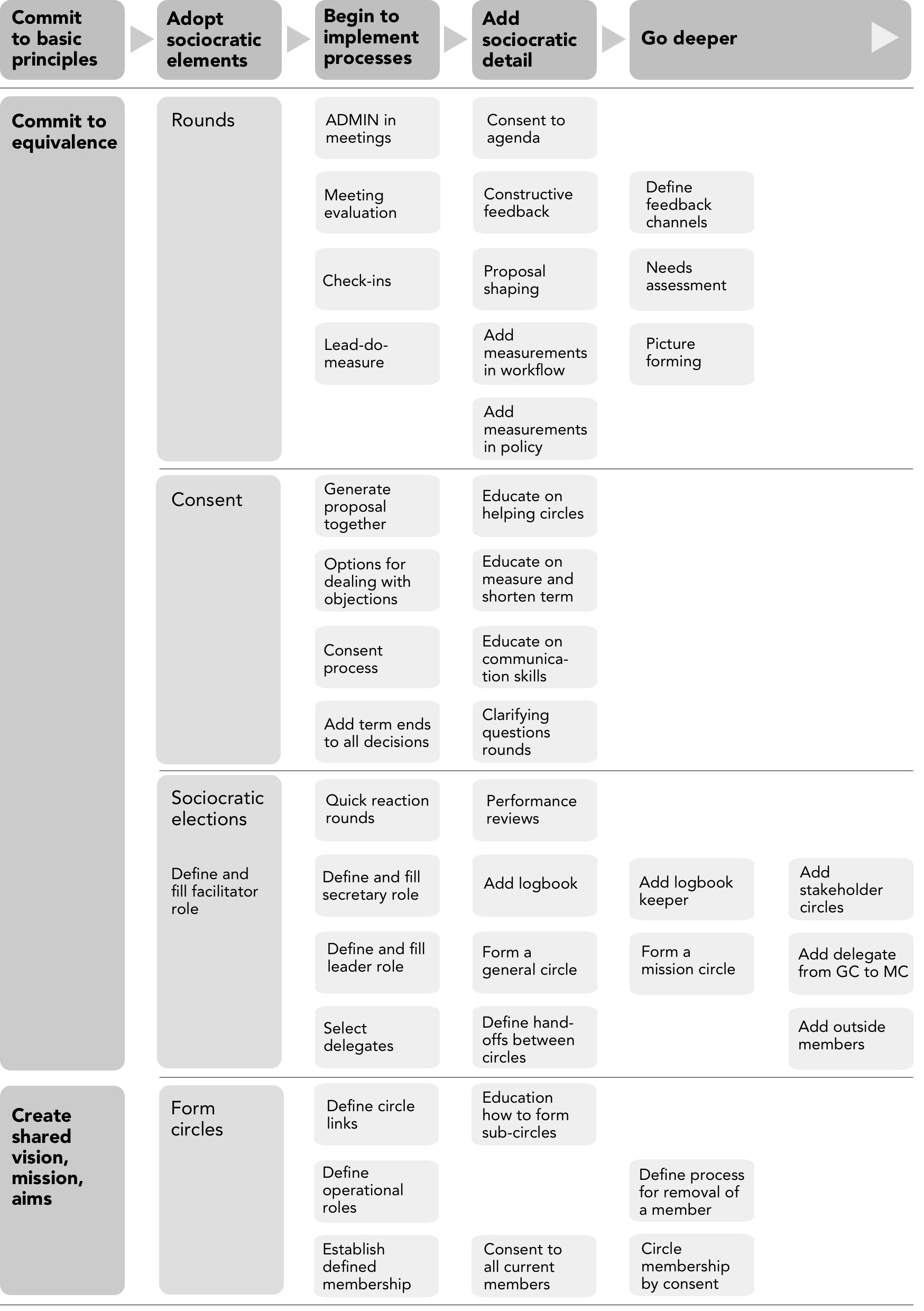 |
Note: the flowchart is not a recommended map for implementation.
There is a danger in partial and incremental implementations. Some people may become disillusioned with a partial or incremental implementation when the benefits of sociocracy are not quickly observable or existing organizational problems are not quickly resolved - they may then conclude that sociocracy doesn’t work. In those cases, listen with care and remind people of the potential benefits of adopting sociocracy more thoroughly.