 | 1.4. How to use this manual | |
|---|---|---|
| ↢ | Chapter 1. Sociocracy: Why, What and Who? | ↣ |
Governance is tricky to teach. The biggest challenge is that one has to know everything at the same time. Practitioners have to know the meeting format, all processes, understand consent, know what a helping circle is, how to do a round, be aware of feedback, have emotional literacy and needs consciousness and more at once – oh, and be aware of operational roles! Sociocratic governance works best if practitioners master it all. How can we achieve that? We tried to write this book so readers can browse through the book, reading sections at a time. That is the reason why there is some repetition in the book, as we strive to keep each section more or less comprehensive.
We compare it to learning how to swim. We can talk a lot about how to shape your hand for the perfect breaststroke or the line your arms have to form when doing a crawl stroke. But if we are struggling to stay afloat, that is irrelevant information because it is too detailed. If we forget our feet while focusing on our breathing we might still go down. The first step is to stay above the water. Then make your strokes more efficient, work on breathing, better form and so on. If you ever learned to swim and you were taught explicitly, you might remember that moving through water seemed impossible at first. Then, after practice, practice, practice, something clicks. We get the hang of it.
So, we are swimming teachers. We want readers to stay above the water without anxiety. If you are a beginner whose goal it is to stay above water, you are holding a book in your hands that gives you a level of detail that is probably too much for now. If we could wave a magic wand, we would want readers to read it twice and practice in between. Then read it again six months later. It will be an entirely different book by then because more experienced learners will take in the information very differently.
When teaching our daughters to swim, I would often take them on my back to give them a sense of swimming, feeling the movements in their body. I was hoping that the different elements might make more sense to them after experiencing them together. That’s what Sociocracy For All does in online training. We figuratively throw teams of people into a pool and safely carry them through initial meetings, letting go more and more as they are able to stay afloat by themselves.
That is not the case for this book. Some people have an easy time applying what they read to real-life contexts. For many, it will be hard, and we encourage readers to get help. Much of this book makes sense once one has first-hand experience. If this does not correspond to how you prefer to learn, we can work with you in finding different ways to learn, or we can refer you to a coach. (See links to resources in section Section A.1, “About Sociocracy For All (SoFA)” in the appendix.)
We wish we could offer readers case studies from organizations in all phases, from all sectors, in different languages. We wish we could offer sample by-laws or governance agreements and organizational structures for every sociocratic organization that exists or should exist. We are working on it. We strive to make any piece of information we produce or get a hold of public because we want all information that would be helpful to others, to be accessible to everyone.
Figure 1.6. Sociocracy For All’s online content
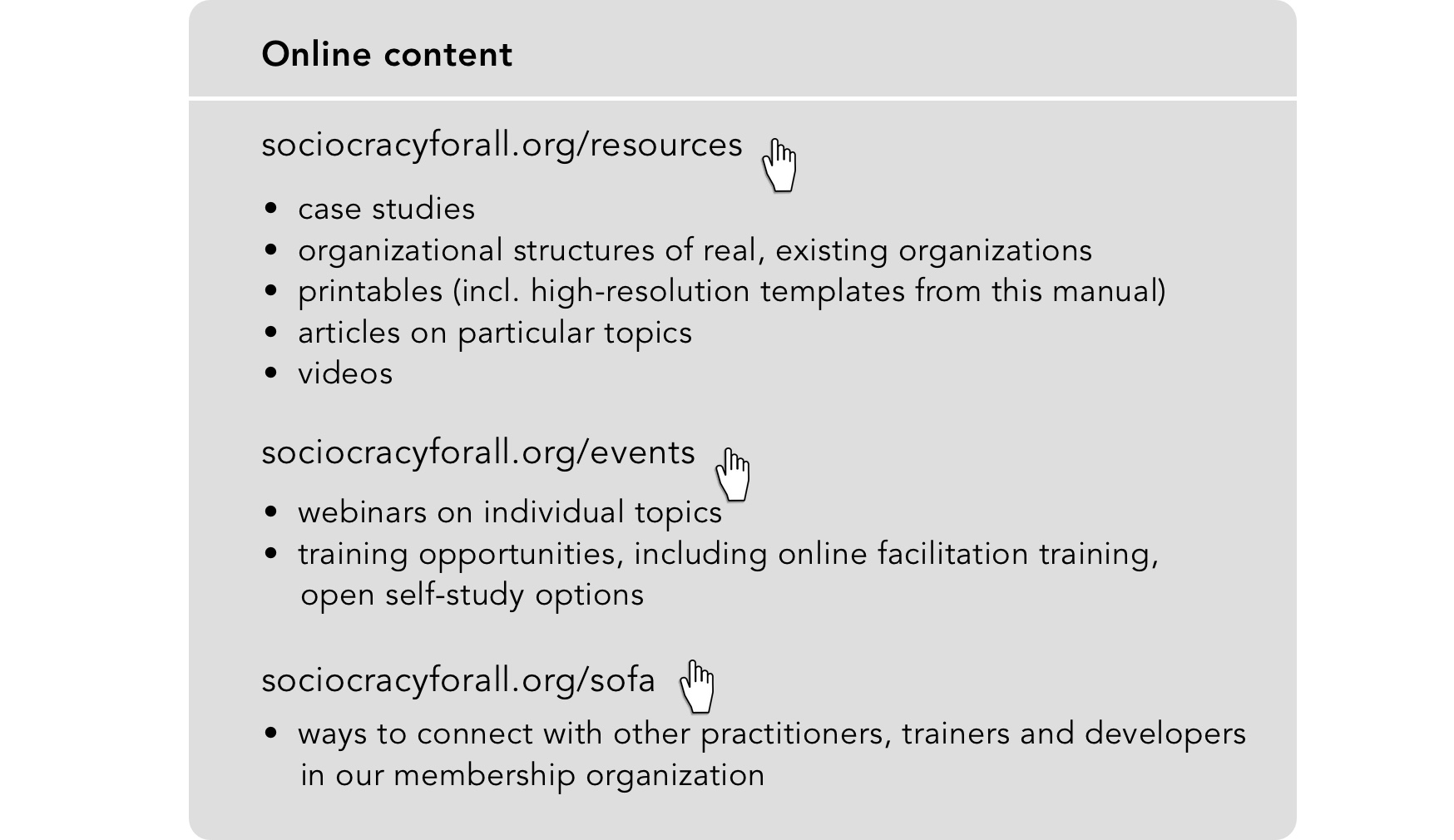 |
Sociocracy For All is about accessibility. We believe that sociocracy skills and knowledge have to be a common good – accessible for all. We know that online content in a limited number of languages is not accessible to everyone, but it is the best we can do. Online content allows for new content to be added and updated, and there have been numerous collaborative translation projects.
We invite readers to reach out if they have resources to share or if they would like to cooperate or translate to create content. We can also often connect people who are interested with someone from the same industry or region to work with.
Feedback is a big topic in sociocracy. We talk about feedback loops. We plan something, carry it out, and evaluate how well our product has worked. There is a lot of data to consider and readers have a huge part in helping us understand how this book could be improved in the next round.
What do you want to see in the next edition?
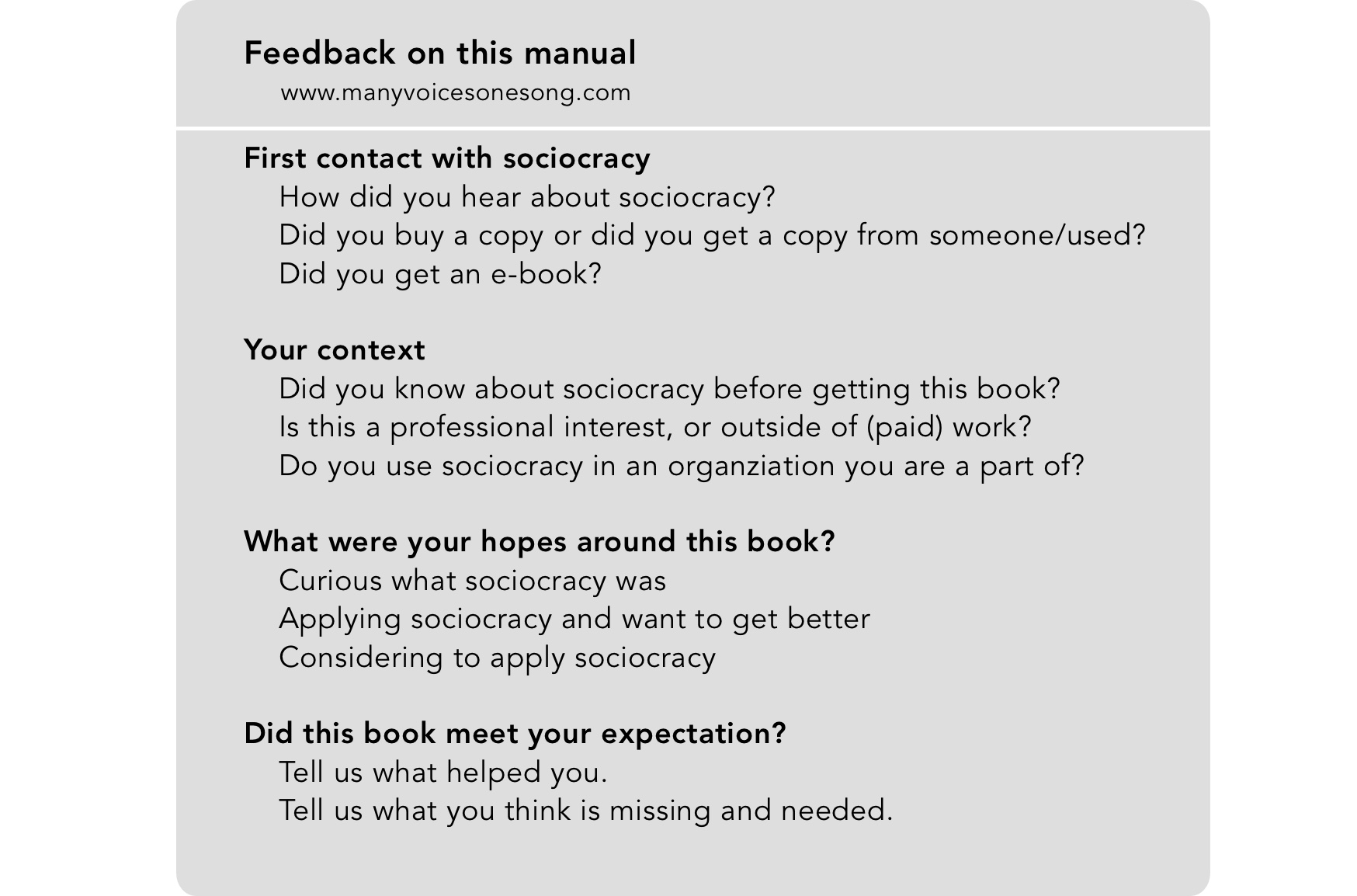
On the website www.manyvoicesonesong.com Is
this actually available?, readers can give us feedback on
this book. That would be our preferred way of receiving feedback.
Readers will find the following questions – we say it now so readers
can think about it as they read through the next chapters. (Of course,
the survey is subject to change as we learn about what we can improve
about the survey!) We invite readers to fill out the survey at any
time. Thank you in advance!
Figure 1.7. Give us feedback about this book at
www.manyvoicesonesong.com
 |