 | 1.3. Sociocracy in context | |
|---|---|---|
| ↢ | Chapter 1. Sociocracy: Why, What and Who? | ↣ |
The term ‘‘sociocracy’’ was brought into common use by the French philosopher Auguste Comte in the 1850’s. The word began to take its current meaning in the 1940’s in a Quaker school in the Netherlands.
The founders of that school, Kees Boeke and Betty Cadbury were Quakers, educators, and peace activists. Boeke saw sociocracy as a form of governance that presumes equality of individuals. This equality is not expressed with the ‘‘one man, one vote’’ law of democracy, but rather by a group of individuals (the circle) reasoning together until a decision is reached that is satisfactory to each one of them. To make sociocratic ideals operational, Boeke used a system of circles to organize decision making within a large organization. Members of each circle were responsible for decisions within their domain. Each circle elected representatives to a ‘‘higher’’ circle. Use of representatives maintained the efficiency of a hierarchy while maintaining basic equivalence of the members of the organization. The school was unique in that the teachers and the students participated in decision making about the running of the school.
One of the students in that school, Gerard Endenburg, went on to study engineering. He further developed and applied Boeke’s principles in the company he took over from his parents, the electrical engineering company Endenburg Elektrotechniek. He articulated the four basic principles as we now know them. This resulted in a formal organizational method, named the “Sociocratische Kringorganisatie Methode” (SCM: the Sociocratic Circle Method).
Gerard Endenburg intended sociocracy to be a method that includes and invites people to show up in their organizations as co-responsible whole human beings. Sociocracy was brought to the United States primarily by John Buck, co-author with Sharon Villines of the 2007 book on sociocracy, We The People: Consenting to a Deeper Democracy. Jerry Koch-Gonzalez studied and worked with John, and Ted J. Rau has done the same with Jerry.
As time passes since the early days of sociocracy, variations in its application have emerged, most notably Holacracy and Sociocracy 3.0. An exploration of the similarities and differences in the variations of sociocracy is beyond the scope of this book. The sociocratic lineage of Sociocracy For All is “classical” sociocracy - meaning directly from Gerard Endenburg and the Sociocratic Circle Method that he and others developed.
In this book we have tried to only use and coin jargon where it supports clarity. How true ‘‘Many Voices One Song’’ is to classical sociocracy will be a matter of debate. We do not intend with this book to start another variation, and we view any fragmentation of the movement around circle-based power with some sadness and skepticism. Our intent is to be Sociocracy For All, which -- for us -- means that we support any effort to spread sociocracy and sociocracy-related education and application.
In the USA, sociocracy is also known as Dynamic Governance or Dynamic Self-Governance. These names were chosen to emphasize the dynamic nature of sociocracy and because the word sociocracy generated negative reactions. To some people, the word sociocracy sounded like socialism, implying the loss of individual freedom. To others, the word sociocracy sounded like another oppressive power-over “-cracy”. And for even others, sociocracy was just a strange word that was hard to pronounce.
In using the original term, Sociocracy For All acknowledges the international nature of the sociocratic movement.
Sociocracy originated in the Netherlands, which also explains a bigger density of sociocratic organizations there. It has since spread slowly in all sectors.
Cohousing communities and ecovillages have been early adopters of sociocracy in Europe and in North and South America. The combination of sociocracy being grounded in community and equal voice had a special appeal in intentional communities. Different from consensus, sociocracy balances the needs of a group with that of the individual which is essential to keep a community sane. Intentional communities were (and many still are) grappling with their own governance, but they are places where:
These traits made these communities a good breeding ground for sociocracy. A big contribution there came from individuals who were, and have been, promoting sociocracy and were themselves deeply rooted in intentional communities. Driving the spread of sociocracy was also the conviction that if they, living together with some sense of shared purpose, cannot work through miscommunications and struggles, then there is no hope for those who aren’t living together, do not have a shared purpose, and have enemy images of each other. Some wanted to prove that working toward a common aim in a community while maintaining harmony can be done. Others simply wanted to reduce the time spent in meetings. The authors of this book live in an intentional community.
Up to this day, those are two possible entry-ways into sociocracy. Some people want a system that is more aligned with their values of an egalitarian, more just society. Others value and appreciate sociocracy for the clarity, effectiveness and transparency it brings to their companies and organizations. Early adopters were independent schools, agile and value-based organizations, people interested in non-violent communication (NVC).
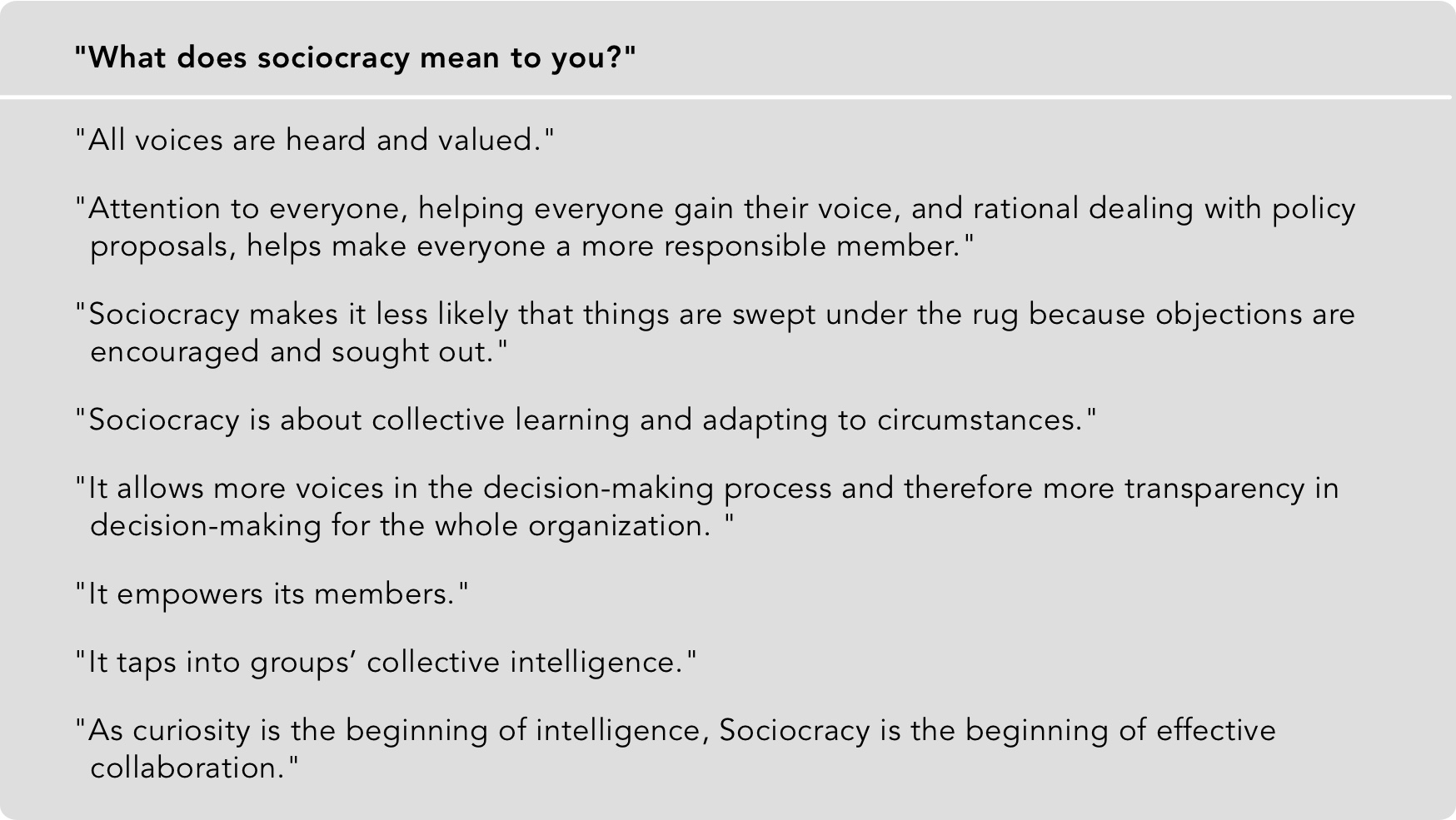
Because people have different priorities that they see in sociocracy, their responses will be very different. We would like to honor the variety of experiences by just making a list of original quotes of people stating what sociocracy means to them.
Figure 1.5. Voices from our training participants
 |
Sociocracy is not the only movement that supports life-serving collaboration. There are other movements that we call the ally movements, in which, organically, sociocracy has been growing in the last years:
Permaculture design as a way to approach stewardship with the flora and fauna (especially the social aspect of permaculture, “people care”)
Non-violent communication as a way to communicate (for the shared value that everyone’s needs matter)
Agile software development (focus on short cycles with continuous improvement, empiricism and semi-autonomous teams)
The cooperative movement (shared value: shared ownership and equal voice for every worker), along with the new-economy movement
More allies are (in no particular order) the transition movement, lean, circular economy, social justice, solidarity economy, workplace democracy, participatory democracy, commoning, community-controlled energy, responsive organizations, mindfulness movement, alternative currencies, inclusive workplace, restorative justice, platform cooperativism, conscious capitalism, democratic schools, anthroposophy, and Montessori education. No one person has the key to everything, and no one movement will always be able to meet all our needs for new systems for all areas of our life. Together, however, these movements, systems and mindsets are potent game changers in how our societies operate.
It is wonderful to see how people take what they know, combine it with sociocracy, and make it into something better. The individuals we have worked and been in contact with have typically been from one of the above movements. There are sociocratic elder care facilities, homeschooling groups, consulting companies, community organizations, restaurants, and summer camps for families. The most touching experience for us has been to hear how tens of thousands of children in India change their immediate situation through their neighborhood-based parliaments and elect leaders using the sociocratic election process.
We, the authors of this book, are in the lucky position of beneficiaries. We have learned an incredible amount about all those movements through our students who often pointed out to us how sociocratic values applied in their particular situation. There are people implementing sociocracy in families, relationships, dance associations, and faith-based groups. The mindset behind sociocracy dovetails with a vision so much bigger than governance: a world based on integration and cooperation.