 | Chapter 1. Sociocracy: Why, What and Who? | |
|---|---|---|
| ↢ | ↣ |
Table of Contents
Sociocracy is a set of tools and principles that ensure shared power. How does one share power?
The assumption of sociocracy is that sharing power requires a plan. Power is everywhere all the time, and it does not appear or disappear – someone will be holding it. We have to be intentional about how we want to distribute it. Power is like water: it will go somewhere and it tends to accumulate in clusters: the more power a group has, the more resources they will have to aggregate more power. The only way to counterbalance the concentration of power is intentionality and thoughtful implementation.
Power, like water, is neither good nor bad. In huge clusters and used against the people, power will be highly destructive. Used to serve the people and the earth, distributed to places where it can work toward meeting the needs of the people and the earth, power is constructive, creative, and nourishing like an irrigation system.
One can think of a sociocratic organization as a complicated irrigation system, empowering each team to have the agency and resources they need to flourish and contribute toward the organization’s mission. We avoid large clusters of power, and we make sure there is flow. Water that is allowed to flow will stay fresh and will reach all the places in the garden, nourishing each plant to flourish. Sociocratic organizations nourish and empower each team to have the agency to flourish and contribute toward the organization’s mission.
Power does not have only one source. In that respect, power is different from an irrigation system. All members of the organization feed their own agency and resources into the organization, in each team. Everyone contributes their power and relies on each other’s power. From there, power, and with it, resources, gets distributed into the whole and gets channeled to where the group wants to put their energy. Sociocratic organizations keep everyone’s own agency and power intact and support people to make changes bigger than they could have made alone.
In order to achieve this, our sociocratic organizations differ from organizations with aggregated, centralized hierarchical power in two ways:
We distribute power more evenly. Those who come with less agency get support to step into more agency. Those who come with more sense of agency contribute toward the whole without diminishing anyone else’s power. Teams doing work together are empowered to contribute.
We let power flow. Flow means the distribution of power needs to be adjusted and potentially changed over time. The sociocratic organization is adaptable and resilient.
Building a system that distributes power by empowering everyone requires thought and intentionality. That is what sociocracy is: the design principles for distributing power in a way that flows with life.
What kind of world do we want to live in? The way we answer this question is: We want to live in a world where people support each other, consider each other and help each other meet needs. A collaborative world.
Organizations are designed in a way that fosters our connection with each other and with ourselves, both within and outside of the organization. To effectively create connections, organizations need to be life-serving and all-embracing. Life-serving means that we want to foster organizations that work for everyone in the organization and hold care for everyone affected by the organization. No one and nothing can be ignored if we want to honor connection.
We want to support living organizations. Living systems can be on any kind of scale: a cell is a living system as it creates a membrane, forms an identity and interacts as a whole with its outside. Organizations are living systems: they interact with their outside (clients, students, consumers, investors), and their members on the inside interact as and information, goods, and energy are being exchanged. A system that does not let the organization breathe like a living system will constrain and muffle its unique expression of life. Living systems have characteristics that we want to be aware of:
Living systems form a whole and can act as a whole. For example, a human body is a complex system of smaller complex systems, but it is perceived and acts as a whole.
Living systems are interdependent with their context. There are no isolated systems. However, many people in Western cultures have been conditioned to think individualistically, as if we were separate from our context and could ignore our impact on the world around us.
Living systems are interactive and open (within limits). An organism that does not interact with its outside will not be able to survive. Organisms provide a (permeable) “membrane” between their inside and their outside. This is the basis of identity and capacity to act.
Within a system, parts are interdependent, which means they rely on each other to meet their needs. This is both true for parts of a cell and it is true for a society.
Living systems are dynamic, they are not static. They change over time as they adapt and change constantly. Living systems can learn and heal. They are resilient.
Living systems are inherently ordered, in their own way. A forest, for example, has an order. So does an organization – living systems are defined by the fact that they create more order than is present in the entropy of their surrounding. Organizations do exactly that: organize to exchange information and resources to meet needs.
What helps organizations to survive and thrive? What helps people in an organization to survive and thrive? What values does sociocracy embody? The urge to boil something down to only a small set of values is likely to leave out aspects of consideration that would have been meaningful for values and needs of other people. That said, here is what is important to us:
Clarity: clarity comes along with predictability, safety. We want organizations where we know what to expect, who is doing what etc.
Choice: we want to be in choice about what we do, and not act out of submission to or rebellion against, authority.
To matter: to know that what we think and feel matters to those around us.
Agency: to know that what we are doing has a positive impact.
Learning: we want to experience learning and discovery about each other, ourselves, and about how the world works.
Connection, belonging, equivalence & resilience: when we experience ourselves as one person within a well-connected organization, it can increase our sense of belonging. Connection and belonging are essential needs for all human beings. A decentralized, tight-knit community is more resilient, than a loose system or a rigid hierarchical system.
Applied to self-governance, each of these values translates into principles that guide self-governance.
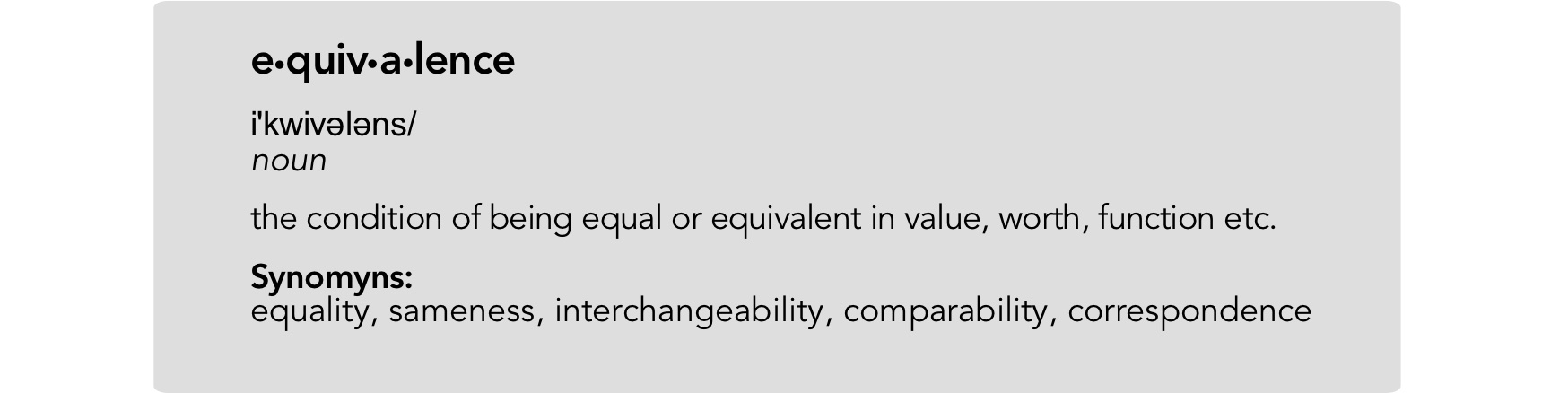
Equivalence: no one ignored. The essential principle underlying sociocracy. (Definition in figure Figure 1.2, “Definition of equivalence”.) We try to consider everyone affected in everything we do; no individual or group is disregarded.
Distributed leadership: Decentralized systems are less vulnerable and therefore more resilient than centralized monocultures. We distribute leadership wherever we can.
Seek the win-win: Every situation will be approached assuming that there is a solution that is mutually beneficial. Scarcity thinking (“when you get what you want, it means I get less”) is not accurate. There are countless examples of how synergy can make an exchange mutually beneficial.
Open to emergence: Acceptance of not knowing and letting go of an attachment to an outcome. The less ego is involved, the easier it is for a solution to present itself. In complex systems, we cannot predict what will happen. No one person will have access to the absolute truth or the perfect idea. Considering everyone’s input is key.
Feedback-rich environments: Feedback and evaluation are the basis of learning. We want organizations to implement many occasions for meaningful evaluation. We rely on data as often as possible to evaluate our work, trying to be as true to data as possible when we interpret and make meaning of that data. Like any living system, we work with reality, and the principle of empiricism ensures we tie our interpretations to actual observations and not wishful thinking or expectations.
Decisions by few, input from many: while we want to hear as much information as possible, this does not mean decisions have to be made in large groups. On the contrary: we can gather more feedback if we separate input and decision making.
Omni-directional flow of information: we try to get information from as many sources as possible. More information is always positive.
Transparency is important because it allows us to access data, and understand and learn. Transparency also levels the playing field because it gives everyone the same access to information. Power dynamics are not played out over access to information.
Good enough for now and safe enough to try are the two key slogans of sociocracy. They mean that we can act on an idea that is not perfect. The key to this principle is that it allows for agency, flow and learning instead of keeping us static.
Intentionality: when we do things with intentionality, we have agency. We are in choice over what we do.
Tensions point to lack of clarity: when there is tension, it is not because someone is to blame but because there is lack of clarity on domains, about roles or about someone’s needs. Tensions are typically a sign that we do not yet understand what is going on. Tensions are an invitation to explore. We don’t want connection and creativity to be shut down by conflict avoidance or moralistic judgment (“right and wrong” thinking).
Effectiveness: we want to know that what we are doing works, is useful, and matters.
Figure 1.1. Tools that embody our principles; our most basic universal needs are met in alignment with living systems
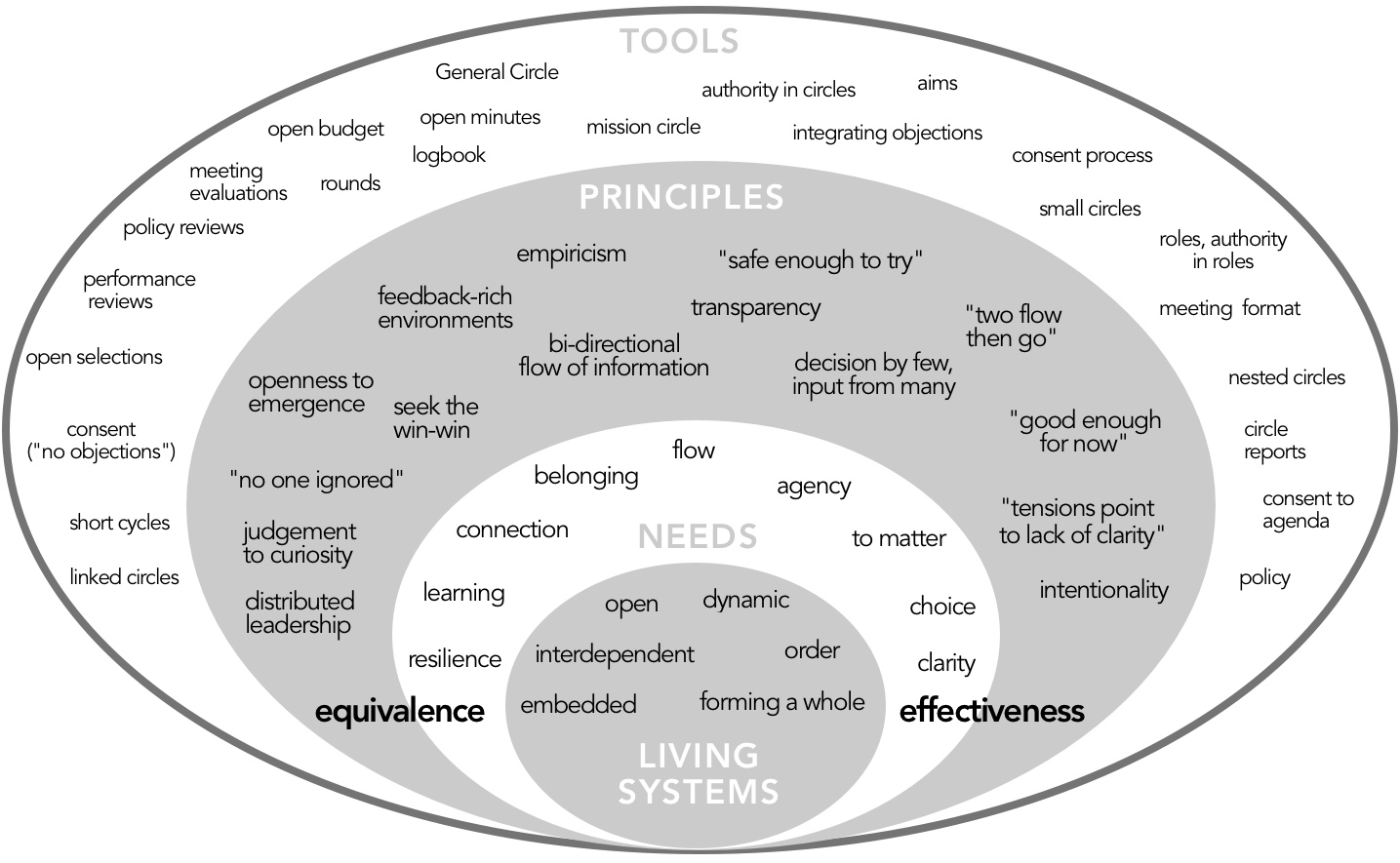 |
This book describes a collection of tools that may help in carrying out the principles we have named. To use tools with integrity, we use them with the intention of the principles behind them. A hammer can be used to build or to destroy. Both are important, tools and principles, practice and intent. We are wedded to values and principles, not to using tools in a rigid way.
This manual focuses on specific tools because we see that this is what the movement needs right now. However, throughout this book, there will be references to principles with the most salient principles being effectiveness and equivalence.
We define equivalence as ‘‘everyone’s needs matter’’, regardless of that person’s role or status. Everyone’s voice has equal value, but not everyone’s voice has equal influence. By equivalence we do not mean sameness. Every person is equal to others and every person is unique. When the needs present in a context are known, we collectively decide how to most effectively meet those needs within whatever limitations are also present.
Figure 1.2. Definition of equivalence
 |
Honoring everyone’s needs is wonderful, but what do we actually do? If we spend too much time talking, our work is not getting done and needs are going unmet. Inefficient process ultimately disregard needs, like the need to contribute to our clients, our students, or our community. What sociocracy does is to create integration between the commitment to action/agency/forward motion and the promise to hold everyone’s needs in consideration at all times.
Mutual reinforcement between equivalence and effectiveness is what makes sociocracy so different. Sociocracy breaks down the many binary principles that do not serve us: individual vs. group, workers vs. management, us vs. them. In the end, we are all one, and sociocracy supports us in reuniting and staying connected, in working, in deciding, and in growing together.
Figure 1.3. Definition of effectiveness
 |
Sociocracy overcomes the misconception that effectiveness has to be at the expense of equivalence and that more equivalence has to slow down an organization. Sociocratic tools harvest hearing people’s needs in a way that increases effectiveness. An effective organization will be more successful at creating a place where all can contribute to meet needs. We are not creating a balance between two opposite ends, we are transforming it to a both-and: both effectiveness and equivalence.
In Sociocracy For All, we get requests from people who would like to witness sociocratic meetings to see what they feel like. As we welcome visitors whenever possible, we have a standard response to their request: Be aware that in a sociocratic meeting one might not see anything amazing. Good governance is invisible. Good governance means getting everything out of the way that distracts us. Distracting feelings can be generated when our needs for connection, integrity or shared reality are not met. That means we want to create a context of clarity for our work, for emotional safety amongst all team members and for process. What exists then is flow. Flow happens when a group is fully and creatively immersed in their process. Governance as a tool blends into the background and in the foreground is content. Good governance is therefore invisible. It only serves to create the conditions where we can be productive together.